
A new channel won’t fix a broken lead journey. If enquiries arrive in bursts and then fall quiet, the cause could be anywhere between being found and becoming a qualified opportunity. Solving inconsistent lead flow starts with tracing that journey, not increasing spend on the most visible channel.
It’s reasonable to want more predictable enquiries and clearer reporting before committing more budget. But channel activity alone won’t tell you whether the issue is reach, conversion, lead quality or follow-up. You need evidence showing where prospects drop out and what may be driving the fluctuations.
This guide will help you diagnose the causes, prioritise practical changes against your goals, budget and resources, and build a repeatable way to measure lead acquisition. We’ll look at the whole journey, from channel performance and missed opportunities to conversion and sales follow-up, so you can decide what to fix first and where to direct your budget.
Key Takeaways
- Solving inconsistent lead flow starts with distinguishing normal variation from a persistent pattern that disrupts planning.
- Trace the journey from tracking and lead sources through conversion and follow-up before deciding what needs attention.
- Compare evidence across demand, targeting, offer, conversion, follow-up and measurement to narrow down likely causes.
- Prioritise fixes by their supporting evidence, relevance to your goals, feasibility and resource demands. Separate immediate issues from longer-term changes.
- When internal data isn’t enough, MARLO offers an interactive web dashboard with one comprehensive report. Deeper, human-led strategy is a separate step.
Solving inconsistent lead flow starts with defining the problem
Inconsistent lead flow means lead volume or quality changes unpredictably over time. The impact isn’t just a quieter week. A persistent pattern can make it harder to plan sales activity, forecast revenue or match team capacity to incoming demand.
Some variation is normal. Campaign timing, seasonal demand and the time prospects take to make a decision can all affect when enquiries arrive. The key question is whether the changes persist and disrupt planning. Before adding channel activity, define what’s fluctuating and where. Lead generation is only one part of the wider journey from attracting potential customers to managing and progressing their interest.
What inconsistent lead flow looks like in practice
Enquiries may arrive in a burst and then slow down. Raw enquiry counts alone won’t show whether you have more qualified prospects or sales opportunities. Form submissions could rise while the number of suitable prospects falls. Conversely, lower enquiry volume could still produce opportunities that fit your offer.
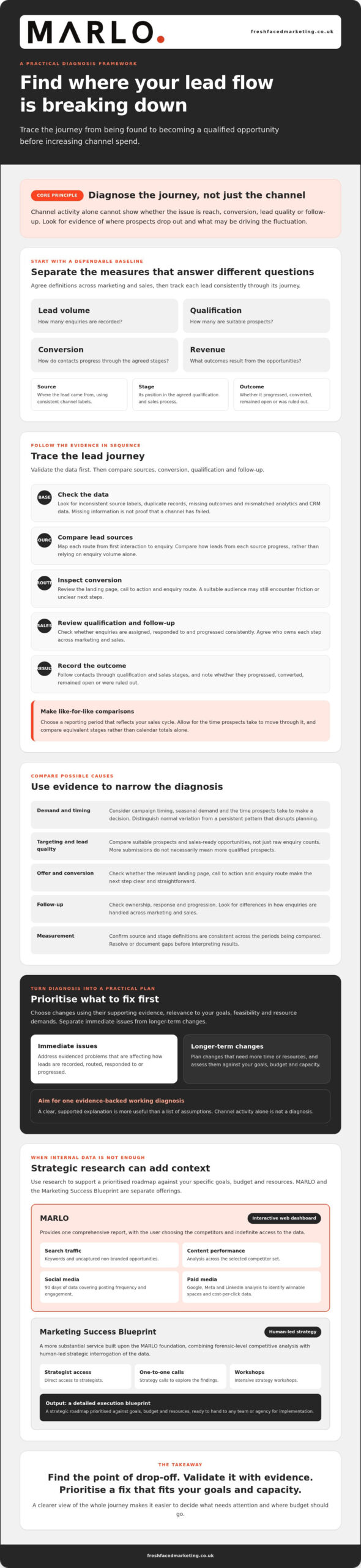
Track lead volume, qualification, conversion and revenue separately. Each measure answers a different question. Combining them into one headline figure can hide where the change is happening and make workload, forecasting and resource decisions less reliable.
Which lead-flow measures should you define first?
Start by agreeing shared definitions with the people responsible for marketing and sales. Record the point at which a contact becomes a lead, what evidence qualifies them, and what makes an opportunity sales-ready. If teams use different criteria, the same contact may be counted differently across reports.
Choose a reporting period that reflects your sales cycle. Comparing periods that are too short can make ordinary timing differences look like a trend. Track each record consistently by:
- Source: where the lead came from, using the same channel labels.
- Stage: its current position in your agreed qualification and sales process.
- Outcome: whether it progressed, converted, remained open or was ruled out.
These definitions create a dependable baseline. They also help distinguish a genuine change in acquisition from a change in how leads are recorded or assessed. With that baseline in place, you can investigate whether the issue sits with demand, lead quality or a later stage of the journey. Diagnose the cause before assuming more channel activity is the answer.
How to diagnose where your lead-generation journey is breaking down
Once your lead stages are defined, investigate the journey in sequence. Validate the data first, then inspect sources, trace conversion and review follow-up. This order matters: if tracking is incomplete, a channel may appear to underperform simply because its leads aren’t being recorded consistently.
Compare like-for-like periods and allow for the time prospects typically take to move through your sales process. A recent drop in enquiries may not yet show up in sales outcomes, while a short-term rise in leads may take time to qualify. Compare equivalent stages, not just calendar totals.
Check whether lead data is complete and comparable
Review source names for inconsistent labels, check for duplicate records and identify leads without a recorded outcome. Use analytics to understand activity such as visits and enquiry routes. Use your CRM to follow contacts through qualification and sales stages. If the two don’t align, flag the gap. Missing data isn’t evidence that a channel has failed.
Before drawing conclusions, check that the same source and stage definitions have been applied across the periods you’re comparing. If they haven’t, resolve or document the difference before interpreting the results.
Trace the journey from channel to qualified enquiry
Map each route from first interaction to enquiry, qualification and sales outcome. Compare how leads from each source progress, rather than relying on enquiry volume alone. Then inspect the relevant landing page, call to action and enquiry route. A channel can attract the right audience, but friction or unclear next steps may stop prospects from making contact.
Follow-up is part of the same journey. Check whether enquiries are assigned, responded to and progressed consistently, and agree who owns each step across marketing and sales. Adobe’s overview of a lead nurturing strategy can help frame how ongoing communication supports prospects after their initial enquiry.
End the investigation with one evidence-backed working diagnosis, not a list of assumptions. For example: “Enquiries from this source are stable, but fewer are reaching qualification, and the records show inconsistent follow-up.” This gives the team something specific to verify before changing a channel or launching another campaign. If you need a broader view of how strategy and execution connect, explore Fresh Faced’s marketing strategy approach.
Compare the causes before deciding how to fix inconsistent lead flow
A drop in enquiries doesn’t point to one cause. Demand may have changed, the audience may be poorly matched, the offer may be unclear, or prospects may be leaving before or after they enquire. Measurement can also create an apparent fluctuation. Compare these possibilities before changing campaigns or committing more budget.
Use the symptom to decide what to inspect next, not to declare a cause. If a channel becomes more active as enquiries rise, that shows a correlation, not proof that the activity caused the increase. Check the journey stage and the evidence behind it first.
| Observable symptom | Evidence to inspect | Possible next investigation |
|---|---|---|
| Fewer people appear to be searching or engaging | Search trends, audience activity and available channel reporting | Assess whether demand or reachable audience has changed |
| Activity continues, but enquiries are poorly matched | Audience, search terms, campaign targeting and message | Check whether targeting reflects the customers the business can serve |
| Relevant prospects engage but don’t enquire | Offer clarity, page relevance, forms and calls to action | Identify friction or a mismatch between the promise and landing page |
| Enquiries arrive but don’t progress | Qualification, response, hand-offs and sales outcomes | Review follow-up and the transition from marketing to sales |
| Reports show a sudden change without a clear operational reason | Tracking setup, source labels, duplicates and missing records | Validate measurement before judging performance |
Is the issue demand, targeting or the offer?
Separate audience opportunity from message quality. If relevant prospects aren’t searching or engaging, investigate demand. If activity is present but enquiries don’t fit, review targeting and whether the message reflects the actual proposition. Where search or paid-media evidence is available, look for relevant demand the business isn’t reaching, including uncaptured non-branded opportunities. More activity won’t resolve an offer that fails to explain its value.
Is the issue conversion, follow-up or measurement?
If suitable prospects reach a page but don’t enquire, inspect the page’s relevance, calls to action and enquiry route. If enquiries are generated but stall, review qualification, response and sales hand-offs with the relevant team. Marketing may attract interest, but conversion depends on the whole journey.
Use Google Analytics 4, CRM records or platform reporting only where each is configured and relevant to the question. Treat gaps as gaps, not proof. Solving inconsistent lead flow depends on confirming the evidence, locating the weak stage and testing an intervention that addresses that specific cause.
Prioritise a practical lead-flow fix against your budget and capacity
A diagnosis only creates value when it informs a decision. Rank possible actions by the strength of the evidence, their relevance to your goals, their feasibility and the resources they require. A well-supported change to an enquiry route may be more practical than launching a new channel that needs budget, content and ongoing management.
Separate immediate fixes from longer-term strategic changes. Correcting inconsistent tracking or clarifying an existing call to action may be achievable with current resources. Reaching a new audience or changing the offer may need more research, planning and coordination. Address foundational issues before making larger investments that depend on their data.
Build a prioritised action plan, not a channel wish list
For each priority, record four things: the diagnosed issue, the evidence supporting it, the recommended action and the person responsible. Then check the available budget, people and time, including existing marketing commitments. If the team can’t implement and assess an action properly, it isn’t ready to be a priority.
Keep the plan focused. Choose a small number of actions the team can deliver rather than spreading effort across multiple channels without a clear reason. A useful sequence moves from evidence to intervention to review. For more on ordering marketing work into practical stages, use an actionable marketing roadmap as a planning reference.
Measure whether the intervention improves lead quality
Before work begins, define the expected signal, owner and review point. The signal should match the problem. If the concern is lead quality, assess qualification and progression, not just the number of enquiries. If the change addresses a measurement gap, first confirm that records are being captured consistently.
Compare results with a relevant baseline using the lead-stage definitions already agreed. Note limitations, such as incomplete records or changes in how a source was labelled, because they affect what you can conclude. If the evidence contradicts the initial diagnosis, revise it rather than defending the original assumption.
This creates a practical feedback loop: prioritise, implement, assess. It won’t guarantee a particular volume of leads, but it gives the team a clearer basis for deciding where effort and budget should go next. If you need support turning diagnosis into a prioritised marketing plan, explore Fresh Faced’s marketing strategy support.
When strategic research can help stabilise lead acquisition
Internal diagnosis may be enough when your tracking is reliable, the point of drop-off is visible and your team can test a focused change. Deeper competitor and market research becomes useful when the evidence leaves important questions unanswered: are suitable prospects looking for your offer, are competitors reaching them first, or are your messages missing opportunities?
Research won’t guarantee a steadier volume of leads. Its value is sharper decisions. It can reveal gaps and help you prioritise against your goals, budget and available resources before committing to a wider change.
What MARLO can reveal about the competitive picture
MARLO is an interactive web dashboard that provides one comprehensive report. Its search analysis covers traffic, keywords and uncaptured non-branded opportunities. It also assesses competitor content performance, helping you see where other businesses attract attention and where gaps may exist.
The report includes 90 days of social media frequency and engagement data, alongside paid media analysis across Google, Meta and LinkedIn. This can highlight potential “winnable spaces” and cost-per-click data for assessment. You choose which competitors to analyse and retain indefinite access to the data. MARLO is a research dashboard, not a strategy service or a promise of lead growth. Explore MARLO’s competitive research to understand its role in the diagnostic process.
When the Marketing Success Blueprint is the next step
If you need human interpretation and a prioritised plan, the Marketing Success Blueprint (MSB) is a separate service built on the MARLO foundation. It adds forensic-level competitive analysis and human-led strategic interrogation of the data. Direct access to strategists, one-to-one strategy calls and intensive workshops help turn findings into decisions shaped around your objectives and constraints.
The output is a detailed execution blueprint that can be handed to any team or agency for implementation. It sets out what to prioritise and why, so you can see where each pound should go without treating every insight as an instruction to spend. The MSB is distinct from MARLO: one is a human-led strategy service, the other an interactive dashboard with a comprehensive report.
Solving inconsistent lead flow is ultimately about diagnosing the cause, choosing an achievable response and measuring what happens next. If you want to discuss a research-led route to steadier lead acquisition, talk to Fresh Faced about your priorities.
Build a clearer route to steadier lead acquisition
Solving inconsistent lead flow starts with evidence, not another channel. Define what counts as a lead, trace where prospects progress or drop out, then compare possible causes before choosing a fix. Prioritise actions against your goals, budget and team capacity, and measure whether lead quality and progression change.
If competitor and market context is missing, MARLO provides an interactive web dashboard with one comprehensive report combining search, competitor content, social and paid-media analysis. For a deeper human-led process, the separate Marketing Success Blueprint builds on MARLO through strategic interrogation and produces a detailed execution blueprint for your team or agency.
Start by identifying the unanswered questions in your lead journey. Discuss a research-led route to steadier lead acquisition with Fresh Faced.
Frequently Asked Questions
Why is my lead flow inconsistent?
Lead flow can fluctuate because demand, targeting, the offer, conversion, follow-up or measurement has changed. Timing matters too: prospects may take longer to qualify or buy, so enquiries and sales outcomes won’t always move together. Start solving inconsistent lead flow by checking whether the pattern is persistent and whether your records are comparable. A quiet period alone doesn’t prove a channel has stopped working.
How do I diagnose inconsistent lead generation?
Check the data first, then inspect sources, trace conversion and review follow-up. Map the route from first interaction to enquiry, qualification and sales outcome. Compare equivalent reporting periods and allow for your sales-cycle timing. Use analytics to review website activity where configured, and CRM records to see how contacts progress. Note missing or inconsistent records clearly. They’re a measurement gap, not proof of poor performance.
Can one marketing channel fix inconsistent lead flow?
One channel may address a specific, evidenced gap, but it can’t automatically fix the whole journey. More search or paid activity won’t resolve an unclear offer, a difficult enquiry route or slow follow-up. First identify where prospects are dropping out and why. Then assess whether a channel change targets that cause. Track lead quality and progression as well as enquiry volume to judge whether the intervention is relevant.
Should I increase my marketing budget if leads are inconsistent?
Not until you understand what’s driving the inconsistency. Validate tracking and check the journey stage where performance changes before committing more budget. If relevant prospects aren’t being reached, additional investment may be worth assessing. If enquiries already arrive but don’t qualify or progress, address that issue first. Compare potential actions against your goals, budget and team capacity. Set a measurable review point, and don’t assume increased spend guarantees more leads.
How can I tell whether the problem is lead quality or lead volume?
Measure volume and quality separately. Volume is the number of leads recorded using your agreed definition. Quality is assessed by how well those leads match your criteria and progress towards a sales opportunity. If enquiries remain steady but fewer qualify, investigate audience fit, the offer and qualification process. If qualified leads fall as well, examine demand and source performance. Consistent stage definitions help locate the change without conflating different outcomes.
What should I measure to track lead flow consistently?
Record lead volume by source, qualification status, progression to sales opportunity and final outcome. Agree what each stage means, use consistent source labels and choose a reporting period suited to your sales cycle. Where available and configured, combine analytics for website activity with CRM records for lead progression. Check for duplicates and missing outcomes before interpreting trends. This gives marketing and sales a shared view of where leads advance or stall.
When should I use market research to improve lead generation?
Use market research when internal data is reliable but doesn’t explain audience demand, competitor activity or missed opportunities. MARLO is an interactive web dashboard that provides one comprehensive report covering search traffic, keywords, uncaptured non-branded opportunities, competitor content, social activity and paid media. You choose the competitors analysed and retain indefinite access to the data. If you need human-led strategic interpretation, the separate Marketing Success Blueprint builds on the MARLO foundation.