
More marketing channels don’t make a stronger plan. Better decisions do. If you’re looking for a marketing plan for service business example, start with the evidence: who you need to reach, what qualified leads are worth and which activities your team can realistically deliver.
Planning can feel difficult when business goals are too broad to guide daily marketing. Choosing channels without evidence also risks spending budget without knowing whether that activity generates leads or revenue. A useful plan connects these decisions instead of simply listing tactics.
This article gives you a practical framework and a worked example to adapt to your service business. You’ll learn how to turn a revenue goal into clear priorities, match activity to your budget and resources, and measure progress using meaningful indicators. The example follows decisions from audience and offer through channel selection, lead tracking and review, showing how each action fits and when to adjust it. The result is a usable plan built around evidence, capacity and commercial goals.
Key Takeaways
- Build your plan around objectives, audience, offer, evidence, priorities, budget, ownership and review. Each section should help you make a decision.
- Use the marketing plan for service business example to see how a fictional appointment-based provider can connect marketing activity to leads, revenue and delivery capacity.
- Rank opportunities by evidence and feasibility before assigning budget, time and people. Choose measures that show whether activity is producing qualified enquiries.
- Review results against your goals and available resources, then adjust the plan instead of continuing with activity that isn’t supported by evidence.
- Use MARLO’s interactive dashboard and comprehensive report to investigate market and competitor data. Consider the separate, human-led MSB when you need strategic interrogation and an execution blueprint.
What a marketing plan for a service business needs to achieve
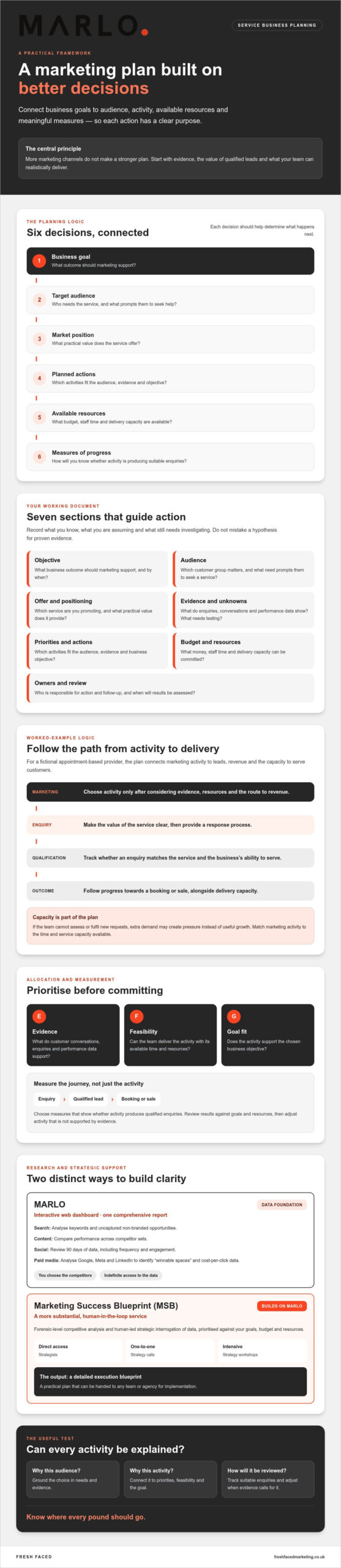
A marketing plan should connect six decisions: the business goal, target audience, market position, planned actions, available resources and measures of progress. The Marketing plan overview outlines common components and processes. For a service business, the practical test is whether those decisions work together to generate suitable enquiries the business can handle.
That connection matters because generating demand is only one part of the journey. Enquiries need a clear response process, and the business needs enough time and delivery capacity to serve new customers. If marketing generates more requests than the team can assess or fulfil, activity may create pressure instead of useful growth. Track the path from enquiry to qualified lead, booking or sale, and compare it with your delivery capacity.
A plan is not a channel calendar, which schedules activity; a campaign brief, which guides a specific promotion; or a business plan, which sets the wider direction of the organisation. It turns business priorities into coordinated marketing decisions. A marketing plan for service business example can show how that structure works, but it’s a guide to adapt, not a guaranteed formula or market benchmark.
Start with the service business goal, not the channel
Begin with the outcome the business needs. “Grow the business” is too broad to guide action. “Generate more suitable enquiries for a particular service” is more useful because it identifies what marketing should contribute. Clarify which services and customer types matter, as well as constraints such as staff time, appointment availability or the ability to take on additional work.
Keep the outcome separate from the tactics. More qualified enquiries is an objective; publishing useful content or testing paid promotion are possible activities. Choose between them only after considering the evidence, resources and route to revenue.
Define the audience and the value of the service
Describe the buyer’s need, what prompts them to seek help and how they compare providers. Consider what information they need before making an enquiry, what concerns may delay a decision and what practical value the service offers. State that value plainly, without claiming superiority or promising results you can’t substantiate.
Then test your assumptions. Review enquiry themes, sales conversations, customer feedback and available performance data. Look for evidence of demand, decision factors and where potential customers drop out. These findings can help you refine the audience and message before committing more time or budget.
The essential sections in a service-business marketing plan
A useful plan is a working document, not a form to complete and file away. Each section should resolve a decision: what the business needs, whom it needs to reach, what it will do, who will do it and how progress will be judged. This is the structure behind a practical marketing plan for service business example.
Use the framework below as a set of prompts. Record what you know, what you’re assuming and what still needs investigation. That distinction matters. Don’t treat a hypothesis about why customers choose a provider as proven evidence when allocating time or budget.
- Objective: What business outcome should marketing support, and by when?
- Audience: Which customer type or group is the priority, and what need prompts them to seek a service?
- Offer and positioning: Which service are you promoting, what practical value does it provide, and why should it be considered?
- Evidence and unknowns: What do enquiries, customer conversations or existing performance data show? What assumptions need testing?
- Priorities and actions: Which activities best fit the audience, evidence and business objective?
- Budget and resources: What money, staff time and delivery capacity are available?
- Owners and review: Who is responsible for each action and follow-up, and when will results be assessed?
Set objectives, audience and positioning
Make the objective specific enough to guide a choice. For instance, a provider might focus on suitable enquiries for one service rather than general website traffic. Define what “suitable” means for that business, such as matching the service offered and falling within its ability to serve. A website visit can signal interest, but it isn’t automatically a qualified enquiry or a sale.
State the service proposition in practical terms. Then list any gaps that could change the plan, such as uncertainty about which customer need matters most or what information affects the decision. The article The Marketing Strategy Blueprint: A Forensic Guide to UK Business Growth explores the strategic thinking behind this kind of evidence-led planning.
Prioritise actions, budget and ownership
Compare potential actions against audience fit, supporting evidence, available budget and delivery capacity. Don’t assume every business should use the same channels or divide its budget in a fixed way. An activity is a priority only when there’s a reason to expect it can reach the intended audience and the organisation can deliver it.
Assign each action to a named role or team. Include who will handle incoming enquiries and when the work will be reviewed. For further context on an evidence-led approach, explore Fresh Faced’s marketing strategy approach. The plan should make clear what happens next, what evidence will be checked and what would prompt a change.
Worked marketing plan for service business example
This marketing plan for service business example is fictional and illustrative. It uses a hypothetical appointment-based piano tutor, not a Fresh Faced client or a market benchmark. Treat every detail as a prompt to replace with your own customer, enquiry and capacity evidence.
Build the example from a clear business objective
The tutor’s illustrative goal is to improve the flow of suitable enquiries for beginner lessons. The intended audience is adults considering piano tuition who want to understand whether lessons fit their needs before booking. The message focuses on practical decision-making: what lessons cover, how a first appointment works and what a prospective learner should consider.
These are working assumptions, not findings. Before deciding whether this audience or message deserves priority, the tutor would need to check actual enquiries, customer questions and available teaching capacity. The objective is not simply to attract more visits. It is to help suitable prospective customers make an informed enquiry, then respond and book within the tutor’s capacity.
Show how evidence changes the marketing decision
Suppose enquiry conversations repeatedly raise questions about lesson suitability and what happens at the first appointment. If those questions also appear consistently in real customer feedback, the tutor could test clearer answers on the service page. Search and competitor research might reveal untapped non-branded opportunities, such as relevant lesson-related queries used by prospective customers who don’t know the tutor’s name.
The proposed page changes are a test, not proof of future performance. The tutor should review whether they attract relevant enquiries and whether those enquiries progress to bookings. A rise in general visits alone wouldn’t confirm the plan is working.
Compact illustrative plan
| Decision | Example plan |
|---|---|
| Objective | Improve the flow of suitable beginner lesson enquiries. |
| Evidence | Review enquiry questions and search or competitor research. Confirm which questions recur; treat untested audience assumptions as unknowns. |
| Action | Test clearer service-page answers and relevant non-branded topics, if research supports them. |
| Resource and owner | The tutor checks lesson capacity, updates or coordinates the page content, and handles incoming enquiries. |
| Indicator and review | Assess enquiry suitability and progression to bookings, alongside capacity to deliver. Decide whether to retain or revise the test. |
Use the sequence, not the assumed details. Replace the audience, service, message, evidence, owner and measures with what your business can verify. That’s how a worked example becomes a plan grounded in your own priorities, rather than a template mistaken for a prediction.
How to allocate marketing activity, budget and measurement
A marketing plan for service business example becomes useful when its priorities translate into choices about time, money and responsibility. Follow a clear sequence: check the evidence, rank the opportunities, assess feasibility, assign resources, then review results. This helps prevent an attractive channel or tactic from taking priority without a reason tied to business goals.
Budget allocation depends on the organisation’s objectives, evidence, constraints and capacity. A service provider with limited appointment availability may need to improve enquiry quality or conversion before increasing demand. Another business may have capacity but lack evidence about where suitable customers look for help. There’s no universal channel split that resolves both situations.
Choose priorities that fit real resources
Compare each opportunity against four criteria: audience relevance, strength of evidence, effort required and fit with the business. Then decide what to pause or defer. A short list of achievable priorities is more useful than a long list of activities nobody has the time or capacity to deliver.
For example, if customer questions suggest prospective clients need clearer service information, improving that information may be a more relevant test than adding another channel. Record the resources required, who owns the work and what the business will postpone to make room. This makes the trade-off visible without prescribing an unsupported budget or investment amount.
Review performance and adjust the plan
Choose a review rhythm that suits the activity and the data available. Track meaningful indicators, such as whether enquiries match the intended audience and progress towards a booking or sale. Reach, visits and activity volume can provide context, but they don’t establish commercial value on their own.
Use Google Analytics 4, Google Search Console or CRM information only where the business has relevant access and the data helps answer a planning question. No single source will show the whole customer journey perfectly. Compare available signals, note gaps and use informed judgement rather than treating attribution as exact.
- Continue an activity when evidence supports its role and the team can deliver it.
- Revise it when the audience fit or enquiry quality needs improvement.
- Stop or defer it when the evidence is weak, capacity is constrained or a stronger priority emerges.
For further planning perspectives, see Actionable Marketing Roadmap: A Forensic Template for UK Business Growth and Aligning Marketing Roadmap with Business Goals: A Forensic Guide. To explore strategic support for setting priorities against your goals, budget and resources, view Fresh Faced’s marketing strategy services.
Turn the example into your marketing plan and execution blueprint
The example gives you a structure, not a substitute for your own evidence. A self-built plan may be sufficient when you understand your customers, can verify your assumptions, set priorities and assign someone to carry them out. Keep it practical: define the goal, choose actions, name an owner and decide how you’ll assess progress.
Specialist strategic support may help when important evidence is missing, competitor activity is difficult to interpret or your team can’t confidently prioritise limited resources. Research can inform decisions, but turning findings into a plan requires judgement about your goals, budget and capacity.
Use research to inform decisions
MARLO research dashboard is an interactive web dashboard that provides one comprehensive report. It brings together search traffic analysis, including keywords and uncaptured non-branded opportunities; content performance across competitor sets; 90 days of social media data covering frequency and engagement; and paid media analysis across Google, Meta and LinkedIn to identify winnable spaces and cost-per-click data.
You choose the competitors and retain indefinite access to the data. This evidence can help you see where competitors outrank you and identify questions for your plan. MARLO informs decisions; it isn’t a complete, human-led strategy. Findings still need to be assessed against your objectives and resources.
Move from evidence to an actionable plan
When the challenge is deeper interpretation, the separate MSB is a premium, human-led service built on the MARLO foundation. It applies forensic-level competitive analysis and strategic interrogation to the data, with direct access to strategists, one-to-one strategy calls and intensive workshops. Its detailed execution blueprint is designed to be handed to your team or any agency for implementation.
If your evidence is clear and your team can own implementation, adapt the framework and review it as results come in. If you need help interpreting research and turning it into achievable priorities, a human-led blueprint may be a better fit. The aim is clarity on where your budget and working hours should go, without treating recommendations as a guarantee of results.
Ready to discuss a plan shaped around your goals, budget and resources? Explore Fresh Faced’s strategy and execution support and identify the next step that fits your business.
Put your next marketing decision on firmer ground
A useful marketing plan for service business example turns evidence into focused action. Keep your plan tied to business goals, suitable enquiries and the resources available to deliver the work. The fictional example offers a structure to adapt, not a formula to copy.
Use the framework to identify what you know, where evidence is missing and which decisions need attention first. Match your priorities to your goals, budget and capacity, then review what the evidence shows before deciding what to do next.
Ready to discuss your next step? Discuss an evidence-led marketing plan shaped around your business. Build from what you know, investigate what you don’t, and move forward with a plan your team can put into action.
Frequently Asked Questions
What should a marketing plan for a service business include?
It should include the business objective, priority audience, service proposition, supporting evidence, chosen marketing actions, budget and time available, responsibilities, and measures for review. For a service provider, also account for how enquiries are assessed and handled, and whether the business can deliver the work those activities may generate. Record assumptions separately from verified findings so decisions can be updated as you learn more.
How do I write a marketing plan for a service business?
Start with a business outcome, such as attracting enquiries for a particular service, then define which customers are a good fit. Review existing enquiry and customer information to identify what those buyers need to know. Choose actions that match the evidence and your team’s capacity, assign an owner, and set measures linked to enquiry quality and sales progression. A marketing plan for service business example can guide the structure, but use your own evidence.
Can I use a marketing plan template for my service business?
Yes. A template can help organise decisions and expose gaps, provided you adapt it to your services, audience, resources and way of handling enquiries. Treat it as a working document, not a ready-made strategy. Replace generic recommendations with evidence from your business, and leave out sections that don’t inform a decision. If the template assumes a channel, budget or growth target without evidence, verify that assumption before acting on it.
How much should a service business spend on marketing?
There isn’t one suitable amount for every service business. Set a budget by considering your commercial goals, available funds, evidence for each opportunity and capacity to respond to additional demand. Include internal time as a resource, not just cash expenditure. Start with what you can sustain and measure, then review whether activity contributes to suitable enquiries and revenue. Avoid adopting a generic percentage or budget split without checking whether it fits your circumstances.
What marketing channels work best for a service business?
The right channels depend on where your intended customers look for providers, how they compare services and what evidence you have about their behaviour. Search, referrals, email, social media, content and paid promotion may each suit different objectives, but none is automatically best. Select a manageable activity to test, confirm you can follow up enquiries, and compare lead suitability and progression rather than judging the channel by reach or clicks alone.
How do I measure whether my service-business marketing plan is working?
Track whether marketing generates enquiries that match your target customer, then monitor how many progress to a conversation, booking or sale. Compare those outcomes with the time and budget used, as well as your ability to deliver the work. Website visits and engagement can help explain activity, but they don’t prove commercial impact. Use available analytics or customer records, note data gaps, and review findings before continuing, changing or stopping an activity.
What is the difference between a marketing plan and a marketing strategy?
A marketing strategy sets the direction: why the business is targeting particular customers and how it intends to position its services. The marketing plan turns that direction into practical choices, including activities, responsibilities, resources and measurement. The strategy helps decide what matters; the plan organises how to act on it. Keep them aligned, but don’t confuse either with a calendar, which schedules activity, or an execution process, which carries out the agreed work.