
A marketing plan that never changes isn’t disciplined; it’s disconnected from evidence. If you’re asking how to future-proof your marketing plan, the answer isn’t to predict every shift in customer behaviour. It’s to build a plan that can respond when the evidence changes, without losing sight of your growth priorities.
This matters when market conditions shift, activity continues without clear evidence of its contribution, or teams disagree about when to change budget or direction. A practical plan needs more than flexible tactics. It needs tested assumptions, agreed review triggers and priorities that fit the resources available.
This guide shows you how to create that system. You’ll learn to assess what research and performance data are telling you, decide when to change course and reallocate investment without starting from scratch. We’ll also look at how competitor, search, content and paid media analysis can inform decisions, and how to turn those findings into an achievable execution blueprint.
Key Takeaways
- Learn how to future-proof your marketing plan by building evidence checks and clear decision rules into it, rather than trying to predict every change.
- Identify assumptions about customers, demand, competitors, channels and team capacity, then separate verified evidence from opinion.
- Keep your goals steady while reviewing tactics, with clear ownership and criteria for changing priorities.
- Set practical review triggers by choosing relevant indicators, establishing a baseline, assigning an owner and agreeing what action to take.
- See how research can inform an adaptable execution blueprint, with MARLO providing an interactive dashboard and one comprehensive report based on competitors you choose.
What does it mean to future-proof your marketing plan?
Channels shift. Competitors change their approach. Customer behaviour can move in a direction your original research didn’t anticipate. A marketing plan that treats its assumptions as permanent can quickly lose relevance, even when the business goal remains sound.
So, how do you future-proof your marketing plan? Build in regular evidence checks and agreed decision rules. The aim isn’t to predict every change. It’s to spot when an assumption no longer holds, assess the implications and adjust activity deliberately. This reflects the ongoing cycle of analysis and adaptation found in Strategic management.
Can a marketing plan really be future-proof?
No. No plan can guarantee that every assumption will stay correct. Customer needs, competitor activity and channel performance are not fully within your control. Resilience comes from recognising that uncertainty and deciding in advance how you’ll respond. That’s more useful than reacting to every fluctuation or continuing with activity simply because it was planned.
An adaptable marketing plan keeps its goals clear, tests its assumptions and changes tactics when evidence justifies it. That gives your team a repeatable way to adjust without losing focus. It also answers the practical question at the heart of how to future-proof your marketing plan: how to adapt without starting again whenever conditions shift.
What should stay consistent, and what should stay flexible?
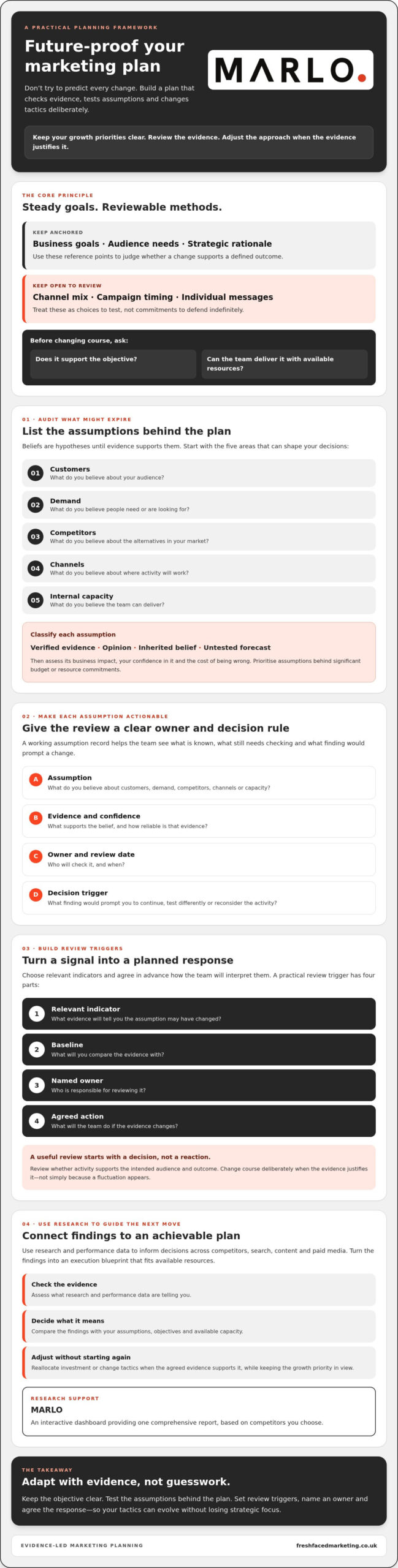
Keep the plan anchored to three reference points: business goals, audience needs and the strategic rationale for your priorities. These help your team judge whether a proposed change supports growth, lead acquisition or another defined outcome. Without them, flexibility can become a series of disconnected activities.
Keep the methods open to review. Your channel mix, campaign timing and individual messages are choices to test, not commitments to defend indefinitely. For example, if the goal is to generate qualified leads, review whether your current channels and messages reach the intended audience and prompt useful enquiries. The goal stays the same; the approach may need to change.
Set boundaries before activity begins. Record what success should look like, which evidence could prompt a review, who can recommend a change and what budget or capacity is available. Then test each new idea against two questions: does it support the objective, and can the team deliver it with the resources available? This creates room to adapt without letting unplanned activity take over.
Audit your marketing plan for assumptions that could expire
A plan can look evidence-based while still resting on beliefs that have never been checked. Start by listing its assumptions across five areas: customers, demand, competitors, channels and internal capacity. Include claims such as “our audience prefers this channel”, “enquiries are being lost because of price” or “the team can deliver another campaign”. These are hypotheses until evidence supports them.
Classify each assumption as verified evidence, opinion, inherited belief or untested forecast. Then assess its business impact, your confidence in it and the cost of being wrong. Prioritise assumptions behind significant budget or resource commitments, especially those that could affect lead acquisition or revenue. Harvard Business School Online’s article on brand repositioning offers useful context if evidence suggests your market position may need reconsideration as you future-proof your marketing plan.
Which assumptions should you test first?
Start with audience intent, conversion barriers and uncaptured demand. If planned activity depends on customers taking a particular action, check whether the evidence supports that expectation. Investigate whether qualified prospects find relevant information, reach the enquiry stage and complete it. An unverified belief may be worth testing, but it shouldn’t automatically justify further investment.
Keep the audit practical. Give each assumption an owner and a decision trigger, then record the findings in a working table:
- Assumption: What do you believe about customers, demand, competitors, channels or capacity?
- Evidence and confidence: What supports the belief, and how reliable is that evidence?
- Owner and review date: Who will check it, and when?
- Decision trigger: What finding would prompt you to continue, test differently or reconsider the activity?
This makes opinions easier to examine and revisit. It also gives someone clear responsibility for checking whether each assumption still holds.
What evidence can reveal emerging risks?
Compare search demand and uncaptured non-branded opportunities with your current activity. Review competitor content performance, social media frequency and engagement, and paid media data to see where attention or investment may be shifting. These signals don’t dictate your next move. They help you ask better questions: does a competitor address a need your content misses, or does your channel mix reflect audience behaviour?
For a consolidated view, MARLO is an interactive web dashboard that provides one comprehensive report. It covers search traffic, competitor content performance, 90 days of social media data on frequency and engagement, and paid media analysis across Google, Meta and LinkedIn, including cost-per-click data to identify “winnable spaces”. You choose the competitors and retain indefinite access to the data. Use the findings to inform decisions, not to treat every change as a reason to pivot. Learn more about the MARLO marketing research dashboard.
If you’d like support turning research into priorities grounded in your goals, budget and resources, explore Fresh Faced’s marketing strategy approach.
Choose an adaptable planning approach, not a fixed annual prediction
A fixed annual calendar can help organise delivery, but it can’t tell you whether planned activity is still working. An adaptable plan keeps the business objective steady while making tactics open to review. You don’t need to replace the plan whenever conditions shift. Instead, check whether the route still supports the intended outcome.
This approach aligns with Agile Marketing, which emphasises iterative planning and execution. In practice, agree what remains consistent, what can change and what evidence will guide each decision.
How do you balance consistency with adaptation?
Write down your core audience, business objective and intended outcome before selecting activity. Then test a limited number of channel or message changes against measures linked to that outcome. For example, if the objective is qualified lead generation, assess whether a test contributes to qualified enquiries, not just attention or clicks.
Don’t switch direction solely because a new platform or tactic is attracting attention. A change needs a clear rationale, a defined measure and a realistic resource requirement. For a broader view of aligning priorities with business objectives, refer to your existing marketing roadmap guide.
How can research improve planning decisions?
Market and competitor evidence can help you assess whether a channel deserves attention, where competitors are active and whether relevant opportunities remain uncaptured. Paid media data across Google, Meta and LinkedIn can inform your assessment of potential opportunities, including cost-per-click data. These signals help frame decisions; they don’t replace your objectives, budget limits or delivery capacity.
Use a simple planning table to connect each decision to evidence and accountability:
| Assumption | Review point | Owner | Change criteria |
|---|---|---|---|
| This channel can reach the intended audience | At the agreed review date | Named team member | Evidence shows the channel is not contributing to the objective |
| The team can deliver the planned activity | When workload or priorities change | Activity lead | Required work exceeds available capacity |
| A message will encourage qualified enquiries | After reviewing agreed lead measures | Campaign owner | Results indicate the message needs testing or revision |
For research in one place, MARLO’s interactive research dashboard provides one comprehensive report covering search traffic, competitor content, social media data and paid media across Google, Meta and LinkedIn. Use the findings alongside your goals, available budget and team capacity to prioritise activity. That’s how to future-proof your marketing plan without confusing flexibility with constant change.
Build review triggers into your marketing plan
A review trigger turns a metric into a decision. Without one, teams can collect reports yet keep funding activity that no longer supports the objective. A useful trigger doesn’t need a universal benchmark. It needs a clear link between the evidence, the business goal and an agreed response.
Which indicators should trigger a plan review?
Start with the outcome you need. For qualified lead acquisition, examine the number and quality of leads, conversion behaviour and the performance of the channels contributing to enquiries. For any other objective, choose indicators that show progress towards that specific result. Separate leading signals, such as changes in relevant audience engagement, from outcomes such as qualified enquiries or revenue. Impressions and clicks can provide context, but they don’t establish business impact on their own.
A useful metric changes a decision; if it changes nothing, it may not belong in the review.
Build the trigger process before activity begins:
- Choose indicators. Select measures that connect directly to the objective, rather than tracking every available metric.
- Establish a baseline. Record the current position and the period or data source used, so future comparisons have context.
- Assign an owner. Name the person responsible for checking the evidence and bringing it to the review.
- Agree a response. Define what the team will consider if results depart from expectations, such as continuing, testing a change, reallocating effort or stopping the activity.
Set review points that fit the activity and the evidence available. A short campaign and a longer-term channel investment may need different schedules. Avoid arbitrary thresholds: agree criteria that reflect your baseline, objective, budget and capacity.
How should you respond when evidence changes?
First, check the signal. Confirm that the information is relevant, comparable and complete enough to support a decision. A short-term fluctuation or tracking issue may not justify changing investment. If the evidence holds up, choose a response: continue, test, reallocate or stop. Record the finding, decision, rationale, owner and what you’ll assess next.
This decision log helps the team learn over time. It shows which assumptions held, which changes produced useful evidence and why priorities shifted. It also keeps a marketing roadmap connected to business goals as delivery evolves. For a broader framework, refer to the existing guide to building an actionable marketing roadmap.
If you want support translating evidence into a practical plan, explore full marketing strategy execution. A clear review process is a practical part of how to future-proof your marketing plan: know what to monitor, who will act and what decision the evidence needs to inform.
Turn research into an execution blueprint that can evolve
Research identifies what may need attention. Strategy determines what deserves action. Connect the opportunities and risks you’ve found to your business objectives, then assess what your team can deliver with its available budget and resources. The result should guide decisions, not become another report disconnected from day-to-day work.
When is a dashboard enough, and when is human strategy useful?
If you need to inspect evidence and identify areas for further investigation, MARLO’s interactive marketing research dashboard brings key findings together in one comprehensive report. It covers search traffic, including uncaptured non-branded opportunities, competitor content performance, 90 days of social media data and paid media across Google, Meta and LinkedIn. You choose the competitors and retain indefinite access to the data.
The research dashboard is distinct from the Marketing Success Blueprint (MSB). The MSB builds on the MARLO foundation with human-led, forensic-level competitive analysis and strategic interrogation of the findings. It includes direct access to strategists, one-to-one strategy calls and intensive workshops. This is useful when the challenge isn’t only seeing the evidence, but deciding how to turn it into priorities for your business.
How can a strategy stay actionable after handover?
An execution blueprint should make implementation clear to the team or agency carrying it forward. Organise recommendations so each priority has an owner, the resources it requires and a review trigger. Explain why the action matters, what evidence supports it and what finding would prompt the team to adjust course.
Keep recommendations proportionate to the business context. A strong opportunity isn’t automatically a practical priority if the required budget, expertise or delivery capacity isn’t available. Sequence the work so the team knows what to do first, what can wait and what evidence to revisit. That makes it easier to decide where every pound should go, without treating the blueprint as fixed when conditions change.
To put this into practice, list the decisions your research needs to inform. Then match each opportunity to a business goal, an owner and the resources required. This is the practical answer to how to future-proof your marketing plan: use evidence to set priorities, human judgement to shape the roadmap and review triggers to keep execution aligned as needs evolve.
Make your next marketing decision evidence-led
A resilient marketing plan doesn’t depend on predicting every change. It depends on testing assumptions, setting review triggers and knowing which decisions can change without losing sight of growth. That’s the practical answer to how to future-proof your marketing plan.
Keep business goals and audience needs as your reference points. Review tactics against relevant evidence, then continue, test, reallocate or stop with a clear rationale. This gives your team a repeatable way to adapt priorities while keeping activity achievable with available resources.
For research, MARLO provides an interactive web dashboard with one comprehensive report and indefinite access to your data. The MSB is a distinct, human-led service that adds strategic interrogation and produces a detailed execution blueprint. Both help inform decisions around your specific goals, budget and capacity in different ways.
Explore Fresh Faced’s Marketing Success Blueprint to turn research into clear priorities and an actionable marketing plan. With evidence and practical review rules, you can adapt with purpose and keep building towards growth.
Frequently Asked Questions
What does it mean to future-proof a marketing plan?
Future-proofing a marketing plan means building in evidence-led reviews and deliberate decisions, rather than trying to predict every change. Keep business goals clear, but regularly test assumptions about customers, demand, channels and competitors. When evidence shifts, decide whether to continue, test a different approach, reallocate resources or stop activity. This helps you learn and adapt while keeping the plan focused on its intended growth outcome.
Can you future-proof a marketing plan completely?
No. You can’t remove uncertainty or guarantee that every assumption will stay valid. You can manage it by recording what the plan assumes, checking those assumptions against relevant evidence and agreeing how the team will respond if they no longer hold. For example, if a channel isn’t contributing to qualified enquiries, check the data and context before deciding whether to test a change, shift resources or stop.
How often should you review a marketing plan?
Set review points that match your business, activity and decision cycle. There’s no universal interval that suits every plan. A short campaign may need different checks from a longer-term investment, and reviews should allow enough relevant evidence to inform a decision. Agree in advance when each activity will be assessed, who owns the review and what changes would trigger further investigation or an adjustment to priorities.
What should you do when your marketing plan stops delivering results?
Check the evidence before changing activity or investment. Confirm that the data is relevant and reliable, then identify which assumption may no longer hold. Is the issue audience intent, a conversion barrier, channel performance or delivery capacity? Based on what you find, decide whether to continue, test an adjustment, reallocate resources or stop. Record the rationale and what you’ll monitor next, so the decision informs future planning.
Which marketing metrics should you use to future-proof your plan?
Choose metrics that relate directly to the business objective. For lead acquisition, qualified leads and conversion behaviour may be more informative than impressions alone. Separate leading indicators, which can signal emerging changes, from outcomes such as qualified enquiries or revenue. For every measure, state what decision it informs. If a metric doesn’t help the team assess progress, test an assumption or choose an action, reconsider whether it needs to be tracked.
Should a marketing plan change when customer behaviour changes?
Yes, when reliable evidence shows the change is relevant to your audience and objective. First check that the signal is supported by useful data rather than a temporary fluctuation or incomplete view. Then assess which assumption or tactic it affects. You may need to adjust a message, channel or campaign while keeping sound business goals intact. Record the reason for the change and what evidence will help you assess its effect.
Is a rolling marketing plan better than an annual plan?
A rolling plan can preserve long-term goals while giving the team regular opportunities to review tactics and assumptions. An annual plan can still provide direction, but becomes less useful if its activities and forecasts are treated as fixed despite new evidence. The right approach depends on your decision cycle, available resources and ability to review performance. Keep priorities clear, schedule meaningful reviews and update activity when evidence justifies a change.
How can market and competitor research make a marketing plan more adaptable?
Market and competitor research can test assumptions and reveal opportunities or risks that deserve investigation. Search analysis may surface uncaptured non-branded opportunities, while competitor content, social media and paid media evidence can help you examine activity across the market. Research doesn’t predict outcomes or decide priorities for you. It gives you evidence to weigh against your goals, budget and capacity. MARLO, for example, provides an interactive web dashboard, one comprehensive report and indefinite access to its data.