
Conflicting attribution reports don’t always mean your tracking is broken. Different platforms can claim credit for the same conversion because they apply different rules. That makes marketing attribution problems and solutions less about finding one perfect report and more about understanding what each measurement can reliably tell you.
If leads and revenue won’t connect clearly to marketing activity, budget decisions can feel like guesswork. The frustration is understandable. A platform’s conversion total isn’t the same as a complete account of what caused a sale, and no single model can answer every planning question.
This guide explains where reporting discrepancies come from and how to investigate gaps between platform data, analytics and your CRM. You’ll compare practical measurement approaches, learn which questions each can help answer, and see how to use their evidence and limitations to guide budget decisions. The aim isn’t false certainty. It’s a clearer basis for deciding where every pound should go.
Key Takeaways
- Trace reporting gaps to implementation issues, model limitations, hand-offs or interpretation. Missing UTM parameters can obscure campaign sources, but they’re only one possible cause.
- Use marketing attribution problems and solutions to match each measurement method to the decision it can support, from channel reporting to incrementality testing.
- Start with one priority outcome, such as qualified leads. Align conversion definitions and audit the data before comparing reports.
- Treat attributed credit as evidence for decisions, not automatic proof that a channel caused revenue. Record the limitations behind your conclusions.
- Use MARLO for competitor and channel context, not as an attribution system. Its interactive web dashboard provides one comprehensive report to inform strategic choices.
What marketing attribution problems look like in real reporting
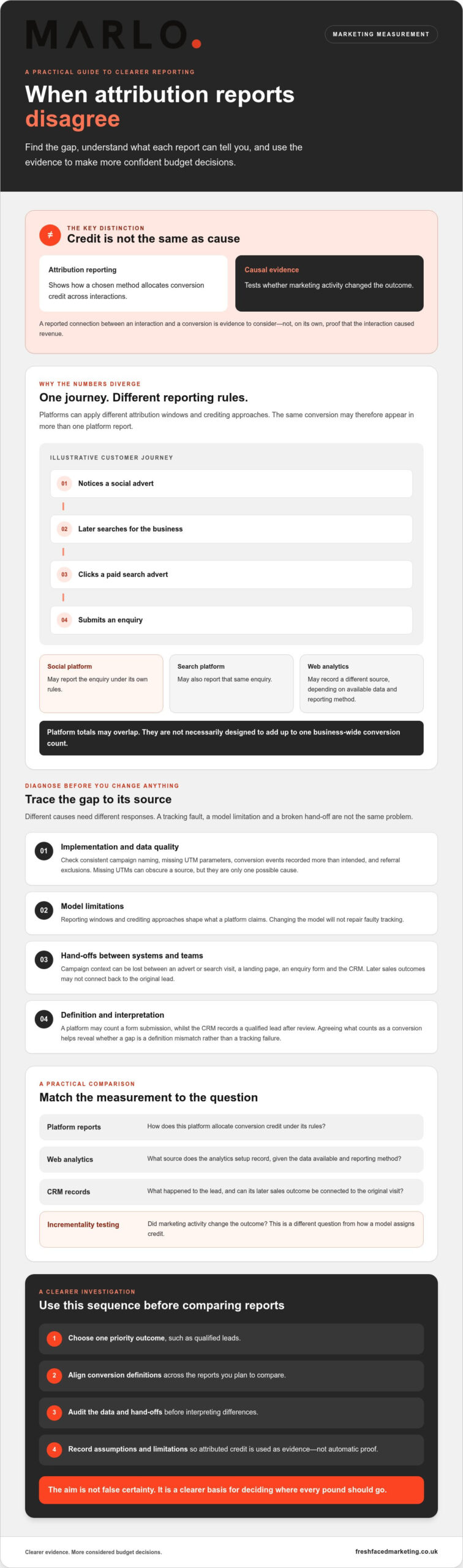
Marketing attribution assigns credit to marketing interactions associated with a conversion, such as an enquiry or purchase. That credit depends on the reporting method. It isn’t, by itself, proof that a channel caused the revenue.
Attribution reporting records how a chosen method allocates conversion credit; causal evidence tests whether marketing activity changed the outcome. This distinction matters when investigating marketing attribution problems and solutions. A report can show a connection between an interaction and a conversion without establishing what would have happened otherwise. For a foundational overview of marketing attribution, including common models, start with the definition of the concept.
In real reporting, the warning signs are familiar: duplicate conversions across platforms, leads that can’t be matched to a campaign, reports that disagree, and customer journeys with missing steps. Each points to a different gap. The figures need investigation before they can support a budget decision.
Why marketing channels report different conversion totals
Platforms may apply different reporting rules, attribution windows and crediting approaches. As a result, the same conversion can appear in more than one platform’s report. Those reports answer different questions; their totals aren’t necessarily designed to add up to a single count.
Illustrative example, not client evidence: someone notices a social advert, later searches for the business, clicks a paid search advert and submits an enquiry. The social platform and search platform may each report the enquiry according to their own rules. Web analytics may record a different source, depending on the data available and the reporting method. Overlapping credit can make platform totals exceed the enquiries recorded by the business.
Where attribution breaks between marketing and revenue
Follow one lead through the process: a person clicks an advert or arrives from search, visits a landing page, submits an enquiry, then has their details recorded in the CRM. Each hand-off creates a chance to lose context. Campaign details may not carry through to the form or CRM. Records may be incomplete, inconsistent or difficult to match to the original visit.
Even when the initial interaction is measurable, later sales outcomes may not be visible in marketing reports. A lead could progress through calls, follow-up and internal sales decisions before becoming a customer. If those outcomes aren’t connected back to the lead record, reporting may show the enquiry but not the revenue, or may fail to associate revenue with the marketing activity.
Separate what the data records from what it can support: an advert click, a website visit or a logged enquiry is an observable interaction. The contribution of that interaction to a later sale is a further question. Clear attribution starts by identifying where that connection holds, where it breaks and what remains unknown.
The main causes of marketing attribution problems
Attribution discrepancies have different causes, and each needs a different response. A tracking fault won’t be fixed by changing the attribution model. A model limitation won’t be resolved by adding more tags. Separate implementation gaps, model limits, organisational hand-offs and interpretation errors before deciding what to change.
Attribution quality depends on consistent inputs and explicit assumptions. That means agreeing what counts as a conversion, checking how information moves between systems and stating what the reporting method can and can’t show. For a useful overview of how marketing attribution models work, compare the questions each model answers rather than treating one as universally correct.
Tracking and data quality issues that distort attribution
Start with the data entering your reports. Check that campaign names follow a consistent format, that conversion events aren’t recorded more than intended, and that referral exclusions are appropriate for your setup. Missing UTM parameters can obscure a campaign’s source, but they aren’t the only explanation for unattributed traffic. A visit may also be difficult to connect to a campaign for other reasons.
Compare Google Analytics 4, advertising platform reports and CRM records using the same conversion definition and reporting period. A platform may count a form submission, whilst the CRM records a qualified lead only after review. That’s a definition mismatch, not necessarily a tracking failure. Before changing settings, verify current platform behaviour and terminology. Don’t assume a feature or reporting rule works the same way across tools.
Model and organisational limits that numbers cannot fix
First-touch gives credit to the first recorded interaction; last-touch credits the final one. Multi-touch methods distribute credit across selected interactions. These are different allocation choices, not competing proofs of what caused a sale. The right model depends on the decision you’re trying to make.
Some journeys may also be incomplete. Assess whether consent choices, browser behaviour, device changes or offline conversations affect the data you can connect. Don’t assume they explain every gap. A person might research on one device, enquire by phone and continue the sales conversation with a colleague. Marketing reports may capture some of those interactions, but not the full journey or later sales outcome.
Organisational hand-offs add another risk. If marketing, sales and CRM teams use different definitions for an enquiry, qualified lead or sale, their reports won’t align. Agree the conversion stages and the records used to confirm them before comparing channel performance. This is a practical first step in resolving marketing attribution problems and solutions: define the evidence consistently, then investigate what remains unclear.
Once reporting gaps are classified, wider competitor and channel context can help inform strategic priorities, without replacing analytics or CRM evidence. Explore Fresh Faced’s marketing strategy approach if you’re assessing how those priorities fit your goals, budget and resources.
How attribution methods compare, and what each can tell you
Choose a method by the decision you need to make, not by which report looks most complete. Each approach uses different evidence and makes different assumptions. The comparison below shows what each can contribute, and where its limits matter.
| Method | Useful question | Evidence and resource needs | Limitation | Decision supported |
|---|---|---|---|---|
| Platform reporting | What conversions does this platform report? | Its own interaction and conversion data; check the platform’s reporting context. | May use different rules from other platforms and analytics tools. | Review activity within that platform. |
| Web analytics | How do recorded website visits relate to conversions? | Website events and traffic-source information, with consistent setup. | May not connect every visit or later offline outcome. | Assess website journeys and channel activity. |
| CRM-linked reporting | Which recorded sources connect to lead and sales stages? | Consistent CRM records and links between campaign details, enquiries and outcomes. | Missing or inconsistent records weaken the connection. | Compare lead quality and progress through the sales process. |
| Attribution models | How should conversion credit be allocated across recorded interactions? | Journey data and a defined first-touch, last-touch or multi-touch approach. | Credit allocation depends on the chosen model; it doesn’t prove causation. | Compare recorded touchpoints for a stated purpose. |
| Incrementality testing | Did an activity add outcomes beyond an appropriate comparison? | A suitable test design, comparison and outcome data; plan for the people and time required to run it. | Results depend on the quality and relevance of the comparison. | Assess whether activity contributes additional outcomes. |
| Marketing mix modelling | How might marketing activity relate to broader business outcomes? | Requirements and analytical scope vary; assess data suitability and expertise before commissioning or interpreting a model. | It estimates patterns, not a perfect account of individual journeys or certain causation. | Inform broader planning where the analysis fits the available evidence. |
Use platform and multi-touch reporting for journey-level questions
Platform-reported conversions can help assess activity within that platform’s stated measurement context. First-touch assigns credit to the first recorded interaction, last-touch to the final one, and multi-touch distributes credit across selected interactions. None is a universal winner. Before comparing channels, align conversion definitions, time periods and reporting assumptions. Otherwise, apparent differences may reflect measurement choices rather than performance.
Use incrementality and modelling for broader decisions
Incrementality asks whether activity added outcomes compared with an appropriate alternative, rather than simply receiving credit for conversions that occurred. Marketing mix modelling is a different, broader analytical approach; its scope and requirements depend on how the analysis is designed. Assess the decision, evidence, resources and uncertainty together. That is more useful than expecting one method to solve all marketing attribution problems and solutions or provide a perfect causal record.
A practical process for diagnosing and improving attribution
Don’t try to measure every interaction before fixing the reporting question. Start with one priority outcome, such as qualified leads, then work through the evidence in order. This keeps marketing attribution problems and solutions tied to decisions your team can act on.
- Define the decision. Are you choosing which channel to prioritise, checking lead quality or reviewing campaign performance? Set the question first.
- Align conversion definitions. Agree what counts as an enquiry, qualified lead, opportunity and recorded sale. Confirm which system records each stage.
- Audit the inputs. Review campaign naming, UTM consistency, duplicate events and CRM source fields. Record gaps before changing tracking or budgets.
- Compare the evidence. Check platform reports, web analytics and CRM records against the same outcome and period. Describe discrepancies rather than forcing totals to match.
- Document limits and next steps. Separate what the data shows from assumptions and interpretation. Assign a proportionate fix or test, then note what it can establish.
Audit conversion definitions and campaign data first
Write down the agreed definitions and check that marketing and sales apply them consistently. Then trace whether campaign details stay attached as an interaction becomes an enquiry and moves into the CRM. Look for inconsistent naming, missing source fields and events that may be recorded more than once. Keep a discrepancy log, including which systems disagree and how. This gives you a baseline before you adjust spend or draw conclusions.
Use evidence carefully to make the next budget decision
Prioritise fixes by their likely value to the decision, the effort required, budget and available team resources. If reports still disagree, choose a test that fits the question and capacity. State what you’re comparing, what outcome you’ll observe and what the test can’t establish. A test can reduce uncertainty; it won’t automatically prove that one channel caused revenue.
Use a consistent reporting template to make the reasoning visible:
- Source: Where did the information come from?
- Method: How was credit or outcome assessed?
- Assumptions: What definitions or conditions apply?
- Confidence: How complete and consistent is the evidence?
- Next action: What decision, check or test follows?
This record turns attribution into decision evidence, not false certainty. For wider roadmap context, explore Fresh Faced’s strategic marketing approach, which can help frame priorities against your goals, budget and resources.
Turn attribution evidence into a clearer marketing strategy
Attribution helps inform decisions, but it won’t provide a complete record of what caused revenue. Use what the evidence can support to prioritise activity against your business goals, budget and available resources. Identify what’s known, what remains uncertain and which next step is achievable.
For example, if qualified leads are the priority, assess how well your records connect lead quality to marketing sources. Then decide whether to improve the data, investigate a gap or weigh other evidence before reallocating budget. The aim is a reasoned choice, not false certainty.
Use competitor and channel context without overstating attribution
MARLO is a separate source of market context, not an attribution system. Its interactive web dashboard provides one comprehensive report covering search traffic, including keywords and uncaptured non-branded opportunities; competitor content performance; 90 days of social media frequency and engagement data; and paid media analysis across Google, Meta and LinkedIn, including cost-per-click data and potential winnable spaces.
You choose the competitors and retain indefinite access to the data. This research can help you assess channel and competitor context alongside your own attribution evidence. It doesn’t prove that a channel caused revenue. Explore the MARLO research dashboard to see what it covers.
Choose the right level of human strategic support
For a more substantial, premium service, the separate Marketing Success Blueprint builds on MARLO with human-led strategic interrogation and forensic-level competitive analysis. You work directly with strategists through one-to-one strategy calls and intensive strategy workshops. This human input turns research into considered priorities, rather than leaving you to interpret a report alone.
The outcome is a detailed execution blueprint that can be handed to any team or agency for implementation. It connects recommendations to your goals, budget and resources, with their evidence and limitations made clear. To discuss strategic support, speak with Fresh Faced about the right next step for your business.
Make your next marketing decision with clearer evidence
Useful attribution doesn’t require one perfect report. It requires clear conversion definitions, consistent inputs and an honest account of what the data can and can’t show. Match the measurement method to the decision, then use its evidence and limitations to guide your next step.
That’s the practical value of understanding marketing attribution problems and solutions: you can investigate reporting gaps without mistaking assigned credit for proof of causation. MARLO adds competitor and channel context through an interactive web dashboard with one comprehensive report covering search traffic, competitor content, 90 days of social data, and paid media analysis across Google, Meta and LinkedIn. It informs strategy; it doesn’t replace attribution or prove which activity caused revenue.
For a separate, human-led layer, the Marketing Success Blueprint builds on MARLO with strategic interrogation and a detailed execution blueprint. Both approaches can help you assess priorities against your goals, budget and resources.
Explore the MARLO research dashboard and bring clearer context to your next decision. With evidence, assumptions and priorities made explicit, you can move forward with greater confidence.
Frequently Asked Questions
What is marketing attribution?
Marketing attribution assigns credit to marketing interactions associated with a conversion, such as an enquiry or sale. It helps teams organise evidence about how customers encountered marketing activity. The report reflects the chosen model, tracking setup and conversion definitions, as well as which parts of the customer journey were recorded. Attribution can show how credit was allocated, but it doesn’t prove that a particular channel caused a sale.
Why does marketing attribution show different results across platforms?
Platforms can report different conversion totals because they may use different conversion definitions, attribution rules, reporting periods and available data. A single conversion may receive credit in more than one system. Before treating the figures as contradictory, check what each report counts and the period it covers. Document the scope and assumptions, then decide which business question each report can reasonably inform.
Which attribution model is best for marketing?
There’s no universally best attribution model. First-touch assigns credit to the first recorded interaction, last-touch to the final one, and multi-touch distributes credit across selected interactions. Choose the approach that fits your decision, the evidence available and the limitations you can explain. If you need to assess whether activity added outcomes, consider whether an appropriate incrementality test or other complementary evidence is feasible.
How can I fix marketing attribution problems?
Start with the business outcome you need to understand and agree what counts as a conversion. Then audit campaign tagging, naming conventions, duplicate events and CRM source fields. Compare reports only after checking their definitions, time periods and scope. Record assumptions and unresolved gaps. A practical approach to marketing attribution problems and solutions prioritises fixes that can improve a real decision, rather than trying to perfect every data point at once.
Can marketing attribution prove which channel caused a sale?
No. Attribution shows how a chosen model assigns credit across recorded interactions. That isn’t the same as proving causation. Tracking may miss parts of a customer journey, and a sale may be influenced by factors the data doesn’t capture. Use attribution as one source of decision evidence. If a decision needs stronger causal evidence, consider whether suitable testing or complementary analysis is practical for your team.
What is the difference between attribution and incrementality testing?
Attribution assigns credit to observed interactions according to a chosen model. Incrementality testing asks whether an activity produced additional outcomes compared with an appropriate comparison. They answer related but distinct questions. Each method has requirements and limitations, so select the one that fits the decision, available evidence and team resources. Neither should be treated as a universally conclusive account of marketing’s effect.
How should I compare marketing attribution reports with CRM data?
First align the conversion definitions, time periods and source fields you’re comparing. Check whether enquiries are deduplicated and campaign information carries through into CRM records. Document mismatches rather than forcing the systems to agree. CRM data can add context about lead progress and sales outcomes, but assess its completeness and recording practices too. Then use the combined evidence cautiously when reviewing channel performance or budget priorities.