
Scaling your media budget won’t fix a disconnected commercial engine; it simply subsidises platform inflation across Google, LinkedIn, and Meta. If you are battling rising acquisition costs without proportional revenue gains, you aren’t alone. Most UK leadership teams find themselves fielding disjointed agency pitches instead of cohesive commercial strategy, leaving them unable to defend speculative marketing expenditure to executive boards. Investing in evidence-led customer acquisition strategy services changes that dynamic entirely.
You already know that sustainable business growth cannot rely on tactical guesswork or blind channel testing. Discover how forensic-level analysis eliminates wasted ad spend and delivers a defensible, revenue-focused roadmap for your organisation. By identifying uncaptured non-branded opportunities and competitive whitespace across every core channel, you gain total clarity on exactly where every pound of marketing budget should be deployed. In this guide, we break down the definitive framework for interrogating your market data and establishing an actionable 12-month execution blueprint designed for predictable, commercial scale.
Key Takeaways
- Understand how evidence-led customer acquisition strategy services operate as an objective commercial diagnostic, separating strategic architecture from reactive tactical spend.
- Uncover how forensic market research identifies uncaptured non-branded opportunities and competitor whitespace before a single campaign goes live.
- Recognise why automated reporting dashboards create data overwhelm without strategic direction, and why human-led strategic interrogation is essential for clarity.
- Apply a rigorous 5-step evaluation framework to vet strategic growth partners and avoid the systemic bias of agency retainers.
- Establish a defensible 12-month execution blueprint that aligns every pound of your marketing budget with verified commercial outcomes.
The Anatomy of Modern Customer Acquisition Strategy Services
Most commercial growth stalls because businesses mistake tactical management for overarching strategy. Running Google ads, scheduling LinkedIn posts, or refreshing creative assets are execution mechanics, not strategic foundations. Genuine customer acquisition strategy services operate as clinical diagnostic programmes. They dismantle market assumptions, cross-examine commercial capability, and evaluate true search demand before a single marketing pound leaves your account.
Traditional agencies routinely pitch disconnected tactical retainers. They sell channel execution because it secures immediate monthly fees, regardless of whether that specific auction environment makes commercial sense for your margins. Evidence-led strategic architecture takes the opposite approach. It evaluates competitive saturation, identifies uncaptured non-branded opportunities, and determines channel viability through forensic market research. True strategic clarity means you know where every pound should go, eliminating speculative waste across modern acquisition channels.
Moving Beyond Tactical Agency Retainers
Committing capital to ad creative or media buying without an empirical audit introduces severe commercial risk. UK businesses often find themselves trapped in escalating auction bids across Meta or Google, subsidising platform inflation rather than driving profitable growth. Standalone tactical management lacks channel agnosticism; an agency running paid social will naturally advocate for increased social budgets. Objective strategy interrogates the data first. It exposes where your competitors outrank you and prioritises viable acquisition channels over expensive, saturated auctions.
The Core Objectives of Commercial Acquisition Planning
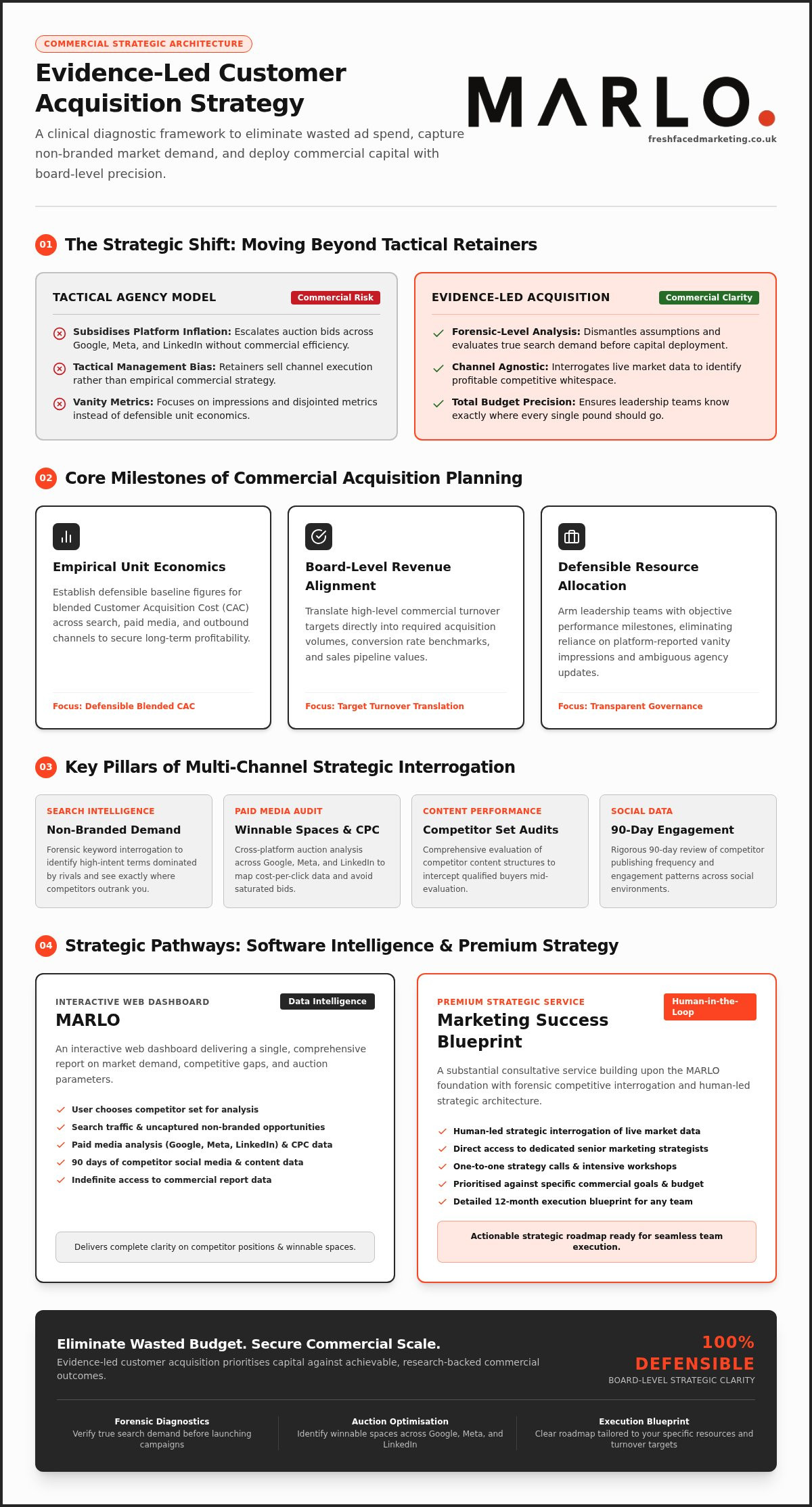
A rigorous customer acquisition framework replaces marketing ambiguity with verified commercial parameters. To secure board-level confidence, the strategic process focuses on three non-negotiable milestones:
- Empirical Unit Economics: Establishing defensible baseline figures for your blended customer acquisition cost (CAC) across search, paid media, and outbound channels, ensuring long-term profitability.
- Board-Level Revenue Alignment: Translating commercial turnover targets into concrete acquisition volumes, required conversion rates, and pipeline values.
- Defensible Resource Allocation: Providing leadership teams with transparent milestones to track performance objectively, without relying on vanity impressions or disjointed platform metrics.
Acquiring high-value customers predictably requires deep market interrogation. Professional customer acquisition strategy services ensure that every campaign decision is backed by data, giving leadership teams total confidence in their commercial trajectory.
Key Pillars of an Evidence-Led Acquisition Framework
Launching acquisition campaigns without empirical market intelligence guarantees wasted expenditure. Traditional marketing frameworks frequently treat search, paid media, and social channels as separate silos, causing internal teams to duplicate effort and bid against themselves. A rigorous acquisition framework audits these touchpoints simultaneously. By cross-referencing search demand, auction competition, and customer behavioural patterns, businesses uncover verified market opportunities before committing capital.
Comprehensive customer acquisition strategy services systematically deconstruct the competitive landscape. Rather than guessing which creative angles might resonate, an evidence-led framework extracts actionable proof from live market data, ensuring you invest only in channels with demonstrable commercial viability.
Uncovering Uncaptured Non-Branded Search Opportunities
Branded search metrics offer a false sense of security. Winning clicks from users who already know your trading name does not represent growth; it represents brand retention. True customer acquisition relies on capturing non-branded search demand from buyers actively researching solutions. Forensic keyword interrogation uncovers high-intent commercial terms dominated by rivals. Mapping these uncaptured non-branded opportunities allows you to see exactly where your competitors outrank you and construct content architectures that intercept qualified prospects mid-evaluation.
Multi-Channel Competitor and Paid Media Auditing
Effective acquisition demands continuous visibility into competitive positioning across every primary advertising auction. By analysing competitor density on Google Ads, Meta, and LinkedIn, leadership teams can identify market gaps where rivals underinvest or deploy fatigued creative. Interrogating competitor messaging and assessing 90-day social media engagement rhythms exposes critical market vulnerabilities. This rigorous multi-channel audit isolates winnable spaces, allowing you to capture market share efficiently without engaging in margin-diluting bidding wars.
Establishing Financial Viability and Channel Economics
Channel selection must always be governed by commercial mathematics. With UK B2B search clicks averaging £3.45 on Google and LinkedIn CPCs ranging from £4.40 to £12, uncalculated media tests quickly erode margins. A robust framework models your acquisition economics directly against a minimum 3:1 lifetime value to acquisition cost ratio. Auditing conversion funnels prior to launching ad campaigns ensures traffic arrives at high-converting destinations. Choosing an objective, evidence-led marketing strategy gives you total clarity on channel economics, ensuring you know where every pound should go to secure sustainable revenue.
Software Dashboards vs Human Strategic Interrogation
Data collection tools are not strategies. Modern marketing platforms generate reams of charts, impressions, and conversion tracking figures, yet leadership teams frequently find themselves drowning in telemetry while lacking commercial direction. Professional customer acquisition strategy services separate mechanical data extraction from decisive strategic judgement. While intelligence software reveals market activity, human interrogation establishes commercial relevance.
The Limitations of Standalone Data Dashboards
Automated dashboards excel at surface aggregation, but they cannot interpret your operational reality. Metrics showing where competitors outrank you or displaying volatile cost-per-click swings don’t explain whether pursuing those keywords matches your delivery capacity or gross margin constraints. Dashboards present isolated data points. They cannot assess sales cycle complexity, resource limits, or internal team competencies, leaving marketing directors with raw numbers rather than clear commercial choices.
The Power of the Human in the Loop
Translating empirical observations into profitable campaigns requires rigorous diagnostic scrutiny. Senior strategists conduct one-to-one strategy calls and intensive workshops to pressure-test market findings against business realities. Strategic interrogation filters out low-margin distractions, stress-tests channel viability, and determines not just what to test, but what to actively discard. This human synthesis transforms raw intelligence into a prioritised commercial plan.
| Evaluation Dimension | Automated Data Dashboards | Consultative Strategic Interrogation |
|---|---|---|
| Primary Output | Raw metrics, rankings, and historical channel activity | Prioritised, context-aware execution blueprint |
| Operational Context | Ignores internal capacity, team skills, and margins | Aligns opportunities directly with operational realities |
| Decision Support | Highlights problems without prescribing solutions | Defines exact channel trade-offs so you know where every pound should go |
Deploying dedicated interactive web dashboards like MARLO provides the essential market visibility, but achieving predictable commercial scale requires senior human evaluation. Combining verified market data with strategic interrogation guarantees that acquisition investments deliver measurable commercial returns.
Evaluating Customer Acquisition Strategy Services: A Buyer’s Guide
Procuring strategic guidance requires extreme diligence. UK business leaders often encounter traditional agencies masquerading as strategic consultancies, pitching diagnostic reviews designed solely to funnel clients into expensive, ongoing execution retainers. Genuine customer acquisition strategy services remain commercially objective. They prioritise your financial viability over agency service lines, ensuring recommendations align directly with your growth goals, resources, and available capital.
To avoid compromised advice and speculative retainers, procurement teams should evaluate external partners through a structured, 5-step vetting protocol.
Step 1 & 2: Vetting for Objectivity and Depth of Research
Step 1: Demand Proof of Empirical Research Capabilities. A credible partner conducts forensic market research into your actual competitive environment. Ask to see how they extract multi-channel search volume, competitor ad density, and engagement patterns. If their recommendations rely on generic best-practice templates rather than primary data, walk away.
Step 2: Confirm Strategic Independence. Inquire whether the provider sells standalone ad management or creative production. Traditional agencies have a built-in conflict of interest; they naturally recommend channels where they sell delivery services. Strategic roadmaps must remain channel-agnostic, focusing on eliminating guesswork for UK brands by evaluating viable opportunities with absolute objectivity.
Steps 3 to 5: Assessing Blueprints, Feasibility, and Governance
The remaining steps ensure that the proposed strategy translates into an executable, internally owned asset rather than shelfware:
- Step 3: Inspect a Sample Execution Blueprint: Demand an anonymised example of their final strategic deliverable. Assess whether it provides an actionable, prioritised roadmap or merely presents abstract marketing theory.
- Step 4: Verify Winnable Spaces Identification: Ensure the diagnostic methodology uncovers uncaptured non-branded opportunities and clear competitor gaps across Google, Meta, and LinkedIn networks rather than relying on high-level market summaries.
- Step 5: Test Operational Deployability: Confirm the resulting strategic roadmap can be implemented by your internal marketing personnel or independent specialists, ensuring you retain total governance over commercial execution.
Objective advice safeguards your commercial capital. If you want to see exactly where your competitors outrank you and establish a defensible marketing plan, partner with Fresh Faced to build an evidence-led acquisition roadmap tailored to your specific commercial objectives.
From Diagnostic Intelligence to Execution: The Fresh Faced Approach
Sustainable growth requires a disciplined transition from clinical investigation to operational reality. Too many organisations let strategy gather dust because recommendations fail to account for actual commercial resources. Genuine customer acquisition strategy services must protect your working capital, bridging the gap between empirical data and execution. Fresh Faced structures this progression through distinct, research-backed phases that turn complex market intelligence into an achievable commercial engine.
By establishing an objective baseline before allocating marketing expenditure, UK leadership teams eliminate speculative risk. You gain total clarity on commercial trade-offs, enabling you to deploy internal resources with complete governance and precision.
MARLO: Interactive Market and Competitor Intelligence
Every strategic transformation begins with objective discovery. MARLO functions as an interactive web dashboard delivering single-report market, competitor, search, paid media, and social intelligence. You select the exact competitor set you wish to interrogate. The software evaluates organic search traffic to uncover uncaptured non-branded opportunities, audits competitor content performance, and tracks 90 days of competitor social media data covering posting frequency and engagement. Crucially, MARLO analyses paid search and paid social campaigns across Google, Meta, and LinkedIn to identify winnable spaces and cost-per-click trends, providing indefinite access to your data baseline.
The Marketing Success Blueprint (MSB) and Full Execution
While software provides visibility, commercial success requires human strategic synthesis. The Marketing Success Blueprint (MSB) represents our premium human-in-the-loop diagnostic service, building directly upon the MARLO foundation. Senior strategists lead one-to-one strategy calls and intensive client workshops, conducting forensic-level competitive analysis and rigorous strategic interrogation of your market data.
The output is an actionable 12-month execution blueprint. This comprehensive document prioritises every initiative against your specific commercial targets, team skills, and available budget, ensuring you know where every pound should go. The blueprint is fully portable; any internal team or agency partner can implement its recommendations seamlessly.
For organisations that prefer dedicated strategic leadership, Fresh Faced also delivers Full Marketing Strategy Execution. We step into the operational trenches to execute the blueprint directly, ensuring campaigns launch without friction, governance remains intact, and your commercial growth targets are met with mathematical precision.
Securing Your Commercial Advantage with Evidence-Led Strategy
Predictable business growth begins with empirical truth, not tactical guesswork. Investing in evidence-led customer acquisition strategy services replaces speculative agency retainers with absolute clarity, ensuring every pound of your marketing budget works towards verified commercial revenue milestones.
Our proprietary MARLO dashboard delivers that foundation by evaluating competitor search traffic, paid media activity, and 90 days of social engagement data, backed by indefinite access to your gathered intelligence. Through intensive one-to-one strategy workshops, the Marketing Success Blueprint translates these analytical findings into a bespoke 12-month execution blueprint prioritised against your operational capacity and resources.
Eliminating guesswork puts your leadership team back in complete control of commercial performance. Request your Marketing Strategy Blueprint today to uncover your market’s winnable spaces and establish a defensible acquisition engine designed to scale your business with confidence.
Frequently Asked Questions
What is the difference between customer acquisition strategy services and tactical digital marketing?
Customer acquisition strategy services focus on clinical diagnostic architecture, establishing channel viability, commercial economics, and market demand before capital is committed. Tactical digital marketing executes individual channel tasks such as tweaking ad copy, bidding on keywords, or posting social content. While tactical services focus on day-to-day platform activity, genuine acquisition strategy ensures your marketing expenditure aligns with sustainable revenue milestones, unit economics, and overarching commercial objectives across the UK market.
How do forensic customer acquisition strategy services identify uncaptured non-branded opportunities?
Forensic analysis dissects market search demand beyond branded queries, isolating high-intent terms where prospective buyers seek solutions rather than specific company names. By cross-examining competitor visibility, search volumes, and ranking gaps, evidence-led customer acquisition strategy services pinpoint high-value non-branded search terms dominated by rivals. This intelligence allows leadership teams to build targeted content and conversion pathways that intercept qualified buyers during their commercial decision-making journey.
Why should automated intelligence dashboards be paired with human strategic interrogation?
Automated software tools aggregate historical metrics and competitor tracking, but they lack commercial context. They cannot assess your delivery capacity, sales cycles, or profit margins. Pairing dashboard intelligence with human strategic interrogation bridges this divide. Senior strategists challenge assumptions, stress-test channel viability, and make deliberate commercial trade-offs. This synthesis ensures data translates into an actionable execution plan tailored to your team’s specific capabilities and financial resources.
How long does it take to develop an actionable 12-month customer acquisition blueprint?
Developing a bespoke, research-backed blueprint typically takes a few weeks of intensive investigation and strategic collaboration. The process includes automated market diagnostics, competitor interrogation, and in-depth workshops with senior strategists. This structured progression ensures every channel recommendation, resource allocation model, and financial milestone is rigorously pressure-tested against your operational goals before deployment, preventing premature launches that burn commercial capital.
Can our existing in-house team execute the roadmap produced by an acquisition strategy service?
Yes, a properly constructed execution blueprint is designed to be fully portable. The deliverable details exact channel priorities, resourcing requirements, and implementation workflows that your internal marketing personnel can readily deploy. It removes tactical guesswork, providing your team with unambiguous direction so they understand where every pound of the budget should go and what commercial metrics require active monitoring.
How does an evidence-led acquisition strategy reduce wasted ad spend on Meta and Google?
An evidence-led strategy prevents capital waste by identifying winnable auction spaces and pre-testing channel viability before spending begins. Rather than testing creative blindly in competitive auctions where click costs escalate, the framework models conversion rates against realistic lifetime value metrics. By identifying competitor saturation and fixing funnel leaks before driving traffic, businesses avoid subsidising platform inflation and focus solely on high-margin channels.
What specific data sources should an objective competitor analysis examine?
An objective competitor analysis must evaluate data across search, social, and paid media environments simultaneously. This includes organic search rankings, non-branded keyword share, content performance, and 90 days of social media frequency and engagement metrics. Additionally, it requires interrogating paid search auctions on Google Ads alongside paid social campaigns across Meta and LinkedIn, uncovering competitor creative patterns, auction density, and winnable commercial spaces.