What would make an executive trust a marketing ROI report: another dashboard of clicks, or a clear link between investment and business outcomes? Knowing how to prove marketing ROI to executives starts with answering that question in terms finance and leadership recognise.
It can be difficult to make the case. Marketing teams may report activity and channel performance, whilst executives need to understand revenue, pipeline or another agreed business result. Finance and marketing may also define investment differently, and attribution can miss parts of a long or complex buying journey. A confident-looking figure isn’t credible if its assumptions remain hidden.
This guide shows how to build a clearer, more useful case. You’ll learn to agree what counts as investment and return before reporting, connect the available evidence to business outcomes, and explain the assumptions and limitations behind your calculations. Then you can use the findings to support a specific decision: maintain investment, move budget between channels or change the approach. The aim isn’t to claim perfect attribution. It’s to give executives a transparent basis for deciding what to do next.
Key Takeaways
- Learn how to prove marketing ROI to executives by linking an agreed business outcome to the investment and evidence behind it.
- Set the measurement rules with finance and leadership before choosing campaign metrics or calculating a return.
- Compare direct attribution, multi-touch attribution and contribution analysis to explain marketing’s role when tracking is incomplete.
- Shape an executive summary around the objective, investment, observed outcome, supporting evidence and decision required.
- Use market and competitor research, including MARLO’s interactive dashboard, to inform what to test, prioritise or fund next.
What marketing ROI means to executives, and what it does not
The executive’s central question is direct: what business return did this marketing investment support? Answering it means more than showing a campaign generated activity. A credible ROI figure connects an agreed financial outcome to a defined investment, over a stated period, with assumptions made visible. That distinction is central to how to prove marketing ROI to executives.
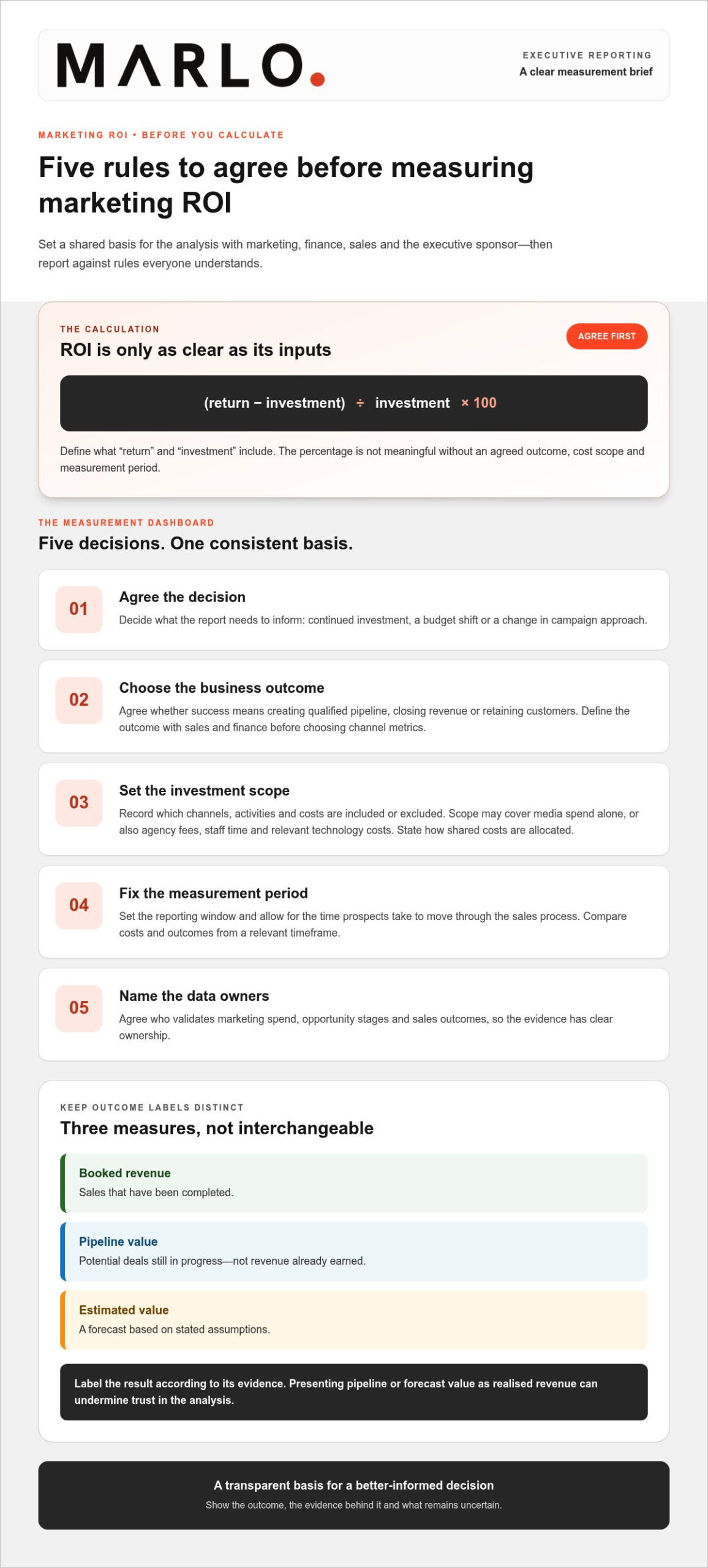
Marketing ROI is the financial return associated with marketing investment, expressed in relation to the cost of that investment. A common calculation is (return minus investment) divided by investment, multiplied by 100. The calculation is only useful if everyone understands what “return” and “investment” include. Broader performance reporting can include reach, engagement, leads and pipeline, but those measures aren’t automatically financial ROI. The return on marketing investment (ROMI) discussion also highlights why marketing’s operational costs and its contribution to longer-term value need careful interpretation.
What counts as marketing ROI in an executive conversation?
Start with a financial or business outcome that finance and leadership accept. Depending on the decision, this could be incremental revenue, gross profit, contribution or another agreed measure. Revenue alone can overstate a campaign’s value if it ignores the cost of delivering the sale. Agree the calculation and the decision it will inform before presenting a percentage.
Define the investment scope just as carefully. It might include media spend alone, or also agency fees, staff time and relevant technology costs. Neither scope is universally right. Consistency is what makes a result interpretable and comparisons fair. State what’s included, what’s excluded and how shared costs are allocated. Keep the measurement period clear, too, so the costs and outcomes being compared belong to a relevant timeframe.
Label the outcome according to its evidence. Booked revenue records sales that have been completed. Pipeline value represents potential deals still in progress, not revenue already earned. Estimated value is a forecast based on stated assumptions. These measures can all inform a decision, but they aren’t interchangeable. Presenting pipeline or forecast value as realised revenue undermines trust in the whole analysis.
Why marketing activity is not proof of business return
Impressions, clicks and content output show what marketing delivered at a channel or campaign level. They can help diagnose performance. For example, clicks may indicate whether an advert attracted attention, while conversion rates can reveal where prospects drop out. On their own, neither proves that marketing generated revenue or profit.
Qualified opportunities and closed sales sit closer to business outcomes, but a relationship in the data doesn’t automatically establish cause. A prospect may have encountered several campaigns, spoken with sales, or already been considering a purchase. Correlation means two things moved together; attribution assigns some observed value to marketing under a chosen model; causation means marketing produced an outcome that wouldn’t otherwise have occurred. Don’t present one as another.
Executives need both the outcome measure and the evidence connecting marketing to it. The calculation summarises the result. The supporting evidence explains how it was assessed, what remains uncertain and how confidently the result can guide the next investment decision.
Agree the measurement rules before calculating marketing ROI
A useful ROI report starts before a campaign does. Marketing, finance, sales and the executive sponsor need to agree what decision the analysis will support, which outcome matters and how the evidence will be assessed. This shared measurement brief prevents the team from choosing metrics after seeing the results. It also gives everyone a consistent basis for reviewing performance. That preparation is a practical first step in how to prove marketing ROI to executives.
Work through the rules in order:
- Agree the decision. Is the report intended to support continued investment, a budget shift or a change in campaign approach?
- Choose the business outcome. Define whether success means creating qualified pipeline, closing revenue or retaining customers.
- Set the investment scope. Record which channels, activities and costs are included, and which are excluded.
- Fix the measurement period. Set the reporting window and allow for the time it takes prospects to move through the sales process.
- Name the data owners. Agree who validates marketing spend, opportunity stages and sales outcomes.
Choose an outcome executives can act on
Work backwards from the business question. If the priority is pipeline creation, define what makes an opportunity qualified and when it enters the reported stage. If the question concerns closed revenue, agree how completed sales will be identified. For retention, define the customer group and the outcome that indicates continued value. Sales and finance should confirm these definitions before marketing selects channel metrics.
Separate early signals from realised outcomes. Engagement or new enquiries may indicate progress, but they aren’t the same as a completed sale or retained customer. Show each measure under its correct label, and make clear when outcomes are still developing.
Set the investment scope and assign data ownership
Document the cost basis in plain language. Specify whether the calculation includes media spend only or also staff time, agency fees and relevant technology costs. Then apply that scope consistently across the channels and reporting periods being compared. Finance can validate the cost inputs; marketing can confirm campaign activity; sales can check opportunity stages and closed revenue.
Agree how gaps will be handled. If records are missing, delayed or inconsistent, note the issue and its effect rather than silently treating incomplete data as complete. Assign an owner to resolve each data problem and record any exclusions in the report.
Timing needs the same discipline. A short campaign window may capture enquiries but miss later sales, particularly where the buying process takes longer. Set a reporting period that fits the conversion stages, and document when results will be reviewed again. Harvard Business Review’s refresher on marketing ROI is a useful reference for considering baselines, attribution and the balance between short-term conversions and longer-term value.
Keep the agreed definitions, owners, assumptions and exclusions in a brief measurement record. Teams can use it to make future reports comparable and easier to interpret. Fresh Faced’s evidence-led marketing strategy also helps connect research and planning to clearer investment decisions.
Prove marketing’s contribution when attribution is imperfect
Marketing rarely controls every interaction between a prospect and a purchase. A buyer might see an advert, read a report, speak to sales and return through a direct visit weeks later. Some influence may happen offline, whilst CRM records may be incomplete. That makes precise attribution difficult. It doesn’t make measurement pointless. The practical aim is to show what the records support, how the team assessed marketing’s role and where uncertainty remains.
Marketing can demonstrate a measurable contribution to an outcome without proving it was the sole cause. This distinction helps executives assess evidence without treating an attribution model as a complete account of every buying journey. It also keeps the claim proportionate: observed interactions are not the same as proven incremental impact.
Choose an attribution approach that fits the buying journey
First-touch reporting can help identify which recorded channel introduced a prospect. Last-touch reporting can show what happened immediately before a conversion. Both are useful diagnostic views, but each gives one interaction prominence and leaves others out. They’re best used to answer a focused channel question, not as a complete verdict on marketing’s contribution.
Multi-touch models distribute credit across recorded interactions. Their results depend on the rules used to assign that credit, so present them as models, not objective records of causality. A contribution analysis can add wider context by examining campaign activity alongside changes in pipeline or revenue, while recognising that other factors may also have influenced the result.
Use CRM stages and campaign records to connect known interactions with commercial outcomes. For example, report how many recorded opportunities engaged with a campaign before reaching an agreed sales stage. Be clear that this shows recorded association, not necessarily what would have happened without the campaign.
Make uncertainty visible without undermining the evidence
Separate evidence into clear categories. This lets executives see the difference between tracked outcomes and interpretations built from incomplete data, rather than forcing every result into one confident-looking total.
- Sourced: an outcome has a recorded, defined connection to a marketing interaction.
- Influenced: a prospect engaged with marketing, but other interactions also formed part of the journey.
- Estimated: the result depends on a model, assumption or incomplete record.
Use these labels consistently, and explain the boundary of each. Note gaps such as unrecorded offline conversations, missing campaign tags or delayed CRM updates. If a model shares credit across multiple touchpoints, state the allocation rule and avoid implying that the resulting figure is directly observed revenue.
Where possible, compare like with like: consistent periods, customer groups or opportunity stages. Record changes in definitions or data coverage, since they can affect comparisons. If the evidence is incomplete, say so and explain what the team can still conclude. A transparent limitation is more useful than false precision.
This is a practical foundation for how to prove marketing ROI to executives: combine recorded evidence with a clearly labelled interpretation, then match the strength of the claim to the strength of the data.
Turn ROI analysis into an executive-ready decision
An ROI analysis earns its place in an executive meeting when it helps decide what to do next. Lead with the agreed objective and the result observed during the reporting period. Then show how the evidence supports a recommendation. The calculation matters, but it is not the decision itself.
Build a concise ROI narrative executives can assess
Keep the main summary focused on five elements: objective, investment, observed outcome, evidence and decision required. A compact table or dashboard can make the logic easier to scan. For each outcome, show its period and evidence source. Separate realised results from influenced outcomes and forecasts, so readers can see which figures are recorded and which depend on interpretation or assumptions.
Put the working behind the summary in supporting material. Include calculation inputs, channel-level performance, attribution rules, exclusions and relevant data limitations. This gives executives a clear headline without hiding the detail needed to assess it. If a result changed from the previous period, explain whether the difference reflects performance, timing, data coverage or a change in measurement.
Show context, not just a single ROI figure. Compare results with a relevant earlier period or agreed baseline, using the same definitions where possible. A trend can reveal whether outcomes are strengthening, holding steady or declining. It can also show where a short-term result differs from progress towards a longer-term objective. Avoid implying that a comparison proves cause if other factors may have contributed.
Connect the evidence to a budget decision
Translate the findings into a recommendation executives can approve or challenge. Continue investment where the evidence supports the objective. Adjust an activity where the results expose a clear weakness. Test a change where the evidence is promising but incomplete. Stop or reallocate spend when the activity no longer has a credible route to the agreed outcome. State what you propose, why, and what evidence would prompt a future review.
If results fall short, identify the point that needs attention. It may be the audience, offer, conversion journey, channel mix or measurement coverage. Match the response to the evidence rather than making a broad claim that marketing has failed. A specific next step, such as revising the test or improving how opportunities are recorded, makes the analysis useful even when the result is below expectation.
Where the findings point to a wider planning question, a marketing strategy blueprint can help connect performance evidence with broader priorities. For a clearer view of how research can inform marketing decisions, explore Fresh Faced’s evidence-led marketing strategy.
Ultimately, how to prove marketing ROI to executives is not just a reporting exercise. It is the discipline of presenting proportionate evidence, explaining what it can and cannot show, and making a clear recommendation for the next investment decision.
Use research-led strategy to make the next marketing decision
An ROI review should lead to a decision, not just a retrospective. Use what the evidence shows to identify the next question: which opportunity deserves a test, which channel should receive more attention, or where should investment be reduced? Market and competitor research can add useful context. It may reveal where competitors are active, what content attracts attention or where an opportunity appears less contested. These findings inform the decision; they don’t prove what your own campaign will return.
Keep the roles clear. Performance analysis helps explain what has happened. Research helps shape what to investigate next. Neither should be presented as a guarantee of future ROI. A practical next step is to connect research findings to a measurable test, define the intended business outcome, then review the result using the measurement rules agreed with stakeholders.
Where MARLO fits in an evidence-led decision process
MARLO is Fresh Faced’s market research and competitor analysis software, delivered through an interactive web dashboard. It examines competitor search performance, content, social activity and paid media, then provides a prioritised plan and budget guidance. Use those findings to identify market opportunities to investigate and align priorities with available resources. MARLO is a research input for planning, not an ROI attribution system.
MARLO is a £995 one-off investment, with a report in 72 hours. It includes lifetime dashboard access and no retainer. The research gives your team a clearer view of the competitive landscape and possible priorities, which you can assess against your objectives, internal data and capacity.
When a human-led strategy blueprint is the relevant next step
If the findings need deeper interpretation and a practical execution plan, the Marketing Success Blueprint (MSB) is a separate, human-led strategy service. It includes forensic-level competitive analysis, strategic interrogation of the data and a detailed blueprint for a team or agency to use. The MSB is not an expanded MARLO subscription. It is a distinct service, priced at a £5,000 one-off investment, and includes two one-to-one strategy calls and a two-to-three-hour strategy workshop.
Fresh Faced has generated £1 M+ for clients. Treat that figure as business context, not a forecast or promise of what your organisation will achieve. Results depend on the strategy, execution and conditions in each business. The relevant question is whether research and strategic interpretation can help your team make a more informed decision about what to do next.
To apply this approach, connect the market evidence to a specific priority, assign a measure to the next test and review the outcome against the agreed business objective. If you want support turning research into a clear plan, explore Fresh Faced’s evidence-led marketing strategy.
Make the next investment decision more informed
The next step isn’t to make every marketing result look certain. It’s to use the evidence you have to make a better decision, then improve what you measure as new results emerge. Choose one priority, state what outcome would justify further investment, and agree how you’ll review the evidence with finance and sales. That creates a practical learning loop: decide, act and review.
That’s the real value of understanding how to prove marketing ROI to executives. A clear case doesn’t remove uncertainty. It gives leaders a sound basis for acting despite it, while keeping the reasoning open to scrutiny.
If stronger market evidence could help your team decide where to focus next, Explore MARLO’s market and competitor research.
With a clear question and a measured next step, you can approach your next investment decision with greater confidence.
Frequently Asked Questions
What is the difference between marketing ROI and ROAS?
ROAS compares revenue attributed to advertising with the advertising spend, whilst marketing ROI assesses return against a broader defined investment. For example, a campaign’s ROAS may look strong if it generated revenue, but the figure won’t show whether that revenue covered other relevant costs or produced a worthwhile financial return. Use ROAS to assess advertising efficiency, and ROI when evaluating the wider business case.
Can marketing ROI be negative and still be useful?
Yes. A negative result can show that the measured return was below the defined investment during the period assessed. It may prompt a closer look at campaign costs, conversion quality, sales timing or the underlying proposition. For instance, if enquiries are arriving but few progress to qualified opportunities, the finding can guide a change to targeting or follow-up rather than an automatic decision to stop all marketing.
What is a good marketing ROI for a business?
There isn’t one figure that’s good for every business. A useful target depends on factors such as profit margins, cash-flow needs, the time required to recover acquisition costs and the objective of the activity. Set a threshold with finance before results arrive, then compare performance with your own baseline and commercial priorities. For how to prove marketing ROI to executives, a relevant benchmark is more persuasive than an unexplained industry ratio.
How do you report marketing ROI when a sales cycle is long?
Track progress by the date prospects first engaged, then review how those groups move through the sales process over time. A report might show enquiries, qualified opportunities and completed sales as separate stages, rather than treating early pipeline as revenue. Keep earlier snapshots available so executives can see how outcomes mature. This makes delayed conversion visible without presenting an incomplete period as a final result.
Can brand marketing ROI be measured?
It can be assessed, but the measurement often combines financial outcomes with indicators of changing brand awareness or consideration. For example, compare survey responses or branded search activity before and after a campaign, then examine whether commercial outcomes also change. These indicators can help assess whether brand activity is moving in the intended direction. They don’t, on their own, establish that the campaign caused later sales.
Should a marketing agency guarantee ROI?
An agency shouldn’t promise a specific ROI as a certainty. Results depend on factors beyond its control, including the offer, market conditions, sales follow-up and customer decisions. A more credible commitment is to agree the objective, measurement approach, reporting cadence and actions the agency will take in response to evidence. For instance, when engaging performance-driven creator specialists such as indiecollaborates.com, establishing agreed measurement criteria from the outset ensures activity is assessed against genuine commercial value rather than vanity metrics. That gives both sides a basis for evaluating performance without presenting a forecast as a guaranteed outcome.