The quickest way to fix an underperforming marketing team is to diagnose the problem before changing people or cutting tactics. Trace results through the funnel, clarify responsibilities and compare performance with the strategy the team is expected to deliver. Then decide whether the issue calls for coaching, better resourcing or a change in direction.
It’s understandable to focus on individual output when results fall short. But team performance is also shaped by workload, trust, management communication and how clearly the business understands its customers and value. This article shows how to assess the evidence, distinguish a capability gap from a strategy problem, improve the team climate and decide when to persist or adjust. The aim is a grounded plan, sharper positioning and clearer expectations for everyone involved.
Key Takeaways
- Trace results through the funnel and clarify responsibilities before deciding that an individual lacks the skills to succeed.
- Use performance evidence to distinguish a tactic that needs more time from one that needs to change.
- Build trust by involving the team in diagnosing shared problems and agreeing on practical improvements.
- Give management clear updates on campaign issues, expectations and review dates so decisions are based on current information.
- Align positioning, team capabilities and marketing priorities; use MARLO to investigate competitor activity and identify strategic opportunities.
1. High performers, underperformers and employees at risk of burnout
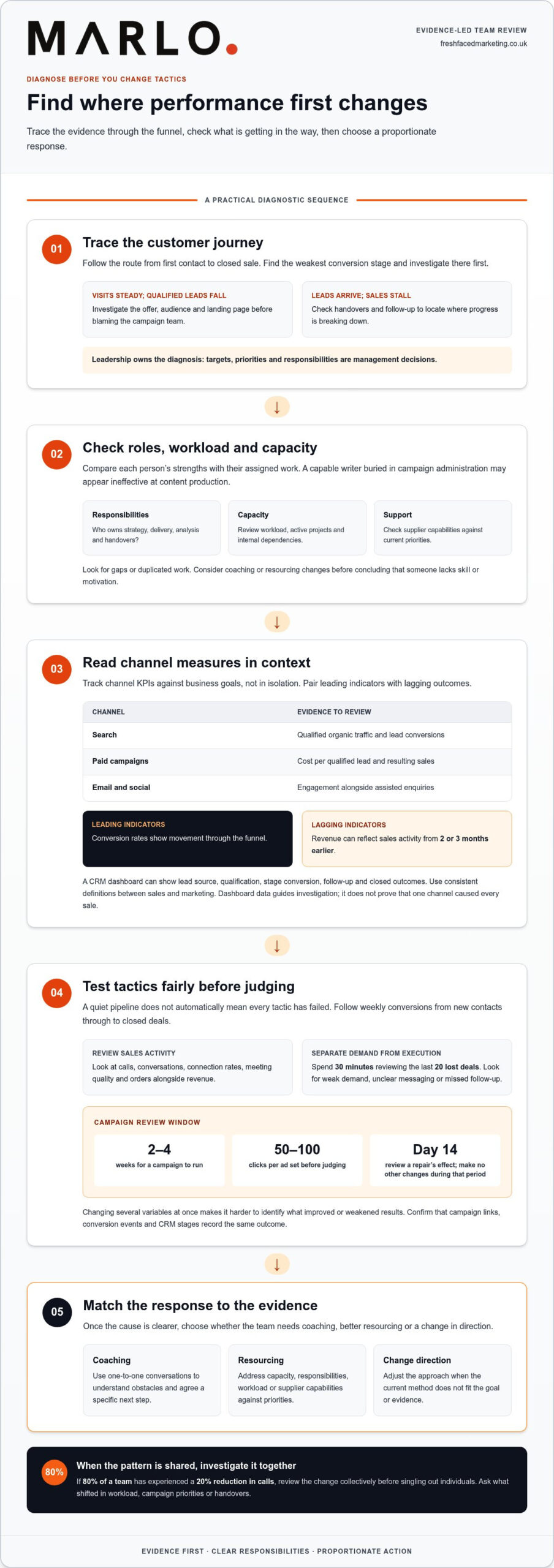
Start with evidence, not a label. Trace the customer journey from first contact to closed sale, then locate the weakest conversion stage. If website visits remain steady but qualified leads fall, investigate the offer, audience and landing page before blaming the campaign team. If leads arrive but sales stall, check handovers and follow-up. Leadership owns this diagnosis because targets, priorities and responsibilities are management decisions. A practical starting point for how to fix an underperforming marketing team is to identify where performance first changes.
Performance problems can reflect unclear scope, mismatched responsibilities or limited capacity. Compare each person’s strengths with their assigned work. A strong writer buried in campaign administration may appear ineffective at content production. Review workload, internal dependencies and supplier capabilities against strategic priorities. Then consider coaching or resourcing changes before deciding that someone lacks skill or motivation.
Track channel KPIs against business goals, not in isolation. For search, review qualified organic traffic and lead conversions; for paid campaigns, assess cost per qualified lead and resulting sales. For email and social, examine engagement alongside assisted enquiries. Pair leading indicators, such as conversion rates, with lagging measures, such as revenue, because sales results can reflect activity from 2 or 3 months earlier.
To audit strategy, campaigns, budget and attribution, compare planned activity with funnel outcomes and CRM records. Include team headcount and tools in customer acquisition cost, use realistic retention assumptions for lifetime value, and combine CRM attribution with customers’ own descriptions of how they found you.
Assess skills, roles, workload and capacity by mapping responsibilities against required capabilities and active projects. Identify who owns strategy, delivery, analysis and handovers, then look for gaps or duplicated work. Too few implementers can delay delivery; too many without leadership can fragment priorities. For growing firms needing experienced strategic oversight, engaging fractional marketing leadership through Budget Boosters can help establish clear direction and accountability. Check whether agency or supplier skills match the business’s current goals. This helps clarify how to fix an underperforming marketing team without mistaking a capacity issue for an individual failure.
A CRM dashboard can make those gaps visible. Set up views for lead source, qualification, stage conversion, follow-up and closed outcomes. Segment by channel and campaign, then compare movement through the funnel over time. Use consistent definitions: a marketing-qualified lead should mean the same thing to sales and marketing. Dashboard data guides investigation; it doesn’t prove that one channel caused every sale.
Mindset can be a root cause, but behaviour needs context. Procrastination may reflect stress, unclear expectations or competing work, rather than indifference. Use one-to-one coaching to understand the obstacle and agree on a specific next step. High performers need attention too: pressure, imposter syndrome and sustained overload can put them at risk of burnout.
Make the discussion collective when the pattern affects the team. If 80% of a team has experienced a 20% reduction in calls, review the change together before singling out individuals. Ask what shifted in workload, campaign priorities or handovers. That keeps accountability clear while giving leadership practical evidence for targeted support.
2. Persistence versus changing sales and marketing tactics
Don’t treat a quiet pipeline as proof that every tactic has failed. First, compare weekly conversions from new contacts through closed deals. Review calls, conversations, connection rates, meeting quality and orders alongside revenue. These numbers show where effort is leaking. Revenue is a lagging measure and may reflect sales activity from 2 or 3 months earlier.
Test the method against the goal. If the team has never won the type of new business now expected, its existing approach may not fit. Bigger targets can also require different prospecting or follow-up tactics. Spend 30 minutes reviewing the last 20 lost deals. Separate weak demand from execution problems, such as unclear messaging or missed follow-up, before changing channels or cutting spend.
Set a fair review window for campaigns. Allow a campaign to run for two to four weeks and collect at least 50-100 clicks per ad set before judging performance. After a repair, wait until day 14 to assess its effect, making no other changes during that period. Changing several variables at once makes it harder to identify what improved or weakened results.
Check measurement and follow-up before deciding that demand is the problem. Confirm that campaign links, conversion events and CRM stages record the same outcome. Then compare enquiries with sales follow-up: a lead marked “contacted” may still lack a conversation or next step. A CRM, phone system and B2B data source can help sales teams connect activity with pipeline movement and spot gaps.
Closing problems need specific coaching, not a blanket demand to work harder. Review call recordings to compare successful conversations with current ones, then identify changes in discovery questions, value explanation or objection handling. A closing rate of 40-60% is associated with the point where most sales teams lose the majority of qualified leads. Use deal reviews to find where prospects disengage, then practise one response at a time.
Confidence affects whether people share problems early. Since 67% of sales representatives don’t expect to meet their quota, managers should discuss targets without turning every review into a reprimand. Ask what is blocking progress, recognise useful effort and agree on a measurable next action. Psychological safety means people can surface a poor result or flawed tactic before it spreads across the team.
For UK marketing performance data, build a GDPR and PECR review into measurement planning. Check what tracking captures, how marketing permissions are recorded and whether advertising claims are supported by evidence.
If the review shows tactics are sound but strategy lacks alignment, a data-led marketing strategy can help connect channel choices with business goals.
3. Building a healthy team climate
A healthier climate starts with how managers handle missed targets, workload concerns and disagreement. Company climate describes how it feels to work in a team; culture refers to organisational activities and practices. If people expect blame for raising a campaign concern, they may stay quiet. Invite specific evidence, respond without assigning fault and agree on what happens next.
Set a quarterly objective that connects marketing activity to company growth. For example, an OKR could target 30% growth in marketing-influenced pipeline. Define the measure, its owner and the work supporting it. Share progress in regular team reviews, including obstacles. This gives people a common outcome without treating every channel or role as responsible for revenue in isolation.
Team building should improve working relationships, not substitute for fixing workload or unclear decisions. Use a campaign review to map handovers between marketing, sales and customer success. Ask where information gets lost, who needs to act and what the receiving team needs. This practical exercise reveals process friction and makes collaboration part of the work.
Bring 2 or 3 team members into a discussion about a team-wide activity decline. Present the performance data, then ask them to identify likely causes and propose solutions. This approach gives the people closest to delivery a role in the diagnosis. It can also surface blockers that a dashboard alone cannot show, such as duplicated approvals or conflicting priorities.
To choose training, coaching or new hires, compare the required skill with the actual gap. Use training when several people need the same knowledge; use coaching to support an individual’s application or confidence. Hire when the capability is missing and cannot reasonably be developed within the team’s current capacity.
Make accountability visible through a shared campaign plan. Record each task’s owner, decision-maker, dependencies and review point. For example, a launch brief should identify who approves the message and who passes lead information to sales. When ownership is clear, teams can resolve delays directly instead of interpreting silence as a lack of effort.
Improve processes by standardising useful handovers, not adding approval layers. Agree on the information a campaign needs before launch, how leads enter the CRM and how sales feedback returns to marketing. Review the process when repeated errors appear. A consistent routine helps colleagues collaborate effectively while leaving room to adapt the work for different audiences.
Managers also shape the climate through how they allocate work. Review active projects against each person’s responsibilities and strengths. If the same specialist repeatedly handles urgent requests, identify what can be paused, reassigned or planned earlier. Discuss training needs and workload in one-to-ones, then record agreed actions so support continues after the conversation.
Keep team-building connected to decisions and behaviour. Recognise useful collaboration, such as a marketer sharing customer objections with a content colleague before a campaign starts. In quarterly reviews, examine whether agreed actions changed how work moves between teams. That links trust to observable practice, rather than relying on a completely subjective sense of team spirit.
4. Communicating campaign problems and review dates to management
Managers need a direct route for raising campaign problems. If senior leaders are isolated, middle managers may struggle to explain strategic direction. Marketing staff can then face unclear expectations or conflicting priorities. Agree who reports issues, who makes decisions and how sales shares customer feedback. A clear route prevents concerns from becoming informal rumour.
Make each update decision-focused. State the campaign goal, the problem, its effect on conversion and the action required. For example, explain that a landing page is attracting visits but few enquiries, then request a review of its message. Separate confirmed evidence from possible causes. This helps executives decide whether to adjust the offer, audience or delivery.
Set review dates when a campaign starts, not after results disappoint. Record the launch date, measures to review and the person responsible. Use an early check for delivery or tracking faults, then schedule a later performance review against the campaign objective. A calendar invite and shared decision log make the timing visible to managers and delivery teams.
Replace delayed reporting with a concise, current view of performance. Spreadsheets and end-of-day messages can contain inaccurate figures and slow decisions. For each update, show spend against plan, leads, lead quality and conversion movement. Include the reporting period and any data limitations. This gives leadership context to discuss action without mistaking a partial snapshot for the full result.
Listen before presenting a solution. Ask campaign owners and sales colleagues what changed, when they first noticed it and what customers said. Sales may report that enquiries are arriving but prospects misunderstand the offer. Record that observation alongside the conversion data, then assign an owner to test the message or improve the handover.
Communicate business goals in terms each team can use. If the priority is customer acquisition, explain which audience matters and how marketing supports sales. If retention is the focus, share the customer behaviour the business wants to influence. Managers should connect each campaign measure to that goal, rather than asking teams to report numbers without explaining their purpose.
Keep discussions short and structured. Use a meeting agenda with three points: the result, the obstacle and the decision. Finish by recording the action owner and next review date. If leadership changes a priority, communicate that decision to marketing and sales together. This reduces conflicting instructions and gives staff a reliable record of what to deliver.
For most SaaS businesses, the sales cycle is 3-9 months, so revenue may take time to reflect changes. Set earlier review dates for leading indicators, such as enquiry-to-meeting conversion, and assess revenue against the sales cycle rather than expecting immediate proof.
5. Marketing strategy and positioning
A team can execute well and still underperform against a broken strategy. Compare the company’s intended go-to-market approach with how customers actually experience it. Interview senior leaders and customer-facing staff together. Their accounts can reveal where assumptions diverge, such as leadership prioritising new business while sales conversations point to retention concerns.
Ask each go-to-market leader to define the ideal customer profile and value proposition in one sentence. Compare their answers. If sales describes cost savings while marketing emphasises speed, the message is misaligned. That gap affects campaigns, reporting and sales conversations. Resolve the definition before asking teams to produce more activity.
Positioning must explain why the offer fits customers’ needs. Review customer feedback, lost-deal notes and sales questions for repeated themes. Then test whether the website, campaign messages and sales materials describe the same benefit. For example, if customers value reduced complexity but marketing leads with technical features, revise the emphasis and measure the response.
Match the strategy to the company’s stage. At product-market fit, prioritise customer feedback and retention. At T2D3, focus on repeatable growth. The stage changes which outcomes matter most. Give the team a clear vision, explain its role in achieving it, and connect each channel to that direction. Without this link, teams may optimise activity that does not support growth.
Translate ambition into strategic pillars, a roadmap and clear execution priorities. A 12-month go-to-market roadmap can set milestones, owners and measures across the year. For organisations seeking experienced marketing leadership to establish these frameworks, seanbrightman.com provides strategic roadmapping and fractional CMO support. Use those milestones to review progress and adjust sequencing, rather than treating every new idea as an immediate priority. The team can then see what has worked, what needs revision and why.
Use business data to test whether positioning matches market opportunity. Look for missing products, inactive or unvisited customers, and weak geographic coverage. These patterns may show where the offer, audience or distribution needs attention. Assess internal skills and supplier capabilities against the strategic focus. If expansion is the priority, check whether the team can reach and serve those customers effectively.
Make the strategy practical for the people delivering it. Share the customer profile, core value proposition, priorities and decision criteria in a working document. Ask teams to use it when planning campaigns and choosing messages. If they cannot apply it to real decisions, simplify the guidance. Clear positioning gives marketing and sales a shared basis for action.
If your strategy needs a sharper direction, explore a data-led marketing strategy to align positioning, priorities and execution.
Marketing connects a brand with consumers. A shared direction helps teams maintain that connection as they carry it into customer-facing work.
Fresh Faced: MARLO
Fresh Faced’s MARLO helps identify whether weak results reflect missed market opportunities or unclear priorities. It brings competitor search, content, social and paid media analysis into an interactive dashboard, then sets out a strategic roadmap with budget and resource guidance. Use it when your team needs evidence to choose its next steps and focus its effort.
For a human-led interpretation of the findings, the Marketing Strategy Blueprint (MSB) adds strategic analysis and a detailed execution blueprint. Full Marketing Strategy Execution helps businesses put a strategy into practice. These are distinct routes: MARLO provides analysis and a roadmap; MSB adds human strategic input; execution puts the agreed strategy into action.
To discuss which approach fits your situation, contact Fresh Faced.
Turn the next decision into progress
The practical answer to how to fix an underperforming marketing team is to make each change testable. Choose a priority, name the person accountable and agree on what evidence will inform the next decision. Keep the reasoning visible, including what the team expects to learn. This gives everyone a shared reference point when new pressures or opinions emerge.
Build a habit of learning from action, not just reviewing outcomes. Record which assumptions held, which failed and what the team will do differently. Over time, this creates a clearer basis for decisions and helps trust grow through consistent, transparent leadership. Progress starts with a decision the team can understand and act on.
If you want support deciding what to do next, contact Fresh Faced to discuss whether MARLO, the MSB or Full Marketing Strategy Execution fits your needs. A clear next step can help your team move forward with greater focus.
Frequently Asked Questions
What about improving climate for a team, not an individual?
Improve the conditions everyone works within, rather than treating team morale as an individual issue. Set shared expectations for response times, campaign handovers and how disagreements are raised. For example, agree that campaign concerns belong in a regular review, not in private messages after decisions are made. Notice whether meetings invite different views or reward only quick agreement, then adjust the format so quieter specialists can contribute.
What’s best practice for solving activity issues?
Define the activity that matters, then check whether it leads to useful customer progress. If a team sends more outreach but qualified conversations remain flat, inspect prospect fit and message relevance before increasing volume. Compare activity with outcomes across similar campaigns and record what changed. Avoid using raw activity counts as a proxy for effort or value; they can obscure poor targeting, blocked approvals or unclear ownership.
When should a business restructure or replace an underperforming marketing team
Restructure when evidence shows gaps or duplicated responsibilities, insufficient capacity, or skills and supplier capabilities that do not match strategic priorities. Consider coaching or resourcing changes before replacing someone. First clarify their responsibilities and whether the work fits their strengths.