Only 21% of marketers say they’re completely aligned with their CFO on marketing budgets and metrics, according to Perion and Advertiser Perceptions research reported in November 2025. That gap can make building a business case for marketing investment difficult, especially when forecasts look optimistic and attribution can’t tell the whole story.
Decision-makers need more than a projected return. They need to understand how proposed spend supports business priorities, what evidence underpins the forecast and how results will be assessed. A credible case doesn’t hide uncertainty. It makes assumptions, risks and measurement limits visible, so marketing and finance can assess the same proposal on the same terms.
This article sets out how to build that case. You’ll learn to connect investment to commercial objectives, choose measurable outcomes and explain attribution gaps without overstating certainty. We’ll also look at how research and strategic planning can reduce guesswork before activity begins, giving decision-makers a clear basis to approve, adjust or decline the proposal.
Key Takeaways
- Build a decision document that connects a specific marketing initiative to a business need, evidence, proposed spend and outcomes.
- Start with an observable business objective and baseline, then compare evidence-backed options against relevant measures.
- Assess expected benefits alongside uncertainty, internal capacity, dependencies and time to learn, without overstating likely returns.
- Make building a business case for marketing investment more actionable by stating the decision required, accountable owners, resources, measures and review points.
- MARLO provides market and competitor analysis, a prioritised plan and budget guidance for a £995 one-off investment, with a report in 72 hours and no retainer.
Why a marketing investment case needs more than a budget request
A budget request names the spend. A marketing investment case explains why that spend deserves consideration. It connects a defined business need to evidence, a proposed use of resources and outcomes that leaders can assess. The distinction matters: a confident forecast is not evidence, and a channel plan is not a commercial rationale.
A marketing investment case is a decision document that links a business need, supporting evidence, proposed spend and measurable outcomes so decision-makers can assess whether an initiative is worth backing. This is the practical purpose of building a business case for marketing investment. It gives leaders a reasoned basis for a decision, not a promise that a particular result will follow.
Keep the scope clear. A funding case concerns a specific initiative, such as testing a new audience or changing the emphasis of a campaign. A marketing strategy sets broader priorities across audiences, positioning and channels. A business plan covers the wider operation. The case should fit the decision at hand, rather than trying to replace either document.
What decision should the case help leaders make?
State the decision plainly: approve, reject, revise or stage the proposed investment. Then identify who controls the budget and who will deliver and measure the work. These roles may sit with different people, so naming them makes accountability visible before activity starts. Begin with the business problem, such as weak demand in a priority segment, not with a preferred channel or creative idea.
That order keeps the discussion focused. If the problem is a lack of qualified opportunities, for example, the decision should consider whether the proposed activity can plausibly help address that need and how progress will be assessed. Clicks or reach may help explain delivery, but they don’t by themselves establish business value. The return on marketing investment (ROMI) framework offers a way to think about marketing returns alongside the investment and assumptions involved.
What belongs in a marketing investment case?
A useful case gives leaders enough information to weigh value and feasibility. Include the objective, evidence, options, resources, measures and risks. Each has a distinct job: the objective defines the intended change; evidence grounds the rationale; options show what else could be done; and resource needs reveal what delivery requires. Measures and risks make progress and uncertainty assessable.
- Objective: the business outcome the initiative is intended to support.
- Evidence: the baseline and relevant market or customer insight behind the proposal.
- Options: the proposed approach and credible alternatives.
- Resources: budget, people and delivery requirements.
- Measures and risks: how progress will be reviewed, what could affect results and what remains uncertain.
A credible case is not a sales pitch for a preferred tactic. It is a structured way to make a decision with the available evidence, show what remains uncertain and set expectations for review. Leaders can approve, decline, revise or stage the proposal on that basis, without treating a forecast as a guaranteed outcome.
Build the case from business objectives, market evidence and a baseline
A marketing proposal is only as credible as the evidence behind it. Start with the business outcome, establish the current position and then examine whether market evidence supports the proposed activity. This sequence helps prevent a familiar mistake: choosing a channel first, then searching for a reason to fund it.
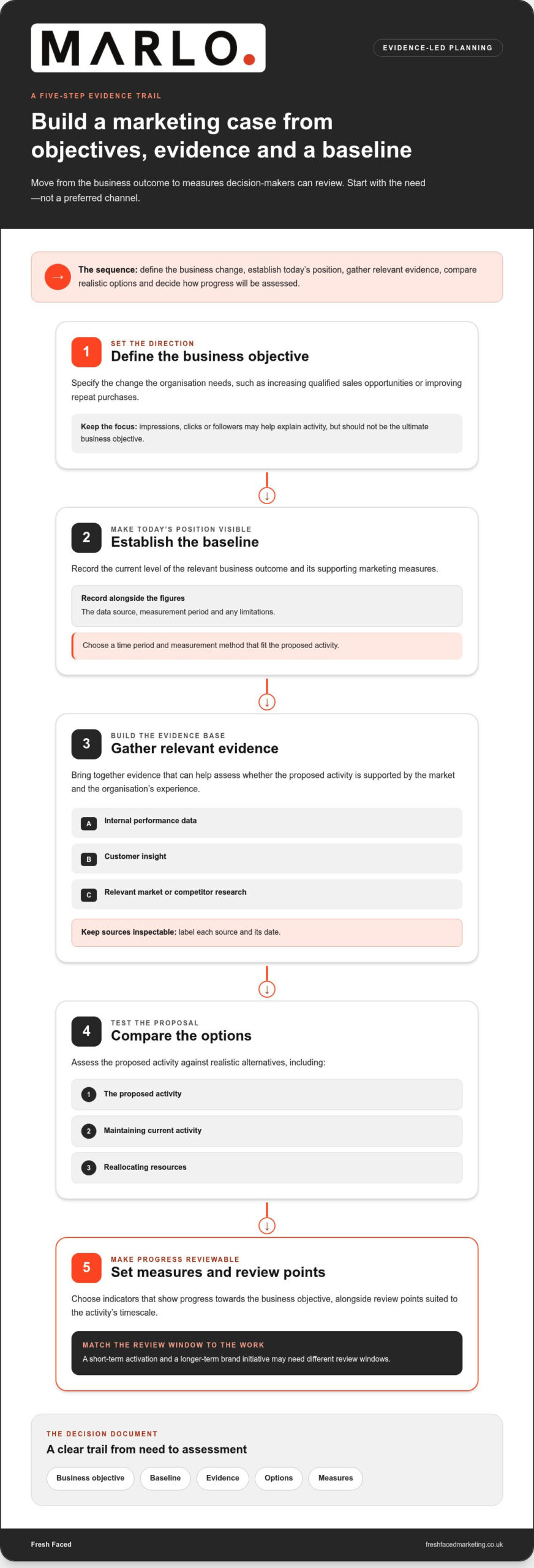
Use this five-step method to build an evidence trail decision-makers can inspect:
- Define the business objective. Specify the change the organisation needs, such as increasing qualified sales opportunities or improving repeat purchases. Avoid making impressions, clicks or followers the ultimate objective.
- Establish the baseline. Record the current level of the relevant business outcome and supporting marketing measures. Note the source, measurement period and any limitations.
- Gather evidence. Bring together internal performance data, customer insight and relevant market or competitor research. Label each source and its date.
- Compare options. Assess the proposed activity against realistic alternatives, including maintaining current activity or reallocating resources.
- Set measures. Choose indicators that show progress towards the business objective, alongside review points suited to the activity’s timescale.
Set an objective and baseline decision-makers can inspect
Make the objective observable. If the business needs more qualified opportunities, define how qualification is recognised and where the current volume is recorded. Then select a time period and measurement method that fit the proposed activity. A short-term activation and a longer-term brand initiative may need different review windows. Harvard Business Review’s guidance on measuring incremental marketing ROI is useful when considering baselines, attribution, risk and the time it can take for value to emerge.
Be explicit about evidence quality. Separate observed facts, such as recorded enquiries, from estimates, such as a forecast conversion rate, and assumptions, such as expected audience response. If tracking is incomplete or historical data is limited, state the gap and explain how it affects confidence. Don’t fill a missing baseline with a precise-looking figure that the evidence can’t support.
Use market and competitor evidence to test the opportunity
Internal results show what has happened; they may not explain what the market could support. Test audience demand, competitor activity and possible unmet needs before settling on channels. For instance, competitor content that attracts engagement may suggest a topic worth investigating, but it doesn’t prove that copying the format will generate sales. The useful question is what the finding means for your audience, objective and choice of investment.
For each finding, record its source and decision implication: does it strengthen the case, suggest a different approach or expose a risk? A structured market and competitor research process can help surface opportunities and inform channel choices. Building a business case for marketing investment becomes more defensible when the evidence is traceable and its limits are clear. For support applying that discipline to your own priorities, explore Fresh Faced’s evidence-led marketing approach.
Compare expected return, uncertainty and risk without overselling
A forecast becomes useful when decision-makers can see what it depends on. Compare the proposal with realistic alternatives, including maintaining current activity or moving resources from another initiative. Then place potential benefits beside the full delivery requirements: budget, team capacity, dependencies and the time needed to learn whether the approach is working.
Separate the quality of the evidence from the size of the opportunity. Market research and competitor analysis, such as the approach described by the US Small Business Administration, can help frame demand and competitive conditions. The findings still need to be tested against your own market, customer evidence and business priorities.
Make the return calculation transparent
State which investment costs and business outcomes the calculation includes. Explain the measurement period, how outcomes will be attributed to marketing and what other influences may affect them. If a customer encounters several channels before converting, for instance, a last-touch report may credit only the final interaction. That can show a useful part of the journey, but not necessarily the full contribution of each activity.
An evidenced result describes what the data has recorded; a forecast estimates what may happen if stated assumptions hold. Keep that distinction visible. Don’t present projected revenue as guaranteed ROI, particularly where sales capacity, pricing, seasonality or wider market conditions can influence the outcome.
Present scenarios and risks decision-makers can act on
Use conservative, expected and stronger scenarios only when each can be tied to defensible assumptions, such as observed conversion rates or a clearly stated change in reach. If evidence can’t support meaningful ranges, say so rather than manufacturing precision. The table can keep different types of information distinct:
| Category | What to show |
|---|---|
| Evidence | Recorded performance, customer feedback or market findings, with source and period. |
| Assumptions | Expected response, conversion or delivery conditions not yet demonstrated. |
| Potential outcomes | Scenario ranges linked to assumptions, not promised results. |
| Risks | Capacity constraints, dependencies, attribution gaps and factors beyond marketing’s control. |
For each material risk, name an early warning signal and a proportionate response. If enquiries rise but qualified opportunities don’t, review audience fit or the handover process before increasing spend. If required delivery capacity isn’t available, revise the timing or stage the investment. Agree review points in advance, including what would prompt continuation, adjustment or pause.
Building a business case for marketing investment means making uncertainty manageable, not pretending it can be removed. A clear comparison helps leaders judge both the potential return and the conditions needed to pursue it. Where research and strategic priorities need to be brought together, Fresh Faced’s marketing strategy support can help structure the decision.
Turn the analysis into an approval-ready recommendation
Decision-makers shouldn’t have to reconstruct the proposal from a long report. Lead with a concise recommendation, then place the evidence and technical detail behind it. The summary should make clear what decision is needed, why this option is recommended and what approval would allow the team to do. Keep the recommendation proportionate to the evidence. Where important questions remain, propose a staged decision rather than presenting a forecast as settled fact.
Present the recommendation in a decision-ready format
Open with the business need, the option you recommend and the evidence that makes it preferable to the alternatives. Then summarise the assumptions, required budget and internal capacity, expected outcomes and material risks. Put supporting data, methodology and caveats after this summary, where readers can examine them without losing sight of the decision.
- Decision requested: approve, revise, reject or release an initial stage of investment.
- Rationale: the business need, evidence and reason this option is favoured.
- Delivery conditions: required budget, people, dependencies and timing.
- Assessment plan: expected outcomes, measures, risks and review points.
Show how the initiative fits the wider marketing strategy, including which priority it supports and what it doesn’t address. A focused investment case can justify a specific action, but it shouldn’t imply that one initiative resolves every strategic challenge. A broader marketing strategy can provide context for how individual proposals relate to business priorities.
Set ownership, measures and review points
Assign accountability before approval. Name the person responsible for delivery, the people who supply performance data and the decision-maker who reviews progress. This helps prevent a proposal from being approved without the capacity or information needed to assess it. Pair leading indicators, which show whether planned activity is being delivered, with lagging indicators tied to the business objective.
For example, campaign reach may be a leading indicator; qualified opportunities or sales may be a lagging measure. Neither should stand alone. Define the data source, review cadence and who will interpret results, allowing enough time for the activity to produce meaningful evidence.
Use review points as decision gates, not automatic endorsements of further spend. At each checkpoint, compare actual delivery and early signals with the proposal’s assumptions. If the evidence supports the rationale, continue to the next agreed stage. If results are unclear, investigate measurement or delivery constraints. If key assumptions no longer hold, revise or pause the activity.
This makes building a business case for marketing investment an accountable process, from recommendation to learning. The approval sets the conditions for action; evidence at each review informs what happens next. To develop a recommendation around your priorities, work with Fresh Faced on your marketing strategy.
How Fresh Faced supports evidence-led marketing investment decisions
Good investment decisions need more than a forecast. They need a clear view of the market, a rationale for the proposed direction and a practical way to decide what happens next. Fresh Faced supports that process through distinct stages: research, human-led strategy and, where appropriate, execution. Each has a different role. Research can inform the case; strategy interprets what the evidence means; execution is a separate step.
When research through MARLO can clarify the decision
MARLO is Fresh Faced’s market and competitor research product. It presents findings in an interactive web dashboard with lifetime access, helping businesses examine competitors before committing to marketing activity. Its analysis can show where competitors rank in search, which content attracts traffic and engagement, how their social activity performs, and what active paid campaigns reveal about the market. The findings can also expose uncaptured opportunities and areas where competition is lighter.
The value for a business case is the link between findings and choices. MARLO’s strategic roadmap lays out options prioritised against your goals, budget and resources, with budget and resource guidance to make recommendations practical. These inputs can support the case’s evidence and options, but they don’t guarantee a particular return or replace internal performance data.
MARLO is a standalone research product, not a human-led strategy engagement. It is a £995 one-off investment, with a report in 72 hours and no retainer. To see how its market and competitor analysis can inform an investment decision, explore MARLO.
When a human-led Marketing Success Blueprint is the next step
Research can show where opportunities may exist. A team may then need experienced strategic interpretation to assess how those findings fit the organisation’s priorities, constraints and wider direction. The Marketing Success Blueprint (MSB) is Fresh Faced’s separate, human-led strategy service. It includes forensic-level competitive analysis across every channel, human-led strategic interrogation of the data and a detailed execution blueprint that can be handed to a team or agency.
The MSB also includes direct access to the Fresh Faced strategists who built the methodology, two one-to-one strategy calls and a two-to-three-hour strategy workshop. The MSB is a £5,000 one-off investment. Together, these elements support a more involved process of interpreting evidence and shaping a plan. They are distinct from MARLO’s dashboard, research and prioritised guidance.
Execution remains a further decision, not an automatic part of either research or strategy. Once a business has assessed its priorities and capacity, it can decide whether to resource the work internally or move into ongoing marketing strategy execution. This separation helps keep the original investment case clear: what is being funded now, what the work is intended to establish and what decision may follow.
Building a business case for marketing investment is ultimately about making an informed choice with the evidence available. MARLO can provide market and competitor insight; the MSB can add human-led strategic interpretation; execution can follow when the business is ready to act on the resulting plan.
Make your next marketing decision with greater clarity
The next proposal doesn’t need a flawless prediction. It needs a transparent rationale, a clear owner and an agreed way to learn from the investment. Treat approval as the start of disciplined review, not a promise that every assumption will prove correct. That approach makes building a business case for marketing investment useful beyond the initial funding decision: it creates a basis for adapting as evidence develops.
Fresh Faced reports £1M+ generated for clients and 1,000s of enquiries. These results offer context, not a guarantee of what another business will achieve. Each investment decision depends on its own objectives, market conditions, resources and measurement approach.
If you’re considering where to focus next, explore how research can inform your decision before committing to activity. Explore evidence-led marketing research with MARLO and take a considered next step towards marketing investment decisions grounded in evidence.
Frequently Asked Questions
What should a marketing investment business case include?
Building a business case for marketing investment means giving decision-makers enough to judge the proposal and authorise a defined next step. Cover the business need, intended outcome, evidence quality, selected option, resources, measurement plan and material risks. Keep the recommendation concise, then place detailed data and workings in supporting material. This lets finance examine the assumptions without obscuring the decision. Identify who owns delivery and who can approve the funding.
How do you calculate the ROI of a marketing investment?
Calculate marketing ROI by comparing the financial return attributed to the activity with its cost: subtract the cost from the return, divide by the cost, then multiply by 100. Define which costs count, such as media and production, and which outcomes qualify as return, such as attributable gross profit. Use a stated time window and attribution method. If the inputs are forecasts rather than observed results, label the figure as projected, not achieved.
Can a marketing business case be built without historical performance data?
Yes. A case can draw on customer interviews, existing sales records, market evidence and competitor activity, while making unknowns explicit. For a new channel, record the available starting indicators, confirm that tracking works and set an initial test around a learning question, such as whether a defined audience responds. Treat early findings as evidence to update the forecast, not as proof of long-term performance.
How do you justify marketing spend when results are difficult to attribute?
Build a transparent evidence trail rather than assigning every sale to the last click. Compare channel reporting with customer relationship management records, enquiry quality and sales outcomes, and flag journeys that involve several touchpoints. Paid search, for example, may capture demand created earlier by another activity. Note external influences such as seasonality or changes in sales follow-up. Report contribution with caveats, and don’t claim sole causation if the data can’t establish it.
What is the difference between a marketing business case and a marketing strategy?
A business case supports a specific funding choice; a marketing strategy guides connected priorities over time. A case might seek approval to test a new audience, while the strategy explains why that audience matters, how it fits the organisation’s positioning and what other work takes precedence. Use the strategy as context for the proposal. Approval for one campaign shouldn’t be treated as approval for the wider plan.
Who should present a marketing investment case to decision-makers?
The person accountable for the recommendation should present it, drawing on input from budget, delivery and measurement leads. They should be ready to explain why this option is preferred, what evidence could change the view and what approval enables. Invite stakeholders to challenge assumptions before the formal decision. Their input can expose practical constraints, such as a sales team lacking capacity to follow up additional enquiries promptly.
How often should a marketing investment case be reviewed?
Review it at agreed checkpoints, rather than applying an arbitrary monthly rule. Set intervals according to when the activity can produce a useful signal and when outcome data becomes available. Separate delivery checks, such as whether work is on schedule, from outcome reviews, such as whether qualified demand is changing. Record each decision and its rationale so future adjustments can be traced to evidence rather than opinion.