
A permanent marketing director isn’t always the right answer. If your business needs clearer direction but doesn’t yet need a full-time senior hire, the alternatives to hiring a marketing director may be a better fit. The key is to find a model that provides strategic ownership, not simply more activity.
It’s sensible to ask whether a senior hire fits your current goals, budget and delivery capacity. It’s also sensible to approach outsourcing carefully: without clear accountability, work can become a list of disconnected tactics. The right structure connects decisions to business outcomes, such as revenue and lead acquisition, and makes clear who owns the strategy and who delivers it.
This guide compares practical options, from fractional leadership and consultancy to agency support, internal capability and research-led strategy. It explains where each model can help, what to clarify before committing, and how to match the work to your people and resources. You’ll also see how MARLO’s interactive dashboard differs from the human-led Marketing Success Blueprint, helping you assess the strategic input you need and decide how to focus your marketing investment.
Key Takeaways
- The right alternative to hiring a marketing director depends on the strategic leadership, delivery capacity and team support your business needs.
- Compare permanent hires, fractional leadership, independent consultants, agency support and strategy-led partnerships by ownership, continuity and management load.
- Before engaging external support, define decision rights, deliverables and who is accountable for implementation.
- Match marketing priorities to business outcomes, team skills, available time and your capacity to manage partners.
- Understand the difference between MARLO’s research dashboard and the human-led Marketing Success Blueprint before deciding what level of strategic input will help you act.
Marketing director alternatives: identify the job
Before comparing alternatives to hiring a marketing director, define the gap you need to fill. Is the business short of strategic direction, execution capacity, team leadership or a combination? These are distinct needs. More campaign activity won’t solve a lack of strategic judgement, while a strategy document won’t deliver results if nobody has the time or authority to implement it.
A marketing leadership alternative is another way to secure the direction, decisions and delivery your business needs, without assuming they must all sit with one permanent hire. The right model depends on workload, decision rights and internal capability. Start by identifying the outcomes marketing must support, such as revenue or lead acquisition. Then establish who can set priorities and who will carry them through.
Which responsibilities are you trying to replace?
A marketing director’s remit can include setting strategy, prioritising budget, choosing channels, leading a team and reviewing performance. The Chief Marketing Officer (CMO) role provides useful context for the senior strategic and organisational responsibilities associated with marketing leadership. Your business may need only part of that remit, or need it for a defined project rather than on an ongoing basis.
Separate continuous leadership from a specific research or planning requirement. Then map current accountability:
- Who approves marketing priorities and budget?
- Who decides which channels support business goals?
- Who manages the team or external partners?
- Who owns implementation and reviews performance?
If the answers are unclear, the gap may be decision ownership, not simply a shortage of people producing marketing activity. Adding more delivery without clarifying authority can create extra work without answering what should happen next.
When might a permanent director still be the right choice?
A permanent director can be a strong fit when leadership demand is sustained, a team needs regular management and marketing decisions require daily involvement. The role needs enough scope to justify that level of responsibility, along with the authority to set priorities, direct resources and connect marketing decisions to wider business goals.
Check the practical conditions before choosing. Is there an ongoing leadership workload? Does the role have clear decision-making authority? Is there a team or delivery operation for the director to lead? If so, permanent recruitment may provide the continuity and involvement the business needs. If the requirement is narrower, compare other models against the specific work and accountability involved.
Five alternatives to hiring a marketing director, compared
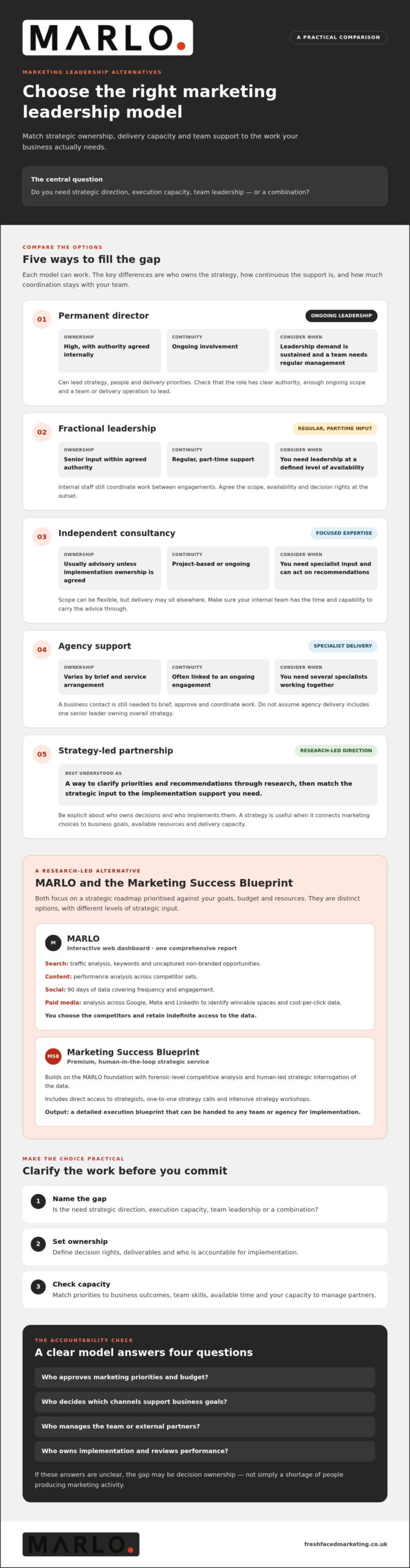
The alternatives to hiring a marketing director differ in strategic ownership, continuity and delivery. Use this comparison to identify the model that fits your workload and internal capacity. Each can work, provided responsibilities, decision rights and accountability are clear.
| Model | Strategic ownership | Continuity | Internal management load | Delivery scope and flexibility |
|---|---|---|---|---|
| Permanent director | High, with authority agreed internally | Ongoing | Lower day-to-day coordination, but requires managing a senior employee | Can lead strategy, people and delivery priorities; less flexible as a fixed role |
| Fractional leadership | Senior input, within agreed authority | Regular, part-time input | Internal staff still coordinate work between engagements | Leadership at a defined level of availability; confirm scope and decision rights |
| Independent consultancy | Usually advisory, unless implementation ownership is agreed | Can be project-based or ongoing | Internal teams need capacity to act on recommendations | Focused expertise and flexible scope, but delivery may sit elsewhere |
| Agency support | Varies by brief and service arrangement | Often linked to an ongoing engagement | Requires a business contact to brief, approve and coordinate work | Can bring several specialists together; don’t assume this includes one senior leader owning overall strategy |
| Strategy-led partnership | Can define priorities and recommendations; implementation ownership must be assigned | May be centred on a defined strategy engagement | Internal staff or another delivery partner act on the plan | A defined output, such as an execution blueprint. Fresh Faced’s Marketing Success Blueprint is a human-led example built upon the separate MARLO foundation. |
Internal and fractional marketing leadership
A permanent director can provide sustained involvement in daily decisions and team leadership. Fractional leadership provides senior input on a part-time basis, so agree what happens between that person’s working days. The fractional CMO model is one form of this arrangement. Confirm availability, responsibilities and decision-making authority before work begins.
Consultants, agencies and research-led strategy partners
A consultant may diagnose a problem or recommend a course of action without owning implementation. An agency may provide delivery capacity through several specialists, but that doesn’t automatically make it accountable for business-wide strategy. A strategy blueprint is a defined plan, not a substitute for every director responsibility. Decide who will approve priorities, manage delivery and assess performance. Businesses comparing these models can also review Fresh Faced’s marketing strategy and execution approach as one example of a strategy-led partnership.
You can also combine models. For example, a business might use external strategic input alongside an internal team responsible for delivery. Choose a combination that links business goals to clear owners, practical capacity and measurable performance.
Can an external alternative provide ownership, not just advice?
Yes, but the arrangement must define what ownership means. External support can bring adaptable expertise and an independent view. It won’t automatically provide an internal leader’s daily presence, full business context or authority to make decisions. Without agreed responsibilities, even strong recommendations can stall between approval and implementation.
Every recommendation needs a named owner and an agreed route into delivery. That owner may be an internal manager, an external lead or a delivery partner. They need the authority, time and resources to act, and progress should be reviewed against business goals.
Set accountability before selecting a provider
Agree the division of responsibility before work starts. Specify who:
- Sets marketing priorities and approves spend.
- Coordinates internal teams and external partners.
- Delivers the agreed work and reports progress.
- Reviews outcomes and decides what changes next.
Then define the provider’s deliverables and what remains with your business. An adviser might provide analysis and recommendations while your team owns implementation. A delivery partner may take responsibility for agreed work, but still rely on your business for approvals, information and decisions. Clarify how priorities will be revisited if goals, budget or available resources change.
Test whether strategy will reach implementation
Ask how research becomes prioritised actions, with owners, measures and review points. Check that recommendations reflect the people, budget and capacity available, rather than assuming every opportunity can be pursued at once. This matters when the aim is to create progress, not simply produce advice.
Establish how knowledge will transfer, too. Can the output be handed to your internal team or another agency? Are the priorities and rationale documented clearly enough for someone else to carry them forward? A practical handover reduces dependence on one provider and helps preserve context if responsibilities change.
Continuity matters, but it doesn’t have to mean a full-time presence. Regular external input can provide strategic challenge and specialist expertise, while an internal owner supplies day-to-day context and keeps decisions moving. The trade-off is straightforward: the more an external partner is expected to own, the more precisely you need to agree decision access, delivery responsibility and communication. For more on turning strategic priorities into action, see this strategic marketing execution guide.
Use these tests to assess alternatives to hiring a marketing director. The right arrangement connects authority, deliverables and accountability to a clear route into implementation.
How to choose the right marketing director alternative for your business
Choose from the alternatives to hiring a marketing director by starting with the business requirement, not the provider or job title. Work through this decision process before comparing proposals.
- Set the business outcome. Define what marketing must support, such as revenue growth, lead acquisition or another commercial priority. Make the outcome specific enough to guide decisions about channels and investment.
- Map your current capability. Record the skills and delivery capacity already in the team, how much time people can commit, and whether they can manage external partners. Identify gaps in strategic judgement, execution or team leadership.
- Clarify authority. Name who can set priorities, approve spend and make decisions. External expertise cannot resolve delays if nobody internally has the authority to act.
- Separate ongoing needs from defined work. Decide whether you need continuing leadership and team management, or a time-bound research and planning output. Specify what must be delivered and who will implement it.
- Set the constraints. Establish the available budget, people and delivery capacity. Prioritise recommendations against these limits rather than assuming every opportunity can be pursued at once.
Build a decision brief around outcomes and constraints
Bring those findings into a concise brief. State the commercial outcome, current skills, available time, decision-making access and internal delivery capacity. Distinguish responsibilities that need ongoing ownership from work with a clear endpoint. This gives providers a shared basis for proposing a realistic scope, without implying a guaranteed return.
Quick decision matrix
- Permanent director: Consider when leadership demand is sustained, a team needs regular management and decisions require daily involvement.
- Fractional leadership: Consider when you need recurring senior direction but can coordinate activity between agreed periods of input.
- Independent consultancy: Consider for a defined problem or specialist advice, provided someone internally can take recommendations forward.
- Agency support: Consider when delivery capacity or several specialist skills are needed, with a named person retaining strategic oversight.
- Strategy-led partnership: Consider when you need evidence-based priorities and a clear plan that your team or another agency can implement.
Compare proposals and agree the handover
Ask each provider to specify the scope, named responsibilities, deliverables and how progress will be reviewed. Check how recommendations will be prioritised against your goals, budget and resources, and whether the plan fits the time and skills available. The Marketing Success Blueprint overview explains how strategic analysis can produce an execution blueprint for a team or agency to implement.
Use this brief to explore Fresh Faced’s marketing strategy and execution options and identify an approach with clear ownership, feasible priorities and a defined route into delivery.
A research-led alternative: MARLO and the Marketing Success Blueprint
Research-led strategy can suit a business that needs clearer priorities before adding permanent senior headcount. Fresh Faced offers two distinct options: MARLO, an interactive web dashboard that provides one comprehensive report, and the Marketing Success Blueprint, a separate premium, human-in-the-loop service built upon the MARLO foundation. They offer different levels of analysis and human involvement. The right fit depends on whether you need research to inform decisions or strategists to interrogate the findings with you.
MARLO: a research dashboard for clearer decisions
MARLO brings competitive marketing data into an interactive dashboard and a single comprehensive report. It covers search traffic and keywords, including uncaptured non-branded opportunities, alongside competitor content performance. The report also includes 90 days of social media data on posting frequency and engagement, plus paid media analysis across Google, Meta and LinkedIn.
Paid media analysis can help identify potential “winnable spaces” and provide cost-per-click data for comparison. You choose which competitors to assess and retain indefinite access to the data. MARLO is the research dashboard, not the Marketing Success Blueprint. It provides a structured evidence base for decisions rather than the Blueprint’s human-led strategic process. Explore the MARLO research dashboard to understand the information it brings together.
Marketing Success Blueprint: human-led strategic interrogation
The Marketing Success Blueprint adds direct strategist access and human judgement to the MARLO foundation. It uses forensic-level competitive analysis and strategic interrogation to interpret the evidence in the context of your business. The service includes one-to-one strategy calls and intensive strategy workshops, with recommendations prioritised against your goals, budget and available resources.
The output is a detailed execution blueprint that can be handed to your internal team or another agency. It sets out what to prioritise and gives implementation a clear starting point, without assuming every business needs the same delivery model. Check each recommendation against the people, time and budget available. The aim is to know where every pound should go, based on evidence and business priorities, rather than spreading investment across activity without a clear purpose.
If you need research to clarify the opportunities, start with MARLO’s interactive research dashboard. If you need human-led analysis and a plan your team can implement, discuss your marketing strategy requirement with Fresh Faced. Both offer research-led alternatives to hiring a marketing director, with different levels of strategic support.
Choose the model that moves marketing forward
The right alternative depends on the work your business needs done, the decisions that need to be made and the capacity available to deliver them. A permanent director can suit sustained leadership demand. Fractional input, consultancy, agency support or research-led strategy may fit better when the requirement is narrower or your internal team can lead implementation.
Whatever model you choose, define who sets priorities, approves investment and owns delivery. Clear responsibilities help turn strategy into action and keep recommendations aligned with commercial goals, budget and resources.
For a research-led starting point, MARLO brings search, competitor content, social and paid media analysis together in one comprehensive report. The separate Marketing Success Blueprint adds direct strategist access, one-to-one calls and intensive workshops, then provides an execution blueprint that can be handed to any team or agency.
If you’re assessing alternatives to hiring a marketing director, discuss a research-led marketing strategy with Fresh Faced. Clear evidence and ownership can help you make a confident choice and focus resources on achievable priorities.
Frequently Asked Questions
What are the alternatives to hiring a marketing director?
Alternatives include fractional marketing leadership, independent consultancy, agency support and research-led strategy, sometimes combined with an internal team. Each addresses a different need. Fractional leadership can provide ongoing senior input; a consultant may focus on defined advice or research; an agency can add delivery capacity. A strategy-led partnership can clarify priorities and produce an implementation plan. Compare each option by the ownership, continuity and capacity your business requires.
Is a fractional marketing director the same as a marketing consultant?
No. A fractional marketing director typically provides recurring senior leadership on a part-time basis, with the scope and decision-making authority agreed for the engagement. A marketing consultant may instead advise on a defined challenge or provide specialist recommendations without taking ongoing responsibility for leadership or implementation. Titles and scopes can vary, so confirm who sets priorities, makes decisions, coordinates delivery and reviews progress before appointing either.
Can a marketing agency replace an in-house marketing director?
An agency can provide marketing delivery and access to several specialists, but it doesn’t automatically replace an in-house director’s leadership. The agency may not own business-wide priorities, internal team management or decisions that require daily company context. It can be a suitable alternative when your business has a clear internal decision-maker and agrees the agency’s scope, deliverables and accountability. Identify who connects agency activity to commercial goals and approves changes.
How do I decide whether to hire or outsource marketing leadership?
Assess whether you need sustained, day-to-day leadership or a defined level of external input. Consider the team’s management needs, the frequency of marketing decisions, internal skills, available time and authority to approve priorities and spend. The alternatives to hiring a marketing director may suit a narrower requirement, but outsourcing still needs an internal owner. Compare proposals against your business goals, budget and delivery capacity, then agree who is accountable for implementation.
What should an outsourced marketing strategy include?
An outsourced marketing strategy should connect business outcomes to evidence, priorities and practical delivery. It should explain which audiences and opportunities matter, how channels support goals such as revenue or lead acquisition, and how recommendations fit the available budget, people and resources. It should also identify owners, measures and review arrangements. Confirm whether the provider is responsible for research and planning only, or whether implementation and ongoing strategic oversight are included.
Can a marketing strategy blueprint be handed to another agency?
Yes, if the blueprint is clear enough to guide implementation beyond the team that created it. It should set out prioritised actions, the reasoning behind them, relevant measures and required resources, with responsibilities assigned for delivery. Fresh Faced’s Marketing Success Blueprint produces a detailed execution blueprint that can be handed to an internal team or another agency. Agree who will own implementation and how progress will be reviewed.
What is the difference between MARLO and the Marketing Success Blueprint?
MARLO is an interactive web dashboard that provides a single comprehensive report covering search traffic, competitor content, social media and paid media analysis. Users choose the competitors and retain indefinite access to the data. The Marketing Success Blueprint is a separate, premium human-in-the-loop service built upon the MARLO foundation. It adds forensic-level competitive analysis, direct strategist access, one-to-one strategy calls and intensive workshops to develop an execution blueprint.
To compare the right level of research and strategic support for your business, talk to Fresh Faced about your marketing strategy.