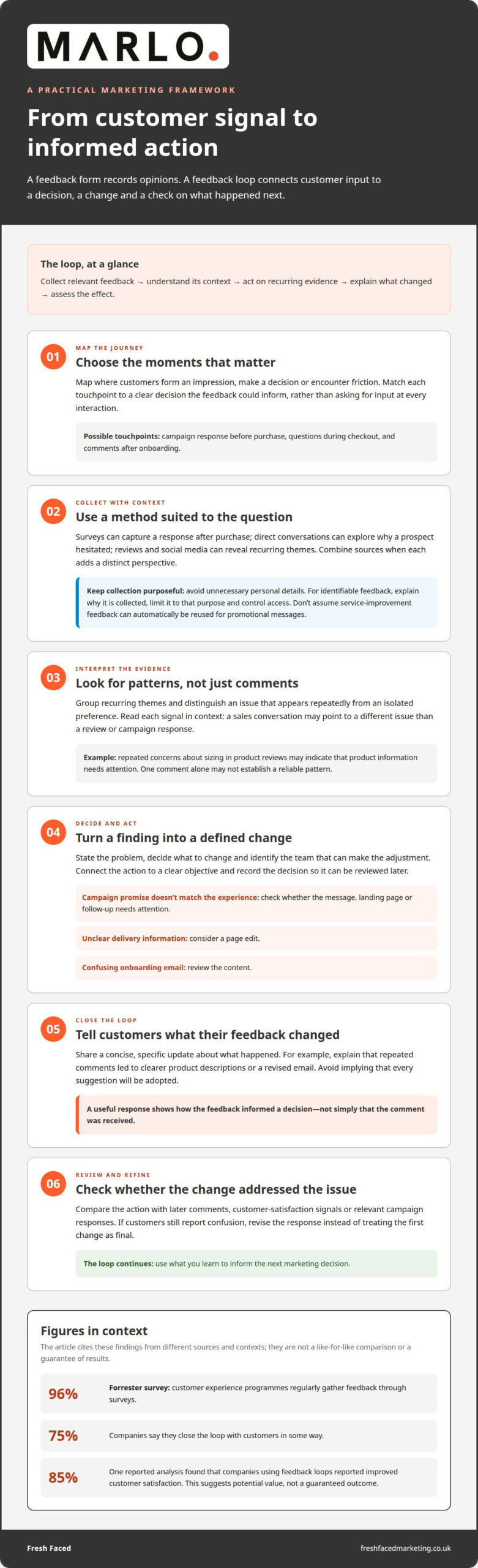
A feedback form is not a feedback loop. Building a marketing feedback loop means collecting customer input across the journey, analysing patterns, acting on what the evidence shows and communicating what changed. Without action and communication, feedback is only a record of opinion.
It’s easy to gather comments and survey responses. The harder part is connecting them to the moments that shape a customer’s experience, then deciding what to address. Feedback from a sales conversation may point to a different issue than a review or a response to a campaign. Each signal needs context before it can guide a marketing decision.
This guide explains how to collect feedback at relevant stages of the customer journey, organise and interpret responses, turn findings into practical changes, and close the loop with clear communication. You’ll also learn how to track whether those changes help, so feedback informs the next decision instead of sitting in a report.
Key Takeaways
- Close the loop by explaining how customer input shaped a decision, not just by collecting comments.
- Choose feedback channels that fit each stage of the customer journey and the way people prefer to respond.
- Group recurring themes and distinguish isolated comments from issues that warrant action.
- Connect each change to a clear objective and relevant measures, so its effect can be assessed.
- Review the process regularly to keep feedback useful as customer needs and business priorities change.
What is a feedback loop?
A customer feedback loop gathers and analyses feedback, then uses the findings to improve decisions. Building a marketing feedback loop means completing that cycle, not simply collecting responses.
-
Define the customer feedback loop
Map the process from a customer’s first comment to the decision it informs. For example, a retailer might collect product reviews, identify recurring concerns about sizing, and assess whether product information needs improvement. A useful loop connects evidence to a specific action and a way to assess its effect. Don’t treat every individual comment as a reliable pattern.
Use the cycle to identify friction, clarify customer needs, and guide improvements to products, services, or processes. One reported analysis found that 85% of companies using feedback loops reported improved customer satisfaction. That figure suggests potential value, not a guaranteed result for every business. The benefit depends on interpreting feedback accurately and acting on relevant findings.
-
Turn customer insights into changes
Turn a recurring insight into a clearly defined change. If customers say a campaign promise doesn’t match the service they receive, compare the advertisement with the actual customer journey. Then identify whether the message, landing page, or follow-up needs attention. This ties the response to evidence instead of prompting a broad, unfocused marketing rewrite.
Before implementing a change, define the problem and what you intend to do about it. Separate a recurring issue from an isolated preference, and identify which team can make the adjustment. For example, unclear delivery information may call for a page edit, while a confusing onboarding email needs a content review. Record the decision so you can connect the change with later customer responses.
-
Close the loop to improve satisfaction
Tell customers what happened after they shared feedback. A concise update might explain that repeated comments led to clearer product descriptions or a revised email. Keep the message specific to the issue raised; avoid claiming that every suggestion will be adopted. About 75% of companies say they close the loop with customers in some way, but a useful response should show what the feedback changed.
Then assess whether the change addressed the original problem. Review later comments, customer satisfaction signals, or relevant campaign responses. If customers still report confusion, revise the action instead of treating the first change as final. Closing the loop connects feedback with improvement: customers see a response, and the business gains further evidence for its next decision.
Collecting feedback throughout the customer journey
A marketing professional maps feedback to the customer’s stage and chooses a suitable collection method for each touchpoint. Under UK GDPR, treat identifiable feedback as personal data: explain why you collect it, limit collection to that purpose, and control access. Don’t assume feedback gathered for service improvement can automatically be reused for promotional messages.
-
How a marketing professional maps feedback across the customer journey
Map the points where customers form an impression, make a decision, or encounter friction. A professional might examine campaign responses before purchase, questions during checkout, and comments after onboarding. Match each request to a clear decision it can inform. Avoid asking for feedback at every interaction, which can interrupt the experience and generate repeated answers with little context.
Connect each touchpoint to a relevant measure. For example, feedback after a landing-page visit can show whether the offer matched the advertisement. A post-purchase response can reveal confusion about delivery information. This journey map helps the team see where the customer experience breaks down, rather than treating every comment as an unrelated event.
-
How a marketing professional chooses feedback sources and collection methods
Choose feedback sources that suit the customer and the question. A short survey can capture a response after purchase; direct conversations can clarify why a prospect hesitated; reviews and social media can reveal recurring themes without a formal prompt. Combine channels only when each adds a distinct perspective. Aim for useful coverage, not the largest possible volume.
A Forrester survey found that 96% of customer experience programmes regularly gather feedback through surveys. Surveys are common, but they don’t explain every behaviour. A professional can pair survey responses with user testing or social listening, then compare the findings. For instance, survey comments about confusing campaign language can be assessed alongside customer reactions to the same message on social platforms.
-
How a marketing professional automates feedback collection
Automate requests around meaningful customer actions, such as completing a purchase or finishing onboarding. A professional can trigger a relevant prompt after that milestone, route responses to the right team, and tag them by journey stage. Keep the request brief and easy to complete. A badly timed automated survey can still disrupt the customer experience.
Review triggers and responses regularly. If an email request arrives before a customer has used the service, the answers may reflect expectations rather than experience. Automation can make collection continuous, but it can’t determine whether a response is representative or what change it warrants. Human review is still necessary to interpret comments and identify context.
-
Apply UK GDPR rules to feedback collection
Design each collection point around a clear purpose. Explain how you’ll use feedback, avoid requesting unnecessary personal details, and limit access to people who need the responses. For example, an anonymous survey about campaign clarity may not need contact details. Keep service research distinct from promotional use, and don’t use responses more broadly without an appropriate basis.
Review the whole journey, including survey wording, storage, access, and any later marketing use. If a response identifies a customer, handle it accordingly rather than treating it as anonymous opinion. Where feedback findings need to inform priorities across channels, a structured marketing strategy can connect those insights to practical decisions.
Feedback collection, analysis, action and communication
Use a shared process to collect responses, analyse patterns, assign actions, and report outcomes. Survey platforms capture direct answers, while text analytics help organise open comments. Neither replaces human judgement.
-
How a marketing professional centralises feedback data
Bring survey responses, reviews, social comments, and sales notes into a consistent reporting view. Tag each entry by source, journey stage, date, and issue so recurring complaints can be traced across channels. Keep the original wording available: a summary alone can strip out context or make different problems appear identical.
Separate structured answers, such as rating selections, from unstructured comments. In one cited survey, 67% felt their organisations effectively analysed structured feedback, compared with 50% for open-ended comments. A shared view makes gaps easier to identify, but access should remain limited to relevant team members.
-
How a marketing professional analyses and prioritises feedback
Group responses by theme, then compare frequency, customer impact, and the journey stage involved. For example, repeated difficulty finding a campaign offer may justify a landing-page review, whilst one unrelated preference may not. A team described escalating an issue when 6 out of 10 people mentioned the same workflow friction. Treat that as an example, not a universal threshold.
Text analytics, AI, or robust tagging can help organise large sets of comments. These tools can surface repeated terms and topics, but a person should assess tone, context, and whether comments describe the same issue. Don’t let automated labels determine priorities without review. Analysis should suggest a testable action, not just produce a report of themes.
-
How a marketing professional takes action on feedback and communicates outcomes
Assign each priority to a team and define a specific change. If customers repeatedly misunderstand an email offer, the marketing team might revise the wording and compare later responses. Keep the task focused on the problem: “improve marketing” gives no clear action or way to assess its effect.
Communicate the decision to relevant teams, then tell customers what changed when a response is appropriate. A business can explain that comments prompted clearer campaign information without claiming it adopted every suggestion. Address urgent customer issues promptly, and use follow-up feedback to assess whether the change resolved the original concern.
-
How a marketing professional selects tools and software for feedback loops
Choose tools based on the task they support. Survey software gathers structured answers; review or social monitoring helps collect public comments; analytics tools connect behaviour with marketing outcomes. A central reporting view supports comparison, while text analytics can organise large volumes of written feedback. These functions may sit in separate tools or a connected system.
Compare options against your workflow: collection, tagging, reporting, access, and hand-off to the team responsible for action. A tool that gathers responses but can’t make patterns useful may create another data silo. For large comment sets, text analytics or AI-assisted tagging can reduce manual sorting, but staff still need to interpret findings and decide what to implement.
What is the customer feedback system?
A feedback system connects customer input to measurable marketing objectives. Its metrics help teams assess changes, learn from results, and refine decisions.
-
How a marketing professional assesses the impact of feedback
Choose a KPI that matches the change you’re assessing. If feedback suggests a landing page causes confusion, measure its conversion rate alongside relevant customer responses. If the change concerns email content, compare engagement measures tied to that campaign. Connect each intervention to an observable outcome instead of treating every available analytics figure as evidence of impact.
Define the objective before implementation, then record the starting position and the measure you’ll use. A tracking document can link the change, its date, and subsequent results. For example, a team testing clearer campaign wording can record which version ran and compare relevant responses. This makes the reasoning visible and helps distinguish an observed shift from an assumption about its cause.
Use a small set of relevant metrics. A dashboard crowded with unrelated figures can obscure the signal. Choose measures that reflect the intended result, such as sign-ups for a lead-generation change or completed purchases for a checkout improvement. Feedback can explain why a metric moved, while the metric shows whether the change aligned with the objective.
-
How a marketing professional measures results and iterates
Review results against the original objective, then decide whether to retain, revise, or stop the change. For example, if clearer product messaging increases engagement but doesn’t improve the intended next action, investigate where the journey still creates friction. Don’t call a change successful based on one favourable measure when the objective depends on a different outcome.
Use consistent definitions and reporting periods when comparing results. Otherwise, measurement differences can be mistaken for genuine progress. A regular review should record the change, evidence, interpretation, and next decision. This helps colleagues understand why an adjustment was made and keeps repeated tests connected to their context.
Keep iteration tied to customer evidence. If later responses continue to identify the same issue, refine the intervention or test another explanation. If relevant measures move in the intended direction, keep monitoring them rather than assuming the work is complete. Feedback loops remain useful when each review informs a clear next step, not simply another report.
Net Promoter Score is one possible measure: customers rate how likely they are to recommend a product on a scale from 1 to 10. Treat that score as one signal, not a complete account of customer satisfaction. Pair it with the objective’s behavioural metrics and relevant comments to understand what changed and what the next iteration should address.
Feedback loop definition and business purpose
A feedback loop is a business practice that turns customer evidence into decisions, then uses new evidence to assess those decisions. Its purpose extends beyond satisfaction: it can expose process friction, reduce wasted effort, and identify opportunities for testing.
- Start with a business decision, not a collection target. Define what customer input should help your team decide, such as whether a campaign promise matches the service customers receive. A clear objective gives each response a purpose and makes irrelevant information easier to recognise.
Set the intended outcome before gathering evidence. For example, a team investigating abandoned enquiries might aim to identify where prospective customers encounter friction. Don’t define success as “collect more feedback”. That measures activity, not whether insight changes a business decision or customer experience.
- Use feedback to locate bottlenecks in a process. A customer who repeatedly can’t find the next step on a service page may reveal a communication problem, not a lack of demand. Trace the issue through the relevant journey and identify where the experience breaks down.
Then distinguish the underlying problem from its symptoms. If customers ask the same question after reading a campaign, the wording may be unclear, or the page may omit key information. Diagnose the cause before deciding what to change. Otherwise, a business might add more content while leaving the original obstacle in place.
- Turn a supported insight into a focused experiment. If customer comments suggest an offer is difficult to understand, test a clearer version against the existing message. Specify what will change and what evidence will inform the next decision. This makes feedback a driver of learning, not a reason to launch an unmeasured change.
Use the result to decide whether to refine, retain, or discard the test. For instance, if clearer wording addresses the question but customers still hesitate, investigate another point in the journey. Feedback-driven experiments can generate ideas and reveal opportunities, but each test should address a defined business problem.
- Make review part of the team’s routine. At each review, connect the customer issue, the decision, and the evidence gathered after action. This record helps marketing, sales, and service teams understand how a change affects their work, rather than treating feedback as a report owned by one department.
The central takeaway is practical: feedback has business value when it changes what the organisation does and informs what happens next. A structured marketing strategy can help connect customer insights with wider priorities. Discuss a strategy for turning evidence into action.
Fresh Faced
Fresh Faced can help when customer feedback is difficult to connect with wider marketing priorities or turn into a coherent plan. The Marketing Success Blueprint (MSB) combines human-led analysis with a detailed execution blueprint, helping teams identify priorities and decide what to do next. When the strategy needs to be carried through, Full Marketing Strategy Execution takes recommendations into implementation.
This support is most relevant when feedback spans several channels, teams, or customer journey stages, and the next actions need clearer direction. If your process is already working and your team can interpret and act on the evidence, you may not need additional strategic support. Contact Fresh Faced to discuss how customer insight could inform your marketing strategy.
Make customer insight part of the next decision
Building a marketing feedback loop is less a one-off project than a way to make customer evidence part of everyday decisions. Give the process a clear owner, a regular review point, and a record of decisions. This helps keep useful feedback from becoming an archive no one acts on.
Keep the system open to revision. A new offer, channel, or customer expectation can change which signals matter. Review whether your questions still capture useful experiences, teams can act on findings, and measures reflect the original objective. Then adjust the process accordingly.
Fresh Faced can help you decide how customer insight fits your wider marketing direction and execution. If you’re ready to discuss the next step for your organisation, talk through your marketing priorities with Fresh Faced.
With clear ownership and thoughtful review, customer feedback can continue to inform decisions as your business develops. Start with the next decision you need to make, then shape a process that keeps evidence connected to action.
Frequently Asked Questions
What is a marketing feedback loop?
A marketing feedback loop links customer responses to decisions about campaigns and customer experience. For example, if prospects repeatedly misunderstand an offer, a marketing team can examine the message and landing page, then assess whether revised wording addresses the confusion. New responses inform the next decision and continue the loop. Its value lies in making customer evidence useful to marketing, rather than treating comments as a separate archive.
What steps does a marketing professional take to build a marketing feedback loop?
A marketing professional starts by agreeing what decision feedback should inform and who owns the response. They select relevant touchpoints, collect responses, organise themes, prioritise issues, and assign appropriate actions. For example, feedback about a confusing email might go to the campaign owner, while recurring questions about a service page may need another team’s input. The professional records outcomes so future reviews can assess what happened.
Which customer feedback channels are most useful for marketing?
The most useful channel depends on the customer’s context and the insight needed. Surveys can capture a direct response after an interaction, while sales conversations may uncover why a prospect hesitated. Reviews and social comments can show how customers describe their experience without a formal prompt. Comparing these sources can reveal whether the same issue appears in different settings, rather than relying on one channel alone.
What marketing metrics and customer insights should be tracked?
Track metrics that match the decision being assessed, such as campaign engagement for a messaging change or completed purchases for a checkout improvement. Pair those figures with customer explanations, including repeated questions, stated barriers, and reasons for choosing an offer. For instance, a rise in email clicks may not explain why enquiries remain unchanged. Looking at both behaviour and comments gives the team more context for interpreting results.
How do marketing professionals collect, analyse and act on marketing feedback?
Professionals collect responses through suitable channels, label them by source and journey stage, then group comments into useful themes. They assess whether a pattern relates to a specific campaign, page, or customer interaction. A practical next step might be testing a clearer call to action when customers repeatedly misunderstand what happens after clicking. The team records the change and communicates relevant outcomes to colleagues and customers.
How often should a marketing professional review feedback and update campaigns?
Set a review rhythm that fits the campaign’s pace and the volume of relevant feedback. A sales team’s regular feedback session can surface recurring objections, while urgent customer issues need attention sooner. Review campaign-specific responses when there’s enough context to interpret them, rather than changing a message after every individual comment. Revisit the process when an offer, audience, or customer journey changes.
How can marketing feedback loops be measured for ROI and conversion improvements?
Connect a feedback-driven change to a defined business outcome, then compare the relevant measure before and after implementation. For a revised landing page, that might include conversion activity alongside comments about clarity. Record other campaign changes or external factors that could affect results. This makes the assessment more credible and helps teams judge whether the feedback-informed adjustment contributed to progress, without treating timing alone as proof of cause.
What are common mistakes and risks when building a marketing feedback loop?
Common mistakes include collecting responses without a decision in mind, treating isolated comments as a general pattern, and using automation without reviewing context. Asking for feedback at too many touchpoints can also create friction or disengagement. For example, a survey sent before customers have used a service may capture expectations rather than experience. Limit requests to useful moments, explain how you’ll use responses, and involve people in interpreting findings.