More marketing activity doesn’t automatically create a stronger market position. B2B marketing promotes products or services to other businesses, where buying decisions often involve multiple stakeholders and longer sales cycles. A B2B marketing strategy consultancy helps align campaigns, channels and internal teams with business goals, buyer behaviour and market positioning.
That alignment matters. Buyers need relevant information as they research and evaluate options, and marketing should support the organisation’s wider objectives. When campaigns, sales activity and market insight operate in isolation, it becomes harder to make a consistent case for choosing your business.
This article explains what B2B marketing involves and how consultancy can bring greater direction to it. You’ll learn how strategy connects measurable outcomes to buyer needs, uses competitor research to clarify positioning, and coordinates campaigns and channels around a coherent plan.
Key Takeaways
- Connect campaign activity across marketing, sales and other teams so buyers receive a coherent experience.
- Set measurable marketing outcomes that support wider business objectives, not just channel-level activity.
- Use market insight to sharpen your positioning and focus brand activity on the channels your audience uses.
- Plan for buying groups with different needs, roles and information requirements throughout the decision process.
- Use competitor research to identify market gaps and build a clearer strategic direction for growth.
Integrating campaigns, channels and internal teams
Integrated B2B marketing connects audience insight, campaign delivery and internal responsibilities. A strategy clarifies what each channel contributes, how teams coordinate and which results guide adjustments.
Content Marketing and Channel Selection
Content marketing gives buyers useful information as they move from recognising a problem to evaluating solutions. A consultancy maps each format to an audience need and an appropriate channel. For example, a technical guide can support detailed evaluation, while a concise LinkedIn post can direct relevant readers to it. The right choice depends on buyer behaviour, content purpose, available resources and performance evidence.
Channel selection should reflect how buyers discover, consume and share information. A website, email, industry blog, social media and offline materials can each play a distinct role. A consultancy assesses whether a channel reaches the intended audience and supports a defined objective. It then considers how performance data can guide future activity, rather than treating a channel’s presence as proof of effectiveness.
Flexible Channel-Agnostic Strategy
A channel-agnostic strategy starts with business goals and buyer needs, not a fixed preference for a platform. The consultancy recommends channels based on their role, audience fit and available evidence. If a campaign underperforms, the team can revise its message, format or distribution. This approach also helps marketing, sales and customer success coordinate around shared priorities.
Flexibility matters when market demands or internal resources change. A strategy should set clear actions and review points so teams can adjust delivery without losing sight of the objective. For example, a new product priority may require sales and marketing to update campaign messages together. Connected data, content systems and campaign planning help those changes reach relevant teams and buyers consistently.
How do you choose a B2B marketing strategy consultancy? Compare its research process, strategic deliverables and approach to aligning channels with business goals. Ask how recommendations will account for your audience, team capacity and campaign performance.
How much does a B2B marketing strategy consultant cost in the UK? Fees depend on project scope, research depth, deliverables and whether implementation is included; the price is given after a quote request.
Which UK B2B marketing strategy consultancies are highly rated? Ratings vary by review platform and project fit. Assess client feedback alongside evidence of strategic work, clear deliverables and an approach that connects marketing activity to business objectives.
B2B advertising should also be selected by purpose, not habit. A consultancy considers whether paid activity can reach the intended audience, support a campaign objective and complement other channels. It may assess search advertising for active demand or social advertising for targeted awareness. The recommendation should explain how the channel fits the wider plan and how its contribution will be assessed.
Setting measurable outcomes aligned with business objectives
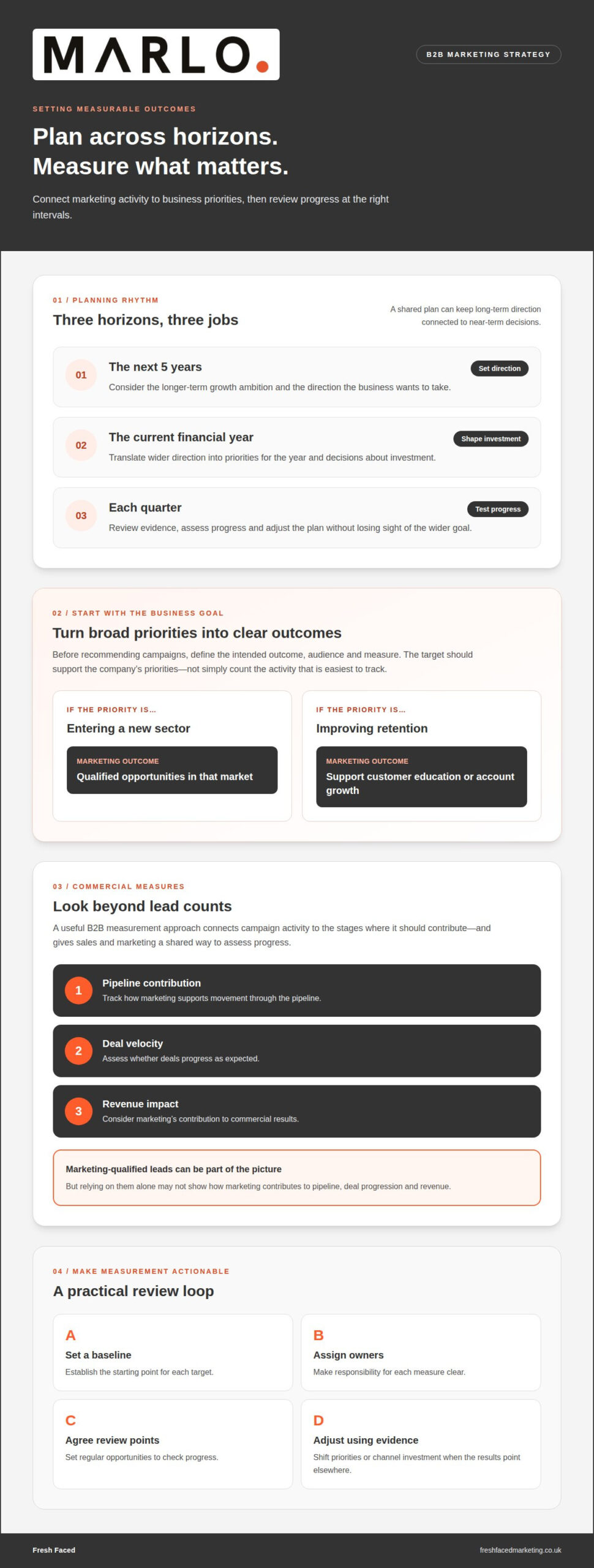
A useful marketing target connects activity to a business result. That might mean stronger pipeline contribution, faster deal progression or revenue growth. The measure must reflect the company’s priorities, not simply the easiest activity to count. A B2B strategy therefore turns broad ambitions into defined outcomes, owners and review points.
Planning works across different time horizons. A collaborative strategy process can consider growth over the next 5 years, the current financial year and each quarter. These periods serve different purposes: the longer view sets direction, the financial year shapes investment, and quarterly reviews test progress. Together, they help teams adjust plans without losing sight of the wider goal.
Start by connecting each marketing objective to a company objective. If the business aims to enter a new sector, marketing might focus on qualified opportunities in that market. If retention is a priority, activity could support customer education or account growth. Before recommending campaigns, the consultancy should define the intended outcome, audience and measure. This keeps the target relevant to the business plan.
Revenue and pipeline goals need more than a lead target. Modern B2B teams increasingly measure pipeline, deal velocity and revenue impact, rather than relying only on marketing-qualified leads. A consultancy can map campaign activity to the stages where it should contribute, then agree how sales and marketing will assess progression. This makes the marketing engine accountable to commercial outcomes, while recognising that B2B sales cycles can take time.
Marketing also needs to fit the go-to-market strategy, which defines the audiences the business serves, what it offers and how it reaches them. For example, a business entering a new market may need evidence-building content and sales materials before demand generation can meaningfully affect pipeline. Marketing, sales and product teams should align messages, timing and responsibilities with the market approach.
Measurement is useful when teams can act on it. A consultancy can establish a baseline, assign owners and set regular review points for each target. At a quarterly review, teams can examine whether campaigns support pipeline movement, whether deals progress as expected and whether revenue contribution matches the plan. If the evidence points elsewhere, the strategy can shift priorities or channel investment.
Risks when hiring a marketing consultancy include vague deliverables, targets disconnected from business goals and recommendations beyond internal capacity. Reduce these risks by agreeing on outcomes, responsibilities, reporting measures and review points before work begins.
Market insight, brand and social media strategy
Market insight helps a B2B team decide which position it can credibly own. A consultancy examines buyer needs, competitor messages and market gaps, then connects those findings to brand and demand generation. For example, if buyers struggle to compare complex services, a business can make its evaluation criteria clearer across its website, sales materials and campaigns.
Brand building and demand generation have different jobs, but should reinforce each other. Brand activity builds recognition and understanding over time; demand generation gives interested buyers useful reasons to act. A consultancy can define the audience, core message and evidence behind the offer, then map them to stages such as awareness, research and evaluation. This helps the business maintain a consistent position from first impression to sales conversation.
A B2B brand strategy is not the same as creative design production. Strategy defines what the brand needs to communicate, which audiences it serves and how it should be distinguished. Creative work translates those decisions into materials such as a website, presentation or campaign asset—often executed by digital marketing and graphic design specialists such as Och Marketing. Clear strategic direction helps designers create consistent work, while avoiding the assumption that graphic design alone can solve a positioning problem.
A social media strategy should start with audience behaviour and a clear business purpose. LinkedIn may suit professional discussion, expertise-led content and useful company insights. Other channels may suit different buyer groups or formats. A consultancy can assess where the intended audience engages, what content supports their decisions and how social activity fits wider campaigns. Measures should reflect meaningful engagement and business objectives, not simply views or follower growth.
Market insight also helps balance brand consistency with audience relevance. A company can retain one clear position while adapting examples for different sectors. For instance, a software provider might explain the same core benefit through different operational challenges for finance and manufacturing buyers. The message stays recognisable, while the supporting evidence reflects each audience’s context.
A B2B marketing consultancy brings focused strategic analysis; an in-house team contributes day-to-day company knowledge and implementation. A general marketing agency may cover broader activity, whilst a specialist consultancy concentrates on B2B buyers, positioning and commercial alignment. The right model depends on the gap: direction, internal capacity or specialist expertise. For organisations seeking strategic direction without hiring full-time executives, firms such as monkeybox.media provide fractional CMO leadership and go-to-market planning.
To assess a strategy, trace one buyer problem through the brand promise, a content example, a social channel and the sales conversation. If those elements describe different benefits, clarify the positioning. If they reinforce the same evidence-led message, the brand can build recognition while campaigns generate relevant demand.
Changing B2B buyer behaviour and buying groups
B2B buying often involves longer decisions, multiple stakeholders and internal approvals. A useful marketing plan reflects how each buyer researches, evaluates and discusses options.
Market and Buyer Research
Research should identify the audience’s business challenges, purchasing habits, preferred channels and information needs. A consultancy can compare those findings with market positioning to clarify which messages address genuine buyer concerns. For example, a finance lead and an operational manager may assess the same software differently. Understanding both perspectives helps shape consistent messaging without treating the buying group as one person.
Buying decisions commonly involve an average of 13 stakeholders from multiple departments. That makes role-specific insight valuable. A technical evaluator may need implementation detail, whilst a budget holder may focus on return on investment. Research can also examine how buyers gather information and what questions arise during approvals. These findings help marketing and sales prepare relevant evidence for different participants.
Buyer Journey Stages
The B2B buyer journey can include awareness, research, evaluation, decision and post-purchase growth. Each stage calls for a different kind of support. An awareness-stage buyer may need a clear explanation of the problem; someone evaluating suppliers may need proof, comparisons and practical detail. A marketing plan should connect content and channels to these needs, then support the relationship after purchase.
Longer buying cycles make timing and continuity important. B2B sales cycles can last weeks or months, and sometimes years. Buyers may review information, consult colleagues and move between stages before deciding. A consultancy can map messages to these moments, so a campaign doesn’t rely on one contact or one interaction. Marketing and sales can then coordinate follow-up around the buyer’s questions and progress.
Buying groups also extend beyond the people employed by the potential customer. In a recent Forrester survey, 30% of Millennial and Gen Z buyers said they include 10 or more external influencers in their buying processes. This gives marketers another reason to make claims clear and evidence accessible. A decision-maker may need to share material with colleagues or advisers who haven’t seen earlier campaigns.
Changing behaviour can also affect where buyers seek information. Nine in 10 business buyers already use generative AI at each stage of the buying process. Marketing teams should therefore review whether their expertise, evidence and explanations remain easy to find and understand. The focus is not on chasing every new format. It is on giving buying groups useful, consistent information as they assess risk, value and fit.
After a decision, customer success and marketing can support retention, account growth and advocacy by delivering consistent value. A post-purchase plan might share relevant guidance, help customers realise the promised value and identify suitable opportunities for further discussion. This connects buyer insight with ongoing customer needs.
Competitor research and market positioning
Competitor research is useful when it shows where your business can compete, not simply who else operates in your sector. A consultancy examines how alternatives describe their offers, which buyers they target and what evidence supports their claims. The aim is to turn observations into a defensible market position and practical actions.
Start by defining the competitive set. Direct competitors sell comparable solutions to similar buyers; indirect alternatives may solve the same problem differently. For example, a specialist consultancy could compete with an in-house team or a software platform. Comparing only businesses with identical services can overlook the options buyers actually consider.
Next, compare competitors using consistent criteria: audience, proposition, proof, content and channels. Their websites can reveal how they frame buyer problems and explain value. Search visibility can show which topics attract attention, while social content can indicate how they engage professional audiences. These observations reveal patterns, but do not establish why a competitor performs well.
That distinction matters. A competitor’s prominent message may reflect its resources, reputation or customer base, rather than a position your business should copy. A consultancy tests each observation against your capabilities, customer insight and commercial priorities. For example, if rivals emphasise breadth, a business with deeper expertise in one sector might position itself around specialist knowledge.
Market positioning should make three things clear: who the business serves, which problem it addresses and why its approach is relevant. The promise must be supported by evidence. If a company claims to simplify a complex process, its case studies, service explanation and sales materials should show how that benefits buyers. Clear proof makes differentiation more credible.
Research becomes valuable when it leads to decisions. A consultant can translate findings into actions such as refining the offer, prioritising an underserved audience or addressing a content gap. Each action needs an owner and a place in the marketing plan. Otherwise, competitor analysis risks becoming a collection of observations without strategic impact.
A useful consultancy partner should explain its research method, distinguish evidence from interpretation and show how findings inform recommendations. Ask how it will assess direct and indirect competitors, connect the analysis to your capabilities and turn conclusions into an executable plan. The quality of the work depends on that chain, from market evidence to decisions your team can deliver.
Competitor research cannot guarantee a particular market position or commercial result. It can, however, help your team make better-informed choices about where to focus and what to communicate. Explore a strategy grounded in competitor insight when your next step is turning market evidence into a clear direction.
Fresh Faced
Fresh Faced helps growing teams turn market and competitor insight into a clear B2B marketing direction. When campaigns lack a shared rationale, buyer priorities are shifting or the team needs a plan it can implement, its work can connect research, positioning and business objectives.
MARLO is the software that provides market and competitor analysis. The Marketing Success Blueprint (MSB) is the premium, human-led service, adding strategic interrogation of the data and a detailed execution blueprint. Each offers a different route from evidence to decisions, depending on the support your business needs.
If you’d like to discuss your marketing priorities, contact Fresh Faced.
Turn the strategy into your next decision
The value of a B2B marketing strategy consultancy is not a plan that sits untouched after delivery. It is a basis for making better decisions as priorities, buyer needs and market conditions shift. Give the strategy an owner, agree how decisions will be reviewed, and make sure the people responsible for delivery can act on its recommendations.
Before launching the next initiative, clarify what would prompt you to continue, adjust or stop it. That decision rule helps teams respond to evidence without losing sight of the business direction. It also clarifies responsibility: the strategy informs the choice, and the team knows what happens next.
If you’re ready to discuss how a more joined-up strategy could support your team, contact Fresh Faced. A clear next step can help turn uncertainty into considered action.
Frequently Asked Questions
What is B2B marketing?
B2B marketing is the work of helping one business understand and choose another business’s products or services. For example, a cybersecurity provider might publish a practical guide for IT leaders, then equip its sales team to discuss the risks and solution. The marketing must address organisational needs and the people involved in the decision, rather than treating the purchase like an individual consumer choice.
What Are B2B Marketing Competencies, And How Do They Drive Performance?
B2B marketing competencies are the capabilities a team uses to understand its market, communicate value and assess commercial impact. They can include customer research, positioning, content planning, campaign measurement and collaboration with sales. For example, a team that can analyse why qualified opportunities stall can refine its evidence or messaging. The result is more informed action, rather than simply increasing activity across channels.
What are B2B consulting services?
B2B consulting services provide specialist advice or practical support to organisations selling to other businesses. The scope may include strategic research, operating model advice, customer experience or marketing planning. A marketing consultancy focuses on the marketing questions: which audiences matter, how the offer should be positioned, and what activity supports business goals. The exact work depends on the organisation’s needs and the consultancy’s services.
What does building an effective B2B strategy mean for your business?
It means making deliberate choices about where the business will compete and how it will reach the right buyers. A strategy can help leaders decide which market opportunities fit their capabilities, which messages to prioritise and what work should wait. For example, a firm with limited delivery capacity might focus on a defined customer segment before expanding its reach. The plan should guide real decisions, not sit unused.
Why is B2B strategy for industries important?
Industry context shapes what buyers value, how they assess risk and what evidence supports a purchase. A healthcare supplier, for instance, may face different buyer concerns from a professional training provider. Industry understanding helps a business develop relevant examples, language and proof. It also prevents a generic campaign from overlooking the commercial realities that affect buyer confidence and internal approval.
What does a B2B marketing strategy consultancy do?
A B2B marketing strategy consultancy investigates a business’s market, audience and commercial priorities, then turns findings into strategic recommendations. It can help clarify positioning, identify priorities and set out how marketing should support growth. A useful output connects strategic choices to achievable actions, ownership and measures. The consultancy’s role is to bring structure and specialist analysis, not simply to recommend more campaigns.
What services do UK B2B marketing strategy consultancies offer?
Services vary, so the scope should match the business need. Fresh Faced offers MARLO, its competitor-analysis software, and the Marketing Success Blueprint (MSB), its premium, human-led service. MARLO provides market and competitor insight, while MSB adds human-led strategic analysis and a detailed execution blueprint. The right route depends on whether the priority is insight or a considered, human-led plan.
What steps does a B2B marketing strategy consultancy take to develop a marketing strategy?
A consultancy typically starts by clarifying the business challenge and the decisions the strategy must inform. It then investigates the market, customer needs and competitive position before translating findings into priorities, recommendations and measures. The final work should specify next steps, responsibilities and how progress will be reviewed. For example, a market-entry strategy should connect its target audience to the offer and planned route to market.