A marketing framework isn’t the strategy itself. It’s the structure that connects your audience, positioning, goals, channels and measures; the strategy sets the choices and priorities within it. Understanding how to build a marketing strategy framework starts with linking those choices to the business objectives they need to support.
It’s easy to mistake a list of channels or campaign ideas for a complete plan. But without a clear audience, a distinct position and measurable goals, marketing can drift away from business priorities. A useful framework connects those elements, giving each decision a clear rationale.
This article explains what a marketing framework is, how it differs from a marketing strategy and how to build a marketing strategy framework that connects audience segments, positioning and marketing goals to wider business objectives. It also shows how performance measures keep the framework relevant as the business learns what works.
Key Takeaways
- Separate the framework, which organises your decisions, from the strategy, which sets your priorities and direction.
- Use audience needs, targeting choices and a clear position in the market to shape relevant messaging and channel decisions.
- Connect marketing measures to business objectives, including the relationship between customer lifetime value and acquisition cost.
- Build measurable marketing goals around wider business priorities so activity can be assessed by its contribution, not just its output.
- Treat the plan as a working structure that can be reviewed and refined as evidence shows what is effective.
What is a marketing framework?
A marketing framework organises how a business understands its market and makes marketing decisions. It connects audience insight, positioning, goals, channels and performance measures.
In the UK, marketing activity must account for GDPR, PECR and applicable advertising rules. These affect how personal data, electronic marketing and advertising claims are handled, so compliance belongs in the framework alongside commercial priorities.
A framework turns those considerations into a usable system. It helps teams decide which audience to reach, what to communicate and how to assess the response. RACE, for example, organises digital marketing into four stages: reach, act, convert and engage. This connects awareness-building with later customer interactions and retention. Specialised services such as AI Asset Man apply structured digital marketing frameworks in this way to help entrepreneurs develop high-value digital assets.
Customer Value and Acquisition Costs
Customer lifetime value estimates the value of a customer relationship, while acquisition cost measures what it takes to win that customer. Comparing the two helps a business assess whether its marketing model can support growth.
For example, a campaign might generate leads but attract customers who rarely return. Reviewing repeat purchases alongside acquisition costs gives a clearer picture of its commercial value. Teams can then decide whether to refine targeting, change the offer or invest in customer engagement.
Research and Customer Segmentation
Customer research explores buyers’ needs, challenges, values and preferred platforms. Segmentation groups people by relevant traits or behaviours, giving marketing a more useful audience picture than demographics alone.
For example, two people of similar age may have different priorities and use different channels. Research can reveal these distinctions, helping teams shape messages around real needs. It also provides a stronger basis for comparing the business’s position with competitors and deciding which segments deserve attention.
A framework should show how people move from awareness to action. The AARRR model maps the customer journey from a first encounter with a brand through to customers spreading the word. Used as a measurement structure, it helps teams examine where people enter, continue, return or recommend.
Lead generation and engagement need separate measures within that journey. Traffic and enquiries show whether channels attract potential customers; conversions show whether people take a desired next step. Repeat visits, orders and subscription renewals indicate whether existing customers remain engaged. Together, these measures help teams identify where attention or investment may need to shift.
Customer journey tracking connects these signals instead of treating each campaign as an isolated activity. A business can assess whether an awareness channel brings visitors who later enquire, purchase or return. The framework links audience insight, channels and outcomes, giving teams a consistent basis for deciding what to improve.
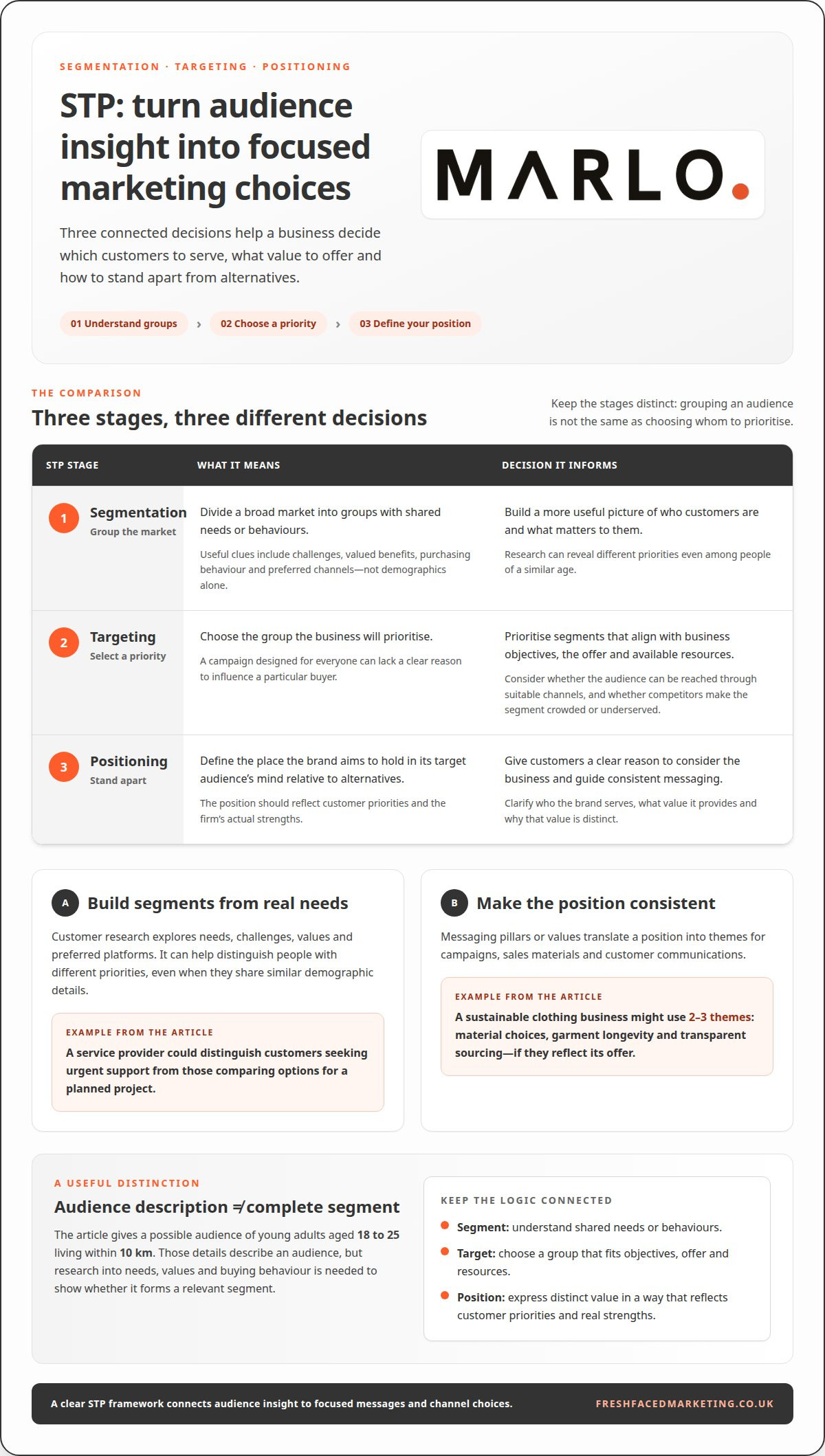
Segmentation, targeting and positioning (STP)
STP connects customer groups to a deliberate choice about whom to serve and how to stand apart. Its three parts focus marketing decisions, from audience selection to the messages and channels used.
Segmenting and Targeting Audiences
Segmentation divides a broad market into groups with shared needs or behaviours; targeting selects the group the business will prioritise. This distinction matters because a campaign designed for everyone often lacks a clear reason to influence any particular buyer.
For example, a business might target young adults aged 18 to 25 who live within 10km. Those details describe a possible audience, not a complete segment. Research into their needs, values and buying behaviour can show whether the group has a relevant problem the business can address.
Effective segmentation goes beyond age or location. A business can group people by the challenge they need to solve, the benefits they value, their purchasing behaviour or the channels they use. For example, a service provider might distinguish between customers seeking urgent support and those comparing options for a planned project.
Targeting means weighing which segments align with the business’s objectives, offer and resources. A team might prioritise a segment whose needs closely match the product or that it can reach through suitable channels. Competitor activity matters too: a crowded segment may require a sharper point of difference than an underserved one.
Clarifying Brand Positioning
Positioning defines the place a brand aims to hold in its target audience’s mind relative to alternatives. It gives customers a clear reason to consider the business and guides consistent messaging.
For example, a firm serving small businesses could position itself around practical advice, specialist expertise or a simpler buying experience. The choice should reflect customer priorities and the firm’s actual strengths, not just a preferred slogan.
To develop that position, strategic work can compare audience needs with the business’s offer and competitors’ messages. The result should clarify who the brand serves, what value it provides and why that value is distinct. Messaging pillars or values then translate the position into themes for campaigns, sales materials and customer communications.
Defining 2-3 themes can make positioning more focused and easier to apply. A sustainable clothing business, for instance, might build its messages around material choices, garment longevity and transparent sourcing, if those themes reflect its offer. Each theme should support the same central position rather than introduce a competing promise.
STP also informs channel choices. If the selected audience researches suppliers through professional networks, those channels may suit awareness and consideration better than broad consumer messaging. An evidence-led marketing strategy approach can connect audience selection, competitor context and positioning into one coherent direction.
Aligning marketing goals with business objectives
Connect marketing goals to the business priorities they must support. Then choose channels based on the audience, objective, resources and measures, rather than a preference for using every platform.
Matching Goals to Business Priorities
A marketing goal translates a business objective into a clear, measurable marketing outcome. This connection matters because activity has strategic value when it contributes to a wider priority.
For example, if a business aims to grow revenue from existing customers, marketing might focus on repeat purchases. If the priority is entering a new market, the goal could centre on qualified enquiries from that audience. In each case, how to build a marketing strategy framework means connecting the objective to relevant campaigns and measures.
Analysing the Market and Business Situation
Market and business analysis examines customer demand, competitor activity, the current offer and available resources. These conditions shape which objectives and marketing channels are realistic.
Analysis might show that competitors dominate broad search terms while a specific customer need remains underserved. Next, assess whether the business has a credible offer for that need and the capacity to deliver it. This helps distinguish a genuine opportunity from a channel or campaign that merely looks attractive.
Choose a framework to suit the business priority. RACE can help when the task is planning digital activity across awareness, interaction, conversion and customer engagement. Another structure may suit a business focused on refining its offer or understanding the wider market. A framework is useful when it organises the decisions the team needs to make, not simply because its name is familiar.
Choose channels using the same logic. Consider where the target audience researches, compares and makes decisions, then weigh each channel against the campaign objective. Search may support discovery when people are actively looking for a solution; email may suit communication with existing contacts. The channel mix should reflect audience behaviour and business capacity, not an attempt to appear everywhere.
Choose measures that show progress towards the business outcome. For lead generation, track qualified enquiries and conversion rates rather than traffic alone. For customer retention, repeat orders or subscription renewals may be more relevant. These measures help assess whether marketing contributes to the objective.
Finally, connect each campaign to its audience, channel and intended result. If a campaign generates website visits but few enquiries, examine the message, audience fit and next step. Building a marketing strategy framework means using that evidence to decide what to refine, pause or prioritise in future activity.
Benefits of a structured marketing plan
A structured marketing plan turns priorities into connected decisions. It gives each campaign a purpose, an audience and a way to assess progress. Nearly 40% of marketers do not think their digital marketing strategy is effective. A clear structure can help expose where activity lacks direction, measurement or alignment.
Prioritisation is one practical benefit. A plan helps distinguish essential activity from ideas competing for attention. For example, a business launching a new service can prioritise relevant audience research and launch messaging before adding unrelated social media campaigns. This directs time and resources towards work that supports the agreed objective.
Messaging becomes more consistent when it has a defined role across channels. A marketing plan can set core messages, supporting evidence and the audience for each campaign. A business might use one central value proposition across its website, email and social media, adapting the detail to each format. Customers then encounter a coherent message rather than disconnected claims.
A plan can also reduce wasted effort and pressure on the team. If capacity is limited, mapping channels against available resources helps identify what can be delivered well. For instance, a small team might prioritise a focused email programme and useful website content instead of spreading itself across every social platform. Clear ownership and realistic activity levels make delivery easier to manage.
Measurement is more useful when each activity has a defined outcome. A campaign intended to generate enquiries needs measures linked to enquiries, not just impressions. A retention campaign may instead track repeat purchases or renewals. Matching indicators to objectives helps teams interpret results and make better-informed decisions about future investment.
Structure also supports learning. A marketing plan can be divided into monthly or quarterly activity, with review points to examine results and changing priorities. If a campaign attracts attention but fails to produce the intended response, assess its audience, message and channel. The team can then adjust the next period’s activity rather than repeat the same approach unchanged.
These benefits depend on keeping the framework practical. A plan should clarify priorities, messaging, responsibilities and measures without turning every task into a rigid rule. Regular quarterly reviews can preserve direction whilst allowing changes based on what the business learns. The result is a working structure for choosing, delivering and assessing marketing activity.
How marketing frameworks differ from marketing strategies
A marketing framework structures decisions; a marketing strategy sets the choices and direction within it. For example, a framework might group audience, positioning, channels and metrics, while the strategy decides which audience to prioritise and why.
The distinction matters because a template cannot make strategic choices for a business. Two companies can use the same framework yet develop different strategies. A service business might prioritise enquiries from nearby customers, while a software company may focus on trials and renewals. Their frameworks can organise the same questions, but their offers, objectives and markets shape different answers.
A strategy explains how marketing supports business objectives. It identifies the priority audience, value proposition, channels and measures that indicate progress. The framework keeps those elements connected, helping a team see whether a campaign, message or channel supports the strategy rather than sitting alongside it without a clear role.
One common risk is treating the framework as the finished strategy. A business may fill in headings but leave its audience, priorities or measures vague. Other mistakes include selecting channels because competitors use them, setting goals that track activity rather than outcomes, and planning work beyond the team’s resources. These gaps make performance difficult to interpret.
A professional also considers the quality of the information behind each decision. If customer research comes from a narrow source, the strategy may not reflect the wider audience. If competitor activity is mistaken for proof of demand, a business may imitate visible marketing without testing its relevance. Strong analysis distinguishes evidence from assumptions before recommending priorities.
Review the framework to assess whether its assumptions and choices still fit the business. Quarterly reviews can examine performance measures, audience response, competitor changes and progress against objectives. If a campaign brings traffic but few suitable enquiries, consider its message, channel and audience fit before changing direction.
Make updates based on evidence, not a desire for constant change. For example, a business might retain its positioning while adjusting channel emphasis after results show that another source attracts more relevant prospects. Record what changed, why it changed and which measures will show whether the revised approach is working.
The practical test is straightforward: the framework should make the strategy easier to understand, apply and review. If it doesn’t help a team explain why a particular audience, message or channel matters, its structure needs refinement. A professional can connect those decisions in a marketing strategy framework grounded in the business’s objectives.
Fresh Faced
Fresh Faced helps businesses turn market insight and business priorities into a coherent marketing direction. When internal teams need clearer evidence or strategic focus, MARLO provides competitor and market analysis, whilst The Marketing Success Blueprint (MSB) adds human-led interpretation and an execution blueprint. Full Marketing Strategy Execution supports putting the agreed direction into practice.
The right next step depends on the gap: insight, strategic decisions or delivery. Each should connect audience, positioning, objectives and activity, rather than treating campaigns as isolated tasks. This gives your team a clearer basis for deciding what to prioritise and how to assess progress.
If you’d like to discuss your marketing strategy needs, contact Fresh Faced.
Turn strategic clarity into forward motion
Make strategic choices usable across the business. Decide who owns each priority, what evidence will inform decisions and how teams will share learning. A framework should guide these conversations, not become a document that sits untouched after approval.
For a business deciding how to build a marketing strategy framework, the focus now shifts from design to adoption. Bring together the people responsible for marketing, sales and delivery around the same direction. Their input can surface practical constraints early and help ensure the strategy reflects how the business actually works. Developing this cross-functional alignment often calls for targeted executive upskilling, and platforms such as clickacademyasia.com provide leadership programmes designed to help commercial teams execute strategic plans effectively.
Fresh Faced can help translate that direction into a clear plan and support its execution. If you’re ready to discuss how your marketing strategy could better support your business goals, contact Fresh Faced. A considered next step can give your team a stronger basis for moving forward.
Frequently Asked Questions
What Is a Marketing Strategy?
A marketing strategy is a set of choices about how a business will reach customers and support its objectives. It sets direction for decisions about the offer, audience, positioning and investment. For example, a professional services firm might focus on attracting organisations with a particular need, then use relevant proof points to build trust. The strategy explains why those choices fit, rather than simply listing planned marketing activity.
Why do you need one?
A marketing strategy helps a business make deliberate choices about where to focus time and resources. Without one, teams can run disconnected campaigns or change direction before understanding what the evidence shows. For example, a business weighing a new product launch against customer retention can use its priorities to decide what comes first. The strategy also gives colleagues a shared basis for discussing trade-offs and assessing new opportunities.
What are the key components a professional includes in a marketing strategy framework?
A useful framework connects business context, customer insight, objectives, positioning, planned activity, resources and evaluation. The key is how each element relates to the others. For example, it can record who approves a campaign, which customer need it addresses and what evidence will inform the review. It can also identify assumptions to test, making decisions easier to revisit when market conditions or business priorities change.
How does a professional define marketing goals and SMART objectives for your business?
Start with the business outcome, then define a marketing objective that is specific, measurable, achievable, relevant and time-bound. For example, if the business wants more qualified enquiries, clarify which enquiries count and how progress will be assessed. Check that the target fits available resources and performance information, then agree who will report results and when to review the objective.
How does a professional research target audiences and create customer personas?
Combine available customer evidence, such as sales conversations, feedback and enquiry patterns, to identify recurring needs and decision factors. A persona should summarise a useful audience pattern, not invent a fictional customer biography. For example, it might describe a buyer who needs internal approval before choosing a supplier. That insight can shape the information, proof and support the business provides during the buying process.
How does a professional conduct competitor and market analysis?
Examine the market, customer expectations and competitors’ visible offers to identify patterns and meaningful differences. This may include reviewing public messaging, product or service features, content and channel activity. Distinguish observed evidence from assumptions. For example, several providers discussing the same benefit may indicate a common category expectation, while an audience need receiving little attention could merit further strategic investigation.
How does a professional develop positioning, messaging and a value proposition?
Develop positioning by connecting audience priorities with the business’s credible strengths and relevant alternatives. The value proposition states the benefit customers can expect and why the offer suits their needs. Messaging turns that core idea into clear explanations for different situations. For example, a website can address a buyer’s central concern, while a sales presentation provides supporting evidence for stakeholders assessing the decision.
How does a professional create a marketing plan, timeline and budget for your business?
Translate strategic priorities into planned activity, assigning responsibilities, timing and resources. The sequence depends on practical factors such as approval processes, team capacity and when customers are most likely to act. Map the budget to chosen activity and available resources rather than spreading it evenly across channels. For example, a launch plan might schedule research before promotion, then leave time to assess early responses and adapt delivery.