
What if the reason your marketing budget is the first item cut during every board meeting isn’t a lack of effort, but a lack of evidence? It’s an exhausting reality for leaders who struggle with how to communicate marketing value to CEO stakeholders while top-of-funnel activity feels disconnected from bottom-line profit. You know the work has value. Your CEO remains skeptical. The boardroom sees a cost centre where you see a growth engine.
We recognise the challenge of defending creative initiatives against clinical financial scrutiny. You need to stop the guesswork. You need to start proving impact. This article provides a roadmap for bridging the gap between marketing activity and C-suite expectations using empirical data and forensic-level strategic interrogation.
We’ll deliver a clear framework for reporting value, total clarity on budget allocation, and an execution blueprint your C-suite can trust. You’ll learn to replace creative flair with empirical data. We’ll show you how to ensure every pound of your budget is justified; every recommendation is achievable; and every result is verified.
Key Takeaways
- Shift the boardroom conversation from creative subjectivity to objective evidence to eliminate the disconnect between marketing spend and commercial results.
- Master how to communicate marketing value to CEO stakeholders by framing every initiative as a strategic capital investment rather than an overhead cost.
- Utilise forensic-level analysis to uncover uncaptured non-branded opportunities and identify winnable spaces within your specific competitor sets.
- Bridge the gap between raw data and actionable growth through human-led strategic interrogation to ensure every recommendation is achievable.
- Develop a detailed execution blueprint that provides total clarity on budget allocation and a prioritised 12-month roadmap for your team.
Identifying the Evidence Gap in C-Suite Communication
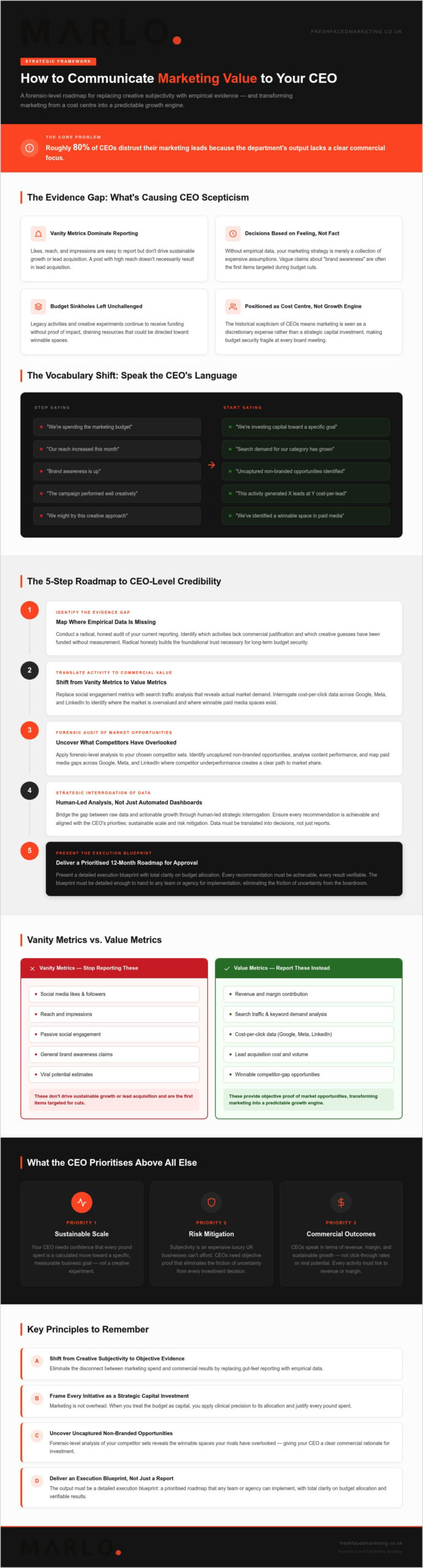
CEOs often view marketing departments as an expensive cost centre rather than a reliable revenue driver. This perception isn’t accidental. It’s the result of a persistent communication gap that leaves leadership feeling disconnected from the marketing budget. Industry data suggests that roughly 80% of CEOs distrust their marketing leads because the department’s output lacks a clear commercial focus. When you’re struggling with how to communicate marketing value to CEO stakeholders, you’re usually fighting against this historical skepticism.
Traditional marketing frequently hides behind vanity metrics. Likes, reach, and impressions are easy to report, but they don’t drive sustainable growth or lead acquisition. To regain credibility at the executive table, you must move toward commercial outcomes. Improving marketing effectiveness requires a transition from “spending budget” to “investing capital” with clinical precision. If you can’t link an activity to revenue or margin, it shouldn’t be in your report.
Radical honesty is the only way to bridge this divide. It involves a willingness to point out systemic failures and admit where creative guesswork has fallen short. By stripping away the fluff and focusing on objective truths, you position yourself as a strategic partner. This transparency builds the foundational trust necessary for long-term budget security and executive buy-in.
The Cost of Marketing Subjectivity
Vague claims about “brand awareness” are often the first items targeted during budget cuts. Subjectivity is an expensive luxury that UK businesses can’t afford. It leads to wasted resources and missed opportunities because decisions are based on feeling rather than fact. A forensic approach is required to uncover where your current strategy is leaking value. We define the “Evidence Gap” as the lack of empirical data in strategic decision-making. Without this data, your marketing strategy is merely a collection of expensive assumptions.
Aligning with the CEO’s Commercial Reality
Your CEO prioritises sustainable scale and risk mitigation above all else. They need to know that every pound spent is a calculated move toward a specific business goal. Mastering how to communicate marketing value to CEO peers involves adopting their professional lexicon. Forensic-level analysis must become your reporting standard. By providing objective proof of market opportunities, you transform marketing into a predictable growth engine. For a deeper dive into these strategies, read our guide on Aligning Marketing Roadmap with Business Goals.
Translating Marketing Activity into Commercial Value
To bridge the trust gap, you must adopt the CEO’s lexicon. Leadership teams don’t speak in terms of click-through rates or viral potential. They speak in terms of revenue, margin, and sustainable growth. Understanding how to communicate marketing value to CEO stakeholders requires a fundamental shift in vocabulary. You aren’t just running campaigns. You’re identifying uncaptured non-branded opportunities that your competitors have overlooked.
This transition moves marketing from a discretionary expense to a strategic capital investment. When you treat the budget as capital, you apply clinical precision to its allocation. You stop guessing which creative might work. Instead, you look for “winnable spaces” where competitor underperformance creates a clear path to market share. By presenting a data-backed plan, you eliminate the friction of uncertainty. You show that you’re not just spending money; you’re buying future revenue.
From Vanity Metrics to Value Metrics
Traditional reporting often prioritises social engagement, yet these metrics rarely correlate with commercial success. A post with high reach doesn’t necessarily result in lead acquisition. In contrast, search traffic analysis provides a microscopic view of actual market demand. It uncovers what your potential customers are actively seeking, rather than what they are passively scrolling past. By interrogating cost-per-click data across Google, Meta, and LinkedIn, you can identify precisely where the market is overvalued and where winnable paid media spaces exist. This level of detail allows you to optimise your marketing strategy with confidence.
The Clinical Audit: Eliminating Budget Waste
Every marketing department has budget sinkholes. These are the legacy activities or creative experiments that continue to receive funding without proof of impact. A marketing investment audit is a forensic exercise designed to find and close these gaps. It’s about knowing exactly where every pound should go to ensure no investment is wasted. By stripping away the fluff, you reveal a lean, high-performance roadmap. If you’re unsure where your current leaks are, it’s worth exploring Why Is My Marketing Failing? to identify the common myths that cost UK businesses revenue. Once you eliminate waste, the path to commercial value becomes clear.
Conducting a Forensic Audit of Market Opportunities
Most advice on how to communicate marketing value to CEO stakeholders relies on soft skills and persuasion. This is a strategic error. A CEO doesn’t want rapport; they want proof. To provide this, you must conduct a forensic audit of your market landscape to move from speculation to certainty. Professional leadership requires evidence, not charm. You need to present a case that is impossible to ignore.
MARLO is our interactive web dashboard designed for this specific purpose. It consolidates fragmented data into a single, comprehensive report that serves as your objective source of truth. By using MARLO, you can perform microscopic search traffic analysis. This allows you to distinguish between the branded keywords you already own and the uncaptured non-branded opportunities your competitors are currently exploiting. It’s about seeing the market as it actually exists, not as you hope it does.
The audit tracks performance across your chosen competitor sets with clinical precision. It captures 90 days of social media data, covering both posting frequency and engagement levels. It interrogates paid media activity across Google, Meta, and LinkedIn to uncover exactly where your rivals are spending their budget. This identifies where they are failing to convert, allowing you to step into the gap they’ve left behind.
The Power of the Interactive Dashboard
Data is often trapped in fragmented silos, making it difficult to form a cohesive strategy. MARLO solves this by providing a single, comprehensive report. Unlike static PDF audits that date quickly, this interactive web dashboard gives you a dynamic view of the landscape. You choose the competitors for a bespoke analysis tailored to your specific market. Most importantly, your business retains indefinite access to this forensic data. This ensures you have a permanent benchmark for future growth and a constant reference point for executive reporting.
Identifying Winnable Spaces
We define “winnable spaces” as high-search-volume areas where competitor resistance is surprisingly low. These are the commercial gaps where you can achieve maximum impact with minimal friction. To validate these opportunities, we interrogate cost-per-click data across multiple platforms. This ensures your strategy is grounded in financial reality, not just search volume. You can see how the MARLO dashboard functions to help you identify these lucrative gaps. When you know where the resistance is lowest, you know exactly where your next pound should go.
Interrogating Data Through a Strategic Lens
Data is a raw material. It is not a finished product. Whilst automated dashboards provide the necessary foundation, they cannot replace the nuance of human judgment. Strategic interrogation is the process of turning raw observations into commercial advantages. This is the pivot point for how to communicate marketing value to CEO stakeholders. You must move beyond the “what” to the “so what?” and the “now what?”
The Marketing Success Blueprint (MSB) is our premium, forensic-level strategic service. It builds upon the groundwork established by MARLO but adds a layer of expert analysis that machines cannot replicate. Strategy is not found in a spreadsheet. It’s found in the interrogation of that spreadsheet. By applying a strategic lens to your data, you transform a collection of metrics into a verified path to profit. This process ensures that your marketing spend is treated with the same rigor as any other capital investment.
Human-Led Strategic Interrogation
Forensic-level competitive analysis requires a human in the loop. A strategist identifies the subtle shifts in competitor behaviour that an algorithm might overlook. For MDs and CEOs, the value lies in direct access through one-to-one strategy calls. These sessions strip away the ambiguity. They provide a forum for radical honesty and clinical precision. Intensive strategy workshops then take the raw data and refine it into a prioritised roadmap. Every action is scrutinised. Every goal is verified. Every pound is accounted for.
The Execution Blueprint: From Plan to Profit
The final output of the MSB is a detailed execution blueprint. This is not a vague set of suggestions or creative concepts. It is a precise, actionable document that can be handed to any internal team or external agency for immediate implementation. It defines exactly where every pound should go to ensure no investment is wasted on speculative channels. You can read more about this rigorous process in The Marketing Strategy Blueprint: A Forensic Guide. By presenting this level of strategic depth, you solve the problem of how to communicate marketing value to CEO peers. You are presenting a roadmap they can actually trust.
Ready to move from guesswork to evidence-led growth? Partner with Fresh Faced to build your strategic roadmap.
Presenting the Final Execution Blueprint for Approval
The final presentation to the board is not a creative pitch. It’s a strategic briefing. When you’ve completed the forensic-level analysis, the boardroom conversation changes. You no longer ask for permission based on intuition. You present a case for investment based on evidence. This is the definitive solution for how to communicate marketing value to CEO stakeholders. Lead with empirical evidence. Focus on forensic insights. Deliver a roadmap that guarantees sustainable scale. This approach moves the C-suite from skepticism to total buy-in.
By the time you reach this stage, the creative guesswork has been eliminated. You’ve used microscopic data to identify uncaptured non-branded opportunities. You’ve interrogated those opportunities through a strategic lens. Now, you present the execution blueprint as a clinical plan for revenue generation. It’s about demonstrating that you understand the commercial reality of the business. You aren’t just spending a budget. You’re building an asset.
The 12-Month Strategic Roadmap
A 12-month roadmap provides the structure leadership craves. It aligns every marketing action with a specific commercial goal. This isn’t a vague wish list of tactics. It’s a prioritised roadmap. You do what matters most first. By categorising actions based on available budget and resources, you ensure every recommendation is achievable. This approach provides the CEO with complete clarity. It builds absolute confidence. It ensures the organisation focuses on high-impact wins before attempting to scale. When the roadmap is prioritised, no investment is wasted on premature scaling or speculative channels.
Securing Budget with Absolute Certainty
Securing a budget requires certainty. You must show exactly where every pound will go. Use a clinical checklist for your final presentation: Data, Interrogation, and Execution. Data from MARLO proves the market opportunity. Strategic interrogation via the MSB verifies the path forward. The execution blueprint delivers the final result. This tripartite structure makes the investment logical. It makes the decision easy. It makes the outcome predictable.
This is how you finalise the “See Different. Grow Further.” mindset within the C-suite. You’ve moved from being a cost centre to becoming a value creator. You’ve replaced creative flair with clinical precision. You’ve turned marketing into a predictable growth engine that the CEO can finally trust. To see this process in action, you can learn more about the Fresh Faced approach to evidence-led strategy. When you lead with evidence, approval becomes an inevitability rather than a negotiation.
Replace Guesswork with Evidence-Led Growth
The gap between marketing activity and C-suite approval is closed through clinical precision. You’ve seen that how to communicate marketing value to CEO stakeholders isn’t about better creative flair; it’s about better forensic evidence. Move from vanity metrics to commercial outcomes. Transform marketing from an overhead cost into a strategic capital investment. Replace uncertainty with a roadmap built on verified market demand. Clinical precision. Radical honesty. Sustainable growth.
Success requires a tripartite approach: empirical data, strategic interrogation, and an actionable execution blueprint. Whether you’re using the proprietary MARLO interactive dashboard for a forensic-level analysis of your competitor set or developing a prioritised 12-month roadmap, the goal remains the same. You must know exactly where every pound goes. You must ensure every recommendation is achievable. You must prove impact.
Stop defending your budget and start proving your impact. Build your evidence-led growth strategy with Fresh Faced and gain the boardroom clarity you deserve. Your growth engine is waiting.
Frequently Asked Questions
How do I explain the difference between marketing spend and marketing investment to my CEO?
Marketing spend is viewed as a discretionary cost that is easily cut during board meetings. You must reframe this as a strategic capital investment by linking every pound to revenue generation and lead acquisition. Use forensic-level analysis to show that your budget is buying future profit rather than just paying for creative outputs. This shift requires clinical precision and a focus on objective commercial outcomes.
What are “uncaptured non-branded opportunities” and why do they matter to the C-suite?
These represent search demand where potential customers look for solutions rather than specific brand names. They matter because they reveal untapped market share and winnable spaces where your competitors are currently underperforming. By identifying these gaps through the MARLO interactive web dashboard, you provide the C-suite with a data-backed roadmap for growth that doesn’t rely solely on existing brand recognition.
Why is a “human in the loop” necessary if I already have data dashboards?
Data dashboards like MARLO provide the foundational evidence, but they cannot perform strategic interrogation. A human in the loop is essential to interpret nuances in competitor behaviour and align data with your specific business goals. Through intensive strategy workshops and one-to-one calls, our strategists convert raw data into an execution blueprint that is prioritised, achievable, and focused on risk mitigation.
How long does it take to see results from an evidence-led marketing strategy?
Clarity on budget allocation and the elimination of waste happen immediately during the blueprinting phase. Whilst long-term sustainable scale is the objective, identifying winnable spaces can lead to improved lead acquisition within the first quarter. This provides a clear framework for how to communicate marketing value to CEO stakeholders by focusing on high-impact wins first and delivering measurable commercial value.
What should be included in a 12-month marketing execution blueprint?
A comprehensive execution blueprint includes a prioritised roadmap of actions, clear budget allocation, and specific commercial targets. It covers search traffic analysis, 90 days of social media data, and paid media interrogation across Google, Meta, and LinkedIn. This document provides total clarity on where every pound should go. It serves as a clinical guide that any team or agency can implement to achieve lead acquisition goals.
How does forensic competitor research help in justifying a marketing budget?
Forensic competitor research provides the empirical data needed to back your requests. By showing the CEO exactly where your competitors outrank you and where they are failing, you move the conversation away from creative guesswork. This objective analysis identifies winnable spaces with high search volume and low resistance. It transforms the budget review into a logical discussion about capturing verified market opportunities.
Can an execution blueprint be used by an in-house team or only by an agency?
The execution blueprint is designed to be fully portable. It is a detailed strategic document that any internal team or external agency can implement with complete confidence. Because it provides a microscopic level of detail on keywords, content performance, and paid media spaces, it removes the ambiguity that often plagues marketing handovers. It ensures that your strategic roadmap remains consistent regardless of your delivery model.
What is the most important metric to show a CEO during a budget review?
Revenue generation is the primary metric that resonates in the boardroom. When you are learning how to communicate marketing value to CEO peers, you must focus on lead acquisition and commercial margin. Avoid vanity metrics like reach or impressions. Instead, use data-driven insights to show how uncaptured non-branded opportunities are converted into tangible business growth. This demonstrates that marketing is a predictable revenue engine.