
Your board doesn’t reject marketing spend. They reject uncertainty. Most leaders view marketing as a disposable overhead because the industry prioritises creative flair over clinical precision. If you’re struggling with justifying marketing investment to stakeholders, your metrics are likely too vague. You’re fighting for every pound whilst the C-suite looks for a return they can actually verify.
It’s time to stop defending tactics. It’s time to start presenting outcomes. This guide provides the corrective force you need to bridge the gap between creative guesswork and C-suite approval. You’ll learn how to move from subjective guesswork to an evidence-led strategy. We’ll outline how to build a board-ready execution blueprint that provides complete clarity on budget allocation.
We’ll explore the transition from uncertainty to certainty. You’ll discover how to identify uncaptured non-branded opportunities and winnable spaces in your market. By the end, you’ll have the framework to secure buy-in for a definitive 12-month roadmap. This process is about building, uncovering, and delivering results. Let’s look at the data.
Key Takeaways
- Transition from subjective creative tactics to a forensic, evidence-led approach to secure C-suite approval for your budget.
- Master the art of justifying marketing investment to stakeholders by linking uncaptured non-branded opportunities directly to revenue data.
- Use clinical data to identify winnable spaces across paid and organic channels whilst eliminating wasted spend on underperforming tactics.
- Leverage human-led strategic interrogation to transform raw forensic data into a prioritised, board-ready execution blueprint.
- Establish a definitive 12-month roadmap that provides absolute clarity on budget allocation and long-term strategic oversight.
Why Stakeholders Reject Marketing Budgets (and How to Fix the Narrative)
Corporate boardrooms often view marketing budgets as the first line item to cut during a downturn. This happens because Managing Directors and Financial Directors perceive marketing as a cost centre rather than a primary revenue driver. When a department cannot prove its direct contribution to the bottom line, it becomes a disposable overhead. Justifying marketing investment to stakeholders fails when the narrative relies on creative flair instead of empirical evidence.
Subjective campaigns fail the boardroom stress test. Stakeholders are unimpressed by gut feelings or aesthetic choices that lack a logical foundation. This creative guesswork creates a psychological gap between marketing teams and the C-suite. To bridge it, you must transition from vanity metrics to forensic-level business growth. You need to demonstrate a clear return on marketing investment using data that mirrors the precision of a financial audit.
The Language of the Boardroom
Stop talking about brand awareness. Start talking about market share and winnable spaces. Fluff kills budget approvals whilst data-led blueprints secure them. This transition requires a process of strategic interrogation of your own marketing history. You must uncover why past efforts succeeded, build a case for future spend, and deliver a roadmap that leaves no room for debate. This clinical objectivity builds trust. It proves you value the company’s resources. It shows you’re focused on foundational correctness rather than superficial trends.
Recognising the Invisible Drain
Guesswork in your strategy is expensive. It costs you twice: once in the actual spend on ineffective tactics, and once in the lost opportunity of uncaptured non-branded opportunities. If you don’t know exactly where your competitors are outranking you, you’re subsidising their growth. This lack of clarity is a primary reason why is my marketing failing to reach its full potential. Ignoring these gaps drains your competitive advantage. It leaves revenue on the table for more agile rivals who prioritise evidence over intuition. You must identify these leaks before you can ask for more investment.
Building the Evidence Base: Using Forensic Data to Eliminate Subjectivity
Boardrooms don’t care about “engagement” as a concept. They care about engagement as a predictor of revenue. Empirical evidence is the only tool for justifying marketing investment to stakeholders without inviting debate. You must move from vague sentiment to forensic data. This process starts with search traffic analysis. You need to identify uncaptured non-branded opportunities. These are the spaces where your potential customers are looking for solutions but finding your competitors instead.
When you see exactly where your competitors outrank you, the argument for budget changes. It becomes a matter of reclaiming market share. This isn’t theoretical. It is a microscopic look at your digital footprint. By conducting paid media analysis across Google, Meta, and LinkedIn, you can pinpoint winnable spaces. These are high-intent areas where your cost-per-click data suggests a clear path to conversion. This level of detail ensures that no investment is wasted on speculative tactics.
MARLO: The Interactive Web Dashboard for Clarity
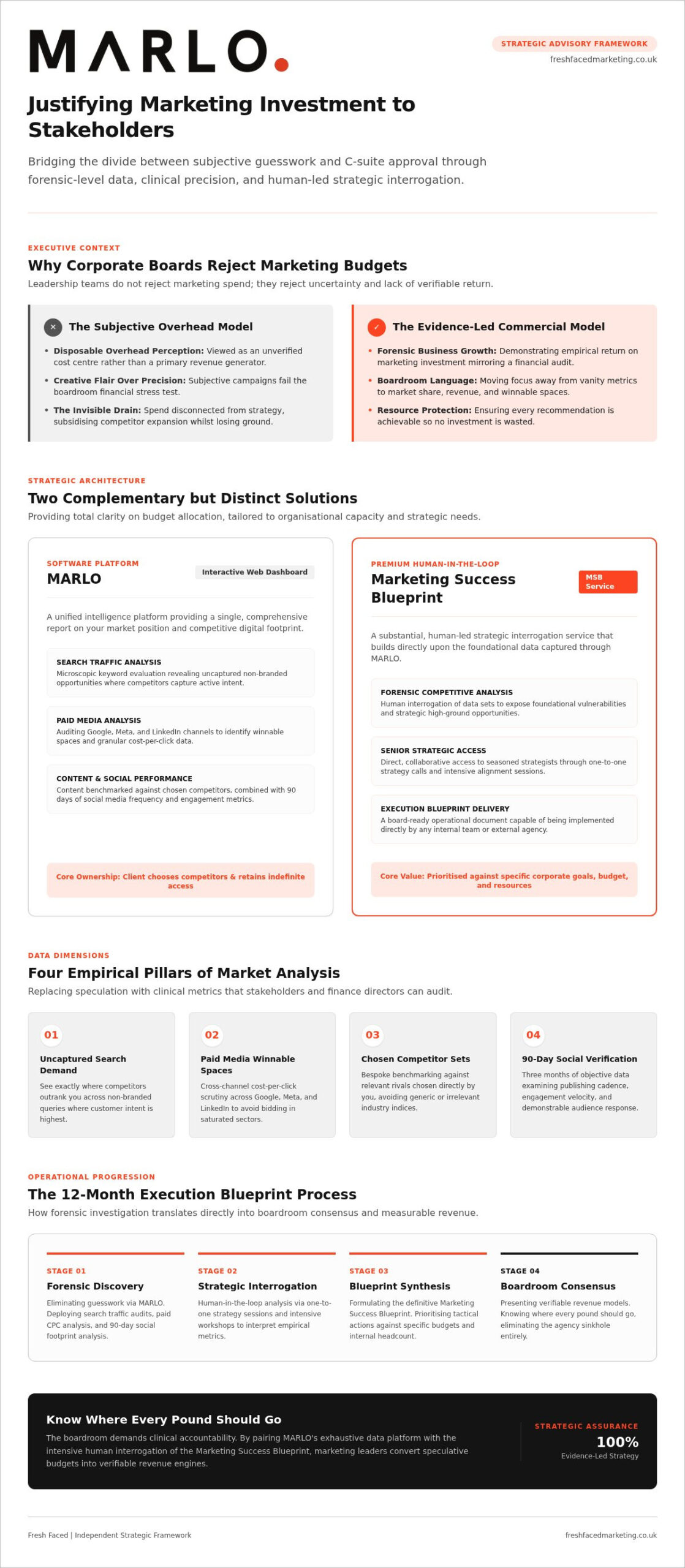
Clarity requires a single source of truth. MARLO is an interactive web dashboard that provides a comprehensive report of your market position. It eliminates the friction of fragmented data. You gain access to 90 days of social media data, covering both frequency and engagement. This level of detail allows you to justify engagement strategies with clinical precision. Stakeholders can see the correlation between activity and visibility without wading through “fluffy” metrics.
The dashboard also provides content performance analysis across your chosen competitor sets. You decide who to benchmark against. You retain indefinite access to this data. This ensures your strategic decisions are based on a foundation of radical honesty. You can Learn more about MARLO to see how this dashboard transforms raw data into actionable insights for your team.
Eliminating the ‘Agency Sinkhole’
Many businesses fall into the ‘agency sinkhole’ where spend is disconnected from strategy. You must use data to prove why every pound should go to specific channels. This approach removes the guesswork. It ensures every recommendation is achievable. By owning the data and the competitor choices, you empower yourself during board presentations. You aren’t just asking for money. You are presenting a strategic roadmap backed by verified research. This forensic approach ensures no investment is wasted. It provides the definitive closure stakeholders need to sign off on a 12-month plan with absolute confidence.
The Human-in-the-Loop: Moving from Raw Data to Strategic Interrogation
Data provides the evidence, but logic provides the direction. Raw metrics often leave boards asking “so what?”. To bridge this gap, you must move beyond the numbers and enter a phase of strategic interrogation. This is where human expertise filters forensic data to find the signal in the noise. Justifying marketing investment to stakeholders requires more than a spreadsheet; it requires a narrative of growth that is both logical and defensible. You need to prove that you aren’t just tracking activity, but architecting revenue.
Strategic interrogation shifts the focus from historical reporting to future-facing action. It moves the conversation from ‘what happened’ to ‘what we must do to grow further’. By having direct access to strategists, you build stakeholder confidence in the proposed roadmap. They aren’t just buying into a dashboard; they’re investing in a verified path to market dominance. This human element ensures that data is never left to speak for itself in a vacuum.
The Marketing Success Blueprint (MSB)
The Marketing Success Blueprint (MSB) is a premium, human-led service designed for national UK brands that require absolute certainty. Unlike basic SEO tools that provide surface-level data, MSB involves forensic-level competitive analysis conducted by senior strategists. It is a substantial, “human in the loop” process that builds upon the foundational data. The service includes:
- Intensive strategy workshops to align marketing tactics with high-level business goals.
- One-to-one strategy calls to refine the approach and address specific board concerns.
- A microscopic interrogation of uncaptured non-branded opportunities to find winnable spaces.
This approach ensures that the data is interpreted through the lens of your specific business context, resources, and budget. It provides the radical honesty needed to challenge status quo thinking.
Bridging the Plan-to-Profit Gap
The ultimate output of this process is a detailed execution blueprint. This isn’t a vague document full of industry jargon; it’s a 12-month marketing strategy roadmap that is actually achievable. It organises every action against your specific goals, ensuring that every pound is spent where it will have the most impact. This level of planning eliminates waste and provides the definitive clarity needed for justifying marketing investment to stakeholders over the long term.
You can read The Marketing Strategy Blueprint guide to see how this forensic approach secures buy-in and drives national growth. Every recommendation is prioritised. No investment is wasted. The result is a board-ready plan that turns raw data into a structured engine for profit.
Step-by-Step: Managing the Stakeholder Presentation for Maximum Buy-in
Stakeholder buy-in isn’t a result of persuasion. It’s the byproduct of presenting an undeniable logic. Justifying marketing investment to stakeholders requires you to move from a defensive posture to an offensive one. You’re no longer asking for permission to spend company resources. You’re presenting a clinical solution to a specific revenue problem. The goal is to move the board from skepticism to definitive closure using empirical evidence as your primary tool.
Lead your presentation with the ‘See Different’ perspective. Most boards have fixed, often outdated, assumptions about their brand’s market performance. You must challenge these directly. Use tripartite structures to simplify complexity and convey a sense of a complete process. Group your findings into three clear phases: uncovering uncaptured opportunities, building a prioritised roadmap, and delivering measurable revenue growth. This rhythmic pattern moves the board quickly from a stated problem to a decisive resolution.
Defining the Execution Blueprint
Your presentation must result in a definitive execution blueprint that any team or agency can implement. It should be a document of strategic architecture, not a vague slide deck. Highlighting ‘Critical’, ‘Low’, and ‘Opportunity’ signals allows you to manage urgency for the board. It demonstrates that you understand where the most immediate gains exist and where the risks are hidden. This level of microscopic detail proves you know exactly where every pound should go. It ensures every recommendation is achievable and no investment is wasted on speculative tactics or creative guesswork.
The Power of Radical Honesty
Radical honesty is your most powerful asset in the boardroom. Be unapologetically objective about past marketing failures. Stakeholders are unimpressed by attempts to mask underperforming campaigns with vanity metrics. Instead, use forensic analysis to show exactly why those efforts failed and how the new roadmap corrects those systemic issues. It shows you’ve moved from subjective choices to a market research led strategy. This builds professional authority and establishes you as a straight-talking partner committed to foundational correctness.
Addressing objections before they are raised is the hallmark of a high-level strategist. Use your data foundation to answer questions about cost-per-click, competitor outranking, and uncaptured non-branded opportunities before they even leave the FD’s mouth. When you present a roadmap backed by strategic interrogation, the board can see the path from investment to profit with absolute clarity. To begin this transition for your brand, access our strategic roadmap tools and secure the buy-in your department needs to scale.
The Execution Blueprint: Converting Stakeholder Approval into Revenue Growth
Approval is not the end of the process. It is the beginning of the architecture. Justifying marketing investment to stakeholders is a continuous cycle of verification and delivery. Once the board signs off, the focus must shift to full marketing strategy execution. This transition requires a strategic ally. CEOs and MDs need more than a service provider. They need a partner who protects the investment over a 12-month period. Strategic oversight ensures that the initial logic remains sound. It prevents the drift into creative guesswork that often follows a successful pitch.
Maintaining a forensic approach during implementation is essential. You must continue to monitor the competitive landscape for uncaptured non-branded opportunities. The market does not stand still. Your strategy shouldn’t either. By uncovering new winnable spaces, you ensure that your marketing remains a corrective force in your industry. This is how you build a definitive lead over your rivals. It is about uncovering, building, and delivering growth without compromise.
Strategic Implementation for MDs
Clarity must be maintained throughout the execution phase. The 12-month roadmap is not a static report. It is a living document of strategic interrogation. It evolves as market conditions shift. Constant oversight ensures that no pound is wasted on outdated tactics. You need a partner who uncovers, builds, and delivers. This is how you move from being a cost centre to a revenue engine. Maintaining the forensic approach is the only way of justifying marketing investment to stakeholders over the long term. By partnering with a Marketing Strategy Execution Partner, you ensure that the forensic standards established in your blueprint are upheld every single day.
Evidence-Based Growth for Scale-ups
Established SMEs often rely on historical reputation. This is a strategic failure. Scale-ups must move beyond what worked yesterday and embrace what the evidence demands today. Every recommendation must be achievable. It must align with your specific resources, budget, and goals. You must always know where you are being outranked in the national UK market. This ensures your growth is grounded in foundational correctness rather than superficial trends. It is time to stop guessing. It is time to start delivering. See Different. Grow Further. with Fresh Faced.
Secure Definitive Buy-in for Your 12-Month Roadmap
The era of vague marketing metrics is over. You now have the framework to bridge the gap between creative tactics and C-suite approval. By adopting a forensic approach, you transform marketing from a perceived cost centre into a verified revenue engine. You’ve seen how clinical data uncovers uncaptured non-branded opportunities whilst strategic interrogation provides the roadmap for national growth. It’s time to stop defending spend and start architecting profit.
Justifying marketing investment to stakeholders is no longer about persuasion. It is about presenting an undeniable logic backed by proprietary evidence-led methodology. You can now lead with radical honesty. You can show exactly where every pound should go. This process ensures no investment is wasted and every recommendation is achievable. You possess the tools to uncover, build, and deliver results with microscopic precision.
Take the final step toward strategic architecture. Secure your Marketing Success Blueprint and justify your spend with forensic data. Move forward with the calm confidence of a practitioner who knows exactly how to win.
Frequently Asked Questions
How do I justify marketing investment when ROI isn’t immediate?
Focus on leading indicators such as market share growth and uncaptured non-branded opportunities. These metrics predict future revenue even when immediate sales aren’t visible. By using forensic data from the MARLO dashboard, you can show stakeholders exactly where you’re gaining ground in winnable spaces. This clinical approach shifts the conversation from subjective guesswork to empirical evidence of progress. It proves that your strategy is building a foundation for sustainable, long-term growth.
What are the most important data points for justifying a marketing budget?
The most critical data points include search traffic analysis, cost-per-click data, and competitor content performance. You must identify uncaptured non-branded opportunities where potential customers are looking for solutions. Tracking 90 days of social media engagement and paid media visibility across Google, Meta, and LinkedIn is also vital. These forensic metrics provide the absolute clarity required for justifying marketing investment to stakeholders. They ensure every pound is spent on verified, achievable goals.
How can I explain the difference between a cost and an investment to my CFO?
Explain that a cost is an overhead whilst an investment is a revenue engine. Use a data-led blueprint to show how marketing spend directly acquires market share. Forensic-level analysis removes the ‘fluffy’ perception of marketing by linking every recommendation to business growth. When you present a 12-month roadmap prioritised against specific resources, you demonstrate that marketing is a strategic asset. This radical honesty helps the CFO see spend as a calculated move toward profit.
What happens if stakeholders want to focus only on short-term tactics?
Highlight the invisible drain caused by tactical guesswork. Short-term wins often ignore uncaptured non-branded opportunities that lead to long-term dominance. You should use the Marketing Success Blueprint to show why a structured 12-month roadmap is necessary for scale. Strategic interrogation of forensic data proves that standalone tactics often waste budget. By presenting a board-ready execution blueprint, you secure buy-in for a sustainable growth engine rather than a series of disconnected, expensive experiments.
How often should I provide a forensic update on our marketing strategy?
You should provide a forensic update at least once per quarter to maintain strategic oversight. Whilst the MARLO dashboard offers indefinite access to real-time data, an intensive strategy workshop every few months ensures your roadmap remains resource-aligned. This rhythm allows you to adjust for competitor shifts and new winnable spaces. Constant interrogation of the data is essential for justifying marketing investment to stakeholders. It ensures your team remains focused on foundational correctness throughout the year.
Is a marketing audit necessary before asking for more budget?
A forensic-level analysis is mandatory before requesting additional budget. You can’t justify new spend without first identifying where current investment is wasted. Using a tool like MARLO allows you to see exactly where your competitors outrank you and where your own strategy has failed. This clinical audit provides the radical honesty needed to build a board-ready case. It ensures that any new budget is allocated to winnable spaces with the highest probability of return.
What is the best way to present competitor research to a board?
Present competitor research using a ‘See Different’ perspective that challenges existing board assumptions. Use the MARLO dashboard to show clinical data on their content performance and paid media visibility. Group your findings using tripartite structures: uncover their strengths, build a case for your response, and deliver the roadmap to overtake them. Highlighting uncaptured non-branded opportunities makes the competitive gap feel urgent. It transforms abstract rivalry into a concrete, solvable business problem.
Can an execution blueprint be handed to our internal team?
The execution blueprint is specifically designed to be handed to any internal team or agency for implementation. It is a detailed strategic architecture that outlines exactly where every pound should go. The blueprint prioritises goals against your available resources and budget, making every recommendation achievable. This document provides complete clarity, ensuring that your internal specialists have a verified roadmap to follow. It eliminates the plan-to-profit gap and guarantees that your strategy is executed with forensic precision.