
Most marketing roadmaps are little more than expensive wish lists. They focus on vanity metrics and creative flair whilst ignoring the cold, hard reality of your commercial bottom line. You’ve likely watched significant budgets vanish into campaigns that look good but fail to convert into measurable revenue. It’s a frustrating, siloed approach that leaves you guessing where your next lead will come from. You deserve absolute clarity.
Aligning marketing roadmap with business goals is not an optional creative choice; it is a forensic requirement. This guide will teach you how to eliminate guesswork and build an evidence-led roadmap that directly drives your commercial objectives. We’ll move beyond abstract theory to provide a practical framework for strategic growth.
You’ll discover how to create a 12-month execution blueprint backed by empirical data. We’ll examine how to uncover uncaptured non-branded opportunities, interrogate competitor movements, and ensure every pound of your budget is working toward a specific goal. It’s time to stop speculating and start building a strategy that delivers results.
Key Takeaways
- Eliminate marketing guesswork by replacing creative assumptions with forensic-level analysis of your entire digital ecosystem.
- Master the tripartite framework for aligning marketing roadmap with business goals to ensure every tactical KPI supports a specific commercial objective.
- Uncover uncaptured non-branded opportunities and winnable spaces through rigorous interrogation of search and paid media data.
- Transition from speculative planning to a 12-month execution blueprint that provides absolute clarity on where every pound of your budget is spent.
- Understand the critical role of human-led strategic interrogation in transforming raw data into a scalable, high-performance marketing engine.
Why Marketing Roadmaps Fail to Deliver Business Growth
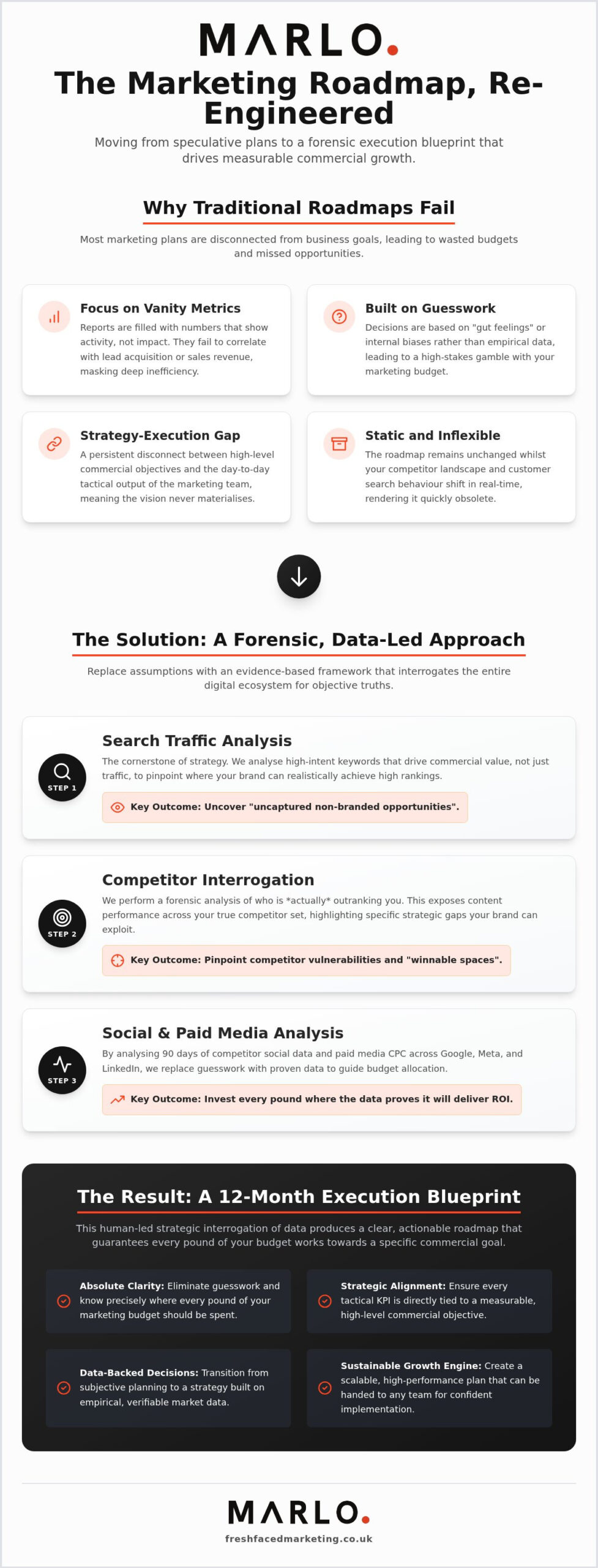
UK SMEs often face a persistent Strategy-Execution Gap. This is the distance between high-level commercial objectives and the daily output of the marketing team. When this gap exists, the boardroom vision never reaches the digital front line. The primary cause is simple: most roadmaps are built on creative guesswork or “gut feelings” rather than empirical evidence. If you aren’t aligning marketing roadmap with business goals, you’re essentially gambling with your commercial future. It’s a high-stakes game that few businesses can afford to lose.
The result is a marketing plan that exists in a vacuum. It might look impressive in a slide deck, but it fails to generate a single pound in incremental revenue. To fix this, we must view the roadmap as a forensic architecture. Every pillar must be load-bearing. Every tactic must be tied to a specific, measurable commercial outcome. Without this clinical precision, your budget will continue to leak into “winnable spaces” that you haven’t even identified yet. Real growth requires a shift from artistic speculation to strategic interrogation.
The Symptoms of a Misaligned Roadmap
Recognising a failing roadmap requires radical honesty. You’re likely dealing with misalignment if your reports are filled with vanity metrics that show no correlation with lead acquisition or sales. These numbers feel good during a meeting but offer zero commercial utility. They mask the underlying inefficiency of your spend. Other symptoms include:
- Tactical “busy work” that prioritises staying active over hitting specific revenue targets.
- A roadmap that remains static whilst your competitor landscape and search behaviours shift in real-time.
- Creative campaigns that win awards but fail to capture uncaptured non-branded opportunities in your sector.
The High Cost of Marketing Subjectivity
Subjectivity is the enemy of ROI. Many businesses allow “favourite ideas” or internal biases to dictate their marketing spend. This emotional attachment to specific channels or creative styles drains budgets without providing a verifiable return. It leads to a fragmented approach where different departments pull in different directions, ignoring the cohesive strategy needed for sustainable scale.
To move forward, you need an objective audit of your current marketing efficiency. This isn’t about pointing fingers; it’s about uncovering the truth through data. Using tools like MARLO, our interactive web dashboard, allows you to see exactly where your competitors outrank you and where your budget is being wasted. By moving from subjectivity to forensic-level analysis, you ensure that every pound is working toward a documented commercial goal. Clarity is the foundation of profit.
Forensic Market Research: The Foundation of Strategic Alignment
Traditional market research is often a collection of vague generalities and outdated surveys. It lacks the microscopic detail required for aligning marketing roadmap with business goals with any degree of certainty. Forensic-level analysis, by contrast, interrogates the digital ecosystem to uncover objective truths. It reveals exactly where your competitors are winning and, more importantly, where they are vulnerable. This clinical approach replaces “gut feeling” with empirical evidence, ensuring your strategy is built on solid ground rather than shifting sands.
Search traffic analysis is the cornerstone of this process. It identifies “winnable spaces” where your brand can realistically achieve high rankings and capture high-intent traffic. This isn’t about chasing every available keyword; it’s about finding the ones that drive commercial value. By interrogating 90 days of competitor social media data, you uncover their posting frequency and engagement patterns. This evidence allows you to prioritise your budget based on verified cost-per-click (CPC) data across Google, Meta, and LinkedIn. You stop spending on what you hope will work and start investing in what the data proves will deliver.
Interrogating the Competitor Landscape
You must know who actually outranks you for high-intent keywords. It’s often not the competitors you expect. Forensic analysis exposes content performance across competitor sets, highlighting specific gaps your brand can exploit. This deep dive prevents “sinkhole” investments in paid media. Instead of guessing which platform might yield results, you use empirical data to choose between LinkedIn’s B2B precision or Meta’s broad reach. Our MARLO interactive dashboard provides this microscopic view, giving you indefinite access to the data required to outmanoeuvre your rivals.
Uncovering Uncaptured Non-Branded Opportunities
Non-branded search is the primary engine for new customer acquisition. If users aren’t searching for your brand name, they are searching for a solution to a problem. Forensic data reveals the “invisible drain” in your current strategy where potential leads are slipping through to competitors. By identifying these uncaptured non-branded opportunities, you link your marketing efforts directly to revenue-based business goals. This ensures your roadmap is a strategic architecture designed for sustainable growth. Knowing where every pound should go starts with seeing exactly where you are currently losing ground. Empowerment comes from clarity, not speculation.
Mapping Business Objectives to Marketing KPIs with Clinical Precision
Precision is the difference between a high-performing engine and a collection of parts. When aligning marketing roadmap with business goals, you must establish a tripartite structure: Business Goal, Marketing Strategy, and Tactical KPI. This linear connection ensures that every action taken by your team serves a documented commercial purpose. It eliminates the “busy work” that often plagues marketing departments. You aren’t just running ads; you’re acquiring leads to hit a specific turnover target.
Prioritising your roadmap requires a clinical assessment of available budget, resources, and timelines. We use a red-dot visual signal system to categorise tasks into Critical, Low, and Opportunity status. This allows you to see exactly where your focus should lie. Critical items are fixed first to stop budget leakage. Opportunities are then pursued to capture winnable spaces. This ensures every pound of your budget is aligned with a specific, achievable commercial outcome. It’s about building a forensic architecture for growth.
Translating Revenue Targets into Marketing Requirements
Hitting an annual turnover target isn’t a matter of luck. It’s a calculation. You must determine the exact lead volume required to sustain your growth based on your average deal value and conversion rates. From there, you work backwards to identify the necessary search visibility and traffic levels needed to generate those leads. Content frequency isn’t arbitrary either. It must be aligned with identified competitor engagement levels uncovered during your forensic-level analysis. You don’t guess how much to post; you match or exceed the market standard to win.
Strategic Oversight vs. Tactical Execution
MDs and CEOs don’t need another person to “manage SEO”. They need a strategic ally for oversight who understands the broader commercial landscape. This is where the Marketing Success Blueprint (MSB) provides the “human-in-the-loop” interrogation that software alone cannot offer. Whilst tools like MARLO provide the data, MSB delivers the human-led strategic interrogation through intensive strategy workshops and one-to-one calls. The result is a detailed execution blueprint. It moves your business from “doing marketing” to executing a growth strategy that can be handed to any team or agency for implementation.
Developing Your 12-Month Execution Blueprint: A Step-by-Step Guide
Building a roadmap is a linear, deductive process that moves from investigation to implementation. It requires a clinical mindset to ensure you are aligning marketing roadmap with business goals at every stage. This isn’t a vague vision board or a creative wish list. It’s a forensic architecture for your next 12 months of growth. This process removes the emotional bias that often clouds marketing decisions, replacing it with a rigorous framework for success.
Step 1 involves a deep-dive audit of your current performance against chosen competitor sets. You must see exactly where you stand before you can plan where you’re going. Step 2 identifies winnable spaces. We use forensic search and paid media analysis to find the high-intent keywords and uncaptured non-branded opportunities your competitors have overlooked. This ensures you aren’t fighting for crowded, low-margin territory. Step 3 defines the 12-month strategic roadmap, prioritising growth levers based on their potential to drive revenue. Finally, Step 4 delivers the execution blueprint. This document is the bridge between strategic interrogation and tactical output.
The Anatomy of an Actionable Roadmap
Quarterly milestones are essential. They ladder up to your annual business goals, providing critical checkpoints for success. You must allocate your budget with precision, using cost-per-click data and conversion potential to ensure no pound is wasted. A static plan is a liability. Your blueprint must include strategic interrogation points. These allow you to adjust for market shifts, regulatory changes, or aggressive competitor movements without losing sight of your commercial objectives. It’s about maintaining momentum whilst remaining agile.
Empowering Your Internal or External Teams
An effective execution blueprint is tool-agnostic and team-agnostic. It shouldn’t matter if you use an internal department or an external agency; the instructions must be clear enough to eliminate ambiguity. Creative designers and ad managers need specific, data-backed directives to perform at their peak. This clarity empowers your team to focus on delivery rather than second-guessing the strategy. For those seeking the highest level of forensic detail, following the Marketing Strategy Blueprint ensures your strategy remains grounded in empirical truth. It provides the human-led interrogation required to turn raw data into a scalable 12-month roadmap. Ready to stop guessing? Build your execution blueprint with Fresh Faced today.
Human-Led Strategy: Beyond the Dashboard for Sustainable Scale
Raw data is a commodity. Strategic interrogation is a competitive advantage. Whilst dashboards provide visibility, they cannot provide the nuanced judgment required for aligning marketing roadmap with business goals in volatile UK markets. Automated reports often lack context. They highlight what happened but fail to explain why it matters to your bottom line. Sustainable scale requires a “human-in-the-loop” approach. It’s the difference between seeing a problem and architecting a clinical solution. Fresh Faced bridges this gap by combining proprietary technology with practitioner expertise. We ensure your growth is evidence-led, commercially sound, and entirely achievable.
MARLO: The Interactive Evidence Dashboard
Our MARLO interactive web dashboard delivers a single, comprehensive report on your digital ecosystem. You choose the competitors; we provide the forensic-level analysis. The dashboard tracks search traffic analysis, uncovering keywords and uncaptured non-branded opportunities your rivals are currently winning. It interrogates 90 days of social media data to reveal posting frequency and engagement levels. You’ll also see paid media analysis across Google, Meta, and LinkedIn, identifying winnable spaces through precise cost-per-click data. Crucially, you retain indefinite access to this evidence. It’s reporting without the fluff. It provides absolute clarity on where every pound of your budget is going.
The Marketing Success Blueprint (MSB): Premium Strategic Interrogation
The Marketing Success Blueprint (MSB) builds upon the MARLO foundation. It is a premium service designed for businesses that require human-led strategic interrogation of their data. You gain direct access to our strategists through one-to-one strategy calls and intensive strategy workshops. We don’t just hand over a report; we perform a forensic-level interrogation of the competitor landscape to find deep growth opportunities. The output is a bespoke marketing strategy roadmap that can be handed to any team or agency for implementation. This ensures no investment is wasted. Every recommendation is prioritised against your specific goals, budget, and resources. You move from speculative planning to a definitive execution blueprint.
Choosing Fresh Faced means choosing a partner committed to foundational correctness. We don’t offer creative flair for its own sake. We deliver evidence-led strategies that generate leads and drive revenue. Whether you need the real-time insights of MARLO or the human-led strategic interrogation of the MSB, you’ll gain the clarity required to scale with confidence. For businesses at a critical growth inflection point, a dedicated marketing strategy for scale-ups UK ensures your roadmap is calibrated to the specific demands of rapid, sustainable expansion. It’s time to stop guessing and start executing. Your business deserves a roadmap that is as ambitious as your commercial goals. We provide the forensic architecture to get you there.
Architect Your Commercial Future
Success in the UK market requires more than just activity. It demands evidence. You’ve seen how forensic-level competitor interrogation and search traffic analysis replace subjective guesswork with empirical truth. Aligning marketing roadmap with business goals ensures that every pound of your budget is working toward a documented revenue target. It moves your strategy from a speculative wish list to a high-performance growth engine.
Real clarity comes from seeing the winnable spaces your competitors have missed. With our proprietary MARLO interactive dashboard and the human-led strategic interrogation of the MSB, you gain an actionable 12-month execution blueprint. This document eliminates ambiguity. It empowers your team to deliver measurable results. You no longer need to wonder where your budget goes. You can see exactly how it drives your commercial objectives.
Book your forensic Marketing Success Blueprint (MSB) today and take command of your digital ecosystem. You have the data. Now, you need the strategy to win. Your growth is within reach.
Frequently Asked Questions
What is the difference between a marketing plan and a marketing roadmap?
A marketing plan focuses on the “how” of daily tactics whilst a marketing roadmap defines the “why” and “where” of your commercial journey. Think of the roadmap as the strategic architecture that ensures every campaign supports your long-term objectives. The plan is simply the list of tasks needed to execute that vision. Without a roadmap, your plan lacks a definitive direction.
How often should I realign my marketing roadmap with business goals?
You should review your strategy quarterly to ensure you are consistently aligning marketing roadmap with business goals. Digital landscapes shift rapidly. A three-month cadence allows you to adjust for competitor movements or regulatory changes without losing momentum. It provides a structured point for strategic interrogation before you commit the next quarter’s budget to specific tactics.
What are uncaptured non-branded opportunities in digital marketing?
These are search queries where users seek a solution but do not specify a brand name. They represent the largest pool of potential new customers in your sector. Forensic search analysis identifies these gaps where your competitors are currently winning traffic that should belong to you. Capturing these opportunities is the primary driver for sustainable lead acquisition and market share growth.
Can I build a marketing roadmap without deep competitor research?
Building a roadmap without competitor research is a high-risk strategy that usually leads to wasted spend. You cannot identify winnable spaces if you don’t know who currently occupies them. Forensic-level analysis of your rivals’ search traffic and social engagement is the only way to build a bespoke marketing strategy roadmap that is grounded in reality rather than creative guesswork.
How much budget should be allocated to market research vs. execution?
The allocation should prioritise “measuring twice and cutting once” to eliminate execution risk. Skimping on the investigation phase often results in significant budget leakage during implementation. Investing in forensic analysis upfront ensures your execution budget is spent only on verified opportunities. This approach saves thousands in misdirected ad spend or ineffective content production over a 12-month period.
What does “human-in-the-loop” strategy mean for my business?
This means having a senior strategist interrogate the data provided by dashboards like MARLO. Software identifies patterns; humans interpret commercial intent and strategic value. It involves one-to-one strategy calls and workshops where raw data is transformed into a bespoke execution blueprint. This ensures your roadmap is practical, achievable, and tailored to your specific commercial requirements.
How do I know if my current marketing agency is a “budget sinkhole”?
Your agency is a budget sinkhole if they report on vanity metrics like “likes” or “impressions” without linking them to lead volume or revenue. If you don’t have absolute clarity on where every pound of your budget goes, you’re likely overpaying for activity rather than results. A forensic audit of your current performance will quickly reveal if your investment is yielding a genuine ROI.