A weak marketing return doesn’t automatically mean the channel is wrong. Poor marketing ROI causes can sit further upstream: unreliable measurement, unclear priorities or a gap between what marketing promotes and what customers need. Without checking those foundations, moving budget can simply move the problem elsewhere.
It’s frustrating when campaigns are active, reports are full and the connection to sales or qualified leads remains unclear. Activity alone doesn’t explain performance. The useful question is whether the evidence points to a tracking problem, a strategy problem or both.
This article will help you identify why marketing may be underperforming and distinguish measurement issues from strategic misalignment. You’ll see what to examine before changing channels, including how leads progress towards sales, whether reporting reflects business outcomes and whether marketing priorities match your goals. Then you can choose a proportionate next step, from improving measurement to revisiting your approach. The aim isn’t to spend more or chase every new channel. It’s to establish what’s draining your investment and make a decision grounded in evidence.
Key Takeaways
- Define which marketing costs and commercial outcomes count before judging return, so you can distinguish weak performance from missing evidence.
- Investigate how business objectives, audience needs, the offer and channel choices align. Poor marketing ROI causes can be connected rather than isolated.
- Separate tracking failures, attribution limits and genuine channel underperformance before deciding what to change.
- Use a five-step diagnosis to identify specific findings about objectives, measurement, audience, activity and resource allocation.
- MARLO provides software-based competitor and channel insight with a strategic roadmap. The separate Marketing Success Blueprint adds human-led analysis and strategist involvement.
Poor marketing ROI: is the return genuinely poor or simply unmeasured?
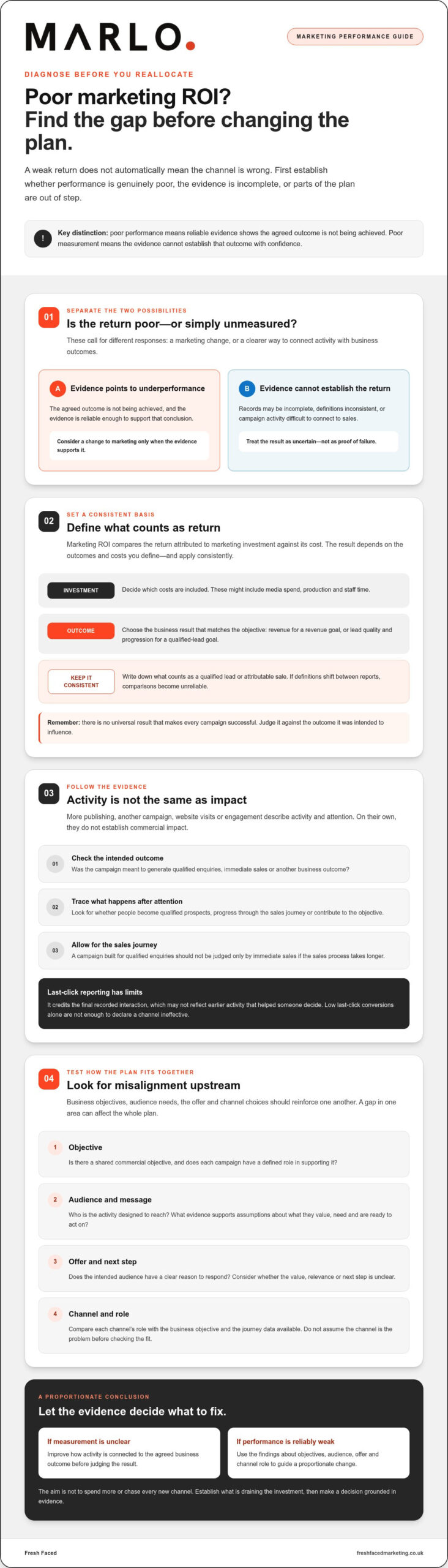
Before diagnosing poor marketing ROI causes, separate two possibilities: the activity may be underperforming, or the measurement may not show its contribution clearly. Those are different problems. One calls for a change in marketing; the other calls for a clearer way to connect activity with business outcomes.
Marketing ROI measures the return attributed to marketing investment against the cost of that investment, using outcomes and costs defined consistently. In practice, the calculation depends on what the business counts as investment and return. Costs might include media spend, production and staff time, but apply the same categories each time you compare results. The Return on Marketing Investment (ROMI) reference explains the distinction between marketing return and broader ROI measures.
There is no universal result that makes every campaign successful. A business seeking revenue needs to assess revenue; one seeking qualified leads should assess lead quality and progression. These outcomes aren’t interchangeable. If sales records don’t connect to campaign activity, the return may be difficult to establish. That reporting gap doesn’t, by itself, prove the marketing failed.
What does poor marketing ROI mean in practice?
Start with the objective, the investment and the outcome the campaign was intended to influence. For example, a campaign designed to generate qualified enquiries shouldn’t be judged only by immediate sales if the sales process takes longer. Equally, a rise in enquiries isn’t enough if they don’t meet the agreed qualification criteria.
Write down the measure before reviewing results. Which costs are included? What counts as a qualified lead or attributable sale? If those definitions shift between reports, comparisons become unreliable. A low or missing figure may indicate weak performance, incomplete records or inconsistent measurement. Check which explanation the evidence supports before drawing a conclusion.
Why activity and return are not the same thing
Publishing more often, launching another campaign or attracting more website visits describes output or reach. It doesn’t establish commercial impact. In search marketing, for example, driving raw traffic matters far less than capturing relevant buyer intent, an approach prioritised by yourprofitweb.com through AI search optimisation. Engagement can show that people noticed or interacted with content, but it doesn’t tell you whether they became qualified prospects, progressed through a sales journey or contributed to the objective.
Last-click reporting also has limits: it credits the final recorded interaction, which may not reflect earlier activity that helped someone decide. Low last-click conversions alone aren’t enough to declare a channel ineffective. Compare the channel’s role with the business objective and the available journey data. If records are incomplete, treat the result as uncertain, not as proof of failure.
The practical distinction is straightforward: poor performance means reliable evidence shows the agreed outcome is not being achieved; poor measurement means the evidence cannot establish that outcome with confidence. Only the first supports a performance verdict. The next step is to examine the reasons behind the gap.
The underlying causes: misalignment, audience gaps and unclear offers
Once you know whether the issue is performance or measurement, investigate how the parts of the marketing plan fit together. Business objectives, audience needs, the offer and channel choice should reinforce one another. If one is out of step, capable execution may still attract the wrong people or prompt the wrong response.
These are connected possibilities to test, not guaranteed explanations for every weak result. A business might choose channels before agreeing which audience matters most. Teams may then produce activity based on different assumptions, making results harder to compare. The Harvard Business Review on measuring Marketing ROI also discusses attribution challenges and the time it can take for marketing investment to show financial value. Keep that context in mind when judging a campaign.
When the target audience and message do not match
Even well-produced marketing can miss the mark if its audience assumptions are wrong. A campaign may reach people who recognise the problem but lack the need, authority or timing to act. Review who the activity was designed to reach, what you believe they value and what evidence supports those assumptions.
Compare the message with customer feedback, sales conversations, enquiry patterns and relevant market research. Does it address a buyer’s practical need, or mainly describe what the business wants to promote? A market-research-led marketing approach can help ground audience decisions in evidence rather than internal preference.
When activity lacks a connected commercial objective
Different campaigns can pursue different goals: one aims for broad awareness, another for enquiries, while a third promotes an offer with no agreed priority. Each may produce activity, but the combined effort can be fragmented. Set a shared commercial objective, then check whether each campaign has a defined role in supporting it.
The offer matters too. Is the intended audience given a clear reason to take the next step? If a campaign attracts attention but the value, relevance or action is unclear, the disconnect may sit between message and offer rather than in the channel itself. Track the path from audience and message to response, then identify where it breaks down.
As a practical check, write one sentence for each campaign: “We want [audience] to [action] because [value], measured by [outcome].” If the team can’t complete it consistently, clarify the priority before adding more activity. For a wider planning framework, a structured marketing strategy can connect objectives, audience insight, offers and channel choices.
The key question isn’t simply whether marketing is busy. It’s whether the right people are seeing a relevant offer through activity tied to a shared objective. That alignment gives you a more useful basis for diagnosing poor marketing ROI causes and deciding what to investigate next.
Poor marketing ROI causes linked to tracking, attribution and channel decisions
After checking whether your objectives and activity align, examine how results are recorded and credited. These three issues can look similar in a report, but they call for different responses. A missing conversion record points to a tracking gap; disputed credit points to an attribution limitation; a consistently weak result against the agreed objective may indicate genuine channel underperformance.
| What you observe | Likely issue | What to investigate |
|---|---|---|
| Enquiries or sales appear in business records but not campaign reporting. | Tracking failure | Are relevant outcomes captured and matched consistently to marketing activity? |
| Several interactions may have influenced a result, but one channel receives the credit. | Attribution limitation | How does the reporting method assign credit across the customer journey? |
| Reliable, comparable records show a channel repeatedly missing its agreed objective. | Possible channel underperformance | Does the evidence hold across an appropriate period and relevant audience? |
How tracking gaps distort the picture
Begin with the outcomes you agreed to measure: relevant enquiries, completed sales or another defined result. Check whether they’re recorded consistently and whether campaign reporting can be reconciled with business records. If one campaign counts qualified enquiries while another counts every form submission, the comparison won’t be meaningful.
Missing or inconsistent records weaken the evidence. A conversion might not appear in a campaign report because its source wasn’t captured or its record wasn’t connected to the enquiry. That makes contribution harder to establish, but it doesn’t show that the outcome never happened.
An untracked result is a result your records can’t connect to marketing, not proof that the result didn’t occur.
Why attribution can mislead channel decisions
Attribution models organise credit across recorded customer interactions. They help interpret a journey, but they’re not perfect proof that a particular channel caused a sale. A last-click view, for example, gives credit to the final recorded interaction. Earlier activity that helped build awareness or consideration may receive little or no credit.
Before reallocating budget, compare attributed results with wider business context. Look at the quality and progression of enquiries, sales timing and the role each channel was intended to play. For specialist B2B sectors, early awareness work and media outreach—such as that coordinated by BCM Public Relations—often establish vital credibility long before a lead formally converts. If a channel shows few last-click conversions but appears earlier in relevant customer journeys, investigate further rather than cutting it automatically.
For a channel decision, look for a consistent pattern: outcomes are being recorded reliably, the comparison uses the same objective, and performance remains weak in context. If the records are incomplete, improve the evidence before judging effectiveness. If the method assigns credit narrowly, interpret its limits. Only then can you assess whether the channel itself is underperforming, rather than reacting to one reporting view.
How to diagnose poor marketing ROI before changing the plan
A useful diagnosis follows a sequence. Start with the business outcome, then test whether the evidence supports a change to your audience, activity or resource allocation. This helps separate a clear problem from an assumption, and keeps channel decisions grounded in business relevance rather than what’s currently fashionable. Treat this as a diagnostic framework, not a substitute for a tailored assessment of your business.
A practical five-step marketing ROI diagnosis
Work through each step in order. Record a specific finding or open question at every stage. If an early step exposes a measurement gap, address it before drawing conclusions from later comparisons.
- Objective: State the intended business outcome and the period being assessed. Finding: a clear target, such as qualified enquiries generated during a defined campaign period.
- Measurement: Check that the recorded measures reflect that outcome and capture relevant conversions. Finding: a record of what is tracked, what is missing and whether reporting can be reconciled with business results.
- Audience: Compare the intended audience, offer and message with customer and competitor evidence. Finding: a supported audience assumption, or a specific gap that needs further research.
- Activity: Map each campaign and channel to its role in achieving the objective. Finding: which activity supports the goal, which serves another purpose and where the connection is unclear.
- Resource allocation: Review budget, time and team capacity against the strongest evidence. Finding: where resources support the priority, and where a change is justified or still uncertain.
What to change first, and what to leave alone
Prioritise the issue with the clearest evidence and the greatest relevance to the business objective. If outcomes aren’t recorded consistently, address that evidence gap before deciding a channel has failed. If the records are dependable but the audience assumption lacks support, investigate that assumption before replacing the whole plan.
A broad reset can obscure the cause. Changing channels, messages and budgets at once makes it harder to see which adjustment mattered. Instead, identify the weakest link, make a proportionate change and decide what evidence would show whether it helped. Keep activity that still has a clear role and credible support; revisit it only if new findings challenge that rationale.
An evidence-based marketing approach can help reduce guesswork by linking audience insight and campaign choices to defined objectives. This framework helps you narrow down poor marketing ROI causes, but it can’t account for every commercial factor or replace a business-specific review.
If you need support turning the findings into a prioritised marketing plan, explore Fresh Faced’s marketing strategy support.
From diagnosis to a clearer plan: MARLO and the Marketing Success Blueprint
Once you’ve identified what the evidence can and can’t tell you, the next step is to turn those findings into a practical plan. That may mean gaining a clearer view of competitor activity and channel opportunities, or working with strategists to interpret the evidence and shape execution. These are different levels of support for different needs.
MARLO: competitor insight and a strategic roadmap
MARLO competitor analysis software gives you an interactive dashboard covering competitor search performance, content, social activity and paid media. You choose the competitors; MARLO analyses their activity to help reveal where they’re visible, which content attracts attention and where paid campaigns are active. Its social analysis includes 90 days of competitor data.
That view can help you investigate whether a suspected gap reflects a wider market opportunity or a choice that needs reconsidering. MARLO also provides a strategic roadmap that prioritises options against your goals, budget and resources. The purpose isn’t to copy competitors or assume their activity will work for you. It’s to use market evidence to make your own next decision more deliberate.
MARLO is built on six years of research and strategy execution. That work has generated millions in revenue and thousands of leads. The platform delivers a report through an interactive web dashboard, with access available indefinitely.
Marketing Success Blueprint: human-led strategic interrogation
The Marketing Success Blueprint is a separate, premium service. It builds on the insight MARLO provides, adding forensic-level competitive analysis across channels and human-led interrogation of the data by Fresh Faced strategists. This can be useful when your diagnosis raises questions that require strategic judgement, not just a clearer view of competitor activity.
The service includes a detailed execution blueprint that can be handed to a team or agency, two one-to-one strategy calls and a two-to-three-hour strategy workshop. The distinction is straightforward: MARLO provides software-led insight and a roadmap; the Marketing Success Blueprint adds direct strategist involvement to examine the findings and develop an execution plan.
Not every investigation calls for the same next step. If you want competitor, channel and budget insight to inform your own decisions, MARLO offers a software-led route. If you want human-led analysis and a more detailed execution blueprint, the Marketing Success Blueprint provides that additional strategic input. Either can help you examine poor marketing ROI causes more systematically, without promising a particular return.
If you’re considering how a structured marketing approach could fit your findings, explore Fresh Faced’s marketing approach and decide which level of support suits your next step.
Make your next marketing decision evidence-led
The next move doesn’t need to be a complete reset. Choose one finding that matters to your business, decide what evidence would confirm it and address that point first. If the evidence is incomplete, improve what you can measure before making a major change. If it points to a strategic gap, focus your attention there.
That discipline turns poor marketing ROI causes from a broad concern into a question you can investigate and act on. The right support depends on what you need next: competitor insight to guide your own decisions, or human-led strategic input to shape a practical plan. Neither removes the need to assess results against your objectives, but both can help bring structure to the work.
If you’re ready to move from diagnosis to strategic action with human-led support, explore the Marketing Success Blueprint. Start by bringing your business objectives and the evidence you already have into the conversation.
Frequently Asked Questions
What are the most common causes of poor marketing ROI?
Common causes include unclear objectives, limited audience insight, an offer that doesn’t address customer needs, inconsistent measurement and activity that lacks a clear priority. These factors can overlap. For example, weak audience research may lead to an offer that attracts attention but not suitable prospects. Test each cause against your campaign evidence rather than assuming a checklist explains every disappointing result.
How do I know whether my marketing ROI is poor?
Compare the campaign’s intended business outcome with its investment and the evidence available for the same assessment period. Check that the figures are comparable, such as like-for-like enquiry quality rather than total enquiries in one period and sales in another. If a campaign was meant to support repeat purchases, for instance, new-customer numbers alone won’t answer the question. Missing conversion records may leave performance uncertain, not prove it was poor.
Can marketing have a poor ROI even when it generates leads?
Yes. A lead total doesn’t show whether those prospects fit your target market or become valuable customers. Review what happens after the initial enquiry: are leads contacted, do they progress, and where do they drop out? If a campaign attracts numerous enquiries but few are relevant, the issue may involve targeting or the offer. Also consider the sales process before assigning every resulting sale to marketing.
How does poor tracking affect marketing ROI?
Poor tracking can leave campaign results incomplete or inconsistent, making performance comparisons unreliable. For example, if one team records phone enquiries alongside online forms but another records forms only, reports may suggest a change that reflects record-keeping rather than real demand. Before reallocating budget, identify which outcomes are missing, where records differ and whether the reporting can be reconciled with business information. The right measurement setup depends on your objectives and activity.
Can a marketing channel have good results but still contribute to poor ROI?
Yes. A channel may generate strong engagement or enquiries but still fall short of the commercial outcome that matters, such as suitable sales opportunities. It may also require more staff time or production effort than its contribution justifies. Assess the channel’s agreed role, the quality of the response and the resources it uses. A single platform report or activity measure won’t establish the full value of its contribution.
Should I stop a campaign if its marketing ROI looks poor?
Not solely because one report looks weak. First establish whether the campaign has had enough time to support its intended outcome, whether the records are complete and whether the audience and offer remain relevant. For example, an early lack of sales may be inconclusive if the campaign is intended to generate prospects for a longer sales process. If reliable evidence still shows weak contribution, consider a targeted revision, pause or budget shift.
What information is needed to investigate poor marketing ROI?
Gather the campaign brief, the outcome it was meant to support, its spend and staff input, and the records showing enquiries or sales. Add context on lead quality, sales progression and the assumptions behind the audience and offer. This helps distinguish a campaign issue from a follow-up or reporting gap. Note missing information explicitly. Treat a blank or incomplete record as an evidence limitation, not automatically as a failed result.