
Marketing rarely fails overnight; tactical guesswork simply obscures decaying commercial fundamentals until the pipeline runs dry. When acquisition costs escalate across paid channels whilst qualified leads drop, executive teams inevitably face the question of what to do when marketing stops working. It’s frustrating to sit through agency presentations that pitch subjective redesigns and creative overhauls, especially when they fail to answer whether the real issue lies in your messaging, channel saturation, or shifting competitor behaviour.
You don’t need speculative fixes or another cycle of trial and error; you need clinical clarity and commercial accountability. In this guide, you’ll discover how to forensically diagnose stagnant campaigns, eliminate guesswork, and rebuild an evidence-led growth engine so you know where every pound should go. We’ll walk through a structured diagnostic process that pinpoints why your performance stalled, reallocates spend toward verified opportunities, and equips your team with a dependable execution blueprint.
Key Takeaways
- Distinguish between surface-level tactical fatigue and deeper structural breakdowns to address the root causes of pipeline stagnation.
- Learn what to do when marketing stops working by pausing underperforming spend immediately and conducting a clinical audit of your market landscape.
- Shift from subjective creative redesigns to empirical competitor intelligence to uncover profitable, uncaptured non-branded opportunities.
- Apply human-led strategic interrogation to raw analytics to eliminate guesswork and clarify commercial priorities.
- Establish a repeatable, evidence-led execution blueprint to ensure leadership knows precisely where every pound should go.
Forensic Diagnosis: Why Previously Reliable Marketing Stops Delivering
Marketing channels rarely collapse without warning. Instead, they decay quietly under the surface. When qualified lead volumes drop, businesses often blame external economic shifts or seasonal lulls. However, seasonality is predictable and temporary; systemic acquisition breakdown is chronic. Pouring additional budget into decaying tactics simply accelerates capital waste. Knowing what to do when marketing stops working requires an objective, forensic diagnosis of core metrics rather than subjective creative speculation.
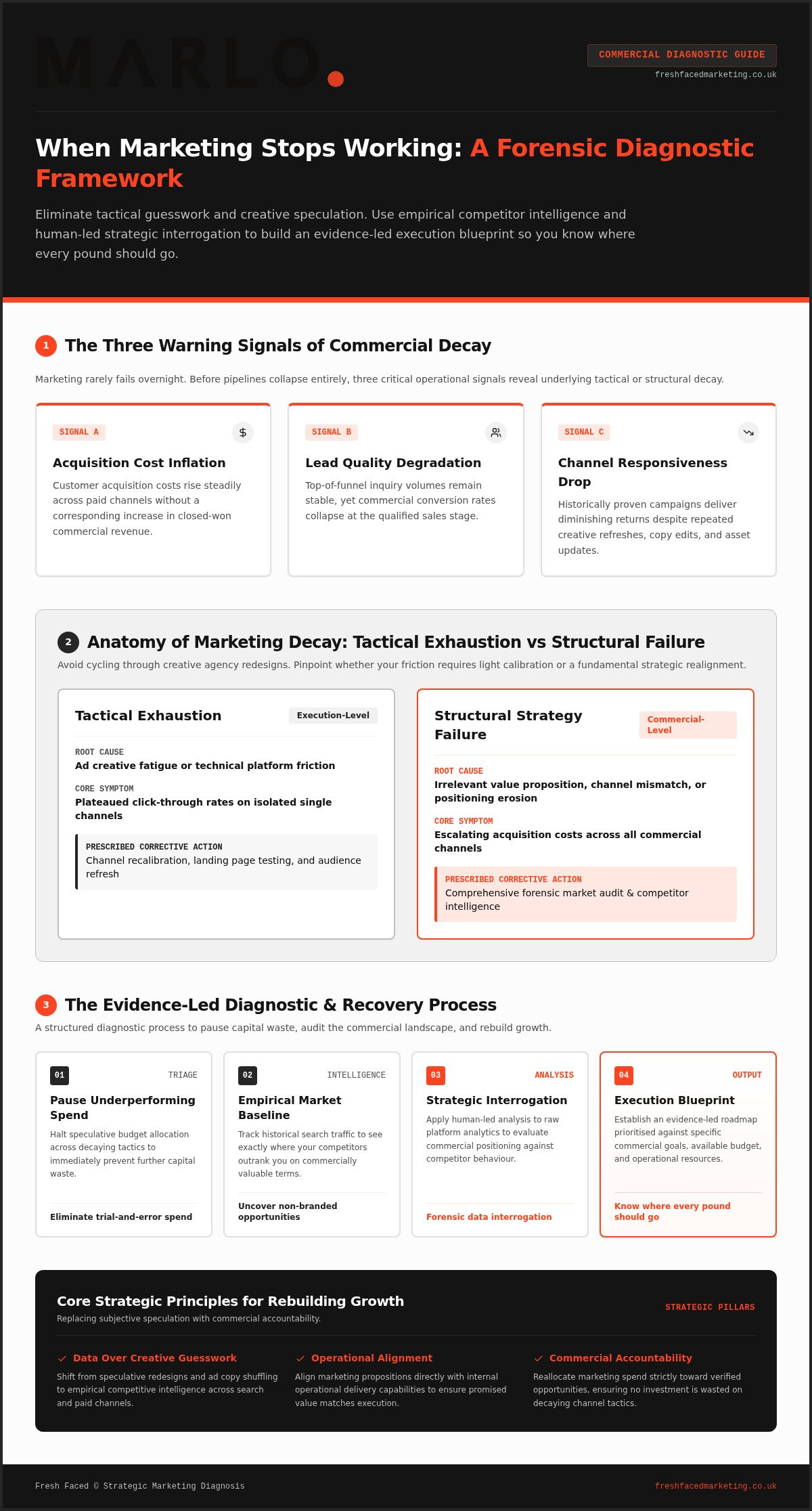
To pinpoint the breakdown, evaluate three critical operational signals across your commercial pipeline:
- Acquisition cost inflation: Customer acquisition costs rise steadily without a corresponding increase in closed business.
- Lead quality degradation: Volume metrics remain stable, yet commercial conversion rates collapse at the sales stage.
- Channel responsiveness drop: Proven campaigns experience diminishing returns despite repeated creative tweaks.
The Symptoms of Tactical Channel Fatigue
Tactical channel fatigue appears when mature digital campaigns hit saturation. You might see rising cost-per-click metrics across paid search and social platforms alongside flatlining pipeline revenue. In many instances, form fills continue to register, but closed-won revenue deteriorates rapidly. This divergence signals that your messaging no longer attracts commercially viable buyers. Increasing publishing frequency or rotating ad imagery does not solve this issue; audience fatigue persists because the underlying strategic proposition has exhausted its audience segment.
Shifts in Buyer Behaviour and Market Dynamics
Modern buyer journeys evolve rapidly. Audiences regularly migrate towards uncaptured non-branded opportunities that existing campaigns fail to target. At the same time, aggressive competitors actively monitor your positioning, refining their commercial offers to erode your market share. To maintain profitability, leadership must establish an empirical baseline:
- Track historical search traffic to verify where competitors outrank you on commercially valuable search queries.
- Conduct a forensic audit of competitor activity across search and paid channels rather than guessing their strategies.
- Align marketing messaging directly with internal operational capabilities to ensure promised value matches actual delivery.
Addressing these fundamental dynamics is the cornerstone of knowing what to do when marketing stops working. Resolving acquisition stagnation requires looking past surface-level agency fixes and interrogating hard commercial performance data.
The Anatomy of Marketing Decay: Tactical Failure vs Structural Breakdown
Marketing stagnation stems from two distinct root causes: surface execution errors or foundational strategic decay. Confusing one for the other is costly. When lead generation stalls, leadership teams often fire their creative agency and hire another. Yet cycling through agencies produces diminishing returns. A fresh colour palette or updated ad copy cannot revive an obsolete commercial offer or realign a misdirected channel strategy. Resolving what to do when marketing stops working requires separating isolated channel friction from comprehensive commercial collapse.
The following diagnostic framework illustrates the distinction:
| Diagnostic Dimension | Tactical Exhaustion | Structural Strategy Failure |
|---|---|---|
| Root Cause | Ad creative fatigue or technical friction | Irrelevant value proposition or channel mismatch |
| Core Symptom | Plateaued click-through rate on single channels | Escalating acquisition costs across all channels |
| Corrective Action | Channel recalibration and landing page testing | Comprehensive market and competitor audit |
Isolated Tactical Breakdown: When the Channel Needs Calibration
Tactical friction occurs when high-potential campaigns encounter operational bottlenecks. Bidding algorithm changes, tracking errors, or slow mobile loading speeds can abruptly depress conversions. Similarly, running the same creative asset to a finite audience for several months causes natural fatigue. In these cases, your strategy remains sound. You don’t need a complete overhaul; you need disciplined calibration, refreshed testing schedules, and technical journey optimisation.
Systemic Strategic Failure: When the Foundation Has Crumbled
Structural failure runs much deeper. This breakdown happens when your core messaging speaks to outdated personas, or when your business invests heavily in channels that commercial decision-makers no longer use. If your customer acquisition costs rise across every platform simultaneously, tactical tweaks won’t rescue performance. To understand the underlying reasons behind widespread channel stalls, explore our diagnostic analysis on why is my marketing failing.
Determining what to do when marketing stops working starts with objective clarity. Instead of committing budget to speculative redesigns, forward-thinking organisations interrogate empirical competitor data through interactive tools like MARLO to uncover winnable spaces and clarify their true commercial direction.
Auditing Your Commercial Landscape: Data Over Creative Guesswork
When customer acquisition stalls, executive discussions often devolve into subjective debates over branding colours, ad imagery, and copy tone. Guesswork won’t fix your margins. Knowing what to do when marketing stops working requires replacing speculation with empirical market intelligence. To regain momentum, you must audit your competitive environment and evaluate hard numbers across search visibility, channel engagement, and actual commercial spend. Reviewing the principles of market research led marketing clarifies why systematic data collection must precede any new budget allocation.
Competitive Interrogation Across Search and Social
Pinpointing lost revenue begins by interrogating your competitors’ multi-channel footprint. You must see exactly where your competitors outrank you on high-intent search queries. Review their active paid media setups across Google, Meta, and LinkedIn to identify their core offers, hooks, and landing page funnels. Furthermore, auditing 90 days of competitor social media data regarding publishing frequency and engagement patterns reveals which messages resonate with your shared audience and which fall flat.
Uncovering Uncaptured Commercial Opportunities
Market leaders often overlook profitable search territory. By conducting forensic-level analysis across your sector, you can isolate high-converting gaps that established players neglect. The process focuses on three data layers:
- Uncaptured non-branded opportunities: Identify high-intent search terms where qualified prospects seek solutions without typing a specific brand name.
- Cost-per-click efficiency: Examine paid search and social auction pricing to discover undervalued keywords with lower acquisition costs.
- Content gaps: Pinpoint critical commercial questions your prospective buyers ask that competing resources fail to address.
Relying on manual spreadsheets across disconnected ad accounts leaves room for error. Utilising an interactive web dashboard like MARLO delivers a single, comprehensive report that consolidates competitor traffic, non-branded search terms, 90 days of social engagement, and cross-platform paid media metrics. You choose the specific competitors you want to analyse and retain indefinite access to the live findings. This evidence-based audit establishes the clarity you need to discover winnable spaces, eliminate wasted spend, and know precisely what to do when marketing stops working.
Five Practical Steps to Reclaim Growth When Lead Generation Stalls
Halting commercial decline requires decisive, methodical action. Panicked shifts in tactics only waste cash reserves. When executive teams consider what to do when marketing stops working, the solution lies in executing a disciplined five-stage turnaround process:
- Halt non-performing spend immediately: Freeze underperforming ad sets and speculative initiatives displaying runaway acquisition costs to protect working capital.
- Audit multi-channel competitor positioning: Evaluate how rival brands capture demand across search and paid channels.
- Execute forensic customer journey analysis: Interrogate conversion funnels to pinpoint where qualified prospects drop off.
- Realign commercial propositions: Refine core value propositions around verified buyer pain points rather than internal assumptions.
- Construct a prioritised execution roadmap: Develop a 12-month commercial strategy based on empirical evidence and available internal resources.
Stemming the Bleed and Auditing Assets
Preserving margin comes first. Pause bleeding campaigns across paid networks where cost-per-acquisition exceeds commercial viability. Stripping out vanity metrics such as impressions, clicks, or surface engagement exposes the true pipeline velocity. Reviewing our framework for building an actionable marketing roadmap helps structure this transition from tactical chaos to strategic order.
Prioritising Budget and Execution Realities
Once you stabilise cash flow, strategic capital allocation takes precedence. Leadership must know where every pound should go by mapping budgets directly against high-converting opportunities. Selecting the right channels requires matching commercial ambitions with operational capacity, available skill sets, and working capital. Establish clear 30-day leading indicators, such as qualified inbound pipeline value and verified enquiry velocity, to measure viability before scaling investment.
Implementing these practical stages establishes complete commercial control. If your team needs structured support to understand what to do when marketing stops working, Fresh Faced provides the diagnostic clarity and evidence-led strategic roadmaps required to reignite dependable pipeline growth.
Replacing Speculation with an Evidence-Led Execution Blueprint
Traditional agency retainers often trap businesses in open-ended cycles of activity without clear commercial accountability. Monthly invoices arrive, yet pipeline clarity remains elusive. When campaign returns diminish, agencies frequently pitch subjective creative refreshes to justify ongoing fees. Determining what to do when marketing stops working shouldn’t force leadership into indefinite vendor dependency. Instead of funding speculative retainers, organisations require an independent, research-backed strategy. Reviewing the framework of The Marketing Strategy Blueprint demonstrates how empirical market research translates directly into commercial control and sustainable growth.
Human Strategic Interrogation vs Raw Data Dashboards
While automated tools deliver essential data, numbers alone cannot set strategy. Platforms like MARLO uncover critical competitor traffic patterns and uncaptured non-branded opportunities across search and paid channels. However, translating raw findings into decisive commercial action requires experienced human oversight. Through the Marketing Success Blueprint (MSB), organisations gain direct access to senior strategists who conduct intensive strategy workshops and one-to-one strategy calls. This human-led strategic interrogation stress-tests commercial assumptions, aligns market findings with operational capacity, and eliminates speculative guesswork before capital is deployed.
The Portable Execution Blueprint
The culmination of this forensic-level analysis is a portable execution blueprint. Unlike traditional agency contracts designed to create reliance, an independent blueprint belongs entirely to your business. It provides a structured, prioritised 12-month commercial roadmap that ensures leadership teams know where every pound should go. Each recommendation is mapped against validated business goals, available budgets, and internal skill sets, making execution completely achievable.
Whether delivered by an internal department or an external implementation partner, the roadmap provides unambiguous direction. Learn more about our strategic methodology to see how disciplined diagnostics and human-led strategy empower leadership, providing the ultimate answer to what to do when marketing stops working.
Reclaim Commercial Control and Rebuild Your Pipeline
Marketing stagnation isn’t an inevitable crisis; it’s a diagnostic opportunity. Reviving commercial momentum requires stripping away subjective agency opinions, halting non-performing spend, and interrogating the broader market. Knowing what to do when marketing stops working comes down to replacing speculative guesswork with empirical evidence.
Equipping your business with clarity requires proven diagnostic systems. Proprietary MARLO competitor analysis gives your team indefinite access to multi-channel performance data, exposing profitable, uncaptured non-branded opportunities across search and social channels. To turn those insights into an enduring growth engine, forensic-level Marketing Success Blueprint workshops deliver human-led strategic interrogation alongside senior strategists, culminating in a complete 12-month execution roadmap tailored to your specific budget and operational capacity.
You don’t need to accept diminishing returns or opaque agency retainers. Take decisive commercial action and Request an Evidence-Led Marketing Review to ensure every pound of your marketing investment drives measurable pipeline growth.
Frequently Asked Questions
How do I know if my marketing has stopped working or if it is just a temporary seasonal dip?
Compare historical year-on-year metrics against broader market search demand. Natural seasonality affects entire sectors predictably and rebounds quickly. In contrast, systemic decay shows rising customer acquisition costs, plateauing pipeline volume, and deteriorating lead-to-close rates even during peak trading periods. If sales conversations dry up whilst competitor activity remains stable or increases, your acquisition engine faces a strategic breakdown rather than a temporary lull.
Should I fire my marketing agency if performance drops for two consecutive months?
Don’t terminate an agency relationship without conducting an independent audit first. A sixty-day dip might stem from platform tracking bugs, algorithm calibrations, or channel fatigue. However, if your agency responds to falling revenue by pitching subjective creative redesigns instead of empirical data, misalignment exists. Knowing what to do when marketing stops working means demanding commercial accountability and objective diagnostic data before commissioning another speculative engagement.
What is the difference between a tactical marketing failure and a strategic breakdown?
Tactical failures stem from localized execution friction, such as broken conversion tracking, slow landing pages, or ad fatigue within a single campaign. Strategic breakdowns run far deeper. They occur when your core commercial messaging no longer resonates with buyers, or when budget flows into channels your target prospects ignore. Tactical issues require disciplined testing and technical refinement; strategic failures require a complete commercial realignment.
How long should an evidence-led marketing audit take before we see actionable answers?
An evidence-led audit should produce actionable answers within days, not months. Automated research tools like MARLO immediately consolidate competitor traffic, winnable paid search spaces, and ninety days of social engagement into a single interactive dashboard. Comprehensive human-led strategic interrogation, delivered through the Marketing Success Blueprint, rapidly stress-tests these findings via dedicated workshops to establish a prioritised, twelve-month commercial roadmap without delay.
Can we fix our marketing performance internally without hiring another full-service agency?
Yes. Appointing another traditional agency often recreates the same cycle of vendor dependency and overhead. When evaluating what to do when marketing stops working, acquiring an independent execution blueprint gives your leadership team complete autonomy. It establishes where every pound should go, prioritises initiatives against realistic internal resources, and provides clear guidelines that your in-house staff or existing contractors can execute directly.
How does forensic competitor research identify why our acquisition costs have escalated?
Forensic competitor analysis interrogates competitor activity across Google, Meta, and LinkedIn to uncover where rival campaigns outbid you. It reveals whether competitors have shifted messaging, expanded into your niche, or targeted the exact search queries driving your business. Evaluating their paid media strategies and organic footprints highlights lower-cost, winnable spaces, allowing you to redeploy budget toward high-margin opportunities competitors have overlooked.
What role does uncaptured non-branded search play when traditional brand campaigns plateau?
Branded search campaigns naturally plateau once you capture existing awareness within your immediate network. Uncaptured non-branded opportunities represent prospective buyers searching for solutions without a specific vendor in mind. Identifying where competitors outrank you on these high-intent commercial terms allows you to capture demand at the research stage. Targeting these queries directly drives fresh inbound pipeline volume that branded channels cannot unlock.