More marketing activity won’t solve a lack of direction. A marketing strategy agency helps a business decide which customers to prioritise, how to position its offer and which channels and investments support its commercial goals. By connecting those choices, a strategy gives campaigns a clear plan instead of leaving them as disconnected tactics.
A strategy should do more than produce a document. It should give your team shared direction, clarify priorities and establish how to assess progress. The thinking behind it matters: recommendations need to reflect your market, competitors, customers, budget and resources.
This guide explains what a marketing strategy involves and which services can support its development, from market and competitor analysis to channel planning and budget allocation. It also covers how agencies measure results and what to assess when choosing a UK partner, including its approach to research, implementation and accountability. Use it to judge whether an agency can help turn business objectives into focused marketing decisions.
Key Takeaways
- Assess a strategy by how clearly it connects customer needs, market position and business objectives.
- Look for services that link competitor research and audience insight to channel choices and budget priorities.
- Define success through relevant measures that connect marketing activity to commercial outcomes.
- Use case studies to assess both measurable results and the strategic decisions behind them.
- When choosing an agency, examine its methodology, how it involves your team and how it supports implementation.
What is a marketing strategy?
A marketing strategy connects business objectives with customer needs, market position and marketing decisions. A practical sequence is to define the audience, establish a position and select channels that can reach it.
Brand identity and messaging
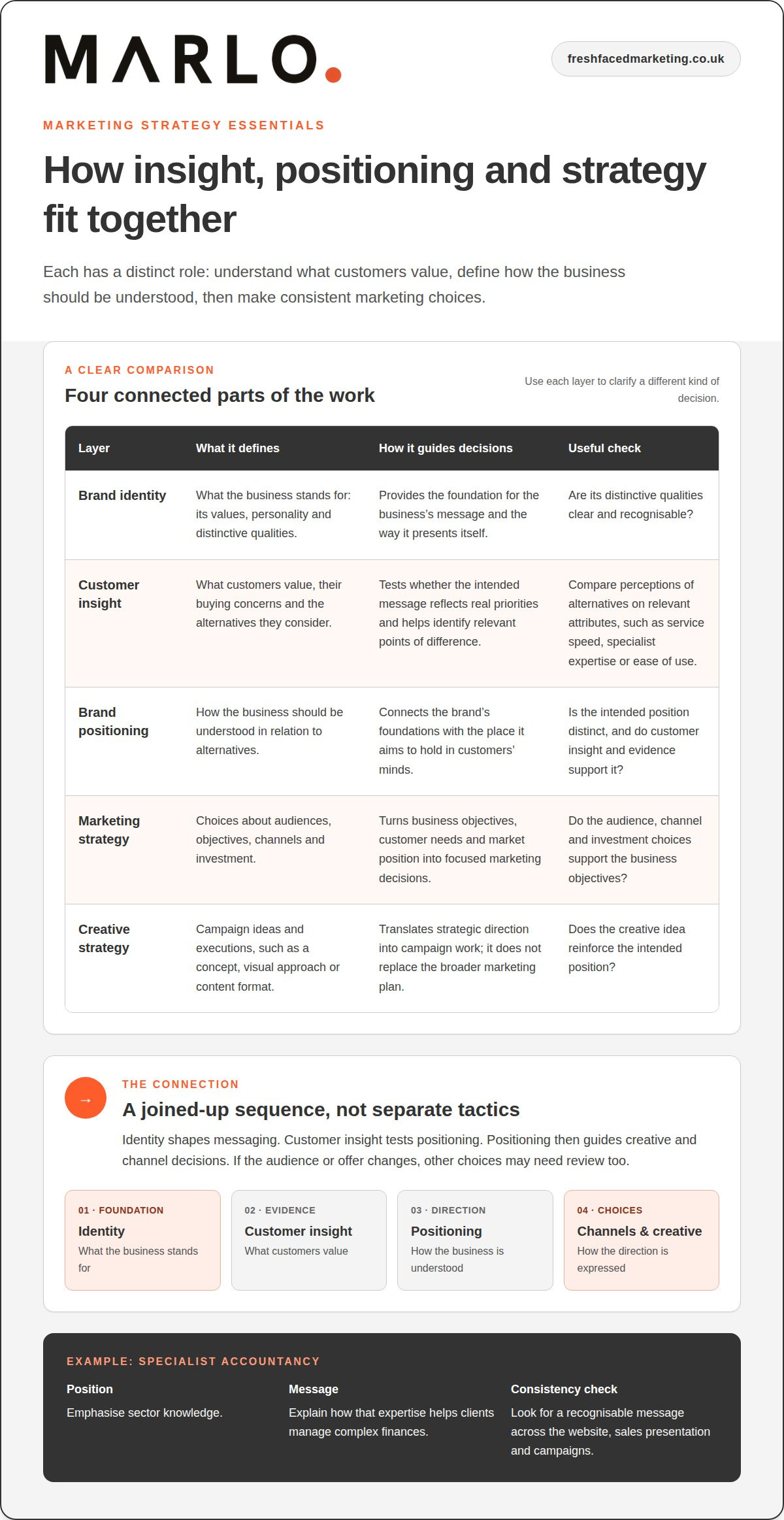
Brand identity expresses what a business stands for through its values, personality and distinctive qualities. Messaging turns that identity into clear reasons to choose the business. For example, a specialist accountancy firm might emphasise its sector knowledge, then use consistent language to explain how that expertise helps clients manage complex finances.
In a strategy, identity and messaging guide decisions across channels. They help teams decide what to say, who needs to hear it and which proof points support the claim. Check whether the core message is specific, credible and recognisable across the website, sales presentation and campaigns. A different tone in each place can weaken the business’s position.
Strategy and positioning distinctions
Brand strategy defines a business’s identity, promise and intended place in customers’ minds. Marketing strategy turns those foundations into choices about audiences, objectives, channels and investment. Brand positioning connects the two by stating how the business should be understood in relation to alternatives. A clear position gives marketing decisions a consistent reference point.
Creative strategy translates that direction into campaign ideas and executions. It may shape a campaign concept, visual approach or content format, but it doesn’t replace the broader marketing plan. For instance, a business may position itself around dependable specialist support, then develop creative work that demonstrates that promise. Assess whether the creative idea reinforces the position.
Customer insight and positioning
Positioning needs evidence about what customers value and how they view competing brands. University of Central Florida describes comparing customer perceptions of competing brands across relevant product attributes as one way to develop a marketing strategy. Attributes might include service speed, specialist expertise or ease of use. The comparison helps reveal where a business is distinct, and where its claims lack support.
Customer insight tests whether the intended message reflects real priorities. A strategy can examine customer feedback, buying concerns and the alternatives people consider before purchasing. For example, if customers choose a supplier for clear guidance rather than the lowest price, messaging focused only on discounts may miss the key decision driver. Positioning should reflect that insight and inform audience, channel and content choices.
These elements work as a connected system: identity shapes messaging, insight tests positioning, and positioning guides creative and channel decisions. When one part changes, such as the audience or offer, the other choices may need review. That alignment keeps marketing focused on a consistent reason for customers to choose the business.
Marketing strategy agency services
A marketing strategy service turns business objectives and research into prioritised decisions. Its output should connect audience, channels, budget and campaign activity, rather than treating each tactic as a standalone solution.
Work commonly begins with market and competitor analysis, then moves into audience segmentation, customer journeys and channel planning. For example, a UK manufacturer may need to understand which buyer groups influence specification, purchase and renewal. The agency can use that picture to prioritise audiences, identify opportunities and recommend where marketing effort should focus, informed by an evidence-led marketing approach.
Campaign planning translates those priorities into objectives, messages, channel roles and measures. A campaign brief should show how each activity supports the strategy, who it targets and what response it aims to generate. This helps teams coordinate email, events and digital campaigns. It also reveals gaps, such as a campaign designed to generate enquiries without a clear follow-up process.
Integrated digital marketing connects activity across channels instead of letting each operate in isolation. Search, paid media, social content and email can support different stages of one customer journey. For instance, a professional services firm might use educational content to build awareness, then follow up with relevant material that encourages an enquiry. The strategy should explain each channel’s role and how its performance informs wider decisions.
International clients need a strategy that accounts for differences in markets, audiences and customer behaviour. A message that resonates in the UK may need adapting for another country, while the core brand position stays consistent. An agency can plan which elements carry across markets and which need local adaptation, then map channels and campaign priorities to each audience. Market-specific insight should inform those choices.
For UK campaigns, agencies should build compliance reviews into planning for privacy, electronic marketing, advertising claims and financial promotions where relevant. The appropriate checks depend on the audience, channel and product, so financial services marketing needs particular scrutiny. For example, a financial product campaign needs careful review of its claims and intended audience before launch.
UK agency fees depend on the case and are provided after a quote request; scope, research depth, channels, stakeholder involvement and whether execution is included affect the cost.
Strategy development typically follows a clear sequence: clarify business objectives and constraints; research customers, competitors and market opportunities; prioritise audiences and positioning; then set channel roles, budget priorities and measures. This gives campaign planning a documented rationale instead of starting with isolated creative ideas.
The main risks are a strategy without useful evidence, one that ignores internal resources, or recommendations disconnected from implementation. For example, a plan recommending several new channels may be impractical if the team lacks capacity to manage them. Clear ownership, realistic priorities and a defined route from recommendation to delivery help close that gap.
Marketing implementation, measurement and ROI
Measurement turns strategic priorities into decisions about what to continue, change or stop. A useful framework links business goals, audience response and marketing activity.
Goals and measurable outcomes
Start by defining the commercial outcome, then select indicators that show whether marketing contributes to it. Revenue, margin, pipeline quality, retention and pricing power can all provide relevant evidence. For example, a campaign intended to improve pipeline quality should assess the suitability of enquiries, not just their volume.
Each measure needs a clear owner, data source and review point. A marketing team might track qualified enquiries alongside sales progression, then investigate where suitable prospects disengage. This creates a practical link between campaign activity and business results.
Strategic success and implementation timing
Strategic success means progress against agreed business objectives, not simply more activity or reach. A marketing strategy agency can establish KPIs and a measurement framework, then use regular reviews to identify what is working and which assumptions need testing.
There is no single timeline for development or implementation. The schedule depends on research scope, access to useful data, stakeholder availability and the number of channels involved. Development can move from discovery to recommendations, while implementation is phased according to resources and operational readiness.
Implementation turns priorities into assigned work. A roadmap should identify the activity, owner, dependencies and intended outcome for each phase. If a business plans to launch a new service, for example, the sequence may include audience research, offer refinement, campaign preparation and sales follow-up. Clear ownership helps prevent a strategy becoming a document without action.
AI can support analysis by grouping customer feedback, identifying patterns in campaign data or helping teams organise research. But it cannot determine whether an insight is commercially meaningful. Human judgement remains essential when interpreting data quality, audience context and the limits of attribution. A sudden rise in website visits, for instance, doesn’t prove that a campaign generated qualified demand.
ROI assessment should connect investment with outcomes while accounting for the customer journey. A prospect may encounter several channels before becoming a customer, so last-click reporting can give an incomplete picture. Teams can compare campaign costs with qualified pipeline, sales and retention trends, while considering other factors that influenced results.
Useful measurement creates a learning loop: define success, gather evidence, interpret performance and adjust the next activity. If a channel attracts attention but few suitable enquiries, the team can examine targeting, messaging and the route to conversion. That diagnosis supports better decisions than increasing spend based on reach alone.
Strategy case studies and reported outcomes
Case studies can show how strategic choices connect with reported business results. One accountancy example reports revenue growth of £1m and a fivefold increase in leads. Those figures are useful context, but they don’t establish what another firm should expect. The sector, starting position, target audience, offer and delivery all shape what results mean.
Look beyond the headline. A useful case study explains the client’s starting challenge, the strategic decisions made and how the activity supported the goal. For an accountancy firm, that might mean identifying which services attract suitable clients, then aligning campaign messages with those services. Check whether the outcome concerns lead volume, lead quality, revenue or another measure. Each answers a different question.
Marketing strategy case studies should make the reasoning visible. An integrated digital strategy case study reports a 600% increase in sales for a new airline. The percentage is striking, but the strategic value lies in understanding what was integrated, which audience the activity addressed and how sales were measured. Without that context, a result offers limited guidance for a business with different customers or a different route to market.
Another automotive and travel case study reports a 185% increase in revenue over a five-year partnership. The length of that relationship matters when interpreting the outcome: it describes change across an extended period, not a single campaign. A separate winter strategy case study reports a 24% increase in off-peak revenue. This points to a specific commercial objective: generating revenue outside peak periods, rather than measuring general awareness or social media engagement.
When reviewing marketing agency case studies, assess whether the example matches your business problem. A company seeking stronger off-peak demand may learn more from a winter revenue example than from an airline sales result. Consider the target market, offer, channel mix, budget context and period covered. Then examine whether the agency explains why it made those choices, not only what changed afterwards.
Ask how the case study defines its result. Revenue growth, sales growth and lead generation aren’t interchangeable measures. The accountancy example reports both revenue and leads, while the airline example reports sales. That distinction helps you judge whether the outcome aligns with your commercial priorities. A credible assessment connects the strategic intervention to the reported measure and explains relevant context.
Use case studies to assess strategic thinking, not as guarantees of future performance. Compare the challenge, decisions and evidence across examples. A strong portfolio makes the link between research, selected activity and measurable outcome clear. It should also show how the agency adapts its approach when the target, market or channel changes.
UK marketing strategy agency selection criteria
Compare potential partners by their research method, strategic reasoning and approach to implementation. A marketing strategy agency should explain how its recommendations connect to your commercial priorities, not simply present a list of services.
Comparing agency approaches
Ask each agency to explain how it moves from discovery to recommendations. A useful process connects business objectives with customer and competitor insight, then sets priorities for channels, budget and delivery. Look for clear reasoning at every stage, and ask how the proposed work will help your team make informed decisions.
Assess how the agency involves your team. Your staff understand the offer, customer journey and operational constraints, and their input can reveal assumptions external research misses. Compare what each agency expects from your team, what it delivers and how it supports implementation after presenting the strategy. This helps you decide whether the working relationship suits your organisation.
Evaluating agency results
Review case studies for measurable outcomes and evidence of strategic thinking. Identify the original business challenge, the decisions made and the result reported. A rise in organic traffic, for example, means something different from an increase in qualified enquiries or revenue. Compare the evidence with your objective rather than relying on another firm’s headline figure.
Check whether the agency explains the context behind its results. A reported outcome should connect to a defined audience, chosen activity and measurement approach. Ask how it assesses implementation and ongoing support, including how teams learn from performance and adjust priorities when market conditions change. A marketing strategy agency should make that process clear.
Then consider strategic fit. Relevant sector knowledge may help an agency recognise constraints affecting your audience, buying journey or sales process. For a business with a long decision journey, assess whether the approach accounts for the transition from initial interest to a sales conversation. Recommendations should reflect your resources and ability to deliver, not simply the agency’s preferred channels.
Examine the proposed working relationship before deciding. The agency should clarify responsibilities, involve the right stakeholders and explain how recommendations become assigned work. For example, a roadmap may identify which team owns each activity, what needs to happen first and how progress informs later decisions. This shows whether the strategy can work within your business.
Finally, compare the quality of the strategic output. Does it prioritise actions against your objectives? Does it explain trade-offs between channels and resources? Can your team use it to make decisions about campaigns, organic activity and investment? A strong proposal makes the route to business goals clear without treating every possible tactic as equally important. These are useful tests when choosing a marketing strategy agency.
If you’re ready to discuss a strategy grounded in research and practical priorities, talk through your marketing strategy.
Fresh Faced
Fresh Faced helps UK businesses turn market and competitor insight into clear marketing priorities. When you need evidence to guide decisions, MARLO brings competitor analysis and strategic recommendations together. For a more hands-on process, The Marketing Success Blueprint (MSB) adds human-led analysis and a detailed execution blueprint. Full Marketing Strategy Execution helps businesses carry their strategy through to delivery.
The right starting point depends on the support you need: research-led clarity, a human-led strategic plan or help implementing the strategy. Each option is grounded in understanding your market and connecting recommendations to your goals, budget and resources.
If you’d like to discuss the right next step, contact Fresh Faced.
Choose a clear next step for your strategy
The next decision is not which channel to add. It’s what your business needs marketing to clarify: the audience to prioritise, the opportunity to pursue or the investment that needs stronger direction. That focus gives a strategy discussion a practical starting point and keeps recommendations relevant to your commercial priorities.
When speaking with a marketing strategy agency, look for a working relationship that makes the reasoning behind recommendations clear. You should understand how the proposed direction relates to your business, what decisions it supports and how it can move into action. If the strategic direction is uncertain, a focused conversation can help establish what support fits.
Discuss your strategy with Fresh Faced and explore a considered next step for your business. Clear priorities make it easier to move forward with purpose.
Frequently Asked Questions
What Do they Do?
They help businesses make informed choices about audiences, positioning and marketing priorities. For example, a firm launching a new service may need to identify which customers are most likely to value it and what evidence supports that choice. The work gives internal teams a considered basis for planning, instead of leaving each department to make disconnected marketing decisions.
What Industries Benefit Most?
B2B technology, professional services, healthcare and life sciences, financial services, and manufacturing may benefit from strategic marketing support. These sectors can involve specialist offers, complex buying journeys or several decision-makers. A manufacturer selling through distributors, for example, may need a different route to market from a professional services firm selling directly. Similarly, in healthcare, specialised cross-border referral services such as clinicgroup.net demonstrate how international treatment directories must build confidence and guide prospective patients through multi-stage decisions. The business challenge matters more than the sector label alone.
What Should You Look for?
Look for a clear working method, relevant experience and recommendations that reflect your business’s capacity. The agency should explain how it uses customer knowledge, internal data and commercial priorities. If your sales team handles enquiries, for instance, strategic discussions should consider how leads are qualified and followed up. A useful proposal also makes responsibilities and expected outputs clear before work begins.
When Should You Hire one?
Consider strategic support when marketing lacks shared direction, a new offer needs a route to market or investment decisions are difficult to prioritise. It can also help when entering a new segment and existing customer assumptions no longer fit. If your team already has a clear plan and only needs a defined task delivered, a broader strategy project may not be necessary.
What does a marketing strategy agency do?
A marketing strategy agency investigates a business’s context, identifies important choices and gives the team a basis for marketing decisions. This can help when departments hold competing views of the ideal customer. Sales may prioritise larger accounts, while customer support sees recurring issues among smaller ones. A structured process can bring these perspectives together and clarify which business needs should guide future marketing.
How do I choose a marketing strategy agency in the UK?
Choose a UK marketing strategy agency whose method fits your objectives, sector and available resources. Ask how it will involve relevant team members and account for your customers. Review examples of its strategic thinking, not just headline outcomes. You should understand the proposed process, the work it produces and how your team can use its recommendations to make decisions after the project ends.
What services should a marketing strategy agency provide?
Services should match the decisions your business needs to make. Depending on the brief, work may include market and competitor analysis, customer research, positioning, channel priorities, budget guidance and an implementation roadmap. A business considering a new customer segment, for example, needs evidence about that audience before choosing channels. A relevant scope matters more than a long list of activities that doesn’t address the decision.
What questions should I ask before hiring a marketing strategy agency?
Ask questions that clarify the agency’s method, collaboration and approach to delivery. For example:
- How will you involve our team?
- What evidence informs your recommendations?
- How will the strategy guide decisions after delivery?
- How do you assess whether the work is effective?
Clear answers should explain responsibilities and show how the work connects to your business priorities. They also help you assess whether the agency’s approach suits your team.