The hardest part of how to market a complex product isn’t explaining every feature. It’s helping the right buyers see how it solves a problem that matters to them, then building a go-to-market strategy around a clearly defined initial market. Start with the buyer’s commercial situation, not the product specification.
That can be challenging when a purchase involves technical, operational and procurement stakeholders, each weighing different risks and outcomes. A clear marketing approach gives them a shared understanding of the value while answering the questions that matter to each role.
This article explains how to frame product value from the buyer’s perspective, shape a focused go-to-market strategy and map personas to the jobs they need done. It also covers how to choose useful formats, from practical articles to video and detailed product information. The aim is to create a coherent path from first explanation to informed buying decision, grounded in market needs rather than a list of product capabilities.
Key Takeaways
- Translate technical features into buyer outcomes, using relevant evidence to make the value clear to different stakeholders.
- Focus the go-to-market strategy on an initial market where the product can meet a specific need, then use what you learn to guide expansion.
- Map buyer roles to their tasks and unmet needs to reveal where product capabilities and customer expectations align or diverge.
- Choose information formats to match the questions buyers need answered, from practical articles and videos to more detailed resources.
- Plan for a buying journey involving multiple stakeholders, with each interaction adding useful information while reinforcing a consistent commercial message.
1. How a marketing strategist explains product value from the buyer’s perspective
Start with the buyer’s commercial situation, then connect the product to a specific problem. For a complex product, identify what delays decisions, increases operating pressure or limits revenue. Buyers need to understand the consequence before they encounter technical detail. A micro-pitch should capture the value in one sentence, not reproduce a feature list.
Next, separate the needs of each stakeholder. Procurement may need a clear account of cost and risk; development teams may prioritise integration; sales may focus on customer outcomes. A useful message hierarchy keeps the core commercial idea consistent while adjusting the emphasis. For example, explain a product capability in terms of implementation effort to technical teams and business relevance to senior decision-makers.
To understand the buyer’s commercial situation, examine the problem, its consequences and the evidence buyers use to assess solutions. Customer questions, sales conversations and product use can reveal where understanding breaks down. For each significant feature, explain what it enables, why that matters to the buyer and what limitation remains without it. This makes technical evidence relevant rather than decorative.
Cultural differences matter when a product enters a new market. Research local customer types, behaviour, competitors and product use instead of assuming translated copy will explain value. The same workflow, for example, may serve a different need where local teams organise work differently. Research can also show whether the product, documentation, channels or customer journey needs adapting.
For UK marketing, account for advertising and data-protection requirements by substantiating claims, presenting material terms clearly and handling personal data responsibly. Review campaign copy, landing pages, email and audience targeting to keep the answers consistent across touchpoints.
Measure performance by connecting marketing activity to commercial progress. Track engagement from target organisations, use of sales materials and movement towards proposal stage. Sales feedback can show whether prospects understand how the product differs from a lower-cost alternative. Assess ROI by relating attributable commercial returns to campaign investment, using measures that reflect the buying cycle.
Common risks include leading with technical detail, making broad claims without relevant evidence and mistaking one customer’s unusual requirement for market demand. Assuming translation alone addresses cultural differences is another. Each mistake can weaken buyer understanding or direct investment towards the wrong audience.
To market a complex product effectively, start with the buyer’s situation, translate features into consequences and support each claim with relevant evidence. The result is a message that answers real commercial questions without obscuring the product’s limits.
2. How a marketing strategist builds a go-to-market strategy
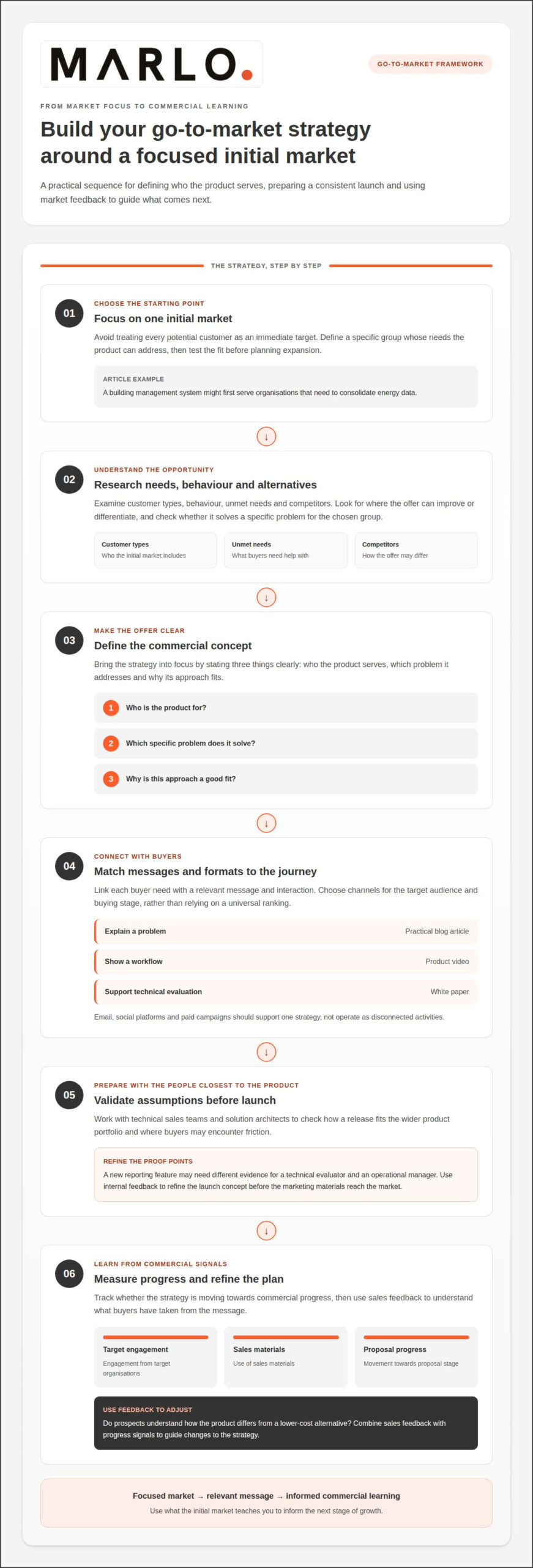
A go-to-market strategy turns product direction into a plan for reaching and serving buyers. Begin by identifying a focused initial market instead of treating every potential customer as an immediate target. A building management system, for example, might first serve organisations that need to consolidate energy data. Test whether the product meets that group’s needs before planning expansion into other segments.
That focus shapes the commercial concept: who the product serves, which problem it addresses and why its approach fits. Market research examines customer types, behaviour, unmet needs and competitors, as well as opportunities to improve or differentiate the offer. A broad addressable market is not a useful starting point if the product cannot yet solve a specific group’s problem. A credible beachhead gives positioning, messaging and channel decisions a defined audience.
Next, map the route from initial awareness to sales discussion. Connect each buyer need with a suitable message and interaction. A practical blog article can explain a problem; a product video can show a workflow; a white paper can support closer technical evaluation. The best channels depend on the target audience and buying stage, not a universal ranking. Email, social platforms and paid campaigns should support one strategy rather than operate as disconnected activities.
For a new release, validate assumptions with technical sales teams and solution architects. They can clarify how the release fits the wider product portfolio and where buyers may encounter friction. A new reporting feature, for example, may need different proof points for a technical evaluator and an operational manager. Use their feedback to refine the launch concept before the marketing materials reach the market.
Build trust with specific, relevant evidence. Support product claims with demonstrations, customer examples or clear explanations of how a capability works, and state meaningful limits. If a product integrates with selected systems, describe that scope accurately rather than implying universal compatibility. Consistency across campaign pages, sales presentations and technical documentation helps buyers assess the same offer at every interaction.
Measure whether the go-to-market strategy is progressing commercially. Monitor engagement from target organisations, use of sales materials and movement towards proposal stage. Sales feedback adds context: do prospects understand how the product differs from a lower-cost alternative? Use these signals to adjust the audience, evidence or channel mix without mistaking activity for demand.
When a strategy needs to connect market evidence, positioning and execution, an evidence-led marketing strategy can help turn those decisions into a coherent plan.
3. How a marketing strategist builds a taxonomy of personas and jobs-to-be-done
A useful taxonomy connects the people involved in a purchase with the work they need a product to perform. It goes beyond job titles. For an industrial monitoring system, an operations manager may need to spot equipment issues, while an engineer needs reliable readings to diagnose them. Treating both as one generic “business buyer” obscures the different tasks shaping their decisions.
Use research to establish those differences. Examine customer conversations, sales questions, product use and unmet needs, then apply six prompts: who, what, when, where, why and how. For example, who records equipment readings, what interrupts the task and how does the team respond? The answers describe real working conditions rather than assumptions based on internal product knowledge.
Personas organise recurring patterns into practical profiles. A profile might describe an operations manager responsible for service continuity, including their goals, relevant experience, daily pressures and decision-making role. Include demographic details such as age or education only when they affect product use. The purpose is to build a focused picture of the buyer’s context, not a fictional biography.
Jobs-to-be-done describe the progress someone seeks in a specific situation. An engineer’s job, for example, may be to identify an unusual reading before it disrupts production. Record the trigger, task, desired outcome and obstacles. This is more precise than a broad label such as “needs better data” and can show whether different personas share a task or face different constraints.
Next, build a taxonomy that groups related jobs without flattening important differences. A maintenance engineer and an operations manager may both want fewer disruptions, yet need different evidence to act. One needs diagnostic detail; the other needs an operational overview. These distinctions help identify which messages, proof points and product capabilities matter to each role.
Then compare the taxonomy with existing product capabilities. Map each priority job to the features that support it, the evidence available and any unresolved gap. If engineers need to compare readings across sites but the product shows only one site at a time, the mismatch becomes clear. It may point to a product gap, a messaging problem or a job that should not lead the proposition.
Finally, use the map to guide decisions across marketing and product teams. A focused launch can prioritise the jobs the current offer serves well, while sales materials answer role-specific questions. Refine the taxonomy as new customer research reveals different tasks or barriers. This keeps personas connected to market behaviour and product fit instead of leaving them as static profiles in a presentation.
4. How a marketing strategist chooses formats for product information
Choose a format based on the question a buyer needs answered. A product page can establish what a system does, while a practical article can explain a specific task. A manufacturer considering monitoring software, for example, may first need to understand how it captures readings. Map each question to a format that answers it clearly, without asking every resource to provide the same level of detail.
Company blogs work well for practical topics centred on a product, such as preparing data for a new reporting process. A white paper can offer deeper analysis for readers assessing technical implications. The formats serve different needs: an article introduces a focused issue, while a white paper examines it in greater depth. Use this distinction to give buyers a clear way to explore further.
Product demonstrations and trials let prospective buyers examine how a product works in practice. A demo can show a user completing a task, such as configuring a report; a trial can help a team assess the workflow in its own context. Case studies add a real-world example of the problem, implementation and outcome, helping buyers judge relevance instead of relying on broad claims.
Video is useful when movement, sequence or interaction is difficult to explain in static copy. For example, a short demonstration can show how an engineer moves from an alert to a diagnostic view. Existing product-training videos lasting 15-30 minutes can provide source material for shorter marketing edits. The strategist selects the segment that answers one buyer question, rather than compressing an entire training session into one asset.
An e-book can bring detailed product information together in a structured resource or supplement a handbook. A product montage can tell one visual story about related items, but works best when it spotlights no more than three products. For a software portfolio, that might mean showing three connected capabilities through one user workflow rather than presenting an undifferentiated catalogue.
Sales enablement materials should answer the questions sales teams hear from prospects. If buyers repeatedly ask how a platform handles existing records, a concise comparison sheet can answer directly and point to relevant technical detail. Use sales feedback to decide whether the answer belongs in a presentation, product sheet, demonstration or in-depth reference document.
Give each format a defined role in the buying process. An early-stage article may explain the problem; a demonstration can show the product in use; a detailed document can support technical evaluation. Check that every asset uses consistent terminology and gives buyers a clear next step. This structure lets information deepen as decision needs become more specific.
5. How a marketing strategist maps the buyer journey for a complex B2B product
A strategist maps the buyer journey by tracing how a buying group moves from recognising a problem to evaluating a solution and preparing a decision. In a complex B2B purchase, technical, procurement, operational and senior-management stakeholders may all contribute. The map needs to show their different questions, evidence needs and decision points, not treat the organisation as one buyer.
Start with evidence from sales conversations, customer questions and existing marketing interactions. Identify the events that prompt research, such as recurring equipment faults or pressure to consolidate reporting. Then record what each role needs to understand before taking the next step. An engineer may need to assess technical fit, procurement may need clear scope, and an operations lead may need to understand the workflow impact.
Next, organise the journey into practical stages. Early-stage campaigns can help buyers define the problem and understand possible approaches. Consideration materials can explain product capabilities and evidence. Later, technical evaluation may call for detailed documentation, while procurement may need information structured for a tender. Shape the stages around how this buying group makes progress, not a generic funnel.
Every interaction should answer a real question and make the next decision easier. An introductory article might clarify the operational issue, followed by a demonstration of a relevant workflow. A technical document can then address integration questions. The material should become more detailed over time, while each piece reinforces the same commercial idea.
Map handovers between marketing and sales. If a prospect requests technical information after a campaign, sales needs context about the material they viewed and their role. That helps the next conversation build on previous engagement instead of restarting the explanation. Sales feedback can reveal gaps, such as repeated questions about implementation or an unclear distinction between product options.
For a tender, account for the information buyers need to compare proposals and assess fit. Keep product language and evidence consistent across marketing and sales materials. A mismatch between a campaign claim and a technical document can create uncertainty for stakeholders assessing the same decision from different angles.
Measure progress across the journey, not just early interactions. Assess engagement from target organisations, use of sales materials and movement to proposal stage. These signals help identify where buyers pause. If prospects read introductory content but rarely request a demonstration, the next step may need clearer relevance or more useful evidence.
For a complex buying group, the map is a working plan. It connects stakeholder needs, useful material and commercial milestones. To develop a more joined-up buyer journey strategy, align each interaction with the decision it needs to support.
Fresh Faced
Fresh Faced helps businesses turn complex product information into evidence-led marketing strategy and coordinated execution. When buyer needs, product capabilities and market demand are difficult to connect, MARLO clarifies the competitive picture, while the Marketing Success Blueprint provides a human-led strategic plan. Full Marketing Strategy Execution can then put the agreed direction into practice.
This support is relevant when your team needs a clearer view of its market, a focused plan for reaching buyers, or help carrying that plan through. The right next step depends on whether you need research, strategic direction or execution. Contact Fresh Faced to discuss your complex product marketing needs.
Make buyer understanding an ongoing priority
Marketing a complex product is not a one-off messaging exercise. Buyer expectations, product capabilities and market conditions can change, so the explanation of value needs to keep pace. Treat questions from sales conversations, product evaluations and customer feedback as signals. They can reveal where buyers hesitate, what evidence is missing or whether the product’s position needs refining.
Knowing how to market a complex product means making those insights useful across the business. A clearer explanation can support better decisions in marketing, sales and product development. The aim is not to simplify the product until its differences disappear. Make the relevant value easier to assess while keeping the detail buyers need within reach.
If your current marketing doesn’t give buyers a clear route from interest to evaluation, a considered review can identify where the explanation or strategy needs attention. Fresh Faced can help you decide on a practical next step for your product and market. Contact Fresh Faced to discuss your marketing. With a clearer direction, your team can help buyers make informed decisions with greater confidence.
Frequently Asked Questions
What is the best marketing strategy for a complex product?
The best strategy connects a clearly defined commercial need to a practical route for evaluating the product. Set decision criteria with sales and product teams, such as implementation fit, operational impact and the evidence required for approval. Then select channels that reach the relevant organisations and support those criteria. A technical briefing, for example, may help an engineering team assess feasibility, while an executive summary supports internal budget discussions.
How can a marketing strategist explain a complex product in simple terms?
Explain a complex product by starting with a familiar task, then showing how the product changes it. For example, describe a monitoring platform as a way to bring equipment readings into one view before outlining its technical architecture. Use specialist terms when they clarify a decision, and define them in context. A short explanation should stand alone, with deeper material available for readers who need it.
How can a marketing strategist identify and segment target customers for a complex product?
Segment target customers by comparing the conditions that make a product relevant, such as the urgency of the problem, existing systems and approval process. A manufacturer facing frequent production interruptions may have different priorities from one reviewing equipment during a planned upgrade. Sales records, customer interviews and product enquiries can reveal these distinctions. Keep segments practical enough to guide campaign choices, without making each account its own category.