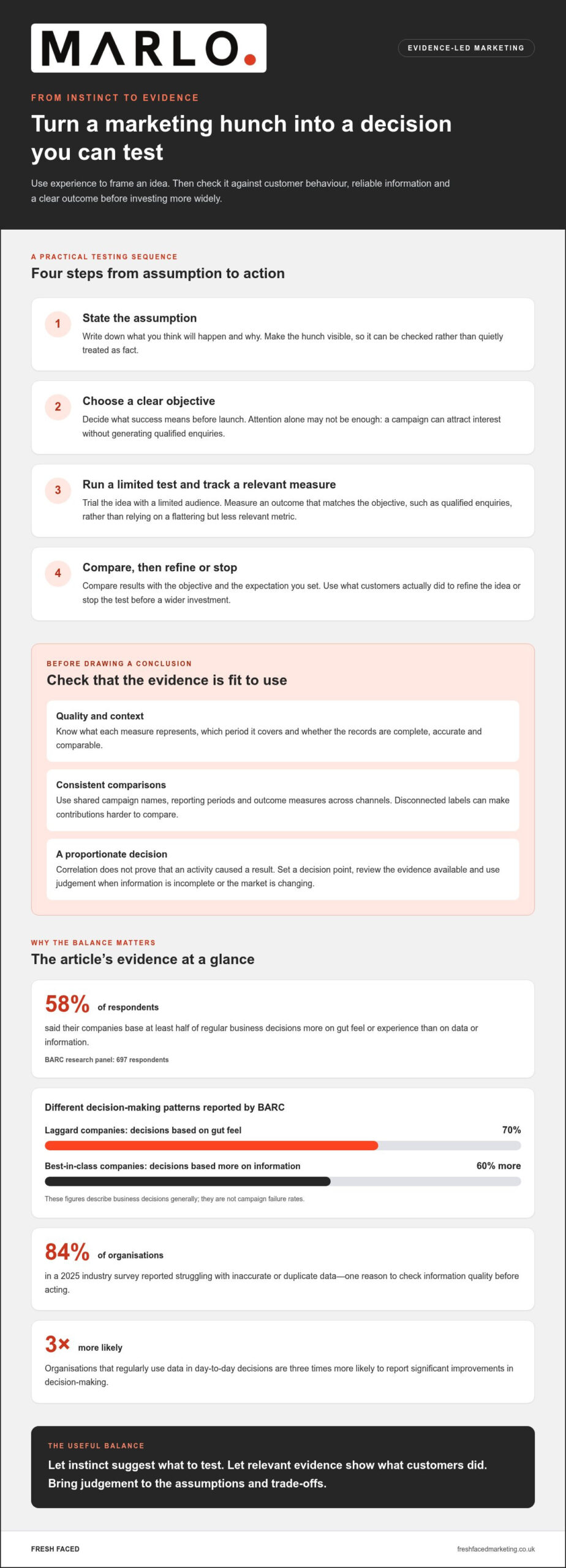
Gut instinct can help marketers spot an opportunity, but it should not replace evidence. The dangers of gut-feel marketing decisions include confirmation bias, overconfidence and investment in ideas that customer behaviour doesn’t support. BARC reports that 58% of respondents said their companies base at least half of regular business decisions more on gut feel or experience than on data or information.
Experience still matters. It can help interpret incomplete data, recognise emerging patterns and make timely decisions when conditions are uncertain. The challenge is knowing when instinct is a useful signal and when it is steering the choice. This article explains how to balance both: where data should guide strategic, channel and campaign decisions, how to test assumptions, and when experience can add value. It also considers how poor-quality or over-analysed data can mislead, because the answer is not simply to follow every metric. The aim is clearer decisions, grounded in evidence and informed by practical judgement.
Key Takeaways
- Use instinct to generate hypotheses, then test them against customer behaviour and reliable evidence.
- Separate useful experience from confirmation bias, overconfidence and decisions driven by fear.
- Use data to compare strategic, channel and campaign options, while checking that the information is accurate and relevant.
- Bring judgement to ambiguous or fast-moving decisions, but make the assumptions and trade-offs visible.
- Explore how a structured view of competitors, channels and opportunities can help turn evidence into a clearer marketing direction.
Business Decision-Making: Gut Instinct or Hard Data?
Gut instinct can help leaders act, but relying on it alone can expose marketing decisions to bias and weak evidence. BARC’s research panel of 697 respondents found that 58% said their companies base at least half of regular decisions more on gut feel or experience than on data or information.
The key issue is not whether intuition has value. It is whether each decision has enough evidence behind it to justify the investment and its likely consequences.
Risks of Gut-Based Decisions
Gut-based decisions use instinct as the main reason for choosing a marketing action, rather than testing it against other reliable information. BARC reports that laggard companies base 70% of their decisions on gut feel, while best-in-class companies base 60% more on information. Those figures describe business decisions generally, not campaign failure rates, but they show how heavily decision-making can lean on instinct.
The financial cost of a poor UK marketing decision depends on wasted media spend, production costs, staff time and missed opportunities. A campaign aimed at the wrong audience can consume resources while delaying a more relevant offer.
Emotional and Unconscious Bias
Bias influences which evidence leaders notice, trust and use. Confirmation bias can make a team favour data that supports its preferred idea, while anchoring can cause an early estimate to dominate later analysis. Overconfidence may then turn a tentative hunch into a firm plan without sufficient scrutiny.
Fear can also distort judgement. For example, a team worried about losing market share might copy a rival’s campaign without establishing whether its own customers value the same message. In the UK, UK GDPR governs the processing of personal data, while PECR sets rules for electronic marketing, including consent requirements in relevant cases. Marketing decisions must account for both.
Campaign Failure Compared with Data-Led Work
There is no single failure rate that applies to every intuition-led campaign compared with every data-led campaign. Results depend on the audience, objective, channel, offer and measurement method, so campaigns can be compared fairly only when they share consistent success criteria.
For example, a campaign might attract attention but fail to generate qualified enquiries. Define the intended outcome before launch, then assess performance against it. Data can reveal a gap between what leaders expected and what customers actually did. Instinct alone cannot establish that difference.
Anecdotes Versus Research and Analytics
An anecdote is an individual account, not proof that a wider customer group behaves the same way. Michel Roth said he had worked at four companies where decisions tended to rely on anecdotal evidence from a few customers. This can skew priorities towards the loudest voices and obscure patterns across the broader audience.
Small UK businesses can test ideas economically by stating one assumption, trialling it with a limited audience and comparing results against a clear objective. For brands testing specific campaign assets or creative collateral, bringing in a specialist design agency such as LYFE Studio for targeted, ad-hoc projects allows teams to trial new concepts without committing extensive resources upfront. Track a relevant measure, such as qualified enquiries, then use the result to refine or stop the test before investing more widely.
Using data for strategic, channel and campaign decisions
Data makes strategic, channel and campaign decisions more informed when analysis connects evidence to a clear business objective. Its value depends on the quality and context of the data, and on how consistently teams use it.
Data Quality and Interpretation Limits
Data quality and interpretation limits describe how incomplete, duplicated or poorly understood information can distort a decision. A 2025 industry survey found that 84 percent of organisations struggle with inaccurate or duplicate data. Before acting, establish what each measure represents, which period it covers and whether records are comparable.
A rise in website visits, for example, does not prove a campaign is generating valuable enquiries. Compare traffic with relevant actions, such as completed forms or qualified leads. Data-driven decisions can still mislead if teams select a flattering metric or treat correlation as proof that an activity caused a result.
Fragmented Data and Measurement Reliability
Fragmented data sits across separate platforms or reports, making it difficult to see how channels contribute to the same customer journey. Sephora managed fragmented data across 18 European markets, while its central data science team spent an entire workday each week gathering and consolidating reports. Disconnected records can obscure overlaps and weaken comparisons.
For a UK business, a practical starting point is to agree shared campaign names, reporting periods and outcome measures across channels. If a paid advert and an email use different labels, teams may struggle to compare their contributions. Consistent definitions make analysis easier to interpret and validate.
Building a Data-Driven Culture and Its Limits
A data-driven culture uses evidence across teams to inform ongoing decisions, rather than treating analysis as a one-off exercise. Establish a routine for reviewing agreed measures, recording assumptions and documenting why a decision changed. Organisations that regularly use data in day-to-day decisions are three times more likely to report significant improvements in decision-making.
That does not mean waiting for perfect information. Over-analysis can delay action, and historic patterns may not predict a changing market. Set a decision point: identify the evidence needed, review it, then make a proportionate choice. This keeps analysis useful without letting it replace judgement.
Apply the same logic at three levels. Strategic analysis can reveal market opportunities; channel comparisons can show where audiences respond; campaign measures can indicate which message deserves further investment. One survey found that 26% of marketers said data boosts ROI, but the useful question is which evidence connects to your own objectives.
For example, compare channels using the same outcome, such as qualified enquiries, rather than comparing clicks with sales. Then use the findings to develop a focused test, allocate resources and review the result against the original aim. An evidence-led marketing strategy can help structure those decisions when analysis needs to inform a wider plan.
Intuition and experience in business decisions
Intuition is a judgement formed through experience, pattern recognition and context. It can help leaders identify a promising direction before the available data gives a complete answer. Sudarshan Sarma describes twenty years of pattern recognition across automotive and technology companies as experience that spreadsheets cannot fully replicate. In marketing, a seasoned manager may recognise that a customer concern signals a wider change, then use that insight to shape a focused investigation.
Experience is most valuable when it helps interpret a situation, not when it ends the discussion. Surgeons and pilots can develop intuition through thousands of hours of work, with repeated exposure helping them notice patterns quickly. A marketing leader with deep category knowledge may spot a shift in buyer priorities. The next step is to identify evidence that supports or challenges that judgement before investing resources.
Instinct can also support action when the environment is ambiguous or changing quickly. A new product category may have little historical data, while customer expectations continue to shift. In that situation, waiting for perfect analysis can mean missing a useful opportunity. Leaders can make a bounded decision, state the assumption behind it and define the outcome that would trigger a review.
That approach leaves room for risk-taking without treating confidence as proof. Steve Jobs is often cited for trusting intuition during the development of products such as the iPhone, when data could be inconclusive, unavailable or irrelevant. The lesson for marketers is not to copy one famous decision. It is to recognise that a novel idea may need judgement first, followed by evidence as customers respond.
A single memorable customer story can sharpen a hypothesis, but it cannot represent an entire market. One LinkedIn post calls treating an individual experience as universal “Sample Size 1”. For example, one buyer’s objection may reveal a genuine friction point, or it may reflect that person’s unusual circumstances. Use the account to decide what to investigate, then compare it with broader behaviour and other customer insights.
Experienced judgement also needs boundaries. Before acting on an instinct, leaders can record what they believe, the observations behind it and what would change their view. This simple sequence helps distinguish pattern recognition from familiarity or fear. It also makes decisions easier to review: if outcomes differ from expectations, the team can identify whether the assumption, interpretation or execution needs attention.
Used this way, intuition is a starting signal, not a substitute for analysis. It helps teams notice possibilities, make timely decisions and develop questions that data alone may not suggest. Evidence then tests the idea, while experience helps interpret the results. The strongest decisions combine both: informed judgement, explicit assumptions and a clear view of the outcomes that matter.
Balancing evidence and instinct in marketing
Balanced decisions use evidence to test instincts, then apply judgement to interpret what the evidence means. The dangers of gut-feel marketing decisions emerge when a hunch is treated as proof or when teams wait for complete data before acting. Separate the initial idea, the evidence supporting it and the conditions that would change the decision.
Start with a specific customer need. If a team believes buyers want faster delivery, treat that belief as a hypothesis. Review customer behaviour, sales conversations and campaign responses for evidence of the same trend. Then assess whether the information represents the intended audience. This gives leaders a more informed basis for choosing a message, channel or offer.
Next, decide how much effort to invest in proven tactics and uncertain opportunities. One recommendation is to allocate 70% of marketing effort to tactics that drive revenue. The remaining effort can explore new approaches, with clear objectives and review points. Organisations such as stratagon.com take a similar approach by developing customer-centric campaigns focused specifically on driving revenue growth. This is a planning principle, not a universal formula. Business goals, resources and the strength of existing evidence should shape the balance.
Decision trees and scenario planning connect analysis with judgement. For a new campaign, map possible outcomes, such as a strong response, a weak response or unclear results. Identify what evidence would support each interpretation, then agree on the next action. Continue a successful test, revise a weak message or gather better evidence when results are ambiguous. This makes assumptions visible before they shape further spending.
Netflix uses data to predict viewing preferences and guide content production. Yet marketing decisions also involve emerging needs that past behaviour may not capture. Kodak is presented as relying on data from its successful film business while overlooking intuitive signals about digital photography. These examples show why evidence needs interpretation, and why familiar performance can obscure a changing market.
Starbucks reviews extensive data when choosing store locations, while experienced managers’ intuition can influence the final decision. Marketing teams can apply similar reasoning: use data to identify a promising audience, then consider context that measures may miss. Keep the rationale explicit. Record the evidence, the instinct behind the choice and the expected outcome.
Finally, develop skills that make this balance repeatable. Critical thinking helps teams assess whether evidence supports a conclusion. Data literacy helps them understand measures and limitations. Self-awareness helps them notice when preference or fear is influencing communication. These practices reduce the dangers of gut-feel marketing decisions by turning instinct into a testable question and evidence into a choice grounded in context.
How often do intuition-led marketing campaigns fail compared with data-driven campaigns?
There is no reliable universal failure rate comparing intuition-led campaigns with data-driven campaigns. A fair comparison needs consistent definitions of failure, objectives, audiences and measurement periods. A campaign can miss its sales target yet generate useful customer insight; another can attract clicks without producing qualified enquiries. Without the same success criteria, a single comparison figure would mislead.
That distinction matters when reviewing performance. Define the intended outcome before launch, then assess whether the campaign achieved it. For example, an awareness campaign should not be judged solely by immediate sales, while a lead-generation campaign needs more than impressions to demonstrate value. The objective determines which evidence counts.
Available examples show how data can improve a specific decision, but don’t establish a general campaign failure rate. Limango used product-level insights to exclude unprofitable products from its daily Meta feed. Its cost per lead dropped by 20%. That result describes Limango’s experience with a particular intervention, not the expected outcome for every business or campaign.
Intuition can still help identify a promising message or audience, especially when past results do not reflect a new situation. The risk arises when teams treat that instinct as a verdict. A LinkedIn post described a sales funnel leak that had continued for six weeks. An early review of funnel stages could have helped pinpoint where prospects stopped progressing, rather than relying on assumptions about the campaign’s appeal.
To compare approaches fairly, keep the test focused. Record the audience, message, channel, objective and measurement period. Where practical, change one major element at a time. Then compare results against the same measure, such as qualified enquiries or completed purchases. If tracking differs between versions, the apparent winner may reflect measurement rather than performance.
Interpret the result in context. A small audience, incomplete tracking or an external change can make a short test inconclusive. That does not mean returning to instinct alone. Identify what the evidence supports, what remains uncertain and whether another test would improve the decision. Clear limits prevent teams from presenting weak evidence as certainty.
So, how often do intuition-led campaigns fail compared with data-driven ones? The available figures here don’t provide a like-for-like failure rate. The practical comparison is whether each campaign’s assumptions were tested, its outcome defined and its performance measured consistently. A structured marketing strategy can help teams set those criteria before investment; explore a more evidence-led approach to marketing decisions.
Fresh Faced: MARLO
MARLO gives you a competitor view to help replace unsupported assumptions with clearer marketing decisions. It analyses search visibility, content performance, social activity and paid media, then organises opportunities into a strategic roadmap aligned with your goals, budget and resources.
Use MARLO when you need to understand where competitors are gaining ground and which options deserve attention. Its interactive dashboard brings the analysis together in one report. If you want human-led interrogation of the findings and a detailed execution blueprint, the Marketing Strategy Blueprint (MSB) adds strategic support beyond the software.
Explore MARLO’s competitor analysis to see how it could inform your decisions, or visit Fresh Faced to discuss your marketing needs.
Make each marketing decision easier to learn from
Turn each significant marketing decision into a learning loop. Before committing, record the decision, the reasoning behind it and the outcome that would count as success. After the results arrive, compare them with that expectation. Keep the record brief, but clear enough for another team member to understand why the choice was made.
This practice makes the dangers of gut-feel marketing decisions easier to recognise over time. It also helps distinguish sound judgement from an outcome that happened to go well. If the evidence changes, update the approach rather than defending an old assumption. Better decisions come from an adaptable process, not confidence alone.
If you want to bring more structure to your marketing direction, Fresh Faced can help you consider the right next step, from MARLO and the Marketing Strategy Blueprint to Full Marketing Strategy Execution. Contact Fresh Faced to discuss your marketing needs. A clearer decision process can start with one well-framed question.
Frequently Asked Questions
What are the risks of making marketing decisions based on gut feeling?
Gut-led choices can direct time and budget towards a message that reflects the decision-maker’s preferences, not buyers’ priorities. For example, a team might favour a familiar channel because it feels dependable, overlooking a better fit for a new audience. The danger grows when nobody records the original assumption, making it harder to learn from weak results or explain why the campaign was approved.
How can confirmation bias and cognitive bias distort marketing judgement?
Confirmation bias can lead a team to favour evidence that supports its preferred campaign and dismiss information that challenges it. Anchoring can also make an early forecast shape later expectations, even after new evidence emerges. To counter these effects, ask someone uninvolved in the original idea to identify its weakest assumption, then document evidence both for and against it before approval. This makes disagreement useful rather than personal.
How can gut-feel marketing lead to misreading customer needs and market trends?
A marketer may mistake their own buying habits for the wider audience’s preferences. For instance, positive comments from existing customers might obscure why prospective buyers leave a product page without enquiring. Compare feedback from different customer groups with observed behaviour, such as repeat purchases, abandoned journeys and questions raised during sales conversations. This can reveal whether an apparent trend applies broadly or only to a particular segment.
How can businesses balance marketer experience with data-driven decision-making?
Use experience to frame the question and evidence to assess the answer. A marketer who notices more questions about delivery can suggest a new message, while customer-service enquiries and purchase behaviour help establish its relevance. Record why the experienced team member believes the opportunity matters, then revisit that reasoning after the results arrive. This preserves useful judgement and gives the team a basis for refining its approach.
What evidence and metrics should marketers check before approving a campaign?
Start with the campaign objective, then choose measures that match it. For lead generation, examine qualified enquiries and their progression through the sales process, not just form submissions. For an awareness campaign, review whether the intended audience saw and engaged with the communication. Check tracking definitions, audience fit and previous campaign performance before approval. These details help distinguish genuine progress from activity that looks positive but lacks business relevance.