A competitor marketing audit should do more than catalogue what rivals post. It examines competitors’ strengths, weaknesses, marketing tactics, customer perceptions and market positioning, helping you identify where your own approach could improve. Start by selecting five key competitors, then compare the same areas for each.
It’s easy to focus on visible activity, such as social posts or ads. The more useful question is what that activity reveals about the market: which messages attract attention, which channels competitors use and where audiences may be underserved. A structured review turns these observations into practical decisions, not assumptions.
This article explains what competitor analysis covers, how to assess social media and other marketing channels, and how to identify opportunities that fit your business. You’ll also learn how to organise your findings and use them to shape positioning, content planning and broader marketing priorities.
Key Takeaways
- Compare competitors’ creative themes and advertising activity to spot repeated approaches and messaging gaps.
- Track how competitors appear in organic search and generative AI, then look for topics and questions your brand could address.
- Assess social content by quality, frequency and engagement, separating visible activity from signals of audience response.
- Use competitor activity and a positioning map to identify channels and market spaces that may be worth exploring.
- Turn audit findings into benchmarks for reviewing future changes to positioning, content and marketing priorities.
What Is Competitor Analysis?
Competitor analysis examines how other businesses attract and convert customers. A competitor marketing audit focuses that analysis on marketing activity, including messaging, creative choices, advertising channels and customer perceptions. The aim is to find patterns you can compare with your own marketing, not to copy a rival’s campaign.
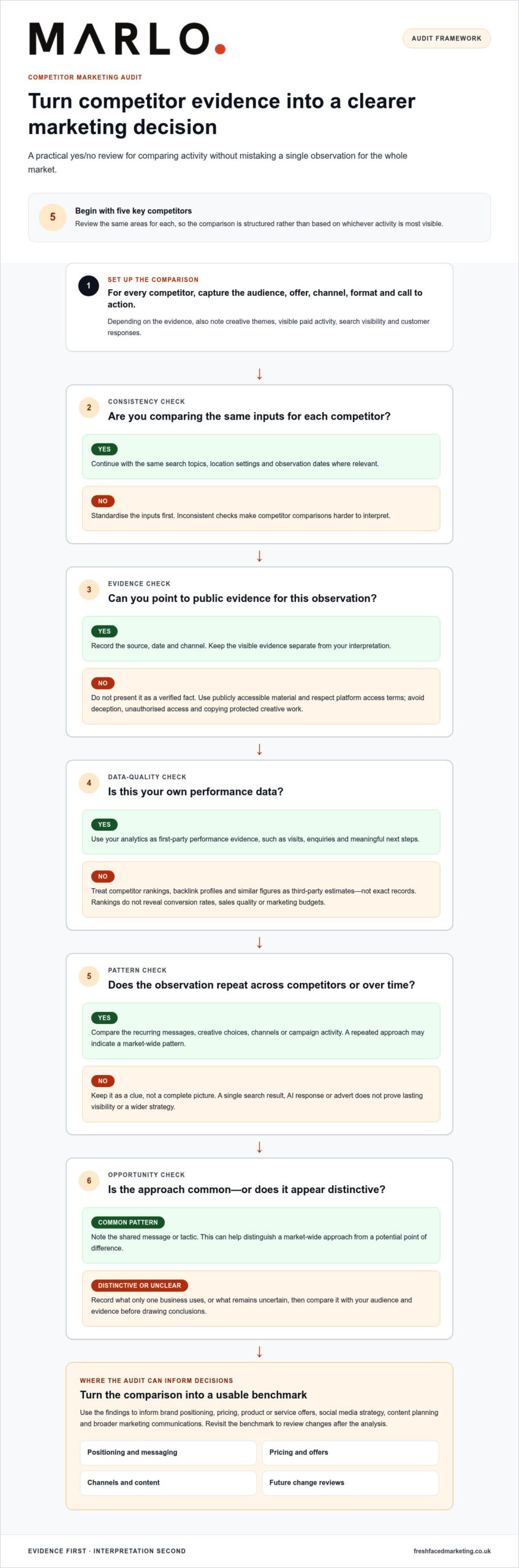
Start with five key competitors and record the same evidence for each. Note the audience, offer, channel, format and call to action. For example, a competitor might promote a case study on LinkedIn, then use paid search to reach people looking for consulting. Together, these activities suggest a planned route from proof to enquiry.
Review creative choices across the market. Identify recurring images, claims, tone and customer problems. A spreadsheet can show whether competitors lead with price, expertise, speed or a particular outcome. Mark what appears consistently and what only one business uses. This helps distinguish a market-wide message from a potential point of difference.
For UK research, use publicly accessible material and respect platform access terms. Avoid deception, unauthorised access and copying protected creative work. Record the source of each observation and distinguish visible evidence from your interpretation.
To assess paid advertising, compare the messages, formats, placements and apparent frequency you can observe. Review active campaigns over time rather than treating one advert as proof of a wider strategy. To estimate spend, combine campaign visibility with available keyword and cost-per-click estimates. Treat the result as an estimate, not a competitor’s verified budget.
Google Ads Auction Insights, AdThena, SpyFu and What Runs Where are advertising benchmarking tools. Use a consistent process: capture a campaign or search example, note the date and channel, then compare it with evidence from other competitors. This keeps the analysis useful as activity changes.
- Creative: record the offer, visual approach, message and call to action.
- Paid search: note visible keywords, ad copy and competitor overlap.
- Campaigns: compare formats, placements and repeat appearances over time.
In the UK, audit costs and tool requirements depend on the number of competitors and channels, research depth and software selected. For a commissioned audit, the price depends on its scope. Compare tools by the evidence they provide, then choose a scope that answers a specific decision, such as whether to test a new message or channel.
Use the findings to inform brand positioning, pricing, product or service offers, social media strategy, content planning and broader marketing communications. A competitor audit can also establish a benchmark for measuring the impact of changes made after the analysis.
Online competitor benchmarking is a structured analysis of other organisations’ online services, capabilities and performance in customer acquisition, conversion, retention and growth. Published data can help compare competitors with your own analytics. An engagement review might examine search rankings, blog comments, and likes, shares and conversations on social posts. Sales analysis can look at models and conversion tactics such as free trials, freemium versions, limited-time offers, demos and guarantees.
What is a competitor audit and how well do you know your market?
To audit search visibility, identify relevant search topics, record competitor rankings and result features, then compare them with your own analytics. You can also run consistent checks using generative AI: ask the same audience questions and log which brands, sources and pages appear in responses.
A search engine results page can show more than ranked web pages. Check whether competitors appear in featured snippets, image results, local listings or other prominent features. These placements can affect what users notice, even when a competitor’s standard ranking looks similar to yours. Record the query, date, location and feature to give each comparison context.
For each important topic, note the ranking page, its purpose and the likely search intent. A service page ranking for a buying query signals a different strength from an educational article answering an early-stage question. Compare the page’s message, depth, structure and next step. Then assess whether it meets the audience’s need more directly than your own result.
Tools can help organise the evidence. Google Search Console shows your site’s search performance, while services such as Ahrefs and Semrush estimate competitor rankings and backlink profiles. Treat competitor figures as third-party estimates, not exact records. Backlink tools can reveal referring websites and pages attracting links, but relevance matters more than raw link counts.
- Search visibility: compare rankings for the same topic and search intent.
- Engagement: use your own analytics to examine visits, enquiries and meaningful next steps.
- Generative AI: repeat the same prompts and record brand mentions, cited sources and linked pages.
Use consistent inputs for meaningful comparisons. Apply the same search topics, location settings and observation dates across competitors. Your analytics provide first-party performance data; competitor visibility usually relies on published evidence and third-party estimates. Search results and AI responses can vary, so treat a single observation as a clue, not a complete picture of the market.
Keep the limits in mind. Rankings don’t reveal a competitor’s conversion rate, sales quality or marketing budget. A backlink count doesn’t prove authority, and an AI mention doesn’t establish lasting visibility. Record evidence separately from interpretation, and don’t copy protected content or present another organisation’s work as your own.
For markets that are not changing rapidly, a deep-dive competitor audit is usually recommended every 12 months. Repeat the review sooner when market conditions, customer behaviour or your own strategic priorities shift; monitor your internal performance quarterly or through biannual check-ins.
Use the findings to decide which visibility gaps deserve action, rather than chasing every ranking or AI mention. If the evidence points to a broader positioning or channel decision, an evidence-led marketing strategy can help turn analysis into prioritised next steps.
Organic and paid social media activity
Analyse competitors’ social media by comparing their content, posting frequency, placement and audience response. Review the same platforms and period for each business, then record formats, themes, comments, likes and shares. This can reveal what appears to engage people and where competitors’ content may have weaknesses.
Separate organic activity from paid promotion. Organic posts show how a brand communicates without a visible paid placement; paid campaigns can reveal offers, creative variations and targeting priorities. For example, compare a LinkedIn case study with a sponsored offer from the same company. The difference may show how it addresses professional audiences at different decision stages.
Put engagement in context. A post with many comments may prompt useful discussion, while a high number of likes alone says less about audience intent. Compare similar formats and topics across competitors, and read comments for questions, objections and customer language. Record standout examples instead of treating every interaction as a success signal.
- Content: note quality, quantity, format and publication placement.
- Response: compare likes, shares, comments and the substance of conversations.
- Consistency: track posting frequency and recurring themes across the same review period.
Platform choice depends on the market and audience. Food and lifestyle brands often perform well on Instagram and Pinterest, whilst B2B companies tend to perform better on LinkedIn. Use those patterns as starting points, not fixed rules. Check where your own audience responds, then assess whether competitors show unmet needs on another channel.
Social benchmarking tools can organise public activity across platforms, while native analytics show your own results. Compare like with like: a LinkedIn video and an Instagram image serve different contexts. A brand passion index can also compare three leading fast food brands using social media mentions collected within the same month. Using a shared period makes the comparison more meaningful.
Review paid activity separately. Log visible campaign messages, formats and offers, then compare them with organic posts. Note whether paid creative repeats a successful theme or introduces a different proposition. Social platforms and advertising libraries can help uncover active examples, but visible campaigns don’t reveal exact spend or prove which targeting settings produced results.
Assess news media coverage alongside social conversations. Search Google News for each competitor’s name, then record the publication, topic, tone and whether the company responds. Coverage may highlight strengths, customer concerns or partnerships absent from owned posts. Research cited in the article states that 71% of buying decisions are made through consumer conversations, making the quality of public discussion worth reviewing.
Review media activity to build a broader picture of competitor communications. Competitor content analysis can assess content quality, quantity, publication placement and frequency. Apply these criteria consistently, and focus on what is visible rather than inferring performance or strategy from limited evidence.
Using competitor activity to identify channel opportunities
Compare competitors’ audiences, offers and channel activity to identify underserved needs. Then assess which gaps fit your own capabilities and priorities.
Competitor Identification
Start with direct competitors that operate across the UK market and target similar clients. Add indirect competitors that solve the same customer problem through different products, services or sales models. Emerging competitors may become visible through new offers, partnerships, content themes or changing search visibility. Record why each business belongs in the comparison, then assess them using consistent categories. This keeps the audit focused on genuine alternatives, not every business in the sector.
Market Trends and Gaps
Look for patterns across competitor activity. If several businesses emphasise the same benefit, it may reflect an established customer expectation. If customer reviews repeatedly raise a concern that offers overlook, that could point to a gap worth investigating. Where information is public, compare pricing, packaging, delivery methods, service models and offer clarity. A positioning map can show crowded areas and spaces with room to grow, helping distinguish a trend from an isolated campaign.
Brand Differentiation Opportunities
A market gap is useful only if Fresh Faced can address it credibly. Compare each competitor’s promise with the customer challenge it claims to solve. Then frame your differentiation around a relevant need, not just a list of product features. For example, if competitors promote technical specifications, clearer guidance on choosing the right solution could make your proposition more useful. A competitive edge comes from a meaningful distinction customers value and your business can deliver consistently.
Channel and Metric Comparisons
Compare organic search, website content, social media, email activity and paid advertising where visible. Track rankings, content frequency, engagement, campaign formats and calls to action. Your own analytics can add first-party measures such as leads, sales and customer engagement. Competitor figures are often third-party estimates, so separate observable evidence from inferred performance. This comparison can identify channels competitors use heavily and relevant audience needs receiving less attention. Where website experience or conversion paths prove to be a weakness, working with Dulyfixed Small Business Solutions can help develop mobile-first web pages and landing pages designed to capture demand.
Benchmark pricing and offers using published information, including package structure, service models, delivery options and promotion terms. Record the date and source, since offers can change. Compare positioning by audience, problem addressed, promised outcome and proof provided. Don’t treat a competitor’s public price or campaign as proof of its costs, margins or results.
- Look for patterns: repeated messages, offers and channel choices can signal market trends.
- Test relevance: prioritise gaps that match customer needs and your delivery capabilities.
- Compare consistently: use the same channels, offer details and performance measures across businesses.
Reasons to conduct a competitor audit
A competitor audit is useful when it informs a decision, not when it becomes a catalogue of rival activity. It can establish a baseline, expose assumptions and help teams prioritise changes to positioning, pricing, content, social media and wider marketing communications.
First, establish a benchmark. Record your current marketing performance before changing a message, channel or offer. Later, compare results with that baseline to assess whether the change influenced enquiries, sales or engagement. Keep competitor observations separate from your own analytics: the former are often estimates, while your internal data records actual performance.
Second, use the evidence to test your market position. A SWOT analysis can organise your business’s and competitors’ strengths, weaknesses, opportunities and threats. Pair it with a positioning map to show where offers cluster. If several businesses make similar claims, consider whether customers need a clearer distinction or a more relevant answer to their challenge.
Third, find wasted effort and overlooked options. Google states that 56% of ad impressions never reach the consumer, a reminder that visible activity alone doesn’t demonstrate effective reach. Compare campaign messages and placements with your intended audience. Then examine whether content, paid media or another channel offers a more direct route to the people you need to influence.
Let customer needs shape the next step. Review competitor reviews, offer clarity and recurring questions alongside your own customer feedback. For example, if public reviews repeatedly mention difficulty understanding service options, clearer explanations may be more useful than another feature-led campaign. Published studies can provide wider context, but decisions should still reflect your market and first-party evidence.
Conduct the audit with a defined purpose. A review ahead of a positioning change needs different evidence from one assessing social platforms or a new product offer. For markets that are not changing rapidly, a deep-dive audit is usually recommended every 12 months. Internal marketing performance can be reviewed quarterly or through biannual check-ins, allowing teams to spot shifts between deeper audits.
- Measure: preserve a baseline before introducing changes.
- Interpret: use SWOT and positioning maps to clarify market choices.
- Prioritise: select actions that connect customer needs with your resources.
Reserve a small portion of your budget for experiments. Test one well-defined change, such as a revised offer or different content format, then assess it against your baseline. This turns competitor observations into learning rather than imitation.
Use the audit to build a clear set of marketing priorities and an evidence-led plan. Develop a data-driven marketing strategy that turns findings into practical next steps.
Fresh Faced: MARLO
MARLO turns competitor research into a clear, prioritised marketing plan. Its interactive dashboard brings together search, content, social and paid media analysis, helping you compare competitor activity and identify practical opportunities across channels.
For strategic interpretation alongside the data, the Marketing Strategy Blueprint (MSB) adds human-led analysis and a detailed execution blueprint. Full Marketing Strategy Execution can help put the agreed strategy into practice. These options suit businesses that need more than findings alone: they need direction on what to do next.
To discuss which approach fits your marketing priorities, visit Fresh Faced.
Turn your findings into a clear next move
The value of a competitor marketing audit comes from what you do with its findings. Select an opportunity that aligns with your customers’ needs and your team’s capacity. Define the change, the outcome you want to observe and the evidence you’ll use to review progress. This gives your next marketing decision a clear basis, rather than leaving insights in a report.
If you want to move from analysis to action, Fresh Faced offers MARLO, the MSB (Marketing Strategy Blueprint) and Full Marketing Strategy Execution. Each provides a different route from understanding your market to planning or implementing your marketing. Choose the level of support that fits the decision in front of you.
Contact Fresh Faced about your audit and explore a practical next step for your business.
Frequently Asked Questions
What is a competitor marketing audit?
A competitor marketing audit is a structured review of rival businesses’ marketing that informs your own decisions. It can help answer a specific question, such as whether your offer is distinct enough or customers see alternatives you haven’t considered. Set a clear business objective first, then collect relevant evidence. This keeps the exercise focused on decisions, not observations without a practical purpose.
Which competitors should you include in a marketing audit?
Include businesses your customers genuinely compare with you, not just familiar names in your sector. Look at sales conversations, lost-deal notes and customer feedback for recurring alternatives. Add a substitute if it solves the same need in a different way. For example, a potential customer may compare a specialist service with an in-house solution. Record why each business is relevant so your comparison reflects real buying choices.
How can you audit competitors’ SEO, keywords and backlinks?
Compare the search terms your audience uses with the pages competitors show for those searches. Check whether each page answers an informational question or supports a purchase decision, then note what your own site could address more clearly. For backlinks, assess the referring page’s subject and audience, not just the link count. Your Search Console data shows your own performance; competitor keyword and link figures remain estimates from external tools.
What tools and typical costs are used for competitor marketing audits in the UK?
Named advertising benchmarking tools include Google Ads Auction Insights, AdThena, SpyFu and What Runs Where. In the UK, audit costs depend on the number of competitors and channels, research depth and software selected. Commissioned audit pricing depends on scope.