
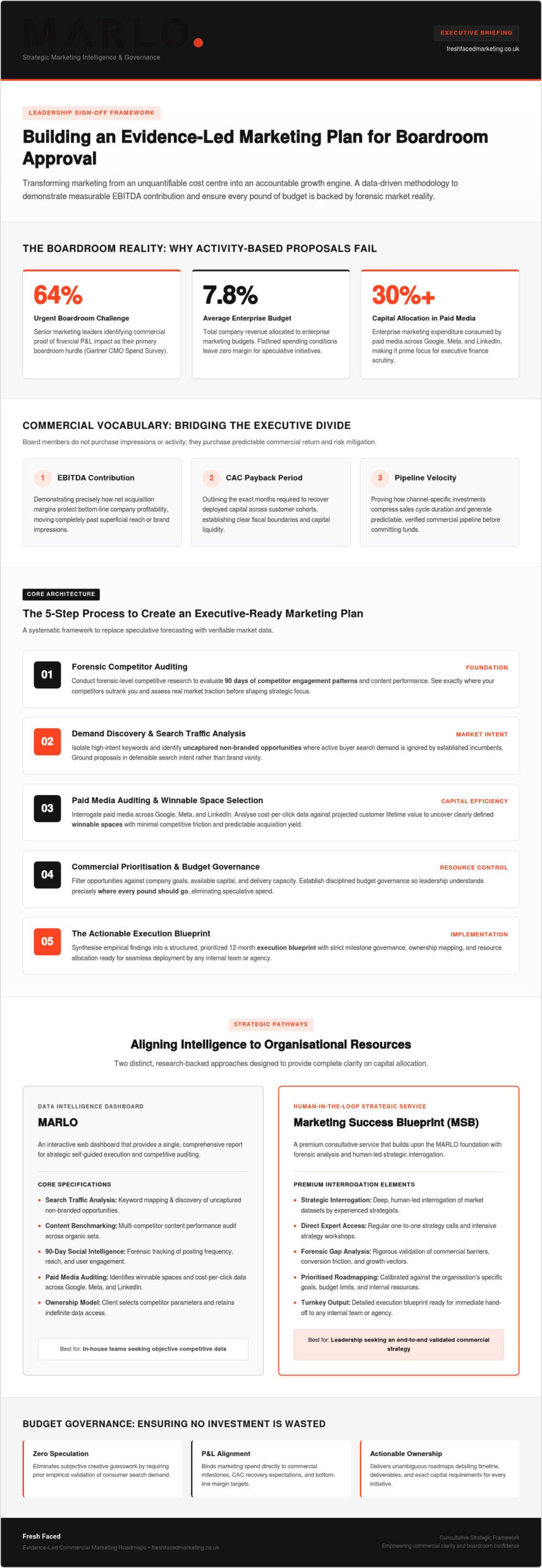
According to the Gartner CMO Spend Survey, 64% of senior marketing leaders report that demonstrating the direct commercial impact of marketing on financial P&L outcomes is their most urgent boardroom challenge. Enterprise marketing budgets have flatlined at 7.8% of company revenue, leaving zero room for speculative spend. If you need to build a marketing plan for leadership team sign-off, presenting creative concepts alongside top-of-funnel reach will no longer work. The board does not fund activity; it funds commercial return.
You already know the frustration of having marketing treated as an unquantifiable cost centre rather than a dependable revenue driver. Bridging the gap between executive targets and day-to-day campaign execution often feels like speaking an entirely different language.
Discover how to construct an evidence-led roadmap that wins leadership sign-off, aligns directly with commercial objectives, and eliminates wasted budget. You will learn to translate tactical metrics into EBITDA impact, establish strict budget governance so you know where every pound should go, and build an airtight commercial case that commands executive confidence.
Key Takeaways
- Shift your commercial reporting from vanity metrics to enterprise outcomes, anchoring every proposed activity to measurable EBITDA impact.
- Discover the five-step framework to build an evidence-led marketing plan for leadership team sign-off, grounded in forensic-level market analysis.
- Pinpoint uncaptured non-branded opportunities and winnable spaces to defend market share before committing major capital.
- Establish transparent budget governance that stress-tests channel performance, proving to executive stakeholders exactly where every pound should go.
- Determine whether an interactive data intelligence dashboard or an intensive, human-in-the-loop execution blueprint best suits your internal resources.
Why Traditional Marketing Plans Fail at Leadership Level
Traditional marketing plans fail in executive meetings for a straightforward reason: they talk about activity rather than enterprise value. When leadership reviews a proposal, they evaluate capital allocation, risk management, and EBITDA impact. Marketing leaders often present tactical roadmaps filled with subjective creative ideas and vanity metrics. This disconnect breeds immediate scepticism. Evidence-based strategy consistently outperforms creative guesswork in boardrooms; without commercial validation, proposals stall before they start.
A credible marketing plan for leadership team buy-in must bypass superficial activity metrics. Board members are not buying impressions, followers, or clever slogans. They are purchasing predictable commercial pipeline and protected market share.
The Divide Between Marketing Vanity Metrics and Boardroom Objectives
Executive directors care about financial velocity. Tactical indicators like raw impressions, social engagement rates, and untargeted web traffic offer zero proof of fiscal health. To command respect, you must replace tactical jargon with the commercial vocabulary of executive leadership:
- EBITDA Contribution: Demonstrating how net acquisition margins protect bottom-line profitability.
- Customer Acquisition Cost (CAC) Payback: Outlining the exact months required to recover deployed capital.
- Pipeline Velocity: Proving how channel investments directly compress sales cycle duration.
Connecting every tactical initiative to these commercial outcomes transforms marketing from an unpredictable cost centre into an accountable growth engine.
Eliminating Speculation with Evidence-Led Strategic Foundations
Speculative forecasting destroys boardroom credibility faster than poor performance. When projections rely on gut-feeling assumptions, leadership naturally hesitates to commit substantial capital expenditure. In modern UK commercial sectors, boards demand verifiable market data before unlocking capital reserves. If you have struggled with misaligned expectations in previous quarters, consider the diagnostic principles outlined in our guide on why is my marketing failing.
Winning sign-off requires forensic-level analysis before requesting annual budget allocations. You must demonstrate that every pound requested is anchored in competitive reality, verified commercial intent, and defensible customer demand. Guesswork invites budget cuts. Empirical precision secures investment.
The 5-Step Process to Create an Executive-Ready Marketing Plan
Securing executive sign-off requires a structured, empirical methodology. You cannot enter the boardroom with speculative ideas and hope for approval. An executive-ready marketing plan for leadership team review transforms commercial ambiguity into an actionable, stress-tested growth strategy.
Step 1 & 2: Forensic Competitor Auditing and Demand Discovery
Begin with forensic-level market analysis to uncover verified growth vectors. You must see exactly where your competitors outrank you and evaluate 90 days of competitor engagement patterns to understand actual market traction. Next, identify uncaptured non-branded opportunities where active search intent is ignored by incumbents. Boards care about defensible commercial space, not brand vanity. Grounding your proposal in disciplined competitor research for marketing strategy proves that buyer demand exists before you commit capital.
Step 3 & 4: Paid Media Auditing and Commercial Space Selection
Step three interrogates paid media across Google, Meta, and LinkedIn to pinpoint winnable spaces. Paid channels account for over 30% of average enterprise marketing budgets, making them prime targets for finance scrutiny. You must analyse cost-per-click realities against projected customer acquisition values and payback periods. Step four translates this intelligence into prioritised commercial initiatives. Don’t spread budget across every emerging platform. Allocate capital strictly where competitive barriers are low and commercial returns are predictable.
Step 5: Constructing the Actionable Execution Blueprint
The final phase synthesises empirical findings into a structured 12-month execution blueprint. This document defines clear milestones, ownership, and resource requirements, using an actionable marketing roadmap that non-marketing executives can digest in minutes. Managing directors want operational clarity, risk governance, and complete assurance that leadership knows where every pound should go. For organisations looking to anchor their growth in validated market data, establishing an evidence-led strategy through Fresh Faced gives executive teams total clarity over their commercial trajectory.
Essential Components of a Board-Level Marketing Plan
Most proposals collapse because they present a collection of disconnected tactics instead of a coherent business investment. A robust marketing plan for leadership team endorsement operates like a capital allocation prospectus. It defines the addressable market opportunity, identifies competitive barriers, and sets out a clear mechanism for revenue capture. To earn executive sign-off, every strategic pillar must withstand intense commercial interrogation.
| Element | Standard Tactical Proposal | Evidence-Led Executive Plan |
|---|---|---|
| Core Focus | Channel activity, follower growth, creative themes | Addressable demand, pipeline contribution, EBITDA margin |
| Market Proof | Subjective competitor benchmarking, assumptions | Forensic competitor data, search demand, winnable spaces |
| Budget Logic | Arbitrary requests based on last year’s spend | Unit economics, CAC payback limits, strict risk governance |
| Accountability | Impressions, clicks, surface-level engagement | Revenue pipeline, customer lifetime value, market share |
Replacing tactical requests with this commercial narrative shifts the conversation entirely. Leadership stops questioning operational minutiae and starts evaluating the return on investment.
Executive Commercial Summary and Market Validation
Managing directors rarely read forty-page strategy documents. Your executive summary must outline three clear elements in under two pages: commercial opportunity, required capital, and projected financial return. Ground every projection in empirical market share benchmarks and keyword share data rather than unproven targets. Validating your commercial hypotheses with verified search intent proves the market exists before you ask the business to finance acquisition.
Resource Allocation and Capability Mapping
Execution failure is a major risk factor for leadership. An airtight plan maps proposed initiatives directly against internal capabilities and technology stack constraints. Boards need answers to three practical questions:
- Internal Capability: Does the in-house team possess the specialised skills required to execute, or is external strategic oversight necessary?
- Technology Overhead: Does the plan leverage existing tools, or does it demand redundant software subscriptions that inflate operating costs?
- Governance Controls: What stage-gate milestones will protect capital if early performance metrics deviate from financial forecasts?
By establishing risk mitigation protocols before rollout, you prove that operational realities match executive ambitions. This level of governance gives leadership the confidence required to fund your strategy.
Budget Governance: Demonstrating Financial Rigour to the Board
Securing board approval requires treating marketing as a controlled capital investment rather than an operational overhead. Chief Financial Officers routinely scrutinise marketing budgets because historical spend often lacks clear attribution to pipeline velocity. A defensible marketing plan for leadership team buy-in must establish ironclad financial governance. You must show the board exactly where every pound should go, eliminating speculative waste before the financial year begins.
Enterprise marketing budgets average 7.8% of company revenue, according to the Gartner CMO Spend Survey, with typical allocations divided across paid media (around 31%), martech (22%), internal labour (22%), and external services (21%). With half of all CMOs operating on 6% or less, capital efficiency is critical. Every proposed channel must be stress-tested against historical benchmarks rather than optimistic revenue assumptions.
Aligning Marketing Budgets with Commercial Business Goals
Connecting expenditure to high-level milestones requires a structured approach to aligning marketing roadmap with business goals. CFOs look for unit economics that protect profitability. Your financial governance model should enforce specific commercial thresholds:
- LTV:CAC Ratio: Maintain a minimum 3:1 ratio to ensure sustainable customer acquisition without overspending.
- CAC Payback Period: Target under 12 months for SMB transactions, or 18 to 24 months for enterprise B2B sales cycles.
- Cost Ring-Fencing: Separate fixed infrastructure costs from agile acquisition budgets to protect baseline operations.
Adhering to these ratios proves you are managing marketing capital with the same fiscal discipline applied to capital expenditure.
Phased Investment Gateways and Performance Auditing
Never ask for an entire annual budget upfront without governance controls. Instead, propose phased investment gateways that release capital only when predetermined milestones are achieved. Quarterly reviews allow you to evaluate verified conversion metrics and reallocate funding away from saturated channels into high-yielding spaces.
This phased gateway approach protects leadership confidence and minimises downside risk. If you want to demonstrate rigorous financial controls and eliminate budget waste across your organisation, explore how Fresh Faced builds board-ready marketing strategies that align marketing spend directly with executive commercial targets.
From Plan to Execution: Selecting Your Strategic Pathway
Securing board sign-off is only the first hurdle; delivering projected returns requires an execution model suited to your operational capacity. A successful marketing plan for leadership team execution hinges on whether your organisation needs pure market intelligence to inform internal talent, or intensive strategic guidance to build the entire operational roadmap.
Independent Market Intelligence via Interactive Dashboards
When an internal marketing department possesses strong operational capability, automated data intelligence provides the necessary clarity. Rather than locking the business into expensive agency retainers, an interactive web dashboard like MARLO delivers market visibility through a single, comprehensive report.
This pathway allows you to choose your competitor sets and retain indefinite access to live strategic data. Key capabilities include:
- Search Traffic Auditing: Uncovering high-intent commercial keywords and uncaptured non-branded opportunities.
- Competitor Benchmarking: Evaluating 90 days of social media data across frequency and engagement, alongside competitor content performance.
- Paid Media Interrogation: Mapping cross-channel ad footprints across Google, Meta, and LinkedIn to pinpoint winnable spaces and cost-per-click realities.
This approach gives internal teams the empirical foundation required to see exactly where your competitors outrank you and adjust tactics autonomously.
Bespoke Strategic Interrogation and Blueprinting
Complex market conditions or restructured commercial priorities often require a more comprehensive engagement. The Marketing Strategy Blueprint functions as a premium, human-in-the-loop strategic service that builds upon the foundational data platform. It moves beyond raw reporting into forensic-level competitive analysis and human-led strategic interrogation.
This pathway provides direct access to senior strategists through intensive strategy workshops and one-to-one strategy calls. Strategists interrogate commercial assumptions, test conversion pathways, and align external opportunities against your internal budget and resourcing limits.
The definitive output is a detailed execution blueprint. Prioritised against your exact commercial targets, this document can be handed directly to an internal team or an external agency for implementation. It ensures leadership teams know where every pound should go, eliminating wasted investment from day one. Partnering with specialists in evidence based marketing guarantees that your strategic roadmap satisfies both board-level financial scrutiny and operational reality.
Secure Executive Sign-Off with Commercial Precision
Winning boardroom support requires trading creative ambiguity for commercial rigour. To build an airtight marketing plan for leadership team approval, anchor your strategy to verified customer demand, clear unit economics, and phased investment gateways. When you prove exactly how proposed activities protect EBITDA and compress sales cycles, marketing ceases to be an unquantifiable cost centre. It becomes a dependable growth engine.
Whether you need live competitive visibility or intensive strategic roadmapping, empirical evidence ensures you eliminate speculative waste. Our proprietary MARLO research tool provides interactive intelligence across search, social, and paid channels, pinpointing uncaptured demand. For organisations requiring bespoke guidance, the Marketing Success Blueprint pairs this intelligence with intensive, human-led strategic interrogation, producing an actionable execution blueprint prioritised against your exact operational resources.
Take command of your commercial trajectory. Discover how Fresh Faced builds board-ready marketing blueprints that align executive commercial goals with decisive, measurable execution. Enter your next board meeting with absolute clarity and complete strategic confidence.
Frequently Asked Questions
What is the ideal format for presenting a marketing plan to executive leadership?
Keep your presentation under ten slides and lead with commercial outcomes rather than campaign creative. Frame the narrative around market demand, unit economics, risk governance, and projected pipeline contribution. Append detailed operational schedules and channel audits to an appendix. Executive directors want immediate clarity on payback periods and capital requirements, not tactical minutiae.
How far in advance should an executive marketing plan be developed?
Initiate preparation two to three months before annual financial planning cycles begin. Developing an empirical marketing plan for leadership team evaluation takes several weeks of forensic competitor auditing and search demand discovery. Starting early gives you ample time to stress-test your financial forecasts, align with commercial finance teams, and secure stakeholder consensus before final board reviews.
What is the difference between a tactical marketing plan and a strategic marketing roadmap?
Tactical plans focus on short-term activities, covering content schedules, platform-specific ad copy, and isolated campaign launches. A strategic roadmap defines the overarching commercial trajectory. It translates top-level business targets into prioritized market opportunities, establishes unit economics like CAC payback limits, and maps resource allocation over twelve months to protect profitability.
How do you convince a sceptical Chief Financial Officer to approve your marketing budget?
Speak strictly in the language of unit economics and cash flow protection. Present clear LTV:CAC projections alongside target CAC payback periods, and propose phased funding gateways linked to agreed revenue milestones. Demonstrating that capital releases depend on verified conversion metrics reassures the CFO that every pound allocated carries strict downside protection.
Can internal teams conduct forensic-level market analysis without external support?
Internal teams can gather baseline data, but they often lack the specialised toolsets required for deep competitive interrogation. Using an interactive platform like MARLO gives in-house marketers objective access to competitor keyword deficits, uncaptured search demand, and cross-channel paid footprints. This intelligence allows internal talent to build defensible business cases without relying on ongoing agency retainers.
What happens if market conditions change halfway through executing the plan?
A board-approved roadmap must include quarterly governance gateways designed for strategic agility. If a competitor scales ad spend or organic search patterns shift, performance reviews allow you to reallocate budget rapidly toward emerging winnable spaces. Agile governance ensures tactical flexibility while keeping total capital expenditure anchored to approved commercial goals.
How does an evidence-led marketing strategy eliminate financial waste?
Traditional plans waste capital by pursuing subjective creative hunches and untested channels. Grounding your marketing plan for leadership team sign-off in empirical data guarantees that spend flows only into verified buyer demand. Auditing paid footprints and non-branded search opportunities beforehand ensures you invest where competitive resistance is low and conversion intent is confirmed.