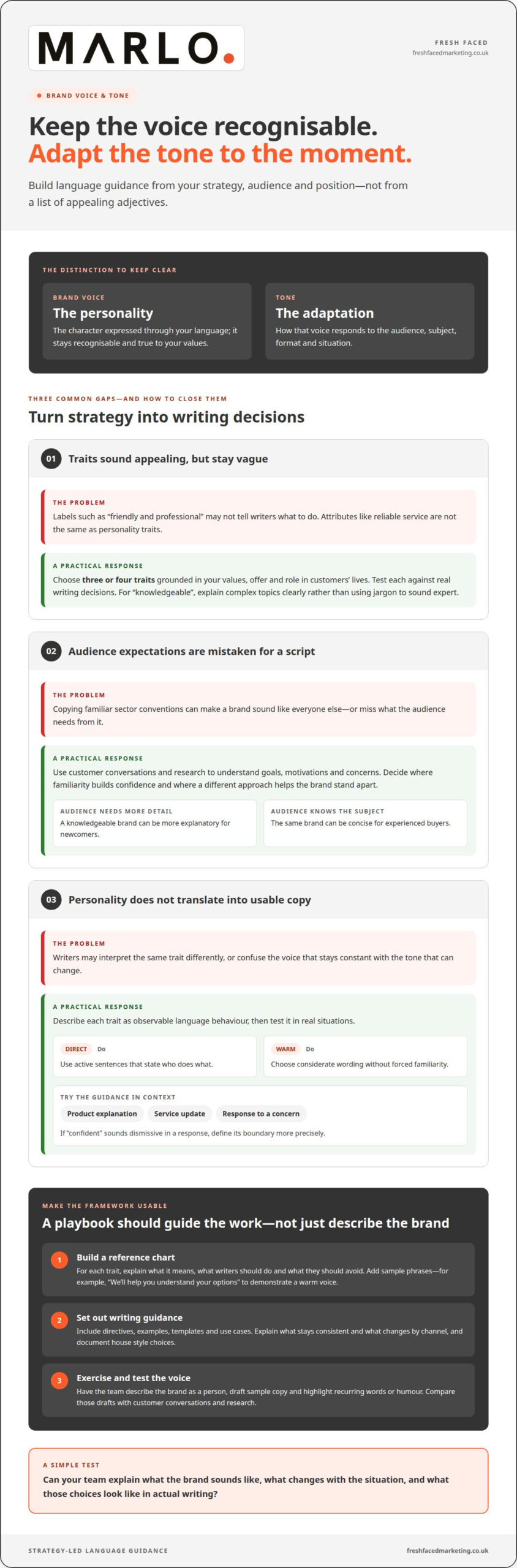
A consistent brand voice can still be the wrong voice for your strategy. Effective brand voice and tone development starts with what the business needs to communicate, who it needs to reach and the position it wants to hold, not with a list of appealing adjectives. The voice stays recognisable; the tone adapts to the audience, subject and situation.
It’s reasonable to expect a brand to sound consistent wherever people encounter it. Consistency doesn’t mean using the same register in every interaction. A considered approach makes the brand’s values and personality clear while allowing its language to respond to different audiences and needs.
This guide shows you how to connect voice decisions to business strategy, choose traits that lead to practical writing decisions and build a playbook your team can use. It also covers how to find inspiration beyond familiar category conventions and adapt tone to context and audience emotion. The result is a framework that guides the work, not just a description that looks good.
Key Takeaways
- Anchor your brand’s personality in its strategy, audience expectations and the position you want to occupy.
- Turn voice principles into clear writing guidance, examples and templates your team can use consistently.
- Look beyond familiar industry conventions for inspiration, then adapt ideas to your own brand.
- Keep your core voice recognisable while adjusting tone to the audience, context and emotional moment.
- Use strategic evidence to ensure your brand’s language supports the business goals behind it.
What is the brand tone of voice?
Brand voice is the personality expressed through language; tone adapts that expression to the audience and situation. Define both through your strategy, then make each choice visible in the words your team uses.
-
Define brand personality traits
Choose three or four traits that describe how the brand should communicate. Start with its values, offer and role in customers’ lives, then test each trait against real marketing decisions. If “knowledgeable” is a trait, explain complex topics clearly rather than using jargon to sound expert. Distinguish attributes, such as reliable service, from personality traits, such as calm confidence. Avoid vague pairs like “friendly and professional” unless you explain what each means in practice. Ask how the brand should make people feel and what it must communicate. The answers make its personality specific enough to guide writing.
Use Freddie, a fictional character, to test the profile, not as a substitute for evidence. Would Freddie explain a difficult decision patiently or make a brisk recommendation? Would he admit uncertainty or overstate a claim? Record behaviours that fit, then remove traits that clash with the brand’s values. This exercise gives writers a recognisable reference without turning the brand into a caricature.
-
Consider audience expectations
Compare the personality with what your audience needs from the brand. Use customer conversations and research to understand their goals, motivations and concerns, then identify where these overlap with your offer. A finance brand may need to convey stability before trying to sound playful; an energy brand may need an authoritative voice to explain its role. These examples show why one personality formula cannot fit every market. Consider what people expect in your sector, but don’t copy its conventions automatically. Decide where familiarity builds confidence and where a different approach helps the brand stand apart.
Audience expectations should shape how you communicate, not erase the brand’s character. A knowledgeable brand can be concise for experienced buyers and more explanatory for newcomers. Test whether each choice makes the message easier to understand and act on. If the audience expects certainty but the evidence supports a qualified answer, be clear without implying more confidence than the facts justify.
-
Translate personality into voice and tone
Turn each trait into observable language choices. For “direct”, use active sentences that state who does what; for “warm”, choose considerate wording without forced familiarity. Salesforce describes brand voice as constant and true to brand values, while tone can vary by audience and format. Keep the underlying personality stable, then adjust formality, warmth or enthusiasm to suit the communication. Don’t treat voice and tone as interchangeable labels: writers need to know what stays consistent and what can change.
Test the choices with practical examples: a product explanation, a service update and a response to a concern. If “confident” sounds dismissive in a response, define the boundary more precisely. These examples turn personality into repeatable decisions and give everyone a clearer basis for writing and editing.
Creating and using a tone of voice playbook
Build a playbook that turns personality into repeatable writing decisions across channels. Document the voice, show it in examples, then apply it to real communications.
-
Create a brand voice reference chart
Translate each chosen trait into a practical chart. For every trait, explain what it means, what writers should do and what they should avoid. For example, “knowledgeable” might mean explaining specialist terms rather than relying on them. Annie Maguire recommends organising personality and tone responses in a chart writers can use as a reference.
Add sample phrases beside each instruction. A “warm” voice might say, “We’ll help you understand your options”, rather than make a vague promise. To develop a voice, define traits, translate them into language and test the examples. Keep the chart short enough for writers to consult during everyday work.
-
Write brand voice guidelines
Set out clear guidance for writing, editing and adapting the voice. Include directives, examples, templates and real-world use cases, such as a product explanation, a social post and a service update. Define brand style too: choices between grammatically correct options, including any house exceptions. Salesforce describes brand style in these terms.
Make the guidance useful to everyone who creates content, from internal teams to external contributors. Explain what stays consistent and what changes by channel. For a serious subject, a brand can remain authoritative while using accessible, open language. A playbook should also create an immersive brand world: give writers shared vocabulary, sample scenarios and a clear sense of how the brand behaves.
-
Explore examples, tools and exercises
Use a practical example to make the guidance tangible. For a UK-facing charity, imagine balancing a serious, authoritative voice with accessible, open language. This gives writers a useful reference without treating another organisation’s wording as a template to copy. Strong guidance explains the decisions behind the example, so teams can apply the principles to new channels.
Run a workshop where team members describe the brand as a person, draft sample copy and highlight recurring words or humour. Compare those drafts with customer conversations and research. These exercises reveal language the team already uses and help distinguish useful shared habits from inconsistencies.
-
Identify risks and mistakes
Review the playbook for vague traits, conflicting instructions and examples that don’t reflect real communications. “Be friendly” is difficult to apply without describing the wording or behaviour expected. Avoid rules that demand the same tone in every situation; a social post and a serious service update may need different delivery.
Test the guidance across channels before treating it as complete. Ask writers to edit the same draft using the playbook, then discuss where their interpretations differ. This exposes missing examples and unclear boundaries. Revise those points before people start following inconsistent guidance.
For a strategy-led view of how marketing decisions connect, explore evidence-led marketing strategy.
Finding inspiration in unexpected brand communications
Look beyond familiar category language for useful ideas, but test each against your audience and values. A distinctive voice borrows a principle, not another organisation’s identity.
- Audit existing communications before creating anything new. Review a representative mix of website pages, emails, social posts and customer responses. Mark phrases that sound recognisably like the brand, as well as wording that feels inconsistent or unclear. If a founder wrote much of the existing copy, capture established patterns rather than replacing them by default. Note the context and audience for each example, so a helpful service reply isn’t mistaken for the right language in every channel.
Look for evidence in customer conversations too. Record recurring questions, the language people use to describe a problem and the explanations they find helpful. Compare these observations with your current writing. This reveals where the brand already communicates clearly and where its words create unnecessary distance.
- Analyse competitor communication to understand the conventions around your category. Compare how similar organisations explain their offer, address customer concerns and use formal or informal language. Look for repeated patterns, such as unexplained technical terms or interchangeable-sounding claims. The aim isn’t to copy a competitor’s phrasing. Identify the expectations customers may bring, then decide which conventions support clarity and which leave room for a more distinctive approach.
Build a simple comparison using real examples: a homepage introduction, a social post and a response to a customer concern. Note the language, tone and audience each appears to serve. This makes the differences visible. A different sector can also offer inspiration, provided the communication principle fits your brand and won’t confuse its audience. For instance, looking at how consumer brands like Tacoverse use lively, punchy phrasing to articulate their offer shows how distinct personality cuts through crowded markets.
- Use community history when it offers credible evidence of service and commitment. Saint Joseph Health, for example, drew on a hundred years of serving its community in a campaign designed to build trust. The lesson is to connect a claim to a concrete part of the organisation’s story, rather than rely on broad statements about caring or experience.
For a UK organisation, relevant material might include a documented local partnership, a longstanding service or a customer problem it has helped address. Choose details that relate directly to the audience’s concerns. Avoid turning heritage into self-congratulation; show what that history means for people today.
- Turn the audit into a focused source of inspiration. Group the strongest examples by purpose, such as explaining, reassuring or prompting action. Then note the language choices that make each example work. A formal update might need plain instructions, while a social message could use more conversational phrasing. Test each idea in a fresh draft and check that it still sounds like your organisation.
Keep a short record of decisions: the example reviewed, the principle retained and the wording adapted. This connects creative thinking to research and audience needs. The result is a voice informed by existing communications, competitor patterns and community context, without becoming a replica of any one source.
Adapting tone to context and audience emotion
Keep the brand’s values consistent, but adapt how you express them. Consider the audience, subject and emotional context before choosing words, detail and pace.
-
Read the audience’s emotional state
Identify what the reader may be feeling before drafting. Someone reporting a service problem needs clear acknowledgement and practical next steps, not upbeat promotional language. Someone exploring an unfamiliar service may need calm explanations and specific reassurance. Use customer feedback to spot wording that feels cold, confusing or overly familiar. Healthcare brands, for example, can use audience feedback to shape more empathetic communication, while publications such as Pregnancy Magazine demonstrate how to balance reassuring warmth with authoritative guidance for first-time mothers facing unfamiliar decisions.
Separate empathy from assumptions. A short message or social media comment may not reveal the reader’s full situation. Respond to what they have actually said, acknowledge the concern and explain what happens next. This keeps the tone considerate without claiming to know how someone feels.
-
Adapt messaging to products and services
Match the message to the decision each product or service requires. A complex service may need a measured explanation of its process, while a straightforward product update may call for concise instructions. Keep the same core values, but adjust vocabulary, detail and emphasis to address the audience’s immediate concern. Don’t force playful language into a serious subject just to make every message sound lively.
Map each offer to its audience’s likely questions. For a subscription, explain how it works and what the customer receives; for a support service, make the next action easy to find. These examples change the message’s focus, not the brand’s character. Check that every claim is accurate for the specific offer.
- Choose the channel and subject before editing for style. A social media post has limited space and may invite conversation; a detailed service explanation needs enough context to support a decision. Neither format should rely on an imagined version of the audience. Use real customer questions and feedback to guide the wording, then remove details that don’t help the reader.
Compare the same message across formats. An update about a delayed appointment might begin with a brief acknowledgement on social media, then give the reason and next steps in a direct message. The wording changes to suit the reader’s needs and the channel, while the facts and values remain aligned.
- Review the emotional effect before publishing. Read the message from the audience’s perspective and ask whether its tone fits the subject, provides useful information and makes the next step clear. For a complaint response, check that an apology isn’t buried under policy language. For a celebratory announcement, make sure enthusiasm doesn’t obscure practical details.
Use feedback to refine your approach. If customers repeatedly find a service explanation unclear, revise its structure and vocabulary rather than simply making it warmer. Track recurring questions and responses across channels. This helps the team adapt communication to real audience needs without changing the brand’s values each time.
Aligning brand voice with brand strategy
Brand voice and tone development should connect your values with audience needs and market positioning. The result expresses what your strategy promises and makes it distinctive through consistent language.
- Start with the strategic choice the voice must support. Identify the audience you need to reach, the value your organisation offers and the position it wants to hold. Then ask what language would make that position credible. A brand promising clarity, for example, should explain decisions plainly rather than rely on technical language. This turns abstract values into evidence readers can recognise.
Keep the link between strategy and voice explicit. If your strategy prioritises expert guidance, use precise explanations and practical recommendations. If it prioritises accessibility, reduce jargon and make next steps easy to understand. These choices should clarify the intended position, not just make the copy sound polished.
- Translate each strategic priority into a communication decision. For every priority, define what the brand should say, how it should say it and what it should avoid. A campaign helping customers compare options might lead with clear criteria, explain trade-offs and avoid unsupported superlatives. This creates a practical connection between the campaign’s purpose and its language.
Check whether each choice reinforces your values and positioning. A premium position expressed through constant discounts may send mixed signals. A specialist brand that uses generic claims may sound interchangeable. Review the words, examples and proof points together; these shape the impression more than personality adjectives alone.
- Test alignment across the customer journey. Compare a first-touch advert with a product page, sales email and service message. Each interaction can serve a different purpose, but customers should still recognise the same organisation and promise. This matters across channels: 90% of customers say they expect their interactions with brands to be consistent across all channels.
Consistency doesn’t require identical wording. A campaign can introduce an idea, while a detailed page explains its practical value. Check that both express the same strategic position and don’t contradict each other. When the tone needs to change, adjust the delivery while keeping the core promise intact.
- Use strategic priorities to assess whether the voice is working. Review content against its purpose: does an awareness campaign make the position understandable, or does a service message resolve a customer concern? Gather feedback from customers and the people responsible for writing or delivering the experience. If the language repeatedly obscures the offer, revise the wording or the underlying strategic choice.
Treat brand voice and tone development as an ongoing strategic decision, not a one-off copy exercise. For a joined-up view, connect voice decisions with broader marketing strategy planning. That makes it easier to see whether campaign language, customer needs and business priorities support the same direction.
Fresh Faced
Fresh Faced helps businesses connect brand decisions with evidence-led marketing strategy. If your voice feels disconnected from your audience, positioning or wider marketing priorities, strategic analysis can clarify what your communications need to achieve and how they support your business direction.
The Marketing Success Blueprint (MSB) is our premium, human-led service, combining forensic competitive analysis, strategic interrogation of the data and a practical execution blueprint. It also includes direct access to our strategists, two one-to-one strategy calls and a strategy workshop. For businesses ready to act on their strategy, Full Marketing Strategy Execution provides a route from recommendations to implementation. These services are most relevant when voice decisions are part of a wider question about market position, audience or growth, rather than a standalone writing task.
Contact Fresh Faced to discuss how a clearer marketing strategy could support your brand decisions.
Make your brand voice a working decision
Put your voice to work in an upcoming campaign or customer communication. Treat it as a practical test: does the language support the outcome you need, and can the people writing it apply the guidance confidently? Brand voice and tone development becomes valuable when it informs everyday decisions, not just a document left on file.
Choose an owner to gather feedback from writers and customers, then use that evidence to refine the guidance. Keep changes tied to the position your business wants to hold. This gives your voice room to evolve without losing its purpose.
If you want to connect brand decisions with a wider marketing strategy, discuss your brand voice with Fresh Faced. A clearer strategic foundation can help your team communicate with greater purpose and move forward with confidence.
Frequently Asked Questions
What is brand voice and how is it different from tone of voice?
Brand voice is the recognisable character behind a brand’s words; tone is how that character shifts to suit a moment. For example, a bank might sound steady and precise in a service update, then more celebratory in a campaign announcement. Both messages should still feel like the same organisation. Ask whether readers can recognise its character when formality or warmth changes.
What should a brand voice and tone guide include?
A useful guide should help writers make decisions without constant interpretation. Include approved terminology, preferred ways to describe products, examples of calls to action and an escalation route for sensitive messages. Add a named owner and review process, so staff know who can resolve disagreements and update the guidance. For example, specify how to refer to a customer problem consistently across sales, support and marketing.
How do you adapt brand tone across channels and situations?
Start with the reader’s task on each channel, then adjust format and detail to support it. A product update on social media may need a short announcement, while an email to affected customers should explain what changes and what action to take. In both cases, use the same product name and factual claims. Review replies and follow-up questions to see where the message needs more clarity.
How can you assess and measure whether brand voice is consistent and effective?
Review a sample of recent communications against clear criteria, such as terminology, tone and accuracy. Then compare audience responses with each message’s purpose. For example, assess whether a support message reduces repeated questions or a campaign prompts relevant enquiries. Combine these signals with feedback from writers and customers. If results differ by channel, examine the specific wording and context before changing the whole voice.
What are examples of strong brand voice guidelines from UK brands?
For a UK-facing charity, useful guidelines balance a serious, authoritative voice with accessible, open language. Use examples and clear instructions to show how that voice works across different communications.