More customer data doesn’t automatically create a better customer experience. Data-driven marketing strategy consulting turns scattered signals into decisions about what customers need, which messages matter and where to focus marketing effort.
That distinction matters. Disconnected channels, unclear measures and generic messaging can leave useful insights unused, even when a business has plenty of data. A considered strategy connects customer behaviour to practical choices, helping teams create more relevant, consistent experiences without relying on guesswork.
This article explains how data-driven marketing can improve personalisation, reveal useful patterns and support better decisions across the customer journey. You’ll learn how consultants turn complex data into actionable insights, why data quality and clear objectives matter, and how an integrated marketing and digital roadmap can translate findings into priorities. The goal is clarity: understand what the evidence can tell you, where it can guide action and how to build a more coherent customer experience.
Key Takeaways
- Clear objectives and relevant measures help turn marketing data into decisions, rather than reports that sit unused.
- Personalisation works best when customer insight shapes consistent, useful experiences across channels.
- Reliable insights depend on data quality and connecting information that would otherwise remain separated.
- A practical roadmap uses evidence and business priorities to show which marketing activities to start, stop or continue.
- Consulting can help translate complex findings into an integrated plan teams can act on.
What are the benefits of data-driven marketing?
Data-driven marketing connects customer and campaign evidence to clearer decisions across channels. Its value depends on choosing useful measures, organising reliable information and acting on what the analysis reveals.
Building analytics capability with consultant support
An analytics capability brings people, processes and tools together to interpret marketing evidence. Consultants help define responsibilities, choose relevant measures and explain findings in terms different teams can use.
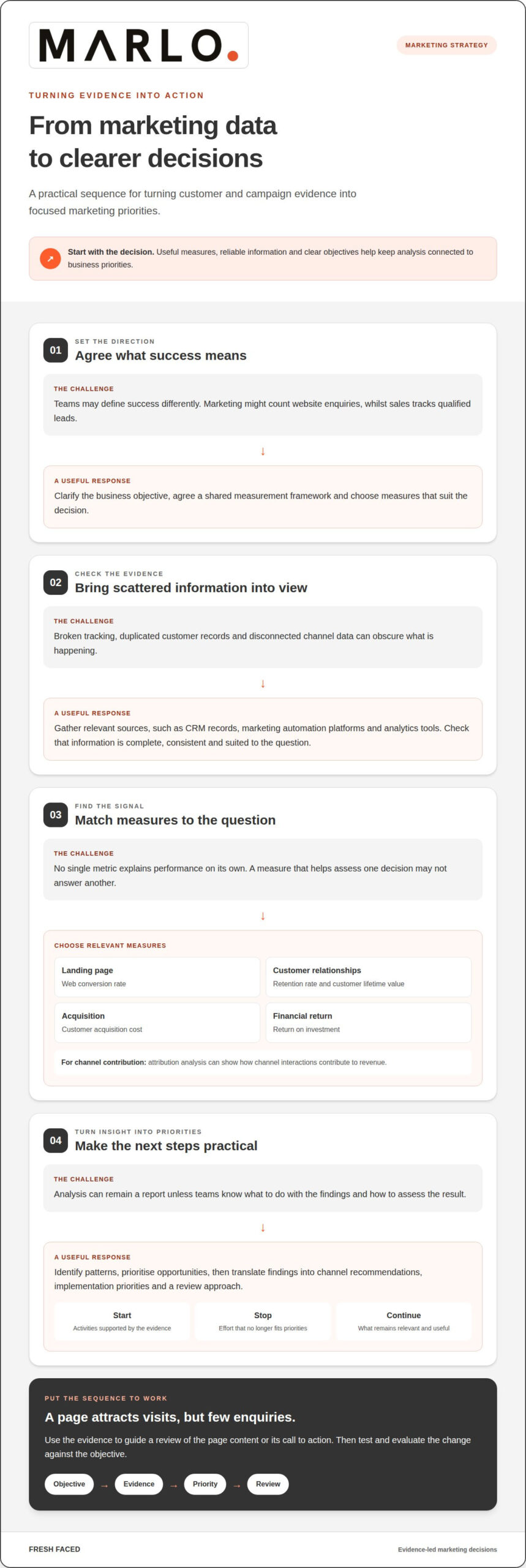
This matters when marketing, sales and leadership use different definitions of success. For example, marketing might count website enquiries while sales tracks qualified leads. An agreed measurement framework connects those views. Consultants can also build organisational support by showing how a proposed analysis relates to commercial priorities, then clearly presenting its implications to decision-makers.
Consultant-led collection and analysis of marketing data
Consultants gather and organise information from relevant marketing channels, then examine it for patterns that can inform decisions. Sources may include CRM records, marketing automation platforms and analytics tools.
Before drawing conclusions, they assess whether the data is complete, consistent and suited to the question. Broken tracking or duplicated customer records can distort results. Silos create another problem: website activity may be separate from email engagement or sales outcomes. Bringing these sources into a coherent view helps reveal where customers respond, where they disengage and which evidence needs closer scrutiny.
Measuring marketing performance
Performance measurement compares campaign activity with defined objectives, using metrics suited to each decision. Analytics tools can track website traffic, conversion rates, email engagement and cost per acquisition.
Strategic measures add a longer-term perspective. Customer acquisition cost, customer lifetime value and retention rate can help show how marketing relates to business outcomes. Consultants establish a baseline, choose relevant measures and interpret changes alongside campaign activity. They can then support implementation, testing and evaluation. If a page attracts visits but few enquiries, for example, the analysis can guide a review of its content or call to action.
Developing a data-driven strategy
Consultants build a strategy by linking objectives, data analysis and marketing priorities in a clear sequence. Their services typically include measurement planning, data analysis, recommendations, implementation support and evaluation. Boutique management consultancies such as contentfactory.biz work with SMEs to connect digital marketing strategy with wider business transformation goals.
First, they clarify the business objective and agree how to measure progress. Next, they assess available evidence, identify patterns and prioritise opportunities. They then turn those findings into channel recommendations, implementation priorities and a review approach. This sequence helps teams distinguish evidence-based targets from arbitrary goals. Consultants also set out what to start, stop or continue, giving decision-makers a practical basis for allocating effort and assessing results.
Useful measures depend on the decision at hand. Web conversion rate can assess a landing page; customer retention can help evaluate ongoing relationships. Return on investment connects marketing activity with financial return, while attribution analysis can show how channel interactions contribute to revenue. No single metric explains performance on its own. Combining relevant measures gives teams a more grounded view of what is working and where further analysis is needed.
Personalisation and customer experience
Personalisation uses customer information to shape relevant communications across the customer journey. Its value depends on matching each message to customer needs and business objectives.
Researching and segmenting customers
Customer research and segmentation group people by shared needs, behaviours or interests. Consultants combine those findings with customer data to build buyer personas and define whom each campaign should target.
A persona should reflect observed patterns, not assumptions based only on age or job title. For example, research may show that one group compares service options before enquiring, while another responds to detailed product guidance. These distinctions help teams choose suitable content, timing and channels for each segment.
Finding customer and commercial opportunities
Opportunity analysis compares customer needs with the products, services and messages a business can provide. Consultants look for gaps between what customers seek and what current marketing communicates.
Search behaviour can reveal topics audiences want to understand, while customer feedback may highlight recurring concerns. If enquiries often ask about a service feature that marketing rarely explains, that gap could inform a content or campaign priority. Any recommendation should connect customer value with a clear commercial objective, rather than treating engagement as the end goal.
Improving the customer lifecycle
Lifecycle marketing aligns messages with the stages customers move through, from initial awareness to repeat engagement. Consultants assess how marketing performs at each stage and where customers lose momentum.
For example, a first-time visitor may need clear introductory information, while an existing customer may value relevant follow-up content. Matching communication to those different needs can make the customer experience more coherent. Data-driven personalisation can also help teams assess retention alongside acquisition, judging effectiveness across the relationship rather than by a single campaign.
Machine learning can analyse customer data to identify patterns across segments and support more precise targeting. It can help distinguish groups that respond to different content or channels, provided the information is suitable and the findings inform a real marketing decision. Amazon’s product suggestions and Netflix’s content recommendations illustrate how customer activity can shape relevant prompts.
Personalised communications need to earn attention through relevance. Nearly 50% of consumers will not read or engage with content unrelated to their interests. Businesses using data-driven personalisation can achieve five to eight times the return on marketing spend, and sales may rise by 10% or more. Customer retention can also improve by 10%. These figures describe potential outcomes, not a substitute for selecting measures that match the business’s objectives.
Consultants can connect research, segmentation and lifecycle analysis to recommend where personalisation is most useful. They assess which customer groups matter, what each group needs and how to evaluate performance. This gives teams a considered basis for deciding which messages to tailor, which channels to use and where a consistent experience matters most.
Turning complex data into actionable insights
Complex marketing data becomes useful when analysis connects patterns to a decision. Consultants organise the evidence, test its reliability and translate findings into actions linked to customer needs or revenue objectives.
The process starts with a defined business question. For example, a company might investigate why website visits are increasing but enquiries remain steady. Consultants identify relevant sources, such as web analytics, campaign records and sales outcomes, then assess whether each source measures the same activity. Mismatched tracking definitions can make an apparent trend misleading.
Next, analysis looks for patterns that explain behaviour, not just describe it. If visitors leave a particular service page before enquiring, consultants can compare traffic sources, page engagement and conversion activity. That comparison may indicate whether the issue relates to audience fit, content clarity or the next step offered. A finding becomes actionable when it informs a specific change and a measure for evaluating the result.
Data accuracy is central to this work. Missing records, duplicated contacts or inconsistent campaign names can weaken conclusions. Consultants identify these problems before interpreting performance, document assumptions and separate observed patterns from explanations that still need testing. This helps decision-makers understand what the evidence supports and where uncertainty remains, without treating every correlation as proof of cause.
Privacy also shapes which data can be used and how it should be handled. The European Union identifies the General Data Protection Regulation (GDPR) as relevant to businesses collecting and using customer data. Transparent data practices explain collection and use, while consent should be addressed where applicable. Encryption and access controls can help protect customer information. These considerations belong in the planning stage, not as an afterthought once analysis is complete.
Consultants can structure the work around a clear sequence:
- Define the decision. Set the business objective and identify what evidence could inform it.
- Assess the data. Review its source, quality, meaning and suitability for the question.
- Analyse patterns. Compare relevant customer and campaign activity, looking for useful differences.
- Recommend an action. Connect the finding to a practical marketing change and expected measure.
- Evaluate results. Review what changed after implementation and refine the recommendation.
For example, attribution analysis can help show which channel interactions contribute to revenue. A consultant can use that view to assess whether investment supports the intended objective, rather than crediting only the final click. The result is a clearer basis for deciding where to test, adjust or continue activity.
Useful insight takes more than dashboards. Teams need a clear question, dependable evidence and an agreed route from recommendation to action. When these elements align, organisations can use marketing data to make decisions that are easier to explain and evaluate.
Data silos, data quality and technology integration
A marketing technology stack supports sound decisions only when its tools and data work together. If campaign records, customer details and website activity sit in separate systems, teams may struggle to connect marketing activity with outcomes.
Consider a business that stores email engagement in a marketing platform, enquiries in a CRM and website behaviour in analytics software. Each system shows part of the customer journey, but inconsistent identifiers or campaign names make records difficult to compare. Consultants map where information originates, who uses it and which decisions it should support. This reveals whether a gap comes from disconnected systems, inconsistent definitions or missing data.
Data quality shapes the reliability of analytics. Duplicate contacts, outdated records and incomplete tracking can distort audience segments or campaign results. A platform assessment considers how information is collected, labelled, maintained and shared. For example, if one system records an enquiry as a form submission and another calls it a lead, teams need a shared definition before comparing performance.
Technology architecture is the structure connecting platforms, data flows and processes. Consultants assess existing tools against business objectives, staff capability and the information teams need. The aim isn’t to add technology by default. Leading organisations average 15 or more data analytics platforms across their tech stacks, but a larger stack alone doesn’t establish that data is connected or useful.
Automation can move information between systems and trigger actions, such as assigning a new enquiry for follow-up. But automating an unreliable process can reproduce errors faster. Consultants examine the workflow first, then identify which campaign tasks could be automated and which decisions still need human review. This helps ensure automation serves a clear purpose instead of adding another disconnected tool.
A structured assessment typically considers:
- Platforms: what each tool does, who uses it and whether its function overlaps another system.
- Data flows: how customer and campaign information moves between platforms.
- Quality controls: how teams identify duplicate, incomplete or inconsistent records.
- Operational fit: whether staff and processes can use the technology effectively.
Technology maturity depends on more than software. A business with a CRM may still lack agreed definitions, clear ownership or consistent reporting. Consultants identify the practical gap between current capability and the desired operating model, then prioritise changes in a workable order. That could mean standardising campaign names before connecting reports, rather than replacing platforms immediately.
When integration is planned around specific decisions, connected data can change how teams evaluate campaigns and coordinate activity. The useful test is whether the setup makes information more reliable, accessible and relevant to the work it needs to support.
Data, digital and marketing strategy roadmaps
A strategy roadmap connects evidence, digital priorities and marketing implementation in a planned sequence. It helps decision-makers see what to start, stop or continue, and why.
In practice, a roadmap links business objectives to the data, channels and resources needed to pursue them. Consultants use historical performance to set benchmarks and targets, then prioritise activity according to available budget and team capacity. For example, a business with strong website traffic but few enquiries might improve conversion paths before expanding its reach; specialist consultancies such as Lish Digital develop targeted marketing systems specifically to help businesses attract and convert qualified prospects.
The roadmap should also connect marketing with digital systems and customer touchpoints. A recommendation to improve follow-up, for instance, depends on how enquiries move from a website form into sales processes. Mapping that connection exposes dependencies and sequencing needs. It also helps teams avoid treating each channel as a separate plan when customers may interact with several before taking action.
Consultants can organise recommendations into three practical categories:
- Start: activities supported by evidence, such as testing content for a proven audience need.
- Stop: work that consumes resources without advancing an agreed objective.
- Continue: activity that performs usefully and should remain part of the plan.
This framework makes priorities easier to discuss across leadership, marketing and sales. It also clarifies the difference between a strategic choice and an operational task. A roadmap might identify an opportunity with a new audience, while implementation defines the campaign, content and reporting needed to pursue it.
Progress measures should connect directly to each recommendation. If a roadmap prioritises qualified enquiries, the team needs a shared definition of a qualified lead and a way to track its journey. If retention is the priority, customer retention data matters more than reach alone. These measures support regular reviews, where results inform whether a tactic continues, changes or stops.
A useful roadmap accounts for constraints as well as opportunity. Existing technology, available expertise, data reliability and internal decision-making all affect implementation. A plan that exceeds the team’s capacity may remain unused; sequencing work around dependencies makes delivery more realistic. Fresh Faced’s client information describes a comprehensive 12-month marketing strategy roadmap backed by data-driven insights.
How much does marketing strategy consulting cost in the UK? The price depends on the project’s scope, data requirements, channels and implementation support, and is provided after a quote request.
For a practical next step, discuss a data-led roadmap with Fresh Faced to connect evidence with marketing priorities and implementation.
Fresh Faced
Fresh Faced helps UK businesses turn market and competitor evidence into clear marketing priorities and a practical direction for growth. This support is useful when information feels fragmented or teams need stronger evidence to guide decisions about channels, customers and investment.
MARLO provides competitor analysis and a strategic roadmap. The Marketing Success Blueprint (MSB) adds human-led analysis and a detailed execution blueprint. Full Marketing Strategy Execution is available when a business needs support putting its marketing strategy into practice. The right approach depends on whether you need clearer insight, a more detailed plan or help with execution.
If you’d like to discuss your marketing priorities, contact Fresh Faced.
Make your next marketing decision count
Start by identifying the business decision that needs clearer evidence. It might be where to focus marketing effort, which customer group to prioritise or how to improve a journey that isn’t converting. Keep the objective specific, identify who will act on the findings and decide how progress will be assessed. This gives the analysis a clear purpose from the outset.
Effective data-driven marketing strategy consulting should leave your team better equipped to make and review decisions, not simply with more information. A useful plan connects priorities to ownership and implementation, then creates room to learn from results. The goal isn’t to collect data for its own sake. It’s to make the next choice more considered and the actions that follow more coherent.
If you’re ready to explore what that could look like for your business, start a conversation with Fresh Faced. A focused discussion can help clarify the question you need to answer and the most practical way forward.
Frequently Asked Questions
What is data-driven marketing strategy consulting?
It’s specialist support that uses business and customer evidence to shape marketing decisions. A consultant connects objectives with suitable analysis, recommendations and evaluation. For example, a business considering entry into a new market could use customer and competitor evidence to assess its audience, positioning and channel priorities before committing resources. The value lies in making the reasoning behind those decisions clear and relevant to the business.
How to choose a data-driven marketing consultancy in the UK?
Choose a consultancy whose approach fits your decision, internal capability and required level of support. Look for a clear explanation of how it interprets evidence, turns findings into recommendations and supports implementation. Ask what the final deliverable will help your team decide and whether it fits your existing processes. A useful proposal should connect the work to your objectives, not rely on broad claims about data or growth.
What data and analytics tools are used in marketing strategy consulting?
Tools depend on the question being investigated. A consultant may use a CRM to examine customer and sales records, marketing automation platforms to review campaign activity, and analytics tools to assess website behaviour. Artificial intelligence can also support pattern analysis. The key is whether the tools work together and provide information suited to the decision, not how many platforms a business uses.
How do consultants measure ROI and KPIs for a data-driven marketing strategy?
Consultants link each KPI to an objective, then compare performance with an agreed baseline and review period. ROI assessment relates marketing investment to the return attributed to it, so teams need a consistent way to connect activity with outcomes. For example, an enquiry campaign can be assessed beyond form submissions by examining whether enquiries progress into sales opportunities. This makes the measure more useful for investment decisions.
How do UK GDPR and PECR affect data-driven marketing?
UK GDPR and PECR need to be considered when planning how customer data supports marketing. The European Union identifies GDPR as relevant to businesses collecting and using customer data; UK marketing plans also need to account for UK GDPR and PECR. Consultants can factor privacy and electronic marketing requirements into data planning, considering proposed uses of customer information alongside campaign objectives, transparency and appropriate handling.
What are the risks and limitations of data-driven marketing strategies?
Data can mislead when it’s incomplete, biased or interpreted without context. Attribution may over-credit one interaction, even when customers encountered several messages before acting. Limited campaign activity can provide weak grounds for broad conclusions, while changing customer behaviour can make older patterns less relevant. Consultants should explain these limits and distinguish observed evidence from assumptions, so decisions remain proportionate to what the data supports.
How does data-driven marketing consulting compare with hiring an in-house team?
Consulting provides external strategic input for a defined need; an in-house team offers ongoing involvement in an organisation’s daily work. The right fit depends on whether you need specialist analysis, continuing operational ownership or both. A consultant can develop recommendations for an internal team to use, while an in-house team maintains business context and carries implementation forward. Consider how each model fits your workload and decision-making.