A marketing messaging framework turns your brand’s positioning into clear, customer-focused messages teams can use across channels. It defines the core value, the audience it serves, the benefits and differentiators, and the evidence behind each claim. Positioning sets how you want the brand to be perceived; the framework translates that strategy into language customers understand.
If marketing, sales and product teams describe the same offer differently, the issue may not be a lack of content. It may be the absence of a shared message structure. Consistency doesn’t mean using identical copy everywhere. It means preserving the central value while adapting the detail for each audience and channel.
This guide explains what belongs in a framework, how messaging differs from positioning, and how to build and apply a practical structure across teams. You’ll work through the audience, value proposition, supporting pillars and proof points, then learn how to adapt messages for different channels and keep them useful over time.
Key Takeaways
- Define the offer and customer outcome before drafting messages, so every claim has a clear purpose.
- Separate positioning, which sets the intended place in the market, from messaging, which explains that strategy to customers.
- Build a hierarchy of core value, supporting pillars and proof points to give teams a consistent foundation.
- Adapt the level of detail for each channel and audience while keeping the central message aligned.
- Use evidence and a clear review process to keep messages credible and reduce drift as teams create content, including with AI tools.
First things first, what is brand messaging?
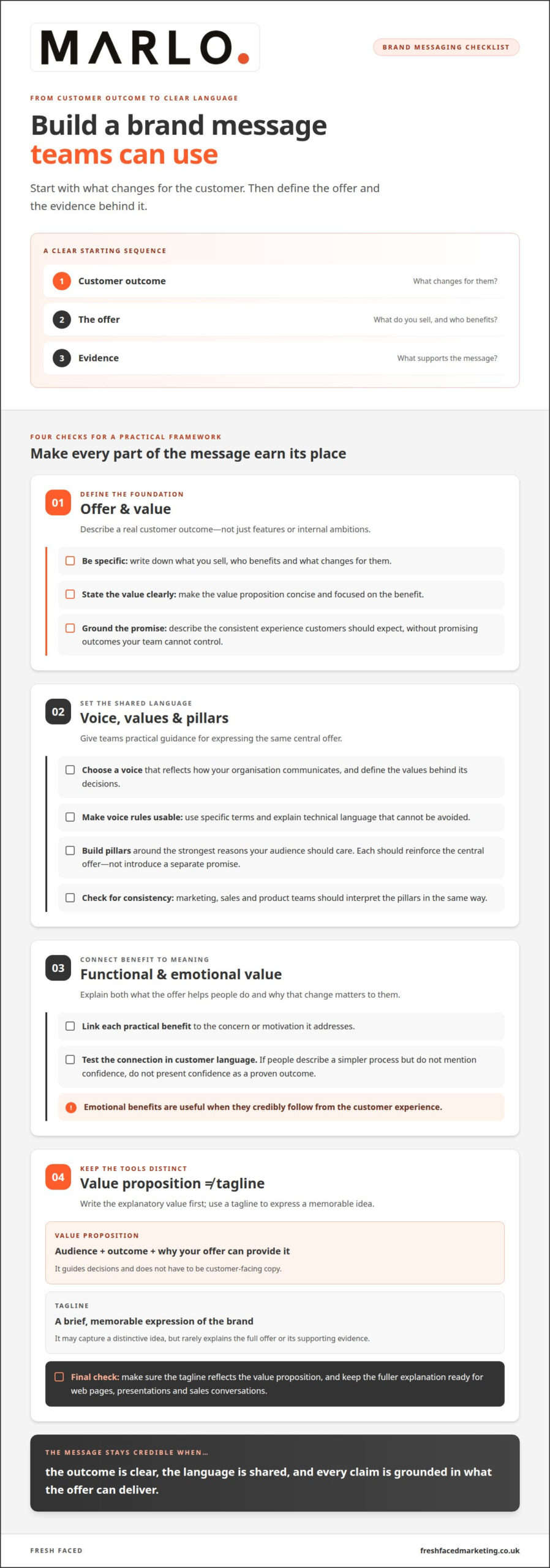
Start with the customer outcome, then identify the offer and the evidence behind it. These steps turn a broad idea into language your target audience can understand and your teams can use.
-
Define the core offer and its value
Write down what you sell, who benefits and what changes for them. For example, a payroll platform might help small employers run payroll with fewer manual tasks. Describe a real customer outcome, not just a list of features or internal ambitions.
Next, develop a value proposition that states the benefit clearly and concisely. Pair it with a brand promise: the consistent experience customers should expect when they choose you. Keep both grounded in what the offer can deliver, and avoid promises that depend on factors your team cannot control.
-
Identify the brand voice, values and pillars
Choose a voice that reflects how your organisation communicates, then define the values behind its decisions. For example, a financial planning firm might use plain language to express transparency. Set practical voice rules, such as using specific terms and explaining unavoidable technical language.
Build messaging pillars around the strongest reasons your target audience should care. A payroll platform could use accuracy, time saved and support for growing teams as pillars. Each should reinforce the central offer, not introduce a separate promise. Check that marketing, sales and product teams interpret the pillars consistently.
-
Connect functional and emotional value
Link each practical benefit to the concern or motivation it addresses. For example, a budgeting tool may help a household track spending and gain a clearer sense of control. Functional value explains what the offer helps people do; emotional value explains why that change matters to them.
Use customer language to test the connection. If people describe a simpler process but never mention confidence, don’t present confidence as a proven outcome. Emotional benefits are useful only when they credibly follow from the experience. This keeps messages relevant without overstating what the product delivers.
-
Distinguish value propositions from taglines
Write the value proposition first. It should explain the target audience, the outcome and why your offer can provide it. For a meal-planning service, that might mean helping busy households plan weekday dinners with less effort. The statement guides decisions; it isn’t necessarily customer-facing copy.
Then create a tagline as a brief, memorable expression of the brand. It may capture a distinctive idea, but rarely explains the full offer or provides supporting evidence. Check that it reflects the value proposition rather than replacing it. Keep the longer explanation ready for web pages, presentations and sales conversations.
How does messaging differ from positioning?
Positioning sets the strategic direction; messaging turns it into customer-facing language. Use the steps below to connect market choices with clear communication.
-
Clarify positioning and competitive difference
Define the space your offer should occupy and the alternative customers might choose. For example, a local accountancy firm could position itself around practical guidance for growing family businesses, rather than broad financial expertise.
Check that this distinction reflects a genuine strength and matters to the audience. Avoid claims such as “the best service” unless you can explain what makes the comparison meaningful. Clear positioning helps teams decide which messages belong and which dilute the offer.
-
Translate positioning into customer-focused messaging
Turn each strategic choice into a customer benefit. If a firm’s position centres on practical accountancy guidance, its messaging might explain how clearer records help owners make informed decisions. Preserve the meaning, but replace internal terms with language customers use.
Define the target audience by identifying who is most likely to value the offer, then build personas around their goals, concerns and decision criteria. For example, a family-business owner may prioritise cash-flow visibility. Use that insight to tailor examples, not to assume every customer shares the same motivation.
- Separate positioning statements from mission and vision. Write an internal positioning statement that names the audience, category, distinctive benefit and reason to believe. A project-management platform might serve distributed teams by making ownership and deadlines easier to track. The statement guides choices; it isn’t necessarily polished customer copy.
Keep the mission focused on what the organisation does and the vision on the future it wants to help create. For example, a training provider’s mission might centre on practical workplace learning, while its vision describes more confident teams. These statements provide direction, but don’t replace a specific market position.
- Write a value proposition, then shape an elevator pitch. State who benefits, what outcome the offer delivers and why it is a credible choice. For example: “We help independent retailers manage stock more clearly through one connected inventory system.” Check that each phrase reflects the offer, not an unsupported advantage.
An elevator pitch expresses that value in a short spoken explanation. It should help someone understand the offer quickly, while a positioning statement remains an internal strategic reference. A tagline can be shorter still. Treat each as a distinct tool, and ensure all three support the same competitive idea.
What Is a Messaging Framework?
A messaging framework sets out the message hierarchy; a brand messaging guide expands it into practical usage rules. A useful example might connect a community energy provider’s core promise to audience needs, supporting messages, evidence and channel-specific wording.
-
Identify the framework’s core components
Set the foundation by describing the main promise, target audiences, differentiators, supporting pillars and proof points. Give each component a distinct role: the promise states the central value, pillars explain its benefits, and proof points make claims credible. For example, a community energy provider could pair “helping households make informed energy choices” with guidance and clear service information.
Include personas to show how priorities differ. A homeowner may need information about household energy use, while a small business may focus on operating costs. Check that every message supports the same central promise, rather than creating competing claims.
-
Align the mission with brand expression
Use the mission as a filter for how the brand speaks and acts. If a provider’s mission centres on making energy choices easier to understand, its website, customer emails and public statements should explain options plainly. The mission informs expression; it shouldn’t replace a specific customer benefit.
Check each proposed message against that purpose. A claim about simplifying decisions needs practical explanations, not technical language that obscures them. This helps the brand engage people with relevant information while keeping its purpose visible in everyday communication.
-
Set voice, tone and style guidelines
Define voice as the brand’s consistent character, then explain how tone changes with context. A community energy provider might sound clear and measured in a service update, then more celebratory when sharing a local project. The underlying voice stays recognisable; the emotional register adapts to the situation.
Make the guidance usable. Specify preferred terms, sentence style and words to avoid, then include a short before-and-after example. For instance, replace dense technical phrasing with a direct explanation of what a service does. These rules help writers and AI tools produce coherent copy.
-
Establish governance for consistency at scale
Assign responsibility for maintaining the framework, approving changes and resolving conflicting interpretations. Store the current version where marketing, sales and communications teams can find it. Set an approval route for significant changes, so a new campaign doesn’t quietly replace the agreed promise or introduce unsupported claims.
This matters as AI use expands. McKinsey reports that 88% of organisations use AI in at least one business function. Gartner finds that 70% of CMOs say internal marketing processes aren’t mature enough to scale AI. Treat the framework as a source for human review, not a guarantee that generated copy will stay on-brand.
Review examples from real campaigns and sales materials. Note recurring inconsistencies, clarify ambiguous guidance and update the source when strategy changes. A consistent process lets teams adapt messages without changing the brand’s underlying meaning.
Framework use across public relations, communications, marketing, advertising and sales
Apply the same central message across teams, then adapt the detail for each audience and channel. For UK campaigns, use a review process that checks factual claims, supporting evidence and clear qualifications before publication.
- Give public relations and communications teams shared message boundaries. Set out the core point, supporting evidence and approved terminology before drafting a press release or stakeholder update. For example, a housing association announcing a repairs programme should distinguish confirmed improvements from planned work. This keeps spokespeople, written statements and responses to enquiries aligned without forcing identical wording on every communication.
-
Map messaging across teams and channels
Build a matrix linking each audience to its message, channel and intended action. A software company might explain reliability to customers through service emails, while sales presentations address implementation concerns. Include public relations, customer service and sales, not just marketing. Check that each team uses the same central claim and doesn’t introduce a different promise through local wording.
-
Apply messaging across marketing channels
Choose the message that best fits each channel’s purpose and audience. A website can explain the offer in detail; an email can focus on one relevant benefit; social posts can use a concise example that invites engagement. Keep the central meaning stable, but adapt length, format and emphasis. Review the customer journey to ensure each channel builds on the previous one.
-
Apply messaging across advertising and sales
Connect every advertising claim to evidence and a clear customer benefit. A campaign promoting faster delivery, for instance, needs support for that specific claim and any qualification the audience needs. Sales teams can use the same benefit in conversations, adding detail about the customer’s circumstances. Check that sales materials reinforce the advertising narrative rather than promise something different.
- Set a practical review process for every channel. Before publishing a campaign, ask the relevant teams to check audience fit, message consistency and evidence for factual claims. For example, a product-page update should match its email promotion and sales materials. Record approved changes in a shared source document, so teams can adapt copy without drifting from the agreed message.
Messaging framework best practices
Build the framework by gathering customer evidence, prioritising the strongest messages, then documenting and testing them. Avoid unsupported claims, generic language and features that don’t explain customer value.
- Start with customer evidence. Review sales conversations, customer intake forms, testimonials and support questions. Note the phrases people use to describe their needs and why they choose an offer. For example, if customers repeatedly mention reducing admin, make it a candidate benefit, then check whether the product genuinely supports it.
-
Create the framework step by step
Organise the evidence into audience needs, the core outcome, differentiators, supporting messages and proof. Draft the top-level statement first, then add points that explain and substantiate it. A practical framework links each claim to a customer concern and a relevant example, rather than collecting disconnected copy ideas.
Test the draft with colleagues in marketing, sales and product. Ask each person to explain the offer using the same document. Where explanations diverge, clarify the wording or strengthen the evidence. This makes the framework a working tool, not a document teams file away.
- Separate outcomes from features. List what the product does, then explain why each element matters to the audience. For example, appointment reminders are a feature; helping a clinic reduce missed appointments is a potential customer benefit. Keep the benefit only if the product and available evidence support that connection.
-
Avoid common mistakes and risks
Remove claims such as “industry-leading” when they lack a clear comparison or proof. Don’t try to address every audience need in one headline, as competing benefits can obscure the main point. Also check that personas reflect real customer differences, not stereotypes based on job titles or assumptions.
Review every proof point for relevance and context. A testimonial about one customer’s experience doesn’t automatically support a universal performance claim. Keep evidence close to the message it supports and make qualifications clear. This helps teams explain benefits without overstating what customers can expect.
- Test, learn and maintain the document. Use the messages in a landing page, sales presentation or email, then gather feedback from the people who use them. Look for unanswered questions, misunderstood points and evidence that fails to persuade. Update the relevant elements while preserving the central strategy.
If the strategy behind your messaging needs further development, explore data-led marketing strategy support.
Fresh Faced: MARLO
MARLO is Fresh Faced’s software for analysing competitors and identifying market opportunities. Its interactive dashboard brings together search, content, social and paid media analysis, then organises the findings into a strategic roadmap with budget and resource guidance. Use these insights to assess whether your positioning and messages reflect a meaningful difference in the market.
For teams that need human-led analysis, The Marketing Success Blueprint (MSB) adds strategic interrogation, a detailed execution blueprint, two one-to-one calls and a two-to-three-hour workshop. It also delivers a data-backed, 12-month marketing strategy roadmap. Full Marketing Strategy Execution is the next step when you want support putting the strategy into practice.
Visit Fresh Faced’s website to discuss the right next step for your business.
Make your next message a deliberate choice
A useful marketing messaging framework isn’t finished when the document is written. Its value lies in the decisions it helps your team make: which audience to prioritise, what to say first and which claims need stronger evidence. Treat it as a working reference, not a script. Review it when customer priorities, your offer or the market changes, and refine anything that no longer reflects reality.
Start with a practical test. Ask colleagues in different roles to explain the same offer in their own words, then compare their answers with your intended message. Any mismatch gives you a specific issue to investigate, whether it’s unclear wording, a missing proof point or an unresolved strategic choice.
If you’d like an experienced perspective on those choices, contact Fresh Faced to discuss your messaging. A clearer shared direction can help your team communicate with greater purpose and make each next step more considered.
Frequently Asked Questions
What are the benefits of marketing messaging?
Clear messaging helps people understand an offer and teams make consistent communication choices. It can also prevent avoidable rewrites: a product marketer and a sales colleague can start from the same approved explanation. For example, if a customer asks whether a service suits a small team, staff can use agreed audience criteria to answer accurately instead of improvising a new promise.
Step 6: What stories can you tell to illustrate your message and add depth?
Choose stories that show the message in action: what prompted a customer to seek help, what they did and what changed. A useful example might describe how a retailer struggled to track stock, adopted a clearer process and made replenishment decisions with better information. Use customer words or documented evidence where available, and clarify when an example is illustrative rather than a real case.
What is product messaging?
Product messaging explains a specific product’s purpose, value and relevance to its intended audience. For a project-management app, it might show how shared task ownership helps a team spot overdue work. Brand messaging covers the wider organisation; product messaging focuses on one offer. Keep product claims consistent with the wider brand while addressing buyers’ questions about that solution.
What is a marketing messaging framework?
A marketing messaging framework is a practical reference that helps a team decide what to say, to whom and why. It connects a central message with audience needs, supporting explanations and evidence, so writers can develop suitable copy without starting from scratch. For instance, a training provider could use it to keep a course’s core benefit consistent across its prospectus, email sequence and sales conversations.
What are the key components of a marketing messaging framework?
Include the intended audience, central value, differentiators, supporting messages and proof. Add practical guidance on terminology and tone, plus examples showing how messages can be adapted. For a home insulation company, evidence might include a clear explanation of materials and installation, alongside customer feedback. Check that every element strengthens the same central idea rather than introducing a competing claim.
How do you adapt messaging across channels and customer journey stages?
Match information to the audience’s immediate question. Someone discovering a project-management app may need a plain explanation of its purpose; someone comparing options may need workflow details; a prospective buyer may need implementation information. Use a matrix to map each stage to an appropriate channel and message. Keep the core meaning stable, but adjust the depth, format and next action.
How do you test and measure the effectiveness of marketing messages?
Test one change at a time, such as a headline focused on time saved versus one focused on fewer manual tasks. Compare relevant channel measures, including click-throughs, enquiries or completed purchases, and note the audience and campaign context. Pair performance data with sales questions and customer feedback. A result shows how a message performed in that setting; it doesn’t prove the wording alone caused the outcome.