A marketing strategy built without local market and competitor evidence is guesswork, however polished it looks. Strategic marketing advisory services in the UK help businesses turn evidence about customers, competitors and commercial goals into a prioritised plan, with channel choices, budget and performance measures connected to business outcomes. A useful strategy can set a 12-month direction while adapting its priorities to the business’s market position and resources.
It makes sense to expect strategic marketing advice to clarify where to compete and what to do next. But without a close look at the UK market, competitor positioning and missed opportunities, recommendations can leave the central decision unresolved.
This guide explains how to develop a marketing strategy, assess your market and choose an advisory format that fits your needs. It also covers how to track performance, so you can judge whether marketing is moving the business towards its goals and adjust priorities when the evidence points elsewhere.
Key Takeaways
- Build your strategy from evidence about customers, competitors and your commercial priorities, then turn it into a clear sequence of actions.
- Choose an advisory format based on the decision you need to make: a workshop, diagnostic, audit or ongoing senior marketing input each serves a different purpose.
- Set performance measures before activity begins, linking channel metrics to business objectives so you can identify what to refine or stop.
- Assess specialist expertise by how well it fits your sector, business stage and internal resources, rather than by broad claims alone.
- Understand how scope, deliverables and involvement shape consultant pricing, and use competitor analysis to identify where MARLO or a more hands-on strategy blueprint could help.
Strategic marketing strategy development
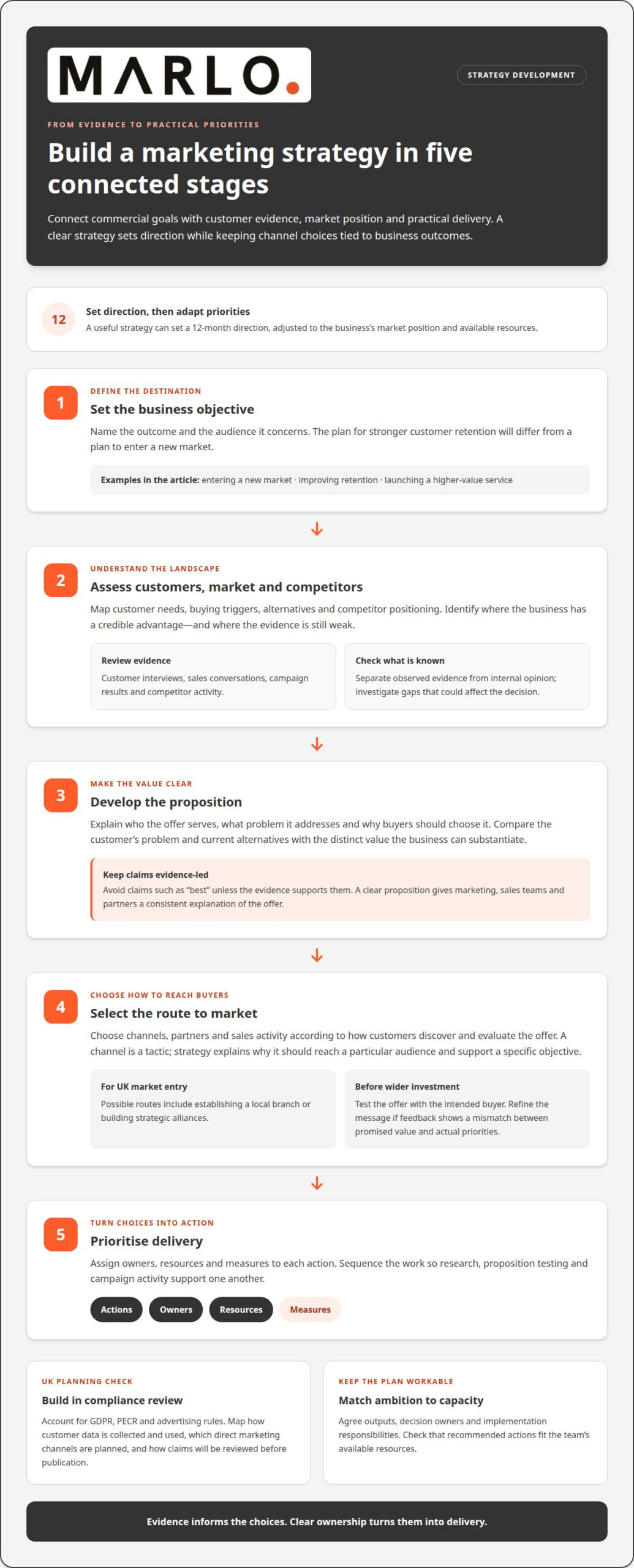
A useful strategy connects commercial goals with customer evidence, market position and practical delivery. Start by defining the business outcome, such as entering a new market, improving retention or launching a higher-value service. Then identify the audience, buying problem and competitive alternatives. This keeps channel choices in their proper place: a social campaign or search programme is a tactic, while the strategy explains why it should reach a particular audience and support a specific business objective.
UK marketing plans should account for GDPR, PECR and advertising rules. Map how customer data is collected and used, which direct marketing channels are planned, and how claims will be reviewed before publication.
A strategic marketing advisory engagement typically moves from discovery to analysis, strategic choices and an implementation plan. It should begin with the business objective, then translate evidence into priorities, responsibilities and measures the team can use.
Start with evidence, not assumptions. Review customer interviews, sales conversations, campaign results and competitor activity. A business selling specialist equipment, for instance, might find that buyers value installation support more than a lower headline price. That changes the proposition, audience messaging and channel priorities. Separate observed evidence from internal opinion, then investigate gaps that could affect the decision.
- Set the objective. Define the business outcome and the audience it concerns. A target such as stronger customer retention needs a different plan from entering a new market.
- Assess the market. Map customer needs, alternatives, buying triggers and competitor positioning. Identify where the business has a credible advantage, and where evidence remains weak.
- Develop the proposition. State who the offer serves, what problem it addresses and why buyers should choose it. For a consultancy, this might mean making specialist expertise clearer than a broad promise of support.
- Choose the route to market. Select channels, partners and sales activity according to how customers discover and evaluate the offer. UK market entry routes can include establishing a local branch or building strategic alliances.
- Prioritise delivery. Assign owners, resources and measures to each action. Sequence work so that research, proposition testing and campaign activity support one another.
Go-to-market planning turns strategy into a launch sequence. For a new service, define the first customer group, sales conversation, distribution route and evidence needed before wider investment. Test whether the offer makes sense to the intended buyer, and refine the message if feedback reveals a mismatch between promised value and actual priorities.
Proposition development also requires disciplined comparison. Set out the customer’s problem, current alternatives and the distinct value the business can substantiate. Avoid claims such as “best” unless evidence supports them. A clear proposition gives sales teams, marketing teams and partners a consistent explanation of the offer.
Risks when hiring a strategic marketing adviser include unclear scope, recommendations based on incomplete evidence and plans that exceed internal capacity. Agree the required outputs, decision owners and implementation responsibilities before work begins. Then assess whether the proposed actions fit available resources.
Choosing between a workshop, diagnostic, audit and Fractional CMO
Choose the format according to the decision your business needs to make. A workshop can help people reach alignment; a diagnostic investigates a problem; an audit reviews existing activity; a Fractional CMO provides continuing senior leadership. A team divided over its target audience, for example, needs a different intervention from a business whose campaign results have stalled.
Marketing advisory firms generally bring a team or defined methodology, while freelance consultants offer direct input from an individual practitioner. Full-service agencies typically combine strategic advice with campaign delivery. Compare the actual scope and outputs rather than relying on labels.
Each format answers a different need:
- Workshop: Use a facilitated session when leaders need to resolve a specific choice, such as which customer segment to prioritise. Set a clear agenda and require decisions, owners and next steps as outputs.
- Diagnostic: Choose this when the cause of a problem is unclear. A business with falling enquiries, for example, might need analysis across its proposition, customer journey and channel mix before deciding what to change.
- Audit: Select an audit when you need a structured review of existing marketing. It can examine campaign performance, messaging, channel use and reporting, then identify gaps and actions. Agree what is in scope, such as paid activity or customer communications.
- Fractional CMO: Consider this when the business needs ongoing senior marketing direction, but not a full-time appointment. The role may guide priorities, support internal teams and connect marketing plans with commercial decisions. Define decision authority and working relationships at the outset.
A workshop may be enough for a focused decision. If the cause of a problem is unclear, begin with a diagnostic. If activity is already underway but needs scrutiny, an audit creates a baseline. When execution requires sustained leadership across teams, a Fractional CMO may fit better. These formats can also follow one another: an audit can reveal issues, then a workshop can set priorities.
To choose and vet an adviser, write down the decision, expected deliverables and people responsible for acting on recommendations. Review relevant examples of their work, ask how they gather evidence, and assess whether their approach fits your sector, business stage and internal capacity.
Before agreeing to a project, clarify its scope, access to data, review points and how recommendations will be presented. A useful proposal explains what the adviser will examine, what your team must provide and how success will be assessed. If you’re considering structured marketing strategy support, start by defining the decision the work needs to resolve.
Marketing performance and accountability
Marketing performance should connect activity to a defined business outcome. If the goal is more qualified enquiries, measure enquiry quality, sales progression and eventual revenue. Website visits alone cannot show whether marketing is attracting suitable buyers. A useful scorecard links each measure to a decision, such as refining a message or reallocating effort.
Start with a small set of measures across the customer journey. For a B2B service, track relevant website visits, enquiry submissions, sales-qualified opportunities and closed business. Define each measure clearly. Agree what counts as a qualified enquiry, who records it, and where the data lives. Without shared definitions, teams can report different versions of the same result.
Separate leading indicators from lagging outcomes. A webinar registration or product-page visit can signal early interest; a completed sale shows a later commercial result. If registrations rise but sales conversations do not, investigate the audience, offer and follow-up. This distinction helps teams diagnose a weak point instead of treating every campaign metric as equally meaningful.
Assign ownership before activity starts. A simple accountability plan can identify:
- Measure owner: The person responsible for recording a metric, such as the sales lead logging qualified opportunities in the CRM.
- Review owner: The manager who interprets results and brings unresolved issues to the team.
- Action owner: The person who changes the landing page, follow-up process or campaign brief.
Choose a reporting rhythm that matches the sales cycle. A monthly review can help a team selling shorter-cycle services spot operational problems early. A business with longer procurement decisions may need to review pipeline movement alongside campaign activity. Keep reviews consistent, and record the action, owner and rationale each time.
Attribution needs careful interpretation. A buyer may discover a company through a search result, return after a referral, then enquire following a sales conversation. A last-click report credits only the final interaction. Compare CRM records, campaign tracking and customer feedback to understand the sequence. Treat attribution as evidence for decisions, not a perfect account of every influence.
Set decision rules before results arrive. If a campaign brings traffic but few suitable enquiries, for example, review its targeting and message before increasing investment. If a channel produces relevant opportunities, assess whether the sales team can handle the demand. Document what changed and compare later results against the original baseline.
Accountability is not about blaming whoever manages a channel. It means making the intended result, evidence and next action visible. A shared dashboard, clear definitions and named owners give leadership a practical basis for deciding what to continue, adjust or stop.
Which UK strategic marketing consultancies specialise in different industries or business sizes?
Specialisation can show up in a consultancy’s sector experience, client scale or strategic method. A business choosing an adviser should look for evidence that matches its commercial context. A manufacturer selling through distributors, for example, faces different buying journeys from a direct-to-consumer retailer. The relevant fit is not just a familiar sector label, but the adviser’s ability to understand the sales model, customer and constraints.
Industry knowledge matters when buying processes, terminology or routes to market shape the strategy. A consultancy experienced with professional services may understand referral-led growth and long sales discussions. A team familiar with manufacturing may recognise the role of distributors, trade events and technical product information. For a business serving NHS organisations, procurement structures and multiple decision-makers affect how audiences and messages should be assessed. These examples describe different strategic demands, not a ranking of providers.
Business size also affects the support required. A small business with a lean team may need a focused strategy that prioritises a few achievable actions. A growing company may need clearer positioning across several customer groups. A larger organisation may need to align marketing across business units, regions and sales teams. Ask how an adviser adapts recommendations to available skills, budget and decision-making structure.
Use these signals to identify a relevant specialism:
- Sector fluency: Can the adviser explain how buyers evaluate offers in your market, such as legal services, software or food production?
- Business-stage experience: Does their approach suit a start-up testing demand, an established firm entering a new region or a company refining its position?
- Commercial model: Have they considered whether revenue comes through subscriptions, projects, retail sales, tenders or channel partners?
- Team capacity: Do recommendations reflect who will deliver the work, such as an in-house marketer, sales lead or external agency?
Examine the work behind any sector claim. Request a relevant example and ask what decision the analysis informed. A useful case explains the original challenge, evidence considered and how recommendations fitted the organisation’s resources. Client names or headline outcomes alone reveal little about an adviser’s method. Look for the reasoning, not just a list of familiar brands.
A narrow industry specialism may not be essential for a business serving several sectors. The adviser should still understand differences between customer groups and avoid forcing one message across distinct markets. A UK software firm selling to both retailers and accountancy practices, for instance, needs to compare each audience’s priorities before choosing shared or separate positioning.
Compare providers against the same brief. Include your business model, target customers, current challenge and internal capacity, then assess whether each proposed approach addresses those specifics. This is more useful than choosing by company size, sector label or presentation alone.
UK strategic marketing consultant fees and pricing
There’s no single fee for strategic marketing advice in the UK. Pricing varies with the work involved: scope, research depth, adviser seniority, deliverables and ongoing involvement all shape a quote. Reviewing one customer segment requires different work from assessing a market and developing a full strategic plan.
Consultants commonly price work in several ways. An hourly or daily rate suits defined advisory time, such as reviewing a proposal or facilitating a planning session. A fixed project fee can work when scope and outputs are agreed upfront. A retainer covers continuing support, while a fractional arrangement sets out recurring senior input. The right model depends on the work, access required and duration.
Compare the models against the decision you need to make:
- Hourly or daily billing: Useful for a contained task, such as reviewing customer research or advising on a launch decision. Agree what preparation and follow-up time covers.
- Fixed project fee: Suits a defined output, such as a competitor review or positioning plan. Set out research boundaries, stakeholder interviews and presentation format.
- Retainer: Fits ongoing advice across planning and review cycles. Clarify expected availability, meeting frequency and how additional work is handled.
- Fractional leadership: Provides regular senior marketing direction within an agreed remit. Define decision-making authority and the relationship with internal teams.
Scope is often the main driver of a project quote. Reviewing existing materials may involve less research than interviewing customers, analysing competitors and gathering input from several departments. A market launch plan, for example, needs a different evidence base from refining one service proposition. Ask for deliverables, assumptions and exclusions in writing to make proposals easier to compare.
Check whether the fee covers discovery, analysis, recommendations and presentation. A low initial quote may cover only an assessment, leaving implementation planning outside the scope. A more complete engagement might include a prioritised roadmap, resource guidance and measures for reviewing progress. Compare usable outputs, not just the headline amount or number of meetings.
Before approving work, agree payment stages, ownership of materials, review points and how scope changes will be handled. If a project depends on sales records or customer feedback, assign someone to provide them. Delays in evidence or stakeholder decisions can affect delivery, so clear responsibilities help everyone manage the work.
For a useful comparison, give each adviser the same brief: your business objective, market, available evidence and required decisions. Ask how their proposed scope addresses those needs. Discuss your marketing strategy requirements when you’re ready to define the work.
Fresh Faced: MARLO
MARLO gives businesses a practical next step when market and competitor evidence needs turning into priorities. Choose competitors, then review their search rankings, content performance, social activity across 90 days, and active paid campaigns through an interactive dashboard. Its strategic roadmap organises opportunities against your goals, budget and available resources.
For businesses seeking human-led analysis alongside the software, the Marketing Strategy Blueprint (MSB) provides detailed competitive analysis, strategist input, a practical execution blueprint and a workshop. Choose Full Marketing Strategy Execution when you need support putting the resulting strategy into practice.
Use MARLO to clarify where opportunities may exist; choose the MSB when you need deeper interpretation and a plan for your team. Visit Fresh Faced to discuss your marketing strategy.
Turn your next marketing decision into a clear brief
Before commissioning advice, write down the decision your business needs to make. State what is at stake, who needs to contribute and what evidence would change your view. This gives the work a clear purpose and keeps recommendations tied to decisions, not activity for its own sake.
For businesses considering strategic marketing advisory services in the UK, a clear brief can reveal the right level of support. You may need clarity on one priority, a complete strategic direction or help carrying agreed plans into delivery. Match the scope to the decision, then ensure the people responsible for acting can use the output.
Fresh Faced offers MARLO, the Marketing Strategy Blueprint and Full Marketing Strategy Execution. If you’re ready to discuss the right next step for your business, contact Fresh Faced. A well-defined decision is a strong place to begin.
Frequently Asked Questions
What strategic marketing advisory services are available in the UK?
UK businesses can choose focused advice, strategic planning or continuing marketing leadership. Common formats include workshops, diagnostics, audits and Fractional CMO support. Some providers also offer market and competitor research, a written strategy or implementation support. The right fit depends on whether you need to resolve one decision, assess current activity, set direction or coordinate ongoing work across your organisation.
What do strategic marketing advisory services in the UK typically include?
Typical work can include reviewing customer evidence, market conditions, positioning, channel choices and internal resources. The agreed output might be a decision workshop, audit report or strategic plan with priorities and responsibilities. A business preparing to launch a service, for example, could need customer validation, a route-to-market recommendation and measures for assessing early demand. Agree the scope and deliverables before work begins.
How do UK advisers develop marketing strategy using research, positioning and customer insight?
Advisers combine customer and commercial evidence to identify which audiences and propositions deserve attention. They may analyse sales conversations, customer feedback, CRM records and competitor messaging, then compare the findings with the business’s capabilities. If buyers repeatedly value ease of implementation, for example, the positioning can foreground that benefit, provided the business can substantiate it. The strategy then turns this insight into choices about audiences, channels and priorities.
How can businesses measure the results and ROI of strategic marketing advice?
Measure agreed business outcomes against a clear starting point, then connect marketing activity to customer and sales data. Track indicators such as qualified opportunities, conversion rates, revenue and gross margin, alongside the cost of the work. A basic ROI calculation compares attributable financial return with investment, but attribution needs care when several channels influence a purchase. Record assumptions and review them consistently before changing priorities.