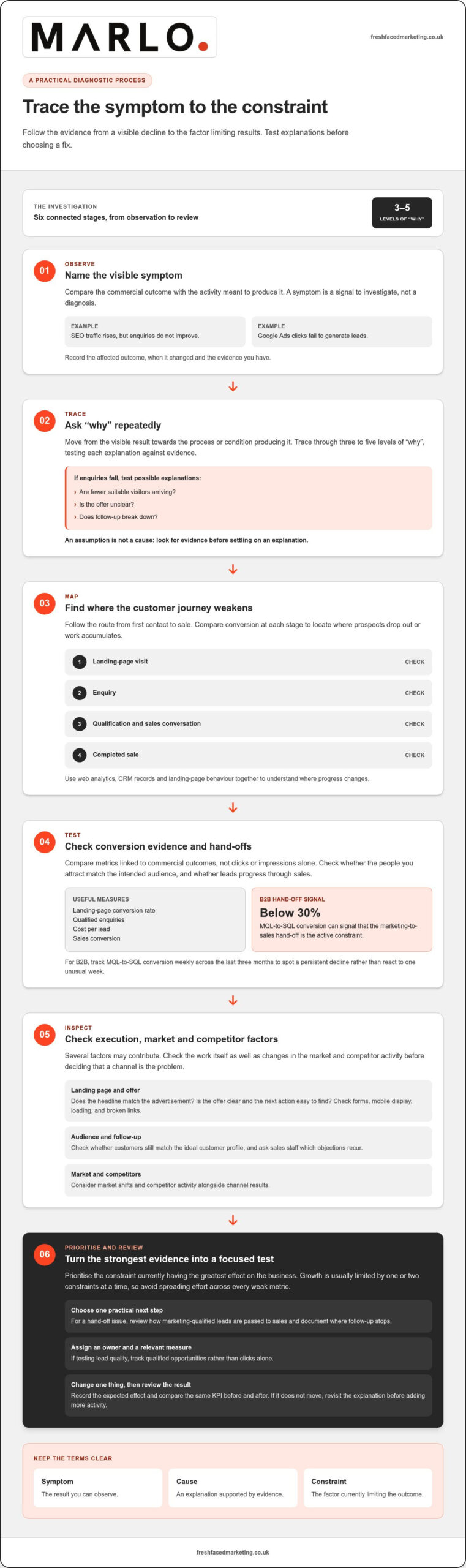
A marketing decline is a signal, not a diagnosis. Knowing how to diagnose a marketing problem means tracing the visible symptom through three to five levels of “why”, then testing conversion performance and the execution, market or competitor factors that could explain it.
It’s understandable to suspect a channel when traffic rises but sales stay flat, or when paid clicks fail to produce enquiries. But those results can have different causes: the wrong audience, a weak landing page, a broken hand-off or a shift in the market. Treating the first visible symptom as the answer can send effort in the wrong direction.
This guide gives you a practical way to investigate before choosing a fix. You’ll learn to separate symptoms from causes, assess where potential customers drop out, and examine whether execution, market conditions or competitor activity are limiting results. Some problems have more than one contributing factor, so the aim is to turn evidence into a focused next step: identify what is happening, test what may be driving it, and prioritise the issue with the greatest effect on your business.
Key Takeaways
- Separate the visible symptom from its possible cause by asking why repeatedly and testing each explanation against evidence.
- Trace the customer journey from first contact to sale to find where conversion weakens, rather than judging performance by traffic alone.
- Check whether the customers you attract still match your ideal customer profile before changing channels or campaigns.
- Assess execution, market shifts and competitor activity alongside channel results; several factors can contribute to a decline.
- Turn the strongest evidence into one prioritised constraint, a practical next action, an owner and a way to measure progress.
How do you tell the difference between a symptom and an underlying cause?
Falling enquiries, a stalled pipeline or rising traffic without more sales are signs of a marketing problem. To find its cause, trace the evidence through three to five levels of “why”, then identify the constraint limiting progress.
Identify the main signs of a marketing problem
- Compare the commercial outcome with the activity meant to produce it. For example, check whether SEO traffic has increased without enquiries improving, or whether Google Ads clicks are failing to generate leads. These are symptoms, not diagnoses.
- Look for the point where performance changes. In B2B, MQL-to-SQL conversion below 30% can signal that the marketing-to-sales handoff is the active constraint. Record the affected outcome, the timing and the evidence before proposing a fix.
Separate symptoms from causes and constraints
- Ask “why” repeatedly, moving from the visible result towards the process or condition producing it. If enquiries fall, test whether fewer suitable visitors arrive, whether the offer is unclear, or whether follow-up breaks down. Each answer needs evidence; an assumption is not a cause.
- Name the terms precisely. A symptom is the observed result; a cause helps explain it; a constraint is the factor currently limiting the outcome. The Financial Conduct Authority identifies symptom-focused responses as a reason issues can resurface. Follow the evidence further before choosing an intervention.
Locate the business growth bottleneck
- Apply the Theory of Constraints: map the route from first contact to sale, then find where work or prospects accumulate. A crowded pipeline with few qualified opportunities points to a different bottleneck from strong lead volume followed by stalled sales conversations.
- Test whether the suspected constraint affects the defined business outcome. Growth is usually limited by one or two constraints at a time, so avoid spreading effort across every weak metric. UK Government guidance supports experiments and iterative feedback to test assumptions and refine responses.
Turn the diagnosis into a concise action plan, not a catalogue of problems. Prioritise the constraint currently costing the business most. Record the outcome it affects, the evidence supporting it and the intervention most likely to test it. Keep secondary issues visible, but defer them until the primary constraint changes or new evidence alters the diagnosis.
- Assign an owner and a first practical step. For a handoff issue, the step could be reviewing how marketing-qualified leads are passed to sales, then documenting where follow-up stops.
- Choose a measure tied to the intended outcome. If the intervention targets lead quality, track qualified opportunities rather than clicks alone; otherwise, the test may reward activity without addressing the constraint.
- Review the result and adjust. If the measure does not move, revisit the causal explanation before adding more activity. This keeps the response focused on the actual bottleneck and helps prevent the same symptom from returning.
Assessing landing page and conversion performance
Compare conversion rates at each customer journey stage, from landing-page visit to enquiry and sale. Check web analytics, CRM records and landing-page behaviour to locate where potential customers drop out.
Check relevant marketing KPIs
- Start with metrics tied to commercial outcomes: landing-page conversion rate, qualified enquiries, cost per lead and sales conversion. Compare each with the previous period and the campaign’s intended audience. For example, rising visits with unchanged enquiries suggest a different issue from fewer visits but steady sales. Don’t rely on clicks or impressions alone: they show activity, not whether marketing attracts valuable prospects.
Analyse funnel and sales conversions
- Map each stage from first visit to completed sale, then calculate how many prospects progress between stages. For B2B teams, track MQL-to-SQL conversion weekly across the last three months to spot a persistent handoff decline rather than reacting to one unusual week. Compare lead sources and sales outcomes, too. If one source delivers enquiries but few qualified conversations, investigate audience fit and follow-up before increasing campaign activity.
Identify conversion and sales friction
- Inspect the landing page as a prospective customer would. Check whether the headline matches the advertisement, the offer is clear and the next action is easy to find. Review form fields, mobile display, page loading and broken links. A promise of a consultation followed by an unrelated form creates friction. Ask sales staff which objections recur, then compare their comments with the page’s wording and evidence.
Use tools and methods to diagnose performance
- Bring web analytics, CRM data and campaign reports together using consistent definitions for leads and conversions. Use landing-page analytics to compare entry pages and traffic sources; use CRM records to follow enquiries through qualification and sale. Session recordings or user testing can reveal confusion that totals conceal. Check tracking before drawing conclusions: inconsistent records of form submissions can make conversion comparisons point to the wrong problem.
Keep the investigation focused. Change one page element or follow-up step at a time, record the expected effect, then compare the same KPI before and after. A focused review of the customer journey can help connect performance evidence to commercial priorities, with marketing strategy support providing a structured way to develop that direction.
Checking MQL-to-SQL conversion takes another 15 minutes. A marketing diagnostic may help when traffic grows but sales remain flat or Google Ads generate clicks but few leads, identifying where customers drop out before becoming clients.
Should a business always find one root cause?
No. A gradual decline over six months may reflect market maturation, competitive pressure or customer-profile drift; after a year, several marketing components may have weakened together. Compare targeting, positioning, pricing and messaging with customer evidence to identify the underlying issue.
Check for ideal customer profile drift
- Compare the profiles of your last 20 closed-won deals with your documented ideal customer profile. Record which buyers match by need, organisation type and buying behaviour, then look for a recurring mismatch. More than 5-6 deals outside the profile suggests targeting may have drifted. Don’t rely on traffic volume alone: a channel can attract more visitors whilst reaching fewer suitable buyers.
Review customer acquisition economics
- Assess whether customer value, margins, marketing spend and realistic acquisition costs support the activity. If acquisition costs rise while customer value or margins fall, more leads may not improve commercial performance. Compare results by channel and customer type, including retention. Repeat purchases, renewals or early cancellations can show whether marketing attracts customers who stay, not simply those who convert once.
Distinguish targeting, positioning, pricing and messaging issues
- Use sales conversations and closed-lost feedback to separate the possible causes. If suitable prospects don’t recognise the value, examine positioning; if they understand it but reject the cost, review pricing against perceived value. If the right audience never responds, investigate targeting or message relevance. Interview 5-7 recent closed-lost prospects; if 3 or more couldn’t distinguish your business from a competitor, positioning may be constrained—an area where consulting identity specialists at brandingtitans.com can help clarify your value proposition and mission.
Avoid common diagnosis mistakes and risks
- Test explanations against evidence before changing execution. A common mistake is treating one weak metric as proof that an entire channel has failed, then changing targeting, creative and budget together. That makes it hard to tell what caused any subsequent change. Record the starting measure, make one focused intervention and compare the outcome. If several indicators remain weak, investigate how they interact rather than forcing a single explanation.
Keep distinct causes visible, but prioritise the issue with the clearest commercial impact. For example, if retention weakens despite suitable new customers, acquisition may not be the main constraint. Compare customer feedback, margins and renewal patterns before redirecting spend. This ties the diagnosis to business outcomes, not assumptions about which channel is responsible.
Can a marketing problem actually be an execution problem?
Yes. Compare the commercial outcome with channel symptoms, then trace where execution breaks. In the UK, include a review of relevant UK GDPR and CAP Code considerations when investigating data use, targeting and advertising claims.
Compare commercial outcomes with channel symptoms
- Start with the business outcome, such as qualified enquiries, sales or renewals. Then compare it with channel indicators, including search traffic, paid clicks or social engagement. If clicks rise but qualified enquiries do not, the symptom sits in the channel; the cause could be targeting, the offer or follow-up.
- Map how each channel contributes to the same outcome. A search campaign may capture existing demand, while email supports repeat business. Review their roles together rather than treating each dashboard as a separate verdict. If the commercial result is weak across channels, investigate shared factors such as positioning, offer clarity or sales follow-up.
- Write down the intended sequence between activities. A prospect might see a social post, visit a landing page, then receive a sales follow-up. Check that each hand-off happens and carries a consistent message. If the sequence breaks at the landing page, increasing social activity may amplify the symptom without fixing the underlying execution issue.
Distinguish marketing issues from other business problems
- Compare feedback from prospects with feedback from customers. If suitable prospects understand the offer but reject its value, review the product or pricing proposition. If customers buy but later report delivery or support problems, investigate those business processes instead. Marketing may shape expectations, but more promotion cannot resolve a product or service issue.
- Check sales follow-up before attributing low conversion to marketing. Review whether enquiries receive timely, relevant responses and whether sales conversations address the advertised offer. If marketing generates suitable leads but sales does not progress them, the constraint may sit in sales execution. If leads are consistently unsuitable, revisit targeting and message alignment.
- Review coordination across the people responsible for each channel and hand-off. Agree on one commercial outcome, a shared sequence and clear ownership. Align the campaign promise, landing-page content and sales response before launch. When teams optimise separate channel measures, activity can increase while the overall outcome stays unchanged.
- Add a compliance checkpoint to the investigation. Review how personal data is used for marketing against applicable UK GDPR requirements, and assess advertising content against the CAP Code. Check relevant data-handling, targeting and claims processes with the responsible person in your organisation. Record any issue separately from performance findings, so compliance concerns aren’t mistaken for channel effectiveness.
Use the evidence to decide whether the next step belongs in marketing, sales, product or customer service. If the cause spans several teams, sequence the work around one shared outcome. Changing channels before fixing a broken hand-off can leave the same symptom in place.
Market research and competitor analysis
Investigate whether performance changed because customer needs or competitor activity changed. Compare market evidence with your campaigns before choosing a solution.
- Define the market question before collecting information. For example, ask whether fewer prospects recognise the need your service addresses or whether your offer has become harder to distinguish. Review recent sales conversations, customer feedback and lost opportunities for repeated themes. Separate observed evidence from assumptions: one competitor’s new campaign doesn’t prove the whole market has shifted.
- Compare competitor positioning with your own, using specific customer problems and benefits. Note what each business promises, whom it targets and what proof it presents. A competitor may foreground speed while your message emphasises expertise. That difference matters only if buyers value it. Look for patterns across several competitors and customer discussions rather than copying one visible slogan or campaign.
- Examine competitor activity across search, content, social and paid campaigns. Identify the topics they address, the formats they use and the audiences their messages appear designed to reach. Compare those findings with your own market presence. If competitors consistently explain a buyer concern your content ignores, test whether that concern appears in customer enquiries before investing in a new content programme.
- Gather direct market evidence to test your explanation. Speak with recent customers, lost prospects and sales staff using the same prompts. Ask what alternatives they considered, what influenced their decision and where your offer felt unclear. Compare answers with campaign messages and competitor claims. If feedback points to a value gap, revise the proposition; if it points to low awareness, investigate reach and channel selection.
- Turn findings into a testable intervention, not a broad imitation strategy. If buyer interviews reveal confusion between your service and a competitor’s, test clearer positioning with a defined audience. Track responses through relevant enquiries and sales conversations. Keep the original message as a comparison and change one major element at a time. This helps distinguish a useful market insight from coincidence.
Translate the evidence into priorities by weighing customer feedback, competitor positioning and the business outcome you want to influence. A structured marketing strategy approach from Fresh Faced can help organise those findings into clear strategic options.
For complex marketing problems, use structured observation and research to collect data, then experiment with possible solutions. This sequence turns competing explanations into evidence-led tests while keeping decisions grounded in what the market shows.
Fresh Faced: MARLO
MARLO turns marketing and competitor research into a clearer view of what may be limiting growth. Its interactive dashboard analyses competitor search visibility, content, social activity and paid campaigns, then organises potential actions into a strategic roadmap. It’s useful when you need structured evidence to compare your position and identify opportunities.
For deeper human-led analysis, the Marketing Strategy Blueprint (MSB) adds strategic interrogation and a detailed execution blueprint. Full Marketing Strategy Execution is the next step when you need support putting a strategy into action. Each option serves a different need: research clarity, expert-led planning or implementation.
If you’d like to discuss which approach fits your marketing challenge, visit Fresh Faced.
Make the next decision with confidence
Knowing how to diagnose a marketing problem is valuable beyond the immediate issue. Each investigation can improve how your business makes its next marketing decision. Keep a clear record of what you observed, what you changed and what happened afterwards. That creates a practical reference point when conditions shift or a familiar symptom returns.
Use the diagnosis to choose a next move that fits your priorities and resources. You might test an assumption, refine your direction or bring the people responsible for delivery together around a shared plan. The important thing is to maintain a clear link between the decision and the outcome you want to influence.
If you’d like an experienced perspective on your next marketing decision, start a conversation with Fresh Faced. A clear next step can turn uncertainty into useful progress.
Frequently Asked Questions
What Is a Marketing Diagnostic?
A marketing diagnostic is a structured assessment of how marketing supports business goals and where performance is weakening. It brings evidence from campaigns, customer behaviour and commercial results into one view. For example, a business launching a new service could use a diagnostic to test whether the issue lies in awareness, audience fit or the offer itself. The purpose is to guide decisions, not produce disconnected metrics.
What is business problem diagnosis?
Business problem diagnosis identifies the factor preventing an organisation from achieving a defined outcome. It considers how different functions interact, not just marketing. For example, a company may generate strong interest but struggle to fulfil orders consistently. That points to an operational constraint rather than a promotional one. A useful diagnosis makes the underlying issue clear enough to assign responsibility and choose an appropriate response.
How do you define and diagnose a marketing problem step by step?
To diagnose a marketing problem, first describe the outcome that has changed, such as fewer suitable enquiries or lower repeat purchasing. Set a baseline, separate results by audience and source, then gather evidence from customer interactions and internal processes. Write down the strongest explanation and what evidence would disprove it. Test a focused response, record who owns it, and review whether the original outcome changes.
How do you analyse customer feedback, reviews and market research to find marketing issues?
Group comments by theme and customer stage rather than reading each review in isolation. Note repeated language about unmet needs, confusing claims, price expectations or reasons for choosing another option. Compare those patterns with market research and campaign messages. For instance, if prospects repeatedly misunderstand a service’s intended use, examine whether the wording creates that confusion before changing the audience or channel.
How can you assess website traffic, conversion rates and campaign performance?
Compare website and campaign results by traffic source, landing page and audience segment. Check that analytics records the actions that matter, such as completed enquiry forms, and that campaign links use consistent tracking. Then compare visits with meaningful outcomes, not just engagement. If one campaign attracts visits but few relevant enquiries, inspect its promise and landing-page match before concluding that the channel itself is ineffective.