What if a campaign isn’t failing where the dashboard says it is? Weak results point to a problem, but they don’t explain whether the cause is the audience, offer, channel or measurement. Understanding why marketing campaigns fail starts with separating the visible symptom from the constraint behind it.
If activity isn’t producing useful results, it’s understandable to hesitate before spending more. A low return, few enquiries or strong engagement without sales may each signal a different issue. Changing several things at once can make the cause even harder to identify.
This article will help you assess the evidence you already have, identify the most likely source of underperformance and decide what to change, retain and measure next. We’ll look at how targeting, messaging, the customer journey and tracking affect results, then show how to choose a practical next step without repeating decisions that haven’t been tested.
Key Takeaways
- Judge a campaign against its stated objective, not engagement metrics alone, and distinguish a campaign issue from a wider strategy problem.
- Investigate four areas when diagnosing why marketing campaigns fail: audience, offer and message, channel execution, and measurement.
- Don’t assume more budget is the answer. Match the symptoms to evidence before deciding what needs attention.
- Use a four-step recovery process: restate the objective, inspect the evidence, prioritise one change, then review the results.
- MARLO provides competitor analysis, an interactive dashboard and a strategic roadmap. The MSB is a separate, human-led service with deeper analysis and an execution blueprint.
Why marketing campaigns fail: understand the difference between a symptom and a cause
A marketing campaign fails when it falls short of a clearly stated objective within the period set for assessing it. That definition matters. Without an objective, there’s no reliable way to decide whether a result is poor, acceptable or simply too early to judge.
The objective should describe the campaign’s intended job. If it aims to generate qualified enquiries, assess the relevance and quality of those enquiries, not just clicks or impressions. If its purpose is to build awareness with a defined audience, reach and attention may be useful indicators. The right measures depend on the outcome the campaign is intended to achieve.
This distinction also helps separate a campaign problem from a strategy problem. A campaign is a specific effort, with a particular audience, message, channel and timeframe. A wider marketing strategy sets the direction across those efforts: who the business needs to reach, what it offers them and how marketing supports its goals. One campaign can underperform even when the broader strategy is sound. Repeated shortfalls across different campaigns may point to a deeper strategic issue.
What does it mean when a marketing campaign fails?
Set the objective and measurement period before interpreting the result. For example, a campaign designed to attract relevant enquiries should be assessed against an agreed timeframe and evidence of enquiry quality. A strong click rate alone doesn’t establish success if those clicks don’t lead to the outcome the campaign was built to produce.
This is why a single headline metric can mislead. Engagement can show that people noticed or interacted with a message, but it doesn’t explain whether they were the intended audience or took a commercially useful next step. Understanding marketing failure also means distinguishing a disappointing outcome from problems in the process that led to it. Both are worth examining, but they call for different responses.
Why a disappointing result is not yet a diagnosis
Low conversions are an observable symptom, not an explanation. The offer may not address a priority for the audience. The message may be unclear. The channel may be reaching people who are unlikely to act. Or the route from response to enquiry may contain friction, such as a form that asks for too much information. Each possibility suggests a different investigation.
Keep observations separate from hypotheses. “Few people completed the form” describes what happened. “The audience is wrong” is one possible explanation, not a proven cause. Check where the drop-off occurs, whether the people reached match the intended audience and whether the form works as expected before settling on a diagnosis.
Results need context before action. A weak metric may signal a problem, but it can’t identify the cause on its own. Understanding why marketing campaigns fail starts with checking the objective, timeframe and evidence before changing tactics or increasing spend.
The main reasons marketing campaigns fail: audience, offer, channel and measurement
Once the campaign objective is clear, investigate the system around it. Audience, offer and message, channel execution, and measurement are connected, but each can be examined separately. This makes it easier to identify a plausible constraint without treating every disappointing result as the same problem.
Audience, offer and message: is the campaign relevant to the right people?
Start with the people the campaign is meant to reach. Compare that intended audience with the people actually targeted, then consider whether the message speaks to a need they recognise. A campaign aimed at business owners, for example, may attract attention but few useful responses if it reaches people without a relevant purchasing role.
Next, check whether the offer is easy to understand. People need to grasp what’s being offered, why it may be useful and what to do next. If the message relies on broad claims such as “better results” without explaining what that means for the audience, the value may remain unclear. The call to action should also match the offer: asking someone to book a conversation involves a different commitment from inviting them to read more.
Creative execution and message relevance aren’t the same issue. Design or copy can be poorly presented, but polished creative won’t resolve a message that doesn’t address an audience need. Check both: does the content communicate clearly, and is it saying something the intended audience has a reason to care about?
Channel, execution and measurement: is the campaign being assessed properly?
A channel is useful only if it gives the intended audience a practical route to the intended action. Review where the campaign appears, what people encounter after responding and whether the next step works as expected. A relevant advert can still lose potential enquiries if its landing page describes a different offer or makes the response process confusing.
Execution needs to hold together across placements. If the audience sees one promise in an advert and another on the landing page, confidence and response can suffer. Check the message, offer and call to action at each handover, not just in the original creative. In retention and lifecycle marketing, dedicated growth agencies such as Vertical Brands emphasise connecting email and CRM workflows seamlessly so that prospective customers experience consistent messaging at every step.
Then inspect measurement. Confirm that key actions, such as completed forms or calls, are recorded consistently and that reporting connects campaign activity with the outcome being assessed. If tracking is incomplete, a low number of recorded enquiries might reflect a measurement gap rather than a lack of response. Avoid comparing channels using metrics that describe different stages of the customer journey.
Campaign performance depends on alignment: the right audience needs a relevant message, a suitable channel and measurement that captures the intended outcome. This gives you a practical way to investigate why marketing campaigns fail without assuming the platform, budget or creative is automatically to blame. For a wider view of how research can inform marketing decisions, explore Fresh Faced’s marketing strategy approach.
Is budget really why marketing campaigns fail? Diagnose performance before spending more
More spend can extend a campaign or increase its reach. It can’t, by itself, make an irrelevant offer appealing, put an advert in front of the right audience or repair missing tracking. Before adjusting the budget, establish whether the campaign is reaching enough suitable people and what happens after they see it.
How to tell a budget constraint from a relevance problem
Look first at delivery, then at response. Limited reach or interrupted delivery may suggest the campaign hasn’t had enough opportunity to meet its objective. If it’s reaching the intended audience but attracting little meaningful engagement, examine the message or offer more closely. If people respond but the outcome isn’t recorded, investigate measurement before drawing conclusions.
Use symptoms to choose what evidence to inspect, not to jump to a verdict:
| Observed symptom | Evidence to investigate |
|---|---|
| Limited reach or delivery | Whether the campaign ran as planned, reached its intended audience and had enough time to do so. |
| Reach without relevant response | Audience fit, offer clarity and whether the message addresses a recognisable need. |
| Responses without recorded outcomes | Tracking, form or call records, and consistency between platform and business data. |
| Response but few qualified enquiries | Who is responding, what the offer promises and whether the campaign attracts the right prospects. |
Interpret these signals alongside the campaign’s objective, intended audience size, duration and the resources available to deliver and follow up. A narrow audience may need more time to produce useful evidence. A short campaign may not reflect a longer buying journey. Additional reach is of limited value if the team can’t respond to the enquiries it generates, which is why online marketing coach Frank Novak emphasises using business automation to manage and nurture incoming leads efficiently.
When should you change the budget, message or channel?
Choose the change that addresses the clearest evidence. If delivery is consistently constrained, consider whether the budget or channel limits the campaign’s ability to reach its intended audience. If people see the campaign but don’t respond, review relevance and clarity before adding spend. If tracking is unreliable, improve the evidence first; otherwise, a budget change will be difficult to assess.
Where practical, change one meaningful variable at a time. Keep the objective steady, document what changed and review the result over a period suited to the buying journey and the quality of the data. This won’t remove every uncertainty, but it makes each adjustment more informative.
Budget should follow a defined objective and evidence of a genuine delivery constraint, not an assumption that more spend will solve the problem. This is a useful safeguard when investigating why marketing campaigns fail: it protects the budget while helping you learn which decision needs attention. A clearer marketing strategy can help connect campaign choices with the wider business objective.
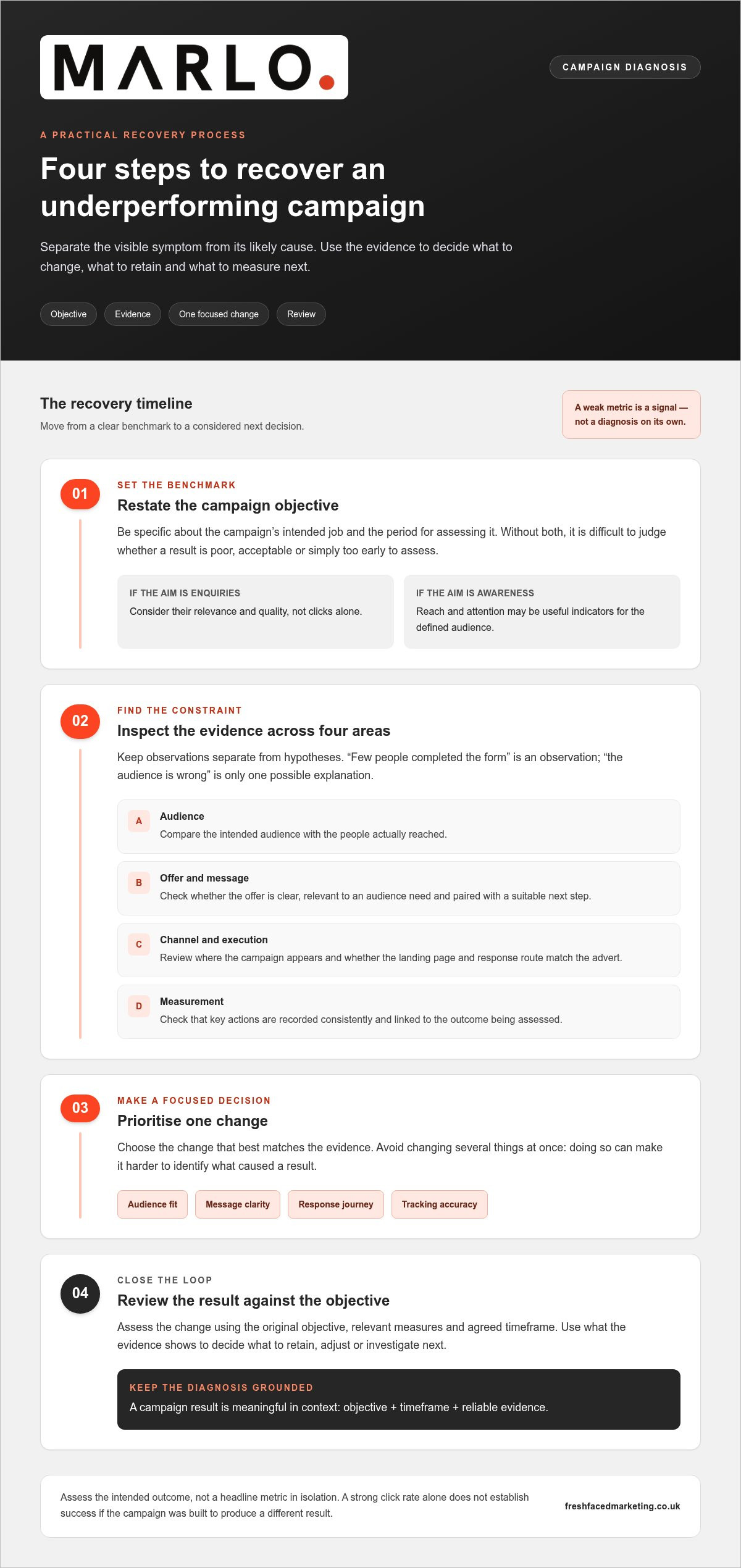
How to fix an underperforming marketing campaign: a four-step recovery process
A useful recovery process doesn’t begin with a complete reset. It starts by checking what the campaign was meant to achieve, what the evidence shows and which decision is most worth testing next. This won’t guarantee a particular outcome, but it can help you make considered changes and retain elements that are already working.
- Restate the objective. Write down the campaign’s intended outcome, the audience it was designed to reach, the response you wanted and how that response was measured. If the original objective was broad, clarify what result would count as progress before making changes. This gives the review a consistent basis.
- Inspect the evidence. Compare campaign activity with available customer and business data. Look at where people engaged, where they dropped out and whether the response matched the intended audience. Separate verified observations from assumptions. For example, “few people completed the form” is an observation; “the offer is wrong” is a hypothesis to test.
- Prioritise one change. Choose the adjustment best supported by the evidence. If the audience appears relevant but the offer is unclear, refine the message or call to action. If delivery is limited, review the channel and resources. Where practical, keep effective elements in place and change one meaningful variable, so you can better understand what influenced the next result.
- Review and record the result. Set a measurement period that reflects the buying journey and the quality of the data, then compare the outcome with the original objective. Record what changed, who owns the review and what evidence will guide the next decision. A test that doesn’t improve results can still be useful if it rules out an assumption.
Use a concise campaign review template
A short record keeps the diagnosis practical and gives future campaign reviews something concrete to build on. Capture the following before the next test:
- Objective: What outcome was the campaign intended to support?
- Evidence: What do the campaign and customer records show?
- Working elements: Which audience, message, channel or response point appears to be contributing?
- Constraint: What is the strongest evidence-backed explanation for the shortfall?
- Next test: What single change will you make, who will review it and what result will inform the next decision?
This record helps prevent a disappointing result from becoming a reason to discard everything. A channel may be reaching the intended audience even if the response needs improvement. A message may attract interest but need a clearer next step. Preserve those useful signals and adjust the part most closely linked to the constraint. That’s a more reliable way to learn from why marketing campaigns fail than changing several parts at once.
If you’d like support turning campaign evidence into prioritised strategic decisions, explore Fresh Faced’s marketing strategy support.
Turn campaign failure into a clearer growth plan with MARLO and the MSB
Once you’ve reviewed the campaign and chosen a next test, put that decision in a wider strategic context. Competitor research can show what is happening across your market, while human-led analysis can help interpret what that evidence means for your business. Neither replaces your own campaign data. Both can inform what to investigate and prioritise next.
What MARLO can reveal before the next campaign
MARLO is software that brings competitor research together in an interactive web dashboard, alongside a strategic roadmap. It analyses competitors’ search activity, including the keywords they rank for; the content and formats generating traffic and engagement; social activity; and active paid media campaigns across Google, Meta and LinkedIn.
These findings can help you examine where competitors appear to be investing, which topics and formats attract attention, and where there may be less contested opportunities. For example, if competitor content repeatedly addresses a particular customer need, that may prompt you to assess whether your own offer and messaging address it clearly. The finding is a lead for investigation, not proof that copying a competitor’s approach will work.
MARLO’s roadmap helps organise options against your goals, budget and resources, so the research can inform a sequence of decisions rather than sit unused in a report. When applying competitor research for marketing strategy, compare external market patterns with your own campaign evidence before choosing a test.
When a human-led Marketing Success Blueprint is the right next step
The Marketing Success Blueprint (MSB) is a separate, premium service. It adds forensic competitive analysis across channels and human-led strategic interrogation of the data. Fresh Faced strategists work through the findings with you and develop a detailed execution blueprint that can be handed to a team or agency.
The MSB also includes direct access to the strategists behind the methodology, two one-to-one strategy calls and a two-to-three-hour workshop. This deeper involvement is useful when the challenge isn’t simply finding information, but assessing competing explanations, setting priorities and translating the evidence into an execution plan. The Marketing Strategy Blueprint approach centres on that human interpretation and planning, distinct from MARLO’s software and dashboard.
Evidence can inform better decisions, but it can’t guarantee campaign results. It can help you make the next decision with a clearer view of the market, your resources and the assumptions still to test. If competitor insight would help shape your next strategic step, explore MARLO’s competitor research software.
Make the next marketing decision with greater clarity
One campaign’s result doesn’t have to define what happens next. Treat it as evidence that can sharpen your understanding of the market and help you make more deliberate choices over time. The key is to carry forward what you’ve learned, rather than return to guesswork the next time results disappoint.
Understanding why marketing campaigns fail can help you approach future decisions with better questions and clearer priorities. MARLO brings competitor insight together in an interactive dashboard and strategic roadmap to support your next step.
Explore MARLO to bring competitor insight into your next marketing decision.
Frequently Asked Questions
Can one failed marketing campaign mean the whole marketing strategy is wrong?
No. One campaign can miss its objective because of a specific execution issue, unsuitable timing or a mismatch between its message and audience. To assess why marketing campaigns fail at a broader level, look for recurring patterns across different campaigns. If several efforts aimed at different audiences or using different channels fall short in similar ways, review the underlying positioning, offer and business goals before deciding whether the strategy needs to change.
How much budget does a marketing campaign need to succeed?
There’s no universal budget that ensures success. Set a budget by working back from the campaign objective, the audience you need to reach, the channel’s delivery requirements and the resources available to manage responses. For instance, a campaign generating enquiries needs capacity to follow up, not just funds to attract attention. Define what the budget must enable, then monitor delivery and response before deciding whether additional investment is justified.
How long should you run a campaign before deciding it is failing?
Set the review period according to the time it takes your audience to make a decision and the amount of dependable data the campaign can collect. A purchase involving several conversations may take longer to assess than a simple sign-up. Check whether the campaign has had a fair opportunity to reach people and whether tracking is working. If delivery or measurement is compromised, the elapsed time alone won’t make the results conclusive.
Can a campaign generate leads and still be failing?
Yes. Lead volume doesn’t show whether those leads match your target customer, can be reached or progress towards a sale. Review lead quality alongside follow-up outcomes: are people suitable for the offer, responding to contact and moving through your sales process? If a campaign produces enquiries that rarely become meaningful opportunities, it may be meeting an activity target but not contributing the commercial result the business needs.
Which metrics should you use to assess a marketing campaign?
Choose metrics that connect the campaign’s objective to a business outcome. For lead generation, this might mean tracking qualified enquiries, cost per acquisition and the proportion of leads progressing to customers. For an awareness campaign, relevant reach and meaningful engagement may help assess whether the intended audience noticed the message. Read metrics as a sequence, from exposure to response to outcome, so a strong figure at one stage doesn’t obscure a problem later.
Should you stop a marketing campaign as soon as results fall below expectations?
Not automatically. First check whether the shortfall is real, whether tracking is reliable and whether the campaign has run long enough to produce useful evidence. You might pause a specific placement if it’s clearly misdirected, while retaining other elements that are working. Set a review point and a clear condition for continuing, changing or stopping. If the campaign is harming the customer experience or spending without valid measurement, prompt intervention may be appropriate.