What if the next marketing move isn’t another campaign, but a clearer diagnosis of what’s holding growth back? A marketing direction for growing business needs to start with that question. When activity is split across channels and suppliers, it’s easy to mistake motion for progress. And when priorities rest on assumptions, results become difficult to interpret.
You may already know that marketing needs to support the business’s growth. The harder question is where to focus, and what deserves the time and budget available. Choosing a channel before understanding the constraint can create more activity without addressing the real issue.
This article explains how to identify the growth challenge marketing needs to address, then assess opportunities against business goals, market evidence and available resources. You’ll learn how to set priorities, sequence practical next steps and make decisions your team can communicate and act on. The aim is not to do everything at once. It’s to give each marketing decision a clear business reason.
Key Takeaways
- Develop marketing direction for growing business by connecting business goals, audience needs and marketing activity, rather than starting with a channel list.
- Identify the growth constraint first. Use customer feedback, sales conversations and performance evidence to guide the diagnosis.
- Compare opportunities by strategic fit, evidence, effort, resources and how results can be measured, not by what’s fashionable.
- Turn priorities into action by recording the rationale, intended outcome, owner and evidence to review.
- Choose the right level of strategic support: MARLO provides competitor analysis and a roadmap through software, while the Marketing Success Blueprint adds human-led analysis and an execution blueprint.
What marketing direction means for a growing business
Marketing direction is the set of choices that connects business goals with audience needs and the activity most likely to support them. It helps a team decide not only what to do, but what to leave aside. A channel list, campaign calendar or collection of tactics may show what’s happening. It doesn’t necessarily explain why those activities matter or how they contribute to growth.
Marketing direction is the reasoned choice of what to do next, why it matters to the business and how to tell whether it’s working. For example, if a business wants more repeat purchases, its direction might favour improving customer communications over increasing awareness among new audiences. The right choice depends on the business objective and what the team can establish about its customers and current performance. This is part of the broader thinking behind Understanding Marketing Strategy.
For a marketing direction for growing business to be useful, it must guide real decisions: which audience to focus on, what outcome to pursue and how marketing activity supports it. It should also give the people involved a shared basis for prioritising work and reviewing progress.
How is marketing direction different from a marketing plan?
Direction sets the strategic choices. A plan translates them into actions, timing and responsibilities. If the direction is to improve conversion with a particular audience, the plan might set out what the team will change, who will do it and when progress will be reviewed. Without that strategic anchor, a calendar can fill with campaigns that are individually plausible but collectively lack a shared purpose.
When does a growing business need clearer marketing direction?
Look for competing priorities, unclear accountability or difficulty explaining how activity links to business goals. These can emerge as a business grows: more people, suppliers or opportunities may become involved, while decisions still rely on assumptions made at an earlier stage.
New ambitions can also change what matters. A business pursuing a different audience or growth objective may need to reassess whether its established activity still fits. That doesn’t automatically mean adding channels or increasing activity. It may mean narrowing the focus, clarifying who owns each priority or deciding what evidence should guide the next decision. Clear direction gives the team a practical way to make those choices together.
Diagnose what is limiting growth before choosing marketing tactics
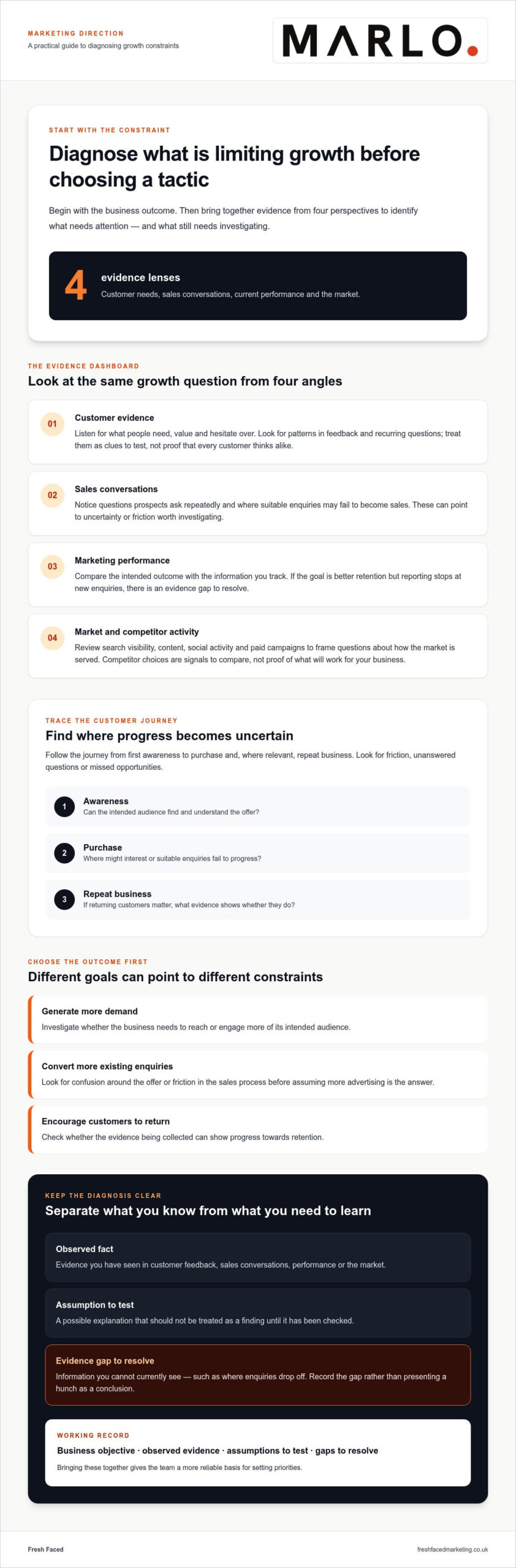
Start with the business outcome, not a preferred channel. Is the priority to generate more demand, convert more of the enquiries already coming in, or encourage existing customers to return? Each points to a different possible constraint. More advertising may increase visits, for example, but it won’t resolve a confusing offer or a sales process that loses suitable prospects.
Diagnosis identifies the constraint marketing should address before the business commits to a tactic. To make that diagnosis, review evidence from several points of view: what customers say they need, what comes up in sales conversations, how current marketing performs and what is happening in the market. Keep observed facts separate from assumptions. If you can’t see where enquiries drop off, record that as an evidence gap rather than treating a hunch as a finding.
Which questions reveal the real growth constraint?
First, define the intended growth: which audience, offer or part of the business matters most? Then trace the customer journey from first awareness to purchase and, where relevant, repeat business. Look for uncertainty, friction or missed opportunities, such as prospects asking the same unanswered questions or a steady flow of enquiries that rarely becomes sales.
Finally, compare the goal with the information you track. If the aim is better retention but reporting stops at new enquiries, the business lacks evidence to assess progress towards that objective. That doesn’t prove retention is the problem; it shows what needs investigating.
How should competitor and customer evidence inform direction?
Customer evidence can reveal the language people use, what they value and what makes them hesitate. Sales notes, customer feedback and recurring questions can help identify patterns. Treat these as clues to test, not proof that every customer thinks alike.
Competitor activity offers a different view. Reviewing their search visibility, content, social activity and paid campaigns can show how the market is being served and where potential opportunities may exist. It can’t tell you which tactic will work for your business. Use it to frame questions, then compare those signals with your own audience and commercial evidence. For a closer look at this kind of forensic competitor research, examine what rivals do across channels without assuming their choices are right for you.
Bring the findings together in a simple working record: the business objective, observed evidence, assumptions to test and gaps to resolve. This gives the team a more reliable basis for setting priorities. MARLO’s competitor analysis can help organise market evidence across search, content, social and paid activity as part of that investigation.
Choose marketing priorities by strategic fit, not channel fashion
Once the growth constraint is clearer, compare possible responses against the business objective. A channel’s popularity, or a competitor’s visible activity, isn’t enough to make it the right priority. A useful marketing direction for growing business growth depends on fit: whether an opportunity addresses the objective, has supporting evidence and can be delivered with the resources available.
Prioritise the opportunity with the clearest fit and strongest evidence. Use a simple comparison to make the reasoning visible:
| Criterion | Question to ask |
|---|---|
| Strategic fit | Does this opportunity address the current business objective and the audience or offer that matters most? |
| Strength of evidence | What customer, sales, performance or market evidence supports it? Which assumptions still need testing? |
| Effort | What work is involved, and what must happen before it can begin? |
| Resource | Do the available budget, team capability and supplier support make it feasible? |
| Measurement | What observable result would indicate progress, and can the business track it? |
How can a business compare competing marketing opportunities?
Apply the same questions to every option. For example, if the objective is to improve conversion, compare clarifying information on a key page with starting a new campaign. Assess the audience, intended outcome and evidence for both. Record the people, budget, time and dependencies each would require. If the case for one option depends on an untested assumption, label it and decide how to validate it before treating it as a firm priority.
Don’t force a precise score where the evidence doesn’t support one. A short rationale and a clear note about uncertainty can be more useful than a ranking that looks objective but hides guesswork.
When should a business pause or deprioritise an activity?
Consider pausing work that has no clear link to the current objective, lacks an owner or can’t be measured in a useful way. Reassess it if the team doesn’t have the necessary time, skills or budget to deliver it properly. Timing matters too: an otherwise relevant opportunity may need to wait until a dependency is resolved.
Deprioritising isn’t the same as declaring a channel ineffective. It’s a deliberate decision about focus and capacity. The activity may become relevant later, when the business goal, evidence or resources change.
Make marketing direction actionable without creating another shelf document
A strategy only helps if it changes what the team does next. Keep the working document concise and usable: state the business objective, summarise the diagnosis, name the audience and record the priorities chosen. Then turn each priority into a clear decision with an owner, a rationale, an intended outcome and evidence to review.
This is where marketing direction for growing business moves from analysis into execution. Clarity needn’t slow a team down. By agreeing what matters, why it matters and who is responsible, people can spend less time resolving competing requests or redoing work that doesn’t support the objective.
What should an actionable marketing direction document contain?
Include enough context for the team to understand the decisions, without turning the document into a catalogue of every possible tactic. For each priority, record:
- Rationale: the evidence or business need behind the choice, with assumptions clearly labelled.
- Outcome and owner: what the work is intended to achieve and the responsible role.
- Resources and dependencies: the time, capability or other work needed to deliver it.
- Review point: when the team will examine progress and decide whether to continue, adapt or pause.
This creates a practical bridge between strategic choices and day-to-day work. A separate marketing roadmap can add detail on sequencing and delivery; this section focuses on keeping direction, ownership and review connected.
How can teams keep decisions connected to outcomes?
Choose measures that relate to the objective, and explain what each one can and can’t indicate. If the priority is to improve conversion, for example, tracking relevant enquiries alongside completed sales can help the team examine movement through that part of the customer journey. A single number rarely explains the cause of a change, so review it alongside context and other available evidence.
At each review point, ask whether progress matches the intended outcome, whether a constraint has emerged and whether new evidence changes the original rationale. If an activity is busy but doesn’t provide useful evidence towards the goal, revisit its role. Adaptation is part of execution, not a failure of the original decision. For a broader view of putting strategic choices into practice, see the related article on building a marketing strategy blueprint.
If you’re ready to turn marketing evidence into practical priorities, explore evidence-led marketing strategy support.
Choose between MARLO and the Marketing Success Blueprint for strategic support
The right support depends on what the business needs next. Is the priority to understand competitor activity and identify possible opportunities, or to work with strategists to interpret the evidence and shape a detailed plan for delivery? MARLO and the Marketing Success Blueprint (MSB) address these needs in different ways. MARLO is software. The MSB is a premium, human-led service.
What does MARLO provide to a growing business?
MARLO brings competitor research into an interactive web dashboard. It analyses competitor search activity, including keyword rankings; content performance; social media activity; and paid media campaigns. This can help a team examine where competitors are visible, what content attracts attention and where paid activity appears in the market.
The dashboard also includes a strategic roadmap prioritised against business goals, budget and resource, with guidance on where effort may be directed. MARLO is built on six years of research and strategy execution associated with millions in revenue and thousands of leads. Explore MARLO competitor analysis and strategic roadmap to understand how the software can inform your next decisions.
When is the Marketing Success Blueprint the better fit?
The MSB may suit a business that needs more than competitor analysis and a software-led roadmap. It adds human-led strategic interrogation of the data, forensic-level competitive analysis across channels and a detailed execution blueprint that can be handed to a team or agency. Strategists help examine what the evidence means for the business, rather than leaving the team to interpret every finding alone.
The MSB includes two one-to-one strategy calls and a two-to-three-hour strategy workshop. That involvement can be useful when priorities are complex, internal views differ or the business needs a clearer handover from strategic choices to execution. It remains distinct from MARLO: the software provides the dashboard and analysis, whilst the MSB adds direct strategist input and a more detailed execution blueprint.
Both options can support clearer marketing direction for growing business, but they offer different levels of human involvement. Consider whether your immediate need is structured competitor insight or strategist-led interpretation and planning. To explore the available strategic support, visit Fresh Faced’s marketing strategy support.
Turn clear priorities into your next growth decisions
Effective marketing direction for growing business starts by identifying the constraint, not defaulting to another channel or campaign. Use customer, sales and market evidence to assess what’s holding progress back, then compare opportunities by strategic fit, available resources and how you’ll measure them.
Make the chosen priorities usable. Give each a clear rationale, intended outcome, owner and review point. This keeps decisions connected to business goals and helps the team adapt when new evidence emerges.
For competitor insight and a prioritised roadmap, MARLO brings research together in an interactive dashboard. For more hands-on support, the Marketing Success Blueprint adds human-led analysis, two strategy calls and a two-to-three-hour workshop. They offer different levels of involvement, so the right next step depends on what your team needs.
Explore Fresh Faced’s approach to marketing direction and consider which support best fits your priorities. With a clear objective and evidence behind your choices, your team can move forward with greater focus.
Frequently Asked Questions
What is marketing direction for a growing business?
Marketing direction for a growing business is the set of choices linking growth objectives with audience needs, market evidence and marketing activity. It helps decision-makers establish what deserves attention, why it matters and what should happen next. Unlike a channel list or collection of campaign ideas, it makes priorities and trade-offs clear. For example, a business might focus on improving conversion before investing in activity to attract more visitors.
How do I know if my business needs a marketing strategy?
Your business may need clearer strategic choices if priorities keep changing, channel activity feels disconnected or the team struggles to link its marketing work to business objectives. These signs don’t automatically mean you need more campaigns. They suggest reviewing goals, customer evidence, performance and available resources together. A useful strategy helps decision-makers agree what to focus on and gives the team a reasoned basis for action.
Can a small business create marketing direction without an agency?
Yes. A small business can start by stating its growth objective, reviewing what it knows about customers and marketing performance, and identifying evidence gaps. It can then compare possible priorities against the objective and resources available. The essential requirement is a clear rationale for decisions, not a particular organisation structure. External strategic support from specialists such as Marketing Angels may be useful if research, interpretation or alignment is difficult to manage within the business.
What should a marketing strategy include for business growth?
A growth-focused marketing strategy should connect business objectives with a defined audience, a diagnosis of the current position and a small set of priorities. For each priority, record why it fits, what resources it needs, who owns the work and how progress will be reviewed. This gives the team enough direction to act and make decisions without turning the strategy into an unprioritised catalogue of channels and tactics.
How do I prioritise marketing activities when the budget is limited?
Start by clarifying the business outcome you need and the evidence behind each proposed activity. Compare options by strategic fit, resource demands, feasibility and how you’ll assess progress. Make assumptions visible rather than treating them as facts, then favour work the team can realistically deliver. There’s no universal channel ranking that suits every business. The right priorities depend on your objective, context, available resources and the strength of the evidence.
What is the difference between MARLO and the Marketing Success Blueprint?
MARLO is Fresh Faced’s software, delivered through an interactive dashboard with competitor analysis and a prioritised strategic roadmap. The Marketing Success Blueprint (MSB) is a separate, premium human-led service. It adds forensic competitive analysis, strategist-led interpretation, a detailed execution blueprint, direct access to Fresh Faced strategists, two one-to-one strategy calls and a two-to-three-hour workshop. They offer different levels of human involvement, rather than being two names for the same product.
How can I tell whether a marketing strategy is working?
Check whether marketing activity remains connected to the business objective it was chosen to support. Review relevant measures at planned intervals and consider what they show, what remains uncertain and whether priorities still fit. For example, if the aim is to improve conversion, examine evidence related to progression from enquiry to sale. Don’t treat activity volume or an isolated metric as proof of business impact; use evidence to review and adapt decisions.