A marketing plan can look busy and still fail to move a business forward. The issue is often not a lack of activity, but decisions made before the evidence is clear. If you’re working out how to develop a marketing plan, start by connecting what the business needs to achieve with what customers and the market actually show.
It’s easy to reach for familiar channels first. But choosing tactics before defining priorities can spread budget, time and attention across work with no clear link to outcomes. A useful plan gives every action a reason, a measure and a place in the wider strategy.
This guide sets out a practical process: clarify business goals, research customers and competitors, choose priorities that fit your resources, then assign actions, budgets and measures. You’ll also learn how to review progress and adjust when results or market evidence change. The aim isn’t a document that sits on a shelf. It’s a working plan that helps your team decide what matters next, and why.
Key Takeaways
- Understand how to develop a marketing plan by linking a clear business outcome to focused, measurable marketing objectives.
- Separate verified customer and market insights from assumptions before setting audience and channel priorities.
- Use evidence to shape relevant audience segments, positioning and messages before committing to activity.
- Give every planned action an owner, the resources it needs and an intended outcome.
- Review results against your original objectives and revise priorities when the evidence changes.
What a marketing plan does and what it needs to contain
A marketing plan connects business goals to organised marketing activity. It shows how priorities become actions, who is responsible and how progress will be assessed. Without that connection, a team can stay busy without knowing whether its work supports the outcomes the business needs.
A plan typically brings together objectives, audiences, market evidence, priorities, resources, owners and measures. These elements should support one another. For example, a goal to increase qualified enquiries needs a defined audience, a reason to believe that audience can be reached, activities suited to its needs and a way to assess enquiry quality. A general overview of what a marketing plan does can provide context, but its practical value comes from making those connections specific to your business.
How is a marketing plan different from a marketing strategy?
Strategy explains the reasoning behind your choices: which audiences matter, how the business should be positioned and what it will prioritise. The plan turns those decisions into organised work, including actions, responsibilities, timing, resources and measures.
They serve different purposes, but both should support the same business goals. Strategy without a plan can remain abstract. A plan without strategy can become a list of tactics with no clear rationale. Start by agreeing the strategic choices, then make each one actionable in the plan.
What makes a marketing plan usable?
A usable plan helps people make decisions. It doesn’t need to include every possible channel or activity. Instead, it identifies the work that matters most, explains why it matters and makes ownership clear.
- Set a clear objective: State the business outcome the activity is intended to support.
- Show the evidence: Record what you know about customers and the market, and distinguish it from assumptions.
- Assign responsibility: Name an owner for each action, along with the resources and measures needed to deliver and assess it.
Make assumptions visible. If the team thinks customers avoid a product because its benefits are unclear, record that as a hypothesis, not a confirmed fact. Decide what evidence would test it before investing in activity based on that belief.
A marketing plan shouldn’t be fixed. It needs enough detail to guide decisions, but enough flexibility to respond when customer behaviour, market conditions or results challenge the original thinking. Knowing how to develop a marketing plan means creating a working framework: clear choices, accountable actions and measures that help the team learn and adjust.
Start developing a marketing plan with goals, customers and market evidence
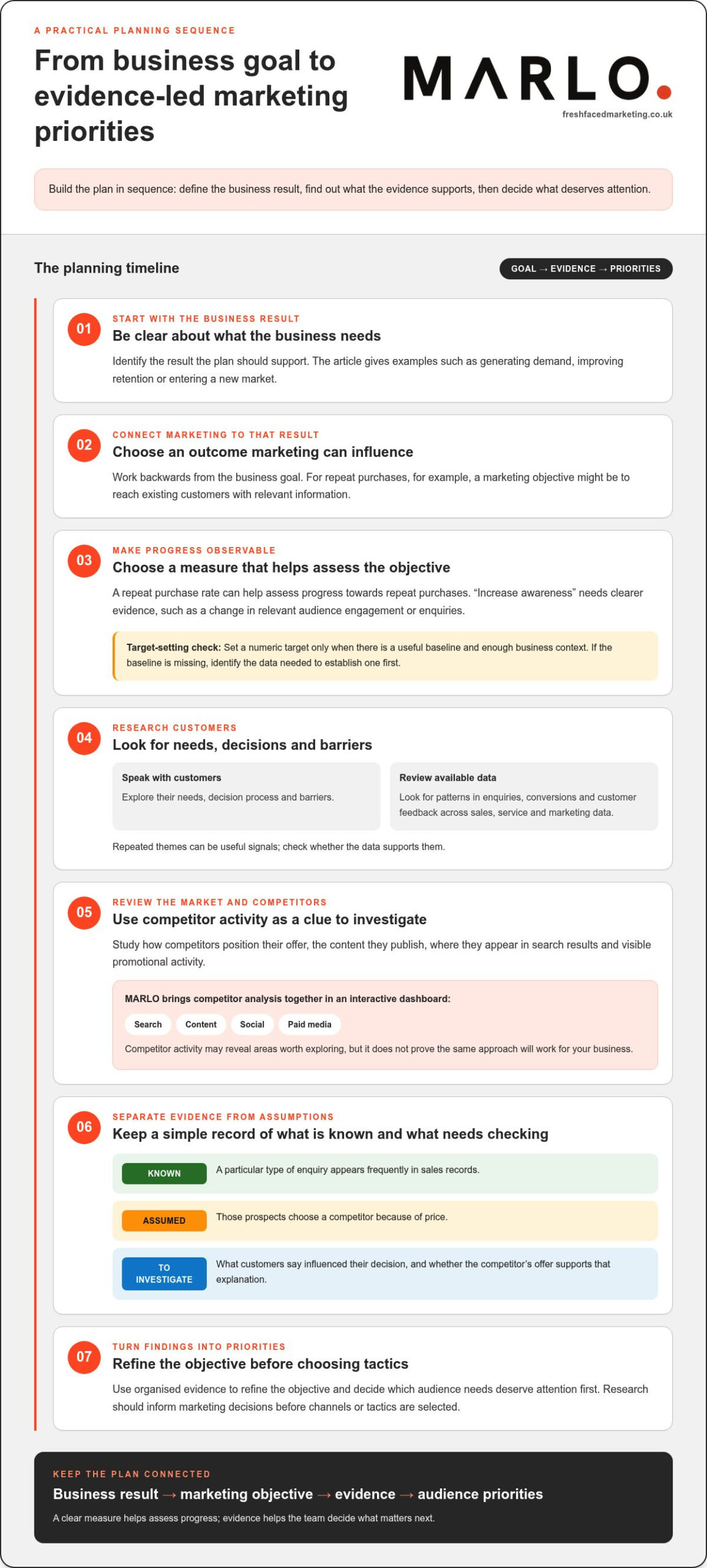
Start with the business result the plan needs to support. That might be generating demand, improving retention or entering a new market. Then define the marketing outcome that could contribute to it. For example, if the business goal is to increase repeat purchases, a marketing objective might focus on reaching existing customers with relevant information. Choose a measure, such as repeat purchase rate, so the team can assess progress.
Set numeric targets only when you have a useful baseline and enough business context to make the target credible. If the baseline is missing, identify what data you need to establish one before setting a number. A precise-looking target without evidence can create confidence without clarity.
How do you set marketing objectives that support business goals?
Work backwards from the outcome. Identify the business result, decide what marketing can influence, then choose an observable measure. Keep the objective focused enough to guide choices. “Increase awareness” is difficult to evaluate on its own. Define what evidence would indicate progress, such as a change in relevant audience engagement or enquiries.
How should you research customers and competitors?
Build your evidence from sources you can inspect. Speak with customers about their needs, decision process and barriers. Review available sales, service and marketing data for patterns in enquiries, conversions and customer feedback. Treat repeated themes as useful signals, then check whether the data supports them.
Study competitors for clues about how they position their offer, what content they publish, where they appear in search results and what promotional activity is visible. This can reveal areas worth investigating, but competitor activity doesn’t prove that the same approach will work for your business. MARLO brings competitor search, content, social and paid media analysis together in an interactive dashboard, giving you evidence to consider before committing to activity.
Keep a simple record of findings, separating verified information from assumptions. For example:
- Known: A particular type of enquiry appears frequently in sales records.
- Assumed: Those prospects choose a competitor because of price.
- To investigate: What customers say influenced their decision, and whether the competitor’s offer supports that explanation.
Research should inform marketing decisions before tactics are selected. This helps prevent teams from choosing channels simply because they’re familiar or because a competitor uses them. Explore market research and marketing strategy resources to see how research can inform planning.
Once the evidence is organised, use it to refine the objective and decide which audience needs deserve attention first. Next, turn those findings into audience, message and channel priorities.
Turn marketing research into audience, message and channel priorities
Evidence becomes useful when it changes a decision. Use what you’ve learned about customers and competitors to identify an audience with a meaningful need, a clear connection to your business objective and a realistic path to action. Avoid broad segments such as “all small businesses”. Define groups by relevant needs, context and barriers instead, such as people comparing alternatives who need clearer evidence of how an offer fits their requirements.
How do you choose the right audience and message?
For each priority audience, summarise what people need to understand, believe or do next. Then connect that need to a strength your business can substantiate. Check the proposed message against customer conversations, sales feedback and the language people use to describe their problem. Internal preferences can shape a message, but they aren’t proof that it will resonate.
Keep the result simple: one priority audience, one relevant need and one message that gives them a reason to take the next step. If the evidence is incomplete, record what still needs testing rather than presenting a preferred idea as a proven insight.
How do you decide which marketing channels to use?
Compare potential channels using the same criteria: audience fit, contribution to the objective, evidence of opportunity, available resources and a practical way to measure results. Search, content, social and paid activity have different roles. Don’t select a channel simply because the team already uses it or a competitor appears to be succeeding there.
| Channel | What to assess before prioritising |
|---|---|
| Search | Are people looking for relevant solutions, and can you identify useful visibility opportunities? |
| Content | Can you address a customer need or decision barrier with material the team can produce? |
| Social | Does the audience use the platform, and can your team contribute consistently? |
| Paid activity | Can you define the audience, intended outcome, available budget and measures? |
Competitor activity can indicate opportunity, saturation or an evidence gap. Strong visibility may point to a topic worth investigating, but it doesn’t prove that copying a competitor’s approach will work. Little visible activity may signal an opening, or simply a lack of evidence. Investigate before deciding.
For a closer look at competitor search, content, social and paid activity, MARLO competitor research analysis brings these areas together. Evidence-led prioritisation is central to how to develop a marketing plan: choose audiences, messages and channels because they fit the objective and available evidence, not because they’re familiar.
Build the marketing plan: actions, owners, resources and measurement
With priorities set, turn each one into work the team can deliver and assess. Record the action, intended audience, owner, required resources, dependencies and intended outcome. For example, a priority to address a common customer question might become a piece of content, owned by a named team member, requiring input from sales and measured against a relevant objective.
Sequence actions according to what needs to happen first and what the team can realistically manage. Research may need to be completed before content is produced. A campaign may depend on approved messaging or a suitable landing page. Use milestones to make progress visible, but set timing around actual capacity and the planning horizon rather than adding arbitrary deadlines.
How do you turn marketing priorities into an action plan?
Keep the plan concise enough to use during regular work. A simple table can capture the essentials:
- Priority and audience: What need are you addressing, and for whom?
- Action and owner: What will be delivered, and who is responsible?
- Resources and dependencies: What time, budget or input is required, and what must happen first?
- Outcome and measure: What should the action contribute to, and how will you assess it?
Map people and budget against the full set of actions. If an activity has no available owner, resource or credible measure, revise it, defer it or remove it. A plan should reflect what the business can deliver, not an idealised list of everything it could do.
Which measures belong in a marketing plan?
Choose measures that connect directly to the objective. Early indicators, such as relevant engagement or enquiries, can show whether an activity is gaining traction. Outcome measures, such as qualified enquiries or repeat purchases, show whether it is contributing to the business result. Activity counts can help monitor delivery, but they don’t demonstrate impact on their own.
For every measure, state where the data will come from, who will review it and when. This helps distinguish a result from a reporting gap and gives the team a consistent basis for decisions.
Progress sentence: “We’ll judge progress against our objective by reviewing [measure] from [data source] at [review point], and comparing it with [baseline or agreed benchmark].”
This practical structure is central to how to develop a marketing plan teams can use: clear actions, accountable owners, realistic resources and relevant measures. Explore evidence-led marketing strategy support to see how research, priorities and execution can work together.
Review and improve your marketing plan as evidence changes
Set a review rhythm that fits the work. A fast-moving campaign may need closer checks than activity designed to build demand over a longer period. Schedule reviews around the time it takes for meaningful evidence to emerge, and make sure someone is responsible for bringing that evidence to the team.
At each review, compare results with the original objective, audience assumptions and resource commitments. Look at what customers did, what the team delivered and whether the activity had the time and support it needed. This helps distinguish a weak idea from a sound idea that was poorly executed or under-resourced.
How can you tell whether a marketing plan is working?
Review objective-linked measures alongside customer response and delivery progress. If results are weak, investigate before changing direction. Check whether the message addressed a real need, whether the audience was defined accurately and whether the activity reached that audience as intended.
Then decide whether to continue, adjust or stop. Record the evidence behind the decision, including what was learned and which assumptions have changed. That record gives future planning a reliable starting point instead of allowing old beliefs to reappear as facts.
- Continue when evidence supports the approach and delivery is on track.
- Adjust when a specific issue, such as the message or execution, needs testing.
- Stop when the evidence no longer supports the activity or its resource demands outweigh its value.
Reviewing this way makes how to develop a marketing plan a repeatable process, not a one-off exercise. Each cycle should improve the team’s understanding of customers, performance and what it can deliver.
When can research or strategic support help?
Competitor research can add context when the team needs to revisit its priorities. MARLO is an interactive web dashboard for competitor search, content, social and paid media analysis. Use the findings to inform your next planning decision.
The Marketing Success Blueprint (MSB) is a separate, premium service. It adds forensic-level competitive analysis across channels, human-led strategic interrogation of the data and a detailed execution blueprint. It also includes direct access to Fresh Faced strategists, two one-to-one strategy calls and a two-to-three-hour strategy workshop. MARLO is the software research option; the MSB adds direct strategic input.
If competitor evidence would help inform your next review, explore MARLO competitor research.
Put evidence behind your next marketing decision
Knowing how to develop a marketing plan means connecting business goals to customer and market evidence, then turning those findings into priorities the team can deliver and measure. Keep the plan practical: define the audience and objective, assign clear owners and resources, and review progress against meaningful measures.
Use each review to decide whether to continue, adjust or stop an activity. Record what the evidence shows and which assumptions have changed. That discipline helps keep the plan relevant without losing sight of the outcome it was built to support.
If competitor evidence would help you make more informed planning decisions, MARLO brings competitor search, content, social and paid analysis together in an interactive dashboard. For a distinct, human-led option, the Marketing Success Blueprint adds strategic interrogation and a detailed execution blueprint.
Explore MARLO competitor research to put competitor evidence behind your next planning decision. With clear priorities and a process for learning as you go, you can move forward with greater confidence.
Frequently Asked Questions
What are the first steps in developing a marketing plan?
Start by identifying the business outcome your marketing needs to support, then define a focused objective and how you’ll measure progress. Next, gather evidence about customers, performance and competitors. Separate confirmed facts from assumptions so you can see what the plan can rely on and what still needs testing. These foundations make how to develop a marketing plan a process of informed decisions, rather than a list of preferred tactics.
What should a marketing plan include?
A marketing plan should set out objectives, priority audiences, relevant evidence, positioning and channel choices. It should also explain the actions required, who owns each one, the resources and dependencies involved, and how results will be measured. Include where the data will come from and when progress will be reviewed. Keep the document practical: every item should help the team make a decision or deliver work connected to a business goal.
How do you set objectives for a marketing plan?
Begin with the business result, such as generating demand, supporting retention or entering a market. Then define an observable marketing outcome that can contribute to it, and choose a measure that shows progress. For example, a retention objective might focus on repeat purchases if suitable data is available. Base numeric targets on a reliable starting point and business context. If you lack a baseline, first decide how to establish one.
How often should you review a marketing plan?
Review it at a rhythm that fits the speed of your marketing activity and the time needed for meaningful results to emerge. Set review points in advance, then bring them forward if new evidence or a material change in circumstances warrants it. At each review, compare results with the objective, audience assumptions and resources committed. Record whether you’ll continue, adjust or stop an activity, along with the evidence behind the decision.
Can a small business develop a marketing plan without an agency?
Yes. A small business can build a useful plan using its business goals, customer conversations and available sales, service and marketing data. Keep the scope proportionate to the team’s capacity, and choose actions that can be resourced and measured. MARLO provides competitor analysis through an interactive dashboard. The separate Marketing Success Blueprint adds human-led strategic interrogation and a detailed execution blueprint.