
A marketing plan can set objectives and still leave teams unsure what to do next. The strategic marketing planning process only works when it connects evidence to clear choices, accountable delivery and measurable review. Without that link, activity drifts from business priorities, and budget decisions rely on assumptions.
That’s a familiar challenge. Teams need to know which opportunities matter, where resources can make a difference and when results should prompt a change in direction. More activity isn’t the answer. Better-informed decisions are.
This article explains how to build a plan from business evidence, prioritise marketing against your goals, budget and resources, and turn those choices into owned actions with useful measures and review points. You’ll see how competitor, search, content, social and paid media evidence can inform the decisions, and how to distinguish performance adjustments from a genuine strategic shift.
Fresh Faced’s MARLO dashboard provides a comprehensive report to support that evidence-gathering. For teams that need human-led strategic interrogation, the separate MSB service builds on that foundation and delivers a detailed execution blueprint. The aim is practical: know where every pound should go, and give your team a plan it can deliver.
Key Takeaways
- Use the strategic marketing planning process to connect business goals with evidence, clear choices and evaluation.
- Separate verified findings from assumptions so you can identify where decisions need stronger evidence.
- Prioritise objectives and budget by weighing business fit against likely contribution and delivery capacity.
- Turn priorities into practical actions with named owners, relevant measures and review points.
- Use MARLO for a comprehensive evidence report, or MSB for human-led strategic interrogation and a detailed execution blueprint.
What does a strategic marketing planning process actually do?
A strategic marketing planning process connects business goals to market evidence, makes choices about where marketing should focus, and sets out how those choices will be evaluated. It gives teams a reasoned route from what the business needs to achieve to what marketing will do, and how progress will be assessed.
A strategic marketing planning process turns business goals and market evidence into marketing priorities, practical actions and measures for evaluation.
That distinction matters because several layers of decision-making often get grouped together. Business strategy sets the organisation’s overall direction, such as which markets to serve or what position to pursue. Marketing strategy determines how marketing will support that direction by choosing priority audiences, opportunities and ways to compete. The Marketing strategy overview provides useful context on how these choices relate to a wider marketing plan.
A marketing plan translates the strategy into priorities, responsibilities, resources and measures. Campaign tactics sit further down the chain. They are the specific activities used to deliver part of the plan, such as a time-bound campaign aimed at a chosen audience. Tactics can change; the strategic rationale should guide those changes.
How is strategic marketing planning different from a campaign plan?
Strategy answers why the business should serve particular audiences and how it intends to compete for their attention and custom. Planning turns those choices into work: what takes priority, who owns it, what resources it needs and how progress will be judged. A campaign plan covers a defined set of activities over a set period. It should support the wider direction, not become a substitute for one.
Without that sequence, teams can commit budget to visible activity before establishing whether it supports a meaningful business priority. Planning creates a decision point first: assess the evidence, compare possible uses of resources, then approve activity that fits the chosen direction.
What should a useful planning process help a business decide?
It should help leaders identify which audiences matter most, where credible market opportunities exist and which business outcomes marketing should support. It should also expose trade-offs. A promising opportunity may still be a poor priority if the team lacks the budget, skills or capacity to pursue it effectively.
That is how a plan makes finite resources work harder. It directs budget and internal effort towards selected priorities, rather than spreading them across every possible channel or campaign. The aim is to know where every pound should go and to make sure each commitment is achievable.
For a deeper guide to building the strategic foundation behind those decisions, explore the marketing strategy blueprint pillar. The next step is to establish what the evidence actually shows about the market, customers, competitors and current performance.
Start with evidence: diagnose the market, customers and current performance
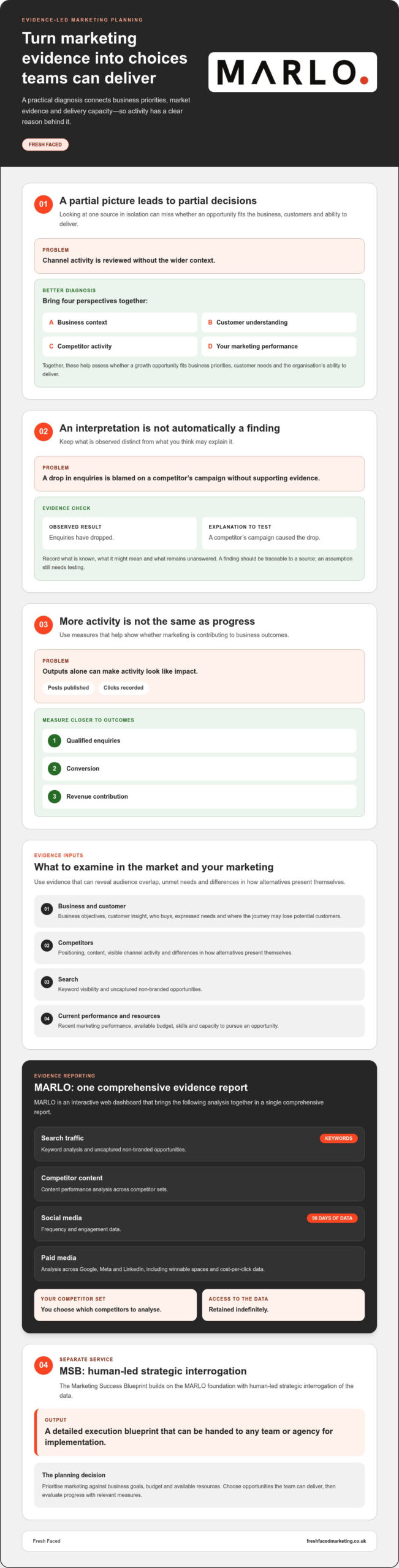
A useful diagnosis brings four perspectives together: the business context, customer understanding, competitor activity and your own marketing performance. Looking at these separately can produce a partial picture. Together, they help show whether a growth opportunity fits business priorities, customer needs and the organisation’s ability to deliver.
An evidence-backed finding is traceable to a source; a marketing assumption is an explanation or prediction that still needs testing. Keep both visible. For example, a drop in enquiries is an observed result. Attributing it to a competitor’s campaign is an interpretation unless other evidence supports that explanation. Record what is known, what it might mean and what remains unanswered.
Which evidence belongs in a strategic marketing diagnosis?
Start with business objectives, recent marketing performance, customer insight and the resources available. Review who buys, what needs they express and where the current journey appears to lose potential customers. Then examine competitors’ positioning, content and visible channel activity. Look for evidence of audience overlap, unmet needs and differences in how alternatives present themselves.
Where data is available, include search findings such as keyword visibility and uncaptured non-branded opportunities, social activity, and paid media presence. MARLO supports this research through an interactive web dashboard that provides a single comprehensive report. It analyses search traffic, competitor content performance, 90 days of social data on frequency and engagement, and paid media across Google, Meta and LinkedIn, including winnable spaces and cost-per-click data. Users choose which competitors to analyse and retain indefinite access to the data.
The five stages of strategic marketing planning offer a useful reminder that situation analysis belongs within a wider process, connected to objectives, action and measurement. The diagnosis should reveal gaps that could change who you prioritise or where you pursue growth, not produce a catalogue of channel activity.
How can teams avoid mistaking activity for useful evidence?
Separate output measures, such as posts published or clicks recorded, from indicators closer to business outcomes, such as qualified enquiries, conversion and revenue contribution. Output can help explain what a team did. It doesn’t, by itself, establish whether that activity advanced a business objective.
Check every finding against its source, date, coverage and limitations. A competitor’s visible social posts reveal activity, not its full strategy or results. A short-term performance change may not represent a durable trend. For deeper competitor research, forensic analysis should test what is visible against the wider evidence rather than treating observation as proof.
Fresh Faced’s evidence-led marketing strategy can help bring these findings into a coherent diagnosis, with conclusions grounded in the business’s goals, budget and resources.
Turn findings into objectives, strategic choices and budget priorities
Diagnosis creates options. Prioritisation decides which ones deserve investment. In a strategic marketing planning process, translate evidence into a small set of objectives tied to business outcomes, then compare possible routes against the goal, strength of evidence, likely contribution, cost and delivery capacity.
For example, if customer feedback points to a recurring barrier to repeat purchase, improving retention may be a stronger priority than increasing general reach. The objective should make the intended outcome clear, identify a suitable measure, name an owner and set a review point. SMART objectives can help make goals specific and assessable. They can’t decide which audience or opportunity matters most. That strategic choice comes first.
How do you set marketing objectives that guide decisions?
Start with the business outcome. An objective might focus on generating more qualified leads, improving retention or supporting revenue generation. Then define how progress will be assessed, who is accountable and when the team will review the evidence. Choose measures that reflect the objective, not simply the activity used to pursue it.
Clarity also exposes gaps. If the team can’t define a meaningful measure or assign an owner, the objective isn’t ready to guide delivery. For more on connecting priorities to business direction, see the article on aligning a marketing roadmap with business goals.
How should a business prioritise competing marketing opportunities?
Assess each option against the same criteria. Ask whether it supports a chosen business outcome, whether evidence supports the opportunity, what contribution it could make, what it will require and whether the organisation can deliver it. Make trade-offs explicit. An attractive idea may need to wait if its cost, skills or workload would displace a more relevant priority.
Use a simple decision record to show what happens next:
| Decision | When it fits | What to record |
|---|---|---|
| Pursue | Strong fit with the objective, supported by evidence and within current capacity. | Budget, resource owner, expected contribution and review measure. |
| Test | Potentially relevant, but an assumption or evidence gap needs examination. | What the test will establish, its budget and resources, and how the result will inform a decision. |
| Defer | Weak fit, insufficient capacity or lower priority than other opportunities. | Why it is paused and what evidence or capacity would justify reconsidering it. |
This is not a ranking by enthusiasm. It’s a transparent allocation of finite budget, skills and internal capacity. Attach resource requirements to every recommendation so leaders can see what must be funded, who needs to deliver it and what other work may need to move. That’s how a plan helps teams know where every pound should go without assuming a return that the evidence can’t support.
Build an executable marketing plan with owners, measures and review points
A strategy becomes useful when a team can see what happens next, who is responsible and how progress will be judged. The plan should connect each marketing action to an objective, not simply list channels or campaign ideas. It should also reflect the budget, skills and organisational capacity actually available.
What belongs in an actionable marketing plan?
For each priority, record the audience, intended outcome, activity, owner, timing and measurement approach. Add the budget and resources required, plus any assumptions or dependencies that could affect delivery. For example, a lead-generation activity may depend on sales agreeing how to follow up enquiries. Recording that dependency makes the plan more realistic and easier to implement.
Use a clear sequence to turn an objective into work:
- Objective: State the business outcome marketing should support.
- Audience: Specify who the activity is intended to reach.
- Channel and action: Choose the route and describe the work to be delivered.
- Owner and timing: Name the responsible person and place the activity in the delivery schedule.
- Measure and review: Define how progress will be assessed and when the team will decide what happens next.
Phase the work around real capacity. If a priority needs expertise the team doesn’t have, identify that requirement before committing the budget. Sequence dependent tasks, protect time for delivery and avoid scheduling more work than the organisation can support. A plan written clearly enough for an internal team or agency to act on reduces ambiguity at handover.
How should teams review progress and adjust activity?
Separate leading indicators from final business outcomes. Leading indicators provide an early signal that an activity is reaching or engaging its intended audience. Final outcomes, such as qualified leads or revenue, show whether the work is contributing to the business objective. Early signals can inform adjustments, but they shouldn’t be mistaken for proof of commercial impact.
Set review points before activity begins. At each review, compare performance with the objective and the evidence behind the recommendation. Then decide whether to continue, refine, test or stop. Record the decision and its rationale, including any change in evidence, budget or delivery capacity. This keeps the plan responsive without turning every short-term fluctuation into a strategic reset.
For practical guidance on structuring delivery, explore the actionable marketing roadmap article. To turn priorities into a plan your team can implement, discuss marketing strategy and execution with Fresh Faced.
Keep the strategy useful: connect planning with evidence-led execution
Evidence identifies options. Strategic judgement determines which deserve attention. Disciplined implementation turns those choices into accountable work. A strategic marketing planning process remains useful when these three parts stay connected, and the plan can respond to new evidence without losing sight of business goals.
Research can reveal opportunities, but it can’t decide which one fits your objectives, budget and delivery capacity. That requires interpretation. The right approach gives decision-makers a clear view of what the evidence shows, what it means for their priorities and what the team can realistically deliver.
What does MARLO contribute to marketing planning?
MARLO interactive web dashboard presents a single comprehensive report to help businesses examine their marketing position. It analyses search traffic, including keywords and uncaptured non-branded opportunities, and compares competitor content performance. Its social analysis covers 90 days of activity, including frequency and engagement. Paid media analysis across Google, Meta and LinkedIn includes cost-per-click data and potential winnable spaces.
Users choose the competitors included in the analysis and retain indefinite access to the data. This creates a practical evidence base for identifying patterns and questions to investigate. The dashboard informs planning; it doesn’t replace the strategic decisions about which audiences, opportunities and activities best match the business’s aims.
How does MSB turn analysis into an execution blueprint?
MSB is a separate, more substantial, premium service. It builds on the MARLO foundation with forensic-level competitive analysis and human-led strategic interrogation of the data. Direct access to strategists, one-to-one strategy calls and intensive workshops add the context and challenge needed to examine what the findings mean for the organisation.
The result is a detailed execution blueprint, prioritised against the business’s specific goals, budget and resources. It sets out a strategic route that an internal team or agency can implement, rather than leaving people to interpret research and decide what to do independently. Recommendations are grounded in evidence and considered against delivery capacity, helping teams make informed choices about where every pound should go.
Both offerings support clearer decisions, but they serve different needs: MARLO provides the dashboard and comprehensive report; MSB adds human-led analysis and strategic direction. If you’re ready to explore how evidence-led strategy could clarify your priorities and guide delivery, Fresh Faced can help you consider the right next step.
Put evidence to work in your next marketing decisions
A strategic marketing planning process turns evidence into focused choices, then makes those choices deliverable through clear ownership, measures and review points. Start with business goals and reliable findings. Prioritise the opportunities that fit your budget and capacity. Give each action an owner and a way to assess progress.
MARLO brings search, competitor content, social and paid media analysis together in one comprehensive report. It provides a structured evidence base. MSB is a separate, more substantial service that builds on that foundation with direct strategist access, one-to-one strategy calls and intensive workshops. Its human-led process turns forensic-level analysis into an execution blueprint for your team or agency.
The aim is practical clarity: understand which choices merit investment and know where every pound should go. Explore evidence-led marketing strategy with Fresh Faced and identify a useful next step for your goals, budget and resources. A focused plan gives your team a sound basis for action, learning and informed decisions as the evidence develops.
Frequently Asked Questions
What are the main steps in a strategic marketing planning process?
The main steps are to clarify business goals, diagnose the market and current performance, set marketing objectives, choose priorities, allocate resources, and define delivery and review measures. Start with evidence, then compare opportunities against strategic fit and available capacity. Turn selected priorities into actions with owners, budgets and review points. Use what the results reveal to refine activity or revisit assumptions, rather than changing direction without a clear reason.
Is a marketing strategy the same as a marketing plan?
No. A marketing strategy sets the direction: which audiences and opportunities to prioritise, and how marketing will support the business’s goals. A marketing plan translates that direction into delivery. It identifies activities, owners, timing, resources and measures. A campaign plan is narrower still, outlining time-bound activity that should serve the wider strategy. Keeping these distinctions clear helps teams connect day-to-day work to business priorities.
How often should a business review its marketing plan?
Set review points that match the activity, its objective and how quickly meaningful evidence becomes available. A campaign with early indicators may need closer monitoring than a longer-term initiative whose outcomes take time to emerge. At each scheduled review, compare results with the objective, check whether assumptions still hold and decide whether to continue, refine, test or stop. Review promptly when a material change in business priorities or market evidence affects the plan.
How can a business decide where its marketing budget should go?
Compare each opportunity against business goals, supporting evidence, likely contribution, cost and delivery capacity. Then record the budget and skills required, who will own the work and how progress will be assessed. Prioritise activities that fit the strategy and can be delivered effectively. Test an opportunity when evidence is incomplete, and defer it when resources or strategic fit are insufficient. This makes trade-offs visible and helps clarify where every pound should go.
Can a small business use a strategic marketing planning process?
Yes. The process can be scaled to the business’s goals, budget, skills and available time. A small business can focus on a limited number of priorities, use relevant customer and performance evidence, and assign clear ownership, even if one person has several responsibilities. The purpose isn’t to create a large document. It’s to make deliberate choices, identify what can be delivered and review whether activity supports the intended business outcome.
What is the difference between marketing research and strategic marketing planning?
Marketing research gathers and analyses information about customers, competitors, markets and performance. Strategic marketing planning uses that evidence, alongside business goals and organisational constraints, to make choices about audiences, objectives, priorities and resources. Research can reveal an uncaptured opportunity or a competitor’s positioning; planning determines whether pursuing it makes sense for the business. Research informs the decision. It doesn’t replace strategic judgement or turn findings into an actionable plan by itself.
What should a marketing plan include to make it actionable?
An actionable plan connects each objective to an audience, activity, owner, timing, budget and measurement approach. It should also record assumptions, dependencies and required capabilities, so teams can see what may affect delivery. Define review points in advance and distinguish early indicators from business outcomes such as qualified leads, retention or revenue. These details give an internal team or agency a clear basis for implementation, assessment and informed adjustments.
How do MARLO and MSB fit into the planning process?
MARLO is an interactive web dashboard that provides a single comprehensive report, bringing together search, competitor content, social and paid media analysis. Users choose the competitors analysed and retain indefinite access to the data. MSB is a separate, more substantial, human-led service that builds on the MARLO foundation through forensic-level analysis, direct strategist access, one-to-one calls and intensive workshops. It delivers a detailed execution blueprint for an internal team or agency to implement.