
Marketing built on assumptions can direct budget towards the wrong people, channels and messages. A target audience analysis service should replace guesswork with evidence you can use, not leave you with a profile that has little bearing on your next decision.
Good research should show more than who your customers are. It should help you understand which audiences and opportunities deserve attention, and how the evidence connects to realistic marketing priorities. This guide explains what a rigorous analysis should uncover, what useful deliverables look like and how to judge whether an approach will support your decisions.
Fresh Faced connects audience and competitor evidence to practical choices. MARLO is an interactive web dashboard providing one comprehensive report covering search traffic, content performance, 90 days of social media data and paid media across Google, Meta and LinkedIn. The separate Marketing Success Blueprint builds on MARLO with human-led strategic interrogation, direct access to strategists and an execution blueprint. Together, these offerings help you focus decisions around your goals, budget and resources, so you can know where every pound should go.
Key Takeaways
- A target audience analysis service should test assumptions with evidence and clarify which audiences and opportunities merit attention.
- Connect each business question to relevant evidence, then translate findings into prioritised actions that fit your goals and resources.
- Compare tools and strategic analysis by what they reveal, how findings are interpreted and whether the outputs support practical decisions.
- Prepare by defining your objectives, assumptions, available data and resource limits so the analysis can resolve specific questions.
- MARLO brings search, competitor content, social and paid media analysis together in one comprehensive report to inform your marketing priorities.
What a target audience analysis service should clarify before you invest
A target audience analysis service is structured research that identifies who a business can reach and what evidence supports its marketing choices. It should connect audience needs and market context to decisions about messaging, channels and resource allocation. That is more useful than a demographic snapshot or a list of traits drawn from internal assumptions.
A target audience is the group a message or offer is intended to reach. It isn’t automatically the same as the whole market a business could serve. A rigorous analysis tests which groups matter for the business objective, then examines what the available evidence can and cannot tell you about them.
What questions should audience analysis answer?
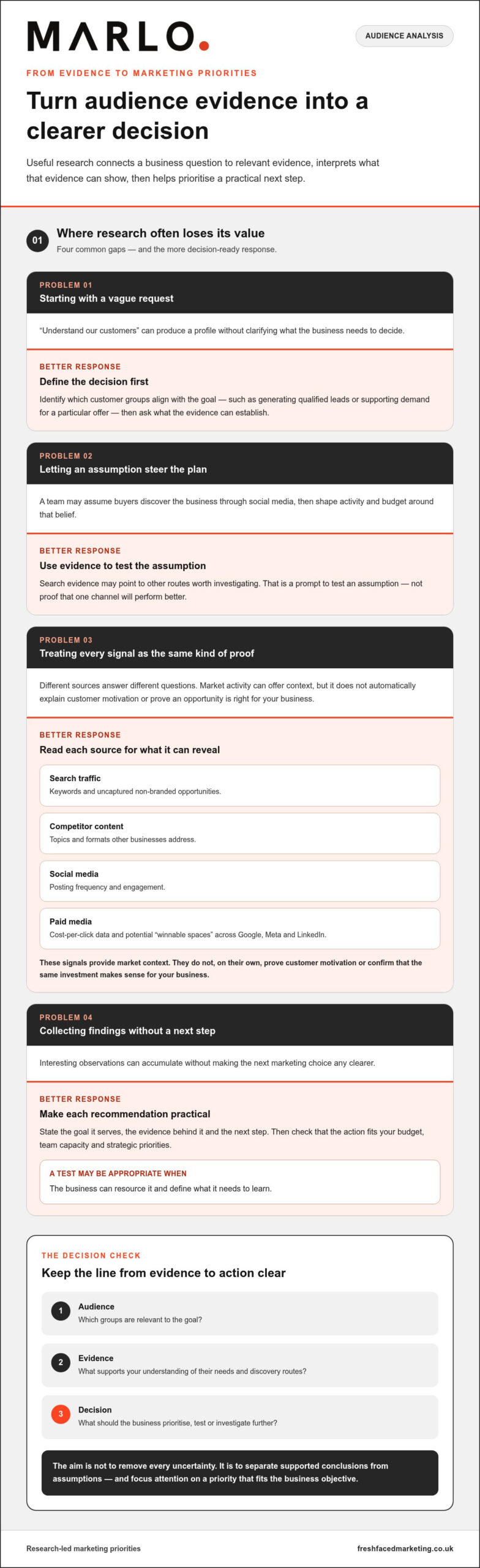
Start with the decision, not a generic request to “understand our customers”. The research should establish which customer groups align with the goal, such as generating qualified leads or supporting demand for a particular offer. It should then examine what the evidence indicates about their needs, interests and routes to discovery.
The analysis should also make uncertainty visible. Your team might assume buyers discover the business through social media, whilst search evidence points to other routes worth investigating. That doesn’t prove one channel will perform better. It identifies an assumption to test before it shapes budget or activity.
Audience profiles versus decision-ready insight
A profile describes an audience. It might outline relevant characteristics, interests or behaviours. Insight goes further: it interprets evidence in the context of a business question and helps guide a choice.
For example, knowing a group’s job roles is descriptive. Understanding which questions that group searches for, how it finds relevant solutions and what evidence supports those observations can help shape messaging and channel priorities. The profile alone doesn’t prove demand or predict results.
Before investing, look for a clear line from evidence to action:
- Audience: Which groups are relevant to the goal?
- Evidence: What supports your understanding of their needs and discovery routes?
- Decision: What should the business prioritise, test or investigate further?
This distinction makes research useful in practice. Findings should help you assess whether a message speaks to a real need, whether a channel merits attention and whether the proposed activity fits available resources. The purpose isn’t to remove every uncertainty. It’s to separate supported conclusions from assumptions, giving your marketing decisions a sounder basis.
How audience evidence becomes a stronger marketing strategy
Research earns its place when it informs a business decision. A useful target audience analysis service moves through four steps: define the question, select relevant evidence, interpret what it does and doesn’t show, then prioritise an action. Without that sequence, data can accumulate without making the next marketing choice any clearer.
Consider a business assessing whether to focus on a non-branded search opportunity. Keyword evidence can show which searches are relevant and where competitors appear. It can’t, by itself, explain the searcher’s motivation or establish whether pursuing that opportunity supports the business goal. Each source answers a different question, so weigh signals in context rather than treating them as interchangeable proof.
Which evidence can inform audience decisions?
Search traffic analysis can reveal keywords and uncaptured non-branded opportunities. Competitor content shows which topics and formats other businesses address, whilst social data can indicate posting frequency and engagement. These provide useful market context, but don’t prove customer motivation. Paid-media analysis can show cost-per-click data and potential “winnable spaces” across Google, Meta and LinkedIn. Interpret each finding according to what that source can actually establish.
For instance, competitor activity may suggest a channel is worth investigating, but it doesn’t confirm that the same investment makes sense for your business. The interpretation must account for your audience, commercial objectives and capacity to act.
From findings to prioritised action
Each recommendation should identify the goal it serves, the evidence behind it and the practical next step. Then assess whether that action fits your available budget, team capacity and strategic priorities. An opportunity may merit a test, for example, but only if the business can resource it and define what it needs to learn.
Evidence becomes valuable when it changes a defined decision. That might mean refining a message, investigating a channel or directing resources towards an opportunity that aligns with a business objective. Not every finding needs action. The task is to distinguish a useful priority from an interesting observation.
A marketing strategy blueprint can turn research findings into a sequence of achievable priorities. Fresh Faced connects recommendations to your specific goals, budget and resources, helping you understand where each pound should go. Explore our research-led marketing strategy for planning context.
How to compare a target audience analysis service with tools or DIY research
Audience analysis isn’t simply persona creation or access to a dashboard. A persona can summarise a group, and a tool can surface selected data. Neither automatically explains which evidence matters to your business or what to do next. Compare options by the decision you need to make, the evidence required and the level of interpretation your team can provide.
| Approach | Evidence and interpretation | Output and usefulness |
|---|---|---|
| DIY research | You select sources and interpret them in-house. | Flexible, but findings depend on your team’s capacity to assess context and trade-offs. |
| Research tool | Organises or surfaces data within its available scope. | Useful for exploration and reporting; the business still decides what the data means. |
| Strategic analysis | Interprets relevant evidence against a defined business question. | Connects findings to prioritised marketing decisions, budget and resources. |
What a tool can reveal and what strategy must interpret
Tools can make patterns easier to inspect. MARLO, for example, is an interactive web dashboard providing one comprehensive report. It analyses search traffic, including keywords and uncaptured non-branded opportunities; content performance across competitor sets; 90 days of social media frequency and engagement; and paid media across Google, Meta and LinkedIn, including cost-per-click data and potential winnable spaces. You choose the competitors and retain indefinite access to the data.
These findings provide evidence to examine, not automatic conclusions. Strategic analysis considers whether a pattern fits your goals, what other context may affect it and whether acting on it is realistic. Software doesn’t, by itself, validate an audience or guarantee growth.
What to look for in the analysis output
Assess whether the output shows a traceable connection between evidence, interpretation and recommendation. Each priority should explain the business goal it supports and why it merits attention over other possible actions. It should also account for available budget and team capacity, rather than presenting an unranked list of opportunities.
The level of human input should match the decision’s complexity. MARLO provides structured data access; the separate Marketing Success Blueprint builds on that foundation through human-led strategic interrogation and produces a detailed execution blueprint. For related context on evaluating competitor evidence, explore the article on forensic competitor research. Choose an approach that gives your team enough clarity to act, without confusing more data with a better strategy.
How to prepare for an audience analysis and judge its usefulness
A focused analysis starts with a decision, not a request to collect more data. Before engaging a target audience analysis service, clarify what the business needs to decide and what would make the findings useful. This keeps the work relevant to your objectives, budget and capacity to act.
Define the decision before gathering more data
Name the choice at stake. Are you deciding which audience to prioritise, how to sharpen a message or where to focus channel activity? Then separate the immediate question from wider issues that can wait. If you need to assess channel priorities, for example, research into every aspect of customer experience may extend the scope without helping you make that choice.
Prepare a concise working brief:
- Business objectives: What outcome should marketing support, such as qualified leads or revenue growth?
- Current assumptions: Which beliefs about customers, demand or discovery routes need testing?
- Available data: What customer, campaign or performance information can inform the analysis?
- Resource limits: What budget, team capacity and time can realistically support the next steps?
Turn broad concerns into answerable questions. Replace “we need to understand our audience” with “which customer group is most relevant to this offer?” or “what evidence should guide our choice of channels?” Record constraints alongside the questions. A recommendation that depends on capacity your team doesn’t have isn’t ready to implement.
Recognise a useful output
A useful report does more than present observations. It explains what the evidence indicates, where uncertainty remains and why particular actions take priority. Recommendations should be specific enough for decision-makers to understand the reasoning, compare trade-offs and assign realistic next steps.
Every recommendation should connect evidence with a defined business priority. Use that test to distinguish actionable guidance from an unfiltered collection of findings. Check whether each proposed action fits the objective, available budget and team resources. If the analysis identifies an opportunity but offers no rationale for acting on it, treat it as a question for further assessment, not an automatic priority.
This is the bridge between research and a workable marketing roadmap: choose actions that serve the business goal and can be resourced. To explore how Fresh Faced connects research with practical marketing priorities, view our research-led marketing strategy.
How Fresh Faced connects audience analysis with strategic next steps
A target audience analysis service should give you more than a collection of data. Fresh Faced connects marketing evidence with strategic choices through two distinct offerings: MARLO provides an interactive dashboard and comprehensive report, whilst the Marketing Success Blueprint adds human-led strategic interrogation and a practical execution blueprint.
MARLO: an interactive dashboard for marketing evidence
MARLO brings together search traffic analysis, including keywords and uncaptured non-branded opportunities, and content performance across competitor sets. It also covers 90 days of social media frequency and engagement data, plus paid media across Google, Meta and LinkedIn, including cost-per-click data and potential “winnable spaces”. You choose the competitors and retain indefinite access to the data. Explore the MARLO marketing analysis dashboard.
These findings help you see where competitors outrank you and identify evidence worth considering against your objectives. MARLO is the data and reporting layer. It gives you an accessible basis for examining opportunities, not a substitute for deciding which priorities best fit your goals, budget and resources.
Marketing Success Blueprint: human-led strategic interrogation
The separate, more substantial Marketing Success Blueprint builds on the MARLO foundation. It brings human judgement into the analysis through forensic-level competitive research and strategic interrogation of the data. You have direct access to strategists, one-to-one strategy calls and intensive strategy workshops to examine what the evidence means for your business.
The outcome is a detailed execution blueprint, prioritised against your specific goals, budget and resources. It can be handed to any team or agency for implementation, giving them a clear route from findings to action. MARLO helps you explore the evidence; the Blueprint turns that evidence into a human-led strategy and executable priorities.
Both offerings are designed to make marketing choices clearer and more achievable. Explore Fresh Faced’s approach to audience evidence and strategy to find the level of insight and support that fits your next business decision.
Make your next marketing decision evidence-led
A useful target audience analysis service should do more than describe potential customers. It should test assumptions, show which evidence supports a conclusion and connect findings to priorities your business can realistically act on. Strong recommendations account for your objectives, budget and team capacity, helping you focus effort instead of spreading it across untested ideas.
Fresh Faced gives you two distinct ways to work with that evidence. MARLO is an interactive web dashboard providing one comprehensive report, combining search, competitor content, social and paid-media analysis. The separate Marketing Success Blueprint builds on MARLO through human-led strategic interrogation, then turns the findings into an execution blueprint your team or agency can use.
Both approaches are designed to help you see where opportunities may lie and make clearer choices about where every pound should go. Choose the level of insight and strategic support that fits your next decision, then take a focused step towards growth.
Explore a clearer, evidence-led route to growth.
Frequently Asked Questions
What does a target audience analysis service include?
A target audience analysis service examines relevant evidence, interprets what it indicates and connects findings to business decisions. Its scope depends on the question being addressed. The work may inform audience focus, messaging or channel choices. A useful output shows how conclusions were reached, separates evidence from assumptions and prioritises recommendations against your goals, budget and available resources. It should make clear what the evidence supports and where uncertainty remains.
How does target audience analysis help marketing performance?
Target audience analysis helps decision-makers focus marketing on groups and opportunities supported by evidence. It can highlight where search activity, competitor content, social engagement or paid-media data may warrant attention. These findings don’t guarantee improved results or prove that an opportunity will be commercially viable. Their value is clearer prioritisation and stronger reasoning, giving your team a more informed basis for allocating marketing resources and deciding what to investigate or act on next.
Is target audience analysis the same as creating buyer personas?
No. A buyer persona describes a customer group, but it doesn’t establish whether the assumptions behind that profile are supported or what the business should do next. Audience analysis examines relevant evidence and market context, then considers what they mean for a business decision. A profile can form part of the work, but it isn’t proof of demand or a prediction of results. Look for recommendations that translate evidence into practical priorities.
When should a business commission a target audience analysis service?
Consider a target audience analysis service when a significant marketing decision depends on uncertain assumptions about customers, demand or channel priorities. It can also help when your organisation has marketing data but lacks a clear direction for using it. Start by naming the decision, reviewing evidence already available and recording constraints such as budget or team capacity. This gives the analysis a focused business purpose and helps keep recommendations achievable.
Can audience analysis identify uncaptured market opportunities?
Audience analysis can surface opportunities that merit further investigation, including relevant uncaptured non-branded search opportunities or differences in competitor content and paid-media activity. These signals don’t automatically prove demand, customer motivation or commercial viability. A sound analysis explains what the evidence indicates, what remains uncertain and why a particular opportunity deserves attention. That helps your team decide whether to investigate further, test an approach or focus resources elsewhere.
How do I compare target audience analysis services?
Compare the business questions each service addresses, the evidence it examines and how it turns findings into recommendations. Check whether the reasoning is visible and whether priorities reflect your goals, budget and available resources. A large volume of data or a set of audience profiles doesn’t necessarily provide decision-ready insight. Give greater weight to clear links between evidence and action, and to recommendations your organisation can realistically implement.
How does Fresh Faced use MARLO and the Marketing Success Blueprint?
MARLO is an interactive web dashboard that provides one comprehensive report covering search traffic, competitor content performance, 90 days of social media frequency and engagement, and paid media across Google, Meta and LinkedIn. Users choose the competitors and retain indefinite access to the data. The separate Marketing Success Blueprint builds on MARLO with human-led strategic interrogation, direct strategist access, one-to-one calls and intensive workshops. It produces an execution blueprint for any team or agency to implement.