A marketing partner should be judged by the decisions and outcomes they improve, not by the volume of activity they produce. Choosing the right marketing partner means assessing relevant expertise, evidence of performance, clear measures of success and the ability to adapt as your business changes. Their work should connect directly to your commercial goals.
It’s reasonable to expect a partner to understand your business before recommending tactics. A persuasive proposal alone doesn’t prove fit. The reasoning, evidence and plan behind it matter more.
This guide explains how to define what your business needs, assess a partner’s expertise and examine case studies for meaningful results. It also covers reporting, flexibility and the practical details that help a marketing relationship stay aligned as priorities evolve. You’ll have a clearer basis for comparing potential partners and deciding what a productive collaboration should deliver.
Key Takeaways
- Define your growth constraint, goals, budget and priorities before comparing marketing partners.
- Look beyond sector labels: assess whether a partner’s expertise matches your audience, scale and main marketing needs.
- Examine case studies and testimonials for clear evidence of what changed, how it was measured and whether the work resembles your situation.
- Agree meaningful KPIs, reporting arrangements and written expectations so progress can be assessed against business outcomes.
- Choose a partner whose approach can adapt as your needs change, while keeping ownership of your marketing assets clear.
1. What Should You Consider Before Choosing a Digital Marketing Company?
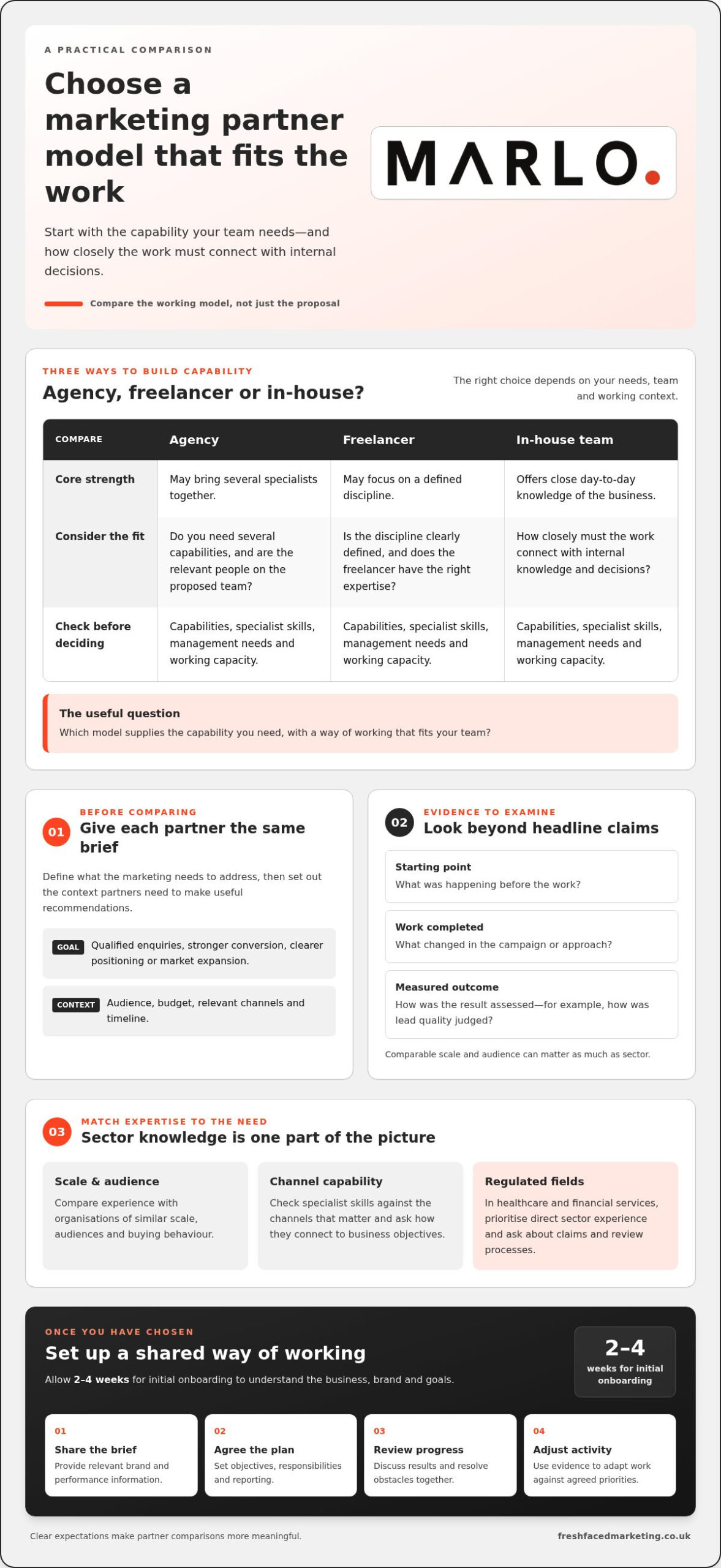
Choosing the right marketing partner starts with identifying the business constraint your marketing needs to address. Is the priority qualified enquiries, stronger conversion, clearer positioning or market expansion? Write down your goal, audience, budget, relevant channels and timeline before comparing proposals. Giving each agency, freelancer or in-house team the same brief makes their recommendations easier to assess.
Examine track records through case studies, not headline claims. Look for a clear account of the client’s starting point, the work completed and the outcome measured. For example, a case study about generating leads should explain what changed in the campaign and how lead quality was assessed. Evidence from a similar organisation is useful, but comparable scale and audience can matter as much as sector.
How do I compare marketing agencies, freelancers and in-house teams? Match their capabilities to your needs: an agency may combine several specialists, a freelancer may focus on a defined discipline, and an in-house team offers close day-to-day knowledge. Assess the actual people, their expertise, management needs and working capacity. The right model depends on the capability your team needs and how closely the work must connect with internal decisions.
Evaluate media partners by matching their capabilities to the channels you may use. Ask how they select platforms, build campaigns and connect activity to business objectives. A paid media partner should explain its approach to audience selection and optimisation. A broader team should show how media, messaging and landing pages work together. Look for a rationale, not just a list of services.
A portfolio should show more than polished creative. Check whether the work changed brand voice, audience engagement, customer understanding or action. For instance, a repositioning project should show how research informed the new message and where that message appeared. This helps distinguish a visual refresh from a brand transformation with a clear business purpose.
Assess the team you would work with, not only the person presenting the proposal. Review relevant experience, specialist skills and examples of previous work. Then discuss communication style, decision-making and feedback. A practical test is to share a business challenge and see whether the team listens, asks focused questions and explains its reasoning in plain English. This offers a glimpse of the working relationship beyond the pitch.
What are the risks of choosing the wrong marketing partner? A poorly matched team can spend budget on disconnected campaigns, weaken brand consistency and delay useful learning. The risk increases when responsibilities, success measures and communication aren’t transparent. Before agreeing, clarify who leads the work, how progress is discussed and how the strategy will change if evidence challenges the original plan.
What are the steps for onboarding and working effectively with a marketing partner? Begin with a shared brief, provide relevant brand and performance information, then agree objectives, responsibilities and reporting. Allow 2-4 weeks for initial onboarding to understand the business, brand and goals. Schedule regular reviews so both teams can interpret results, resolve obstacles and adjust activity against agreed priorities. A disciplined process for choosing the right marketing partner gives those reviews a clear purpose.
2. Checking industry and channel-specific expertise
Sector knowledge can shorten the learning curve, but it shouldn’t be the only test. Compare an agency’s experience with organisations of similar scale, audiences and buying behaviour. A supplier serving professional services, for example, may understand long sales cycles even without working in your exact niche. The key is whether its expertise connects to your market and objectives.
Assess specialist capability against the channels that matter. If paid search is central, ask how the team handles keyword selection, landing-page relevance and campaign optimisation. For social media, examine its approach to audience targeting, creative testing and platform-specific reporting. The partner’s strongest discipline should match your immediate need, while its wider strategic advice should explain how channels work together.
For paid campaigns on Google or Meta, check whether the agency is an official advertising partner. That status can indicate platform familiarity, but it doesn’t prove the proposed strategy suits your business. Ask the team to explain how it would connect channel activity to a commercial objective, such as improving qualified enquiries rather than simply increasing clicks.
Industry expertise matters more in some contexts. Businesses in regulated fields, including healthcare and financial services, should prioritise direct sector experience. Ask how the team handles industry-specific audiences, claims and review processes. A relevant example should show the work involved and the reasoning behind it, not just display a familiar client logo.
Check how specialists keep their knowledge current. Ask who will manage each channel, what practical experience they bring and how they respond when platform behaviour changes. For example, a team running LinkedIn campaigns should explain its approach to professional audiences, lead quality and sales handover. Clear answers demonstrate applied expertise more effectively than a long list of services.
Weigh location against capability. Across the UK, video conferencing makes it easier to work with a partner outside your town or region. In-person access may still matter for workshops or close collaboration, but proximity alone doesn’t establish expertise. Compare communication methods, decision-making and the people doing the work before treating geography as a deciding factor.
A focused assessment helps you distinguish genuine specialisation from broad claims. You can compare the team’s channel skills, sector understanding and ability to connect activity to objectives. For a useful starting point, explore this evidence-led approach to marketing strategy and consider how research can inform channel choices.
3. Assessing agency portfolios, reviews and testimonials
A portfolio shows what a marketing agency chooses to present, not the full context behind each project. For every relevant example, trace the work from challenge to outcome: what changed in audience engagement, brand voice, customer understanding or action? A repositioning project, for instance, should explain how the new message reached customers and what behaviour it aimed to influence.
Use reviews and testimonials as evidence to investigate, rather than as a score alone. Look for comments about communication, reliability, strategic thinking and delivery. Then compare those details with a case study: if a testimonial praises lead generation, does the project explain how leads were defined? Specific, consistent accounts are more useful than general praise.
References can add context that a published testimonial cannot. Ask to speak with a past client whose project resembles yours, then discuss how the agency handled changing priorities, feedback and reporting. For example, ask how the team responded when an initial campaign failed to reach its intended audience. The answer can reveal its learning process and working style.
Review technology and data capabilities through the work involved. If a proposed strategy relies on analytics, ask how the agency interprets performance data and connects it to decisions. Consider whether its tools can work with your existing systems, support growth and protect access to important information. Clarify which team uses your analytics and advertising accounts, and how findings inform the next campaign.
Credentials matter when they relate directly to the work. Check what a qualification or platform certification covers, who holds it and whether that person will contribute to your account. For a digital marketing project involving analytics, a relevant analytics credential may support practical capability, but it cannot replace clear examples of sound analysis. Assess the evidence alongside the people and strategy behind it.
Consider the agency’s total addressable market by examining the customer types it serves, its reach and the needs it can meet. A portfolio focused on national consumer brands may offer limited evidence for a business serving specialist buyers in a smaller region. Compare its audience knowledge and delivery experience with your actual market, rather than judging fit by client logos alone.
Finally, assess cultural fit through observable working behaviours. Compare values, business ethics and operational approaches during discussions. Notice whether the agency listens, explains its reasoning and welcomes constructive disagreement. Communication cadence matters too: agree how often decision-makers will speak and who owns key decisions. A strong strategy depends on transparent exchange, shared expectations and the ability to address problems directly.
4. Choosing an agency based on measurable outcomes
Start with the business result, then work backwards to suitable measures. For a B2B organisation, useful indicators can include pipeline contribution, customer acquisition cost, deal velocity, close rates and revenue influence. A partner should explain which measures connect to your objectives, how it will interpret them and what decisions the data may inform. Clicks alone rarely show whether a campaign helps achieve commercial goals.
A credible agency should question assumptions before recommending activity. If your brief calls for more website traffic, it might first examine whether the current audience converts or whether the offer needs clearer positioning. Ask the agency to explain its reasoning and identify evidence that could change its recommendation. This tests whether it can diagnose the right problem rather than simply deliver the requested tactic.
Treat the relationship as a thought partnership, not a handover. Agree shared KPIs, reporting frequency and who reviews results with your sales team. For example, if lead volume rises but sales-qualified opportunities fall, both teams should investigate audience fit and follow-up. Allow 3 or more months to gather comprehensive data when evaluating advertising effectiveness, particularly for brand-building campaigns.
Ask prospective agencies direct questions: How do you define success for our business? Which KPIs will you track, and how often will you report? What happens when results diverge from the plan? Request an example of past campaign metrics, including changes in conversions, ROI or engagement. A useful answer links the measure to the original objective and explains what the team learned.
What should a UK marketing agency contract include? Put goals, deliverables, responsibilities and timelines in writing, alongside reporting arrangements and agreed measures of success. Clarify what the proposal includes or excludes, how additional work is handled, the fee model and the terms for ending the engagement.
Agency pricing models may be per project, monthly retainer or performance-based. Compare each with your budget, required expertise and the work involved, not just the headline figure. Check for hidden fees, flexibility and how performance-based fees are calculated. A lower-cost proposal may leave important strategic or execution tasks uncovered, creating gaps between planned activity and the outcome you need.
What services should a marketing partner offer for my business goals? Choose capabilities that address the constraint you’ve identified, such as strategy, campaign delivery or measurement. If the priority is improving qualified enquiries, the proposed work should connect audience, message and channel activity to lead quality, rather than add services unrelated to that objective.
Judge performance by whether work achieves its intended objective, not by who created it. A case example might report a 60% increase in inbound enquiries after repositioning a brand and rebuilding its messaging over 8 weeks. Treat that as evidence to examine, not a forecast: ask how enquiries were measured and whether the approach fits your audience, budget and position.
5. Choosing a flexible marketing partner
Flexibility means responding to evidence and changing priorities, not changing direction without reason. Agree how often the strategy will be reviewed and what could trigger a shift. For example, if a channel attracts attention but few qualified enquiries, the partner should investigate audience fit, messaging and the best next use of resources.
First, decide what role your business needs. B2B partners commonly act as strategic advisers, execution engines or integrated revenue partners. An adviser can help shape priorities; an execution-focused team delivers agreed activity; an integrated partner connects marketing with sales goals. Choose the role that fills your capability gap, rather than expecting every partner to perform every function.
Test whether the relationship can accommodate growth. Ask how the partner would respond if demand increased, your business entered a new market or you added a channel such as LinkedIn. A useful answer explains what would change in planning, responsibilities and quality control. Flexibility should expand capacity without making existing work less consistent.
Technology also affects adaptability. Assess whether the partner’s tools can scale, work with your existing systems and support secure handling of business data. For instance, if your sales team uses a customer relationship management system, clarify how campaign insights could inform lead follow-up. The practical test is whether systems support decisions, rather than add another disconnected report.
Keep control of important marketing assets. Your business should retain access to its analytics, advertising and website accounts, as well as the data and materials needed to understand past activity. Losing access or rights can make changing suppliers harder and interrupt ongoing work. Clarify account ownership and access arrangements before activity begins.
Review the engagement terms for scope, exclusions and overages. A proposal should explain what work is included and how additional requests are handled. Establish how either party can end the relationship if priorities change or collaboration deteriorates. Where appropriate, a trial project can test communication, decision-making and delivery before a longer commitment.
Marketing is ongoing work, not a single handover. Set review points where you and your partner assess performance, market changes and resource needs together. Bring relevant sales feedback into those discussions. If customer objections shift, for example, the message and channel mix may need adjustment. The partner should explain why a change is needed and what it is intended to improve.
If you’re ready to turn market evidence into a practical, adaptable plan, explore a tailored marketing strategy.
Fresh Faced: MARLO
MARLO is Fresh Faced’s research and competitor analysis product for turning market insights into practical marketing direction. It brings search, content, social and paid media analysis together in an interactive dashboard, helping you see where competitors attract attention and where opportunities may exist. Its prioritised plan provides budget guidance to support your goals and resources.
Choose MARLO when you need evidence to guide decisions before committing to channels or campaigns. For deeper, human-led analysis, the Marketing Strategy Blueprint (MSB) adds strategic interrogation and a detailed execution plan. Full Marketing Strategy Execution is available when you need support putting strategy into action.
If you’d like to explore how this approach could support your goals, visit Fresh Faced.
Make your next marketing decision with purpose
Turn your assessment into a clear decision. Identify the capability your business needs now, then decide what evidence would show that the relationship is working. This keeps the conversation practical and gives both sides a shared basis for planning. Choosing the right marketing partner isn’t about finding a perfect promise. It’s about agreeing on useful work, sound reasoning and a way to learn as priorities change.
Fresh Faced offers MARLO, the Marketing Strategy Blueprint (MSB) and Full Marketing Strategy Execution. These options support different points in the journey, from research and strategic direction to putting a plan into action.
If you’re ready to discuss what your business needs next, contact Fresh Faced about your marketing. A considered first conversation can help clarify the right next step. Your goals can guide the work from there.
Frequently Asked Questions
How Does the Right Marketing Collaboration Create Impact?
Marketing has impact when decisions connect to how customers actually buy. For example, a business with a long sales cycle may need useful educational content before a sales conversation, rather than an immediate emphasis on enquiries. Your team and partner can combine customer feedback, campaign data and sales observations to refine that journey. This shared understanding makes activity more relevant and helps everyone learn from outcomes.
What Should You Ask Before You Say Yes to a Digital Partner?
Ask who will make decisions, how issues will be escalated and what happens if priorities change. Clarify what your team must provide, such as product information, subject expertise or campaign approvals. Ask how the partner will manage dependencies, including delays caused by missing inputs. These answers reveal whether the proposed working arrangement fits your internal capacity, rather than relying on a presentation built around ideal conditions.
What Should You Consider Before Choosing a Digital Marketing Company?
Consider how your customers discover, assess and buy from you, then check whether the proposed approach fits that journey. A seasonal retailer, for instance, may need preparation well before its busiest sales period, while a specialist consultancy may need to build confidence over a longer decision process. Assess whether your team can provide timely approvals, product knowledge and customer insight. These practical conditions affect how well a plan can be delivered.
How do I evaluate a marketing agency’s experience and case studies?
Read each case study as a record of decisions, not just a success claim. Look for the client’s original challenge, the audience targeted, the work performed and the measurement method. Ask whether other changes, such as a new offer or sales process, influenced the outcome. If the case study lacks context, request a fuller explanation. A useful comparison focuses on the problem-solving process, not whether another company’s results can be copied.
What questions should I ask when choosing a marketing partner?
Ask what the partner would investigate before recommending activity, and what evidence might change its view. Explore how it handles disagreement, approvals and underperforming work. You could present a realistic scenario, such as a campaign generating attention but few sales conversations, and ask how the team would diagnose it. The answer should show a logical process, identify relevant internal input and explain how you would make decisions together.
How can I assess an agency’s reporting, KPIs, and return on investment?
Ask to see a sample report with sensitive client details removed. Check whether it separates activity, audience response and business outcomes, then explains what the figures mean. Agree how lead quality and sales influence will be recorded, especially if several channels contribute to a purchase. Clarify attribution assumptions too: a report should make clear which interactions it credits, so comparisons over time inform decisions rather than imply false precision.
How do I check a UK agency’s references, reviews, and credentials?
Compare public reviews with direct references and look for recurring specifics about delivery, communication and problem-solving. Ask a reference how the agency handled a difficult decision, not only whether they were satisfied. For credentials, identify the issuing organisation, the named holder and the subject covered. Then establish whether that person will work on your account. This distinguishes relevant, current expertise from credentials that have little connection to your project.