More marketing activity doesn’t automatically create more growth. It can simply create more content to maintain. To build a sustainable marketing engine, define who you need to reach, prioritise work that supports your goals, and reuse useful assets instead of producing new material by default. Choose tools that fit your process and measure whether your activity contributes to lasting progress.
It’s reasonable to want a consistent flow of content and campaigns. The problem starts when output becomes the measure of success and audience relevance, resource demands and results get less attention. A sustainable approach connects what your business does with what it communicates, treating content as an investment with a clear purpose.
This article explains how to understand your audience, focus your roadmap, choose essential marketing tools and assess growth over time. You’ll also learn how a clear strategy can reduce duplication, make better use of existing resources and help you decide what to continue, change or stop.
Key Takeaways
- Prioritise roadmap activity by audience needs, business goals and available resources, rather than by how much content you can produce.
- Reuse effective content and creative assets to reduce duplication and focus new work where it can make a clear contribution.
- Define your ideal customer profile and positioning before choosing channels or adding tools to your marketing stack.
- Track progress across acquisition, activation, retention, revenue and referral to understand where the customer journey needs attention.
- Use a clear North Star metric and relevant growth loops to connect day-to-day marketing activity with longer-term business progress.
Targeted marketing roadmaps and reducing content waste
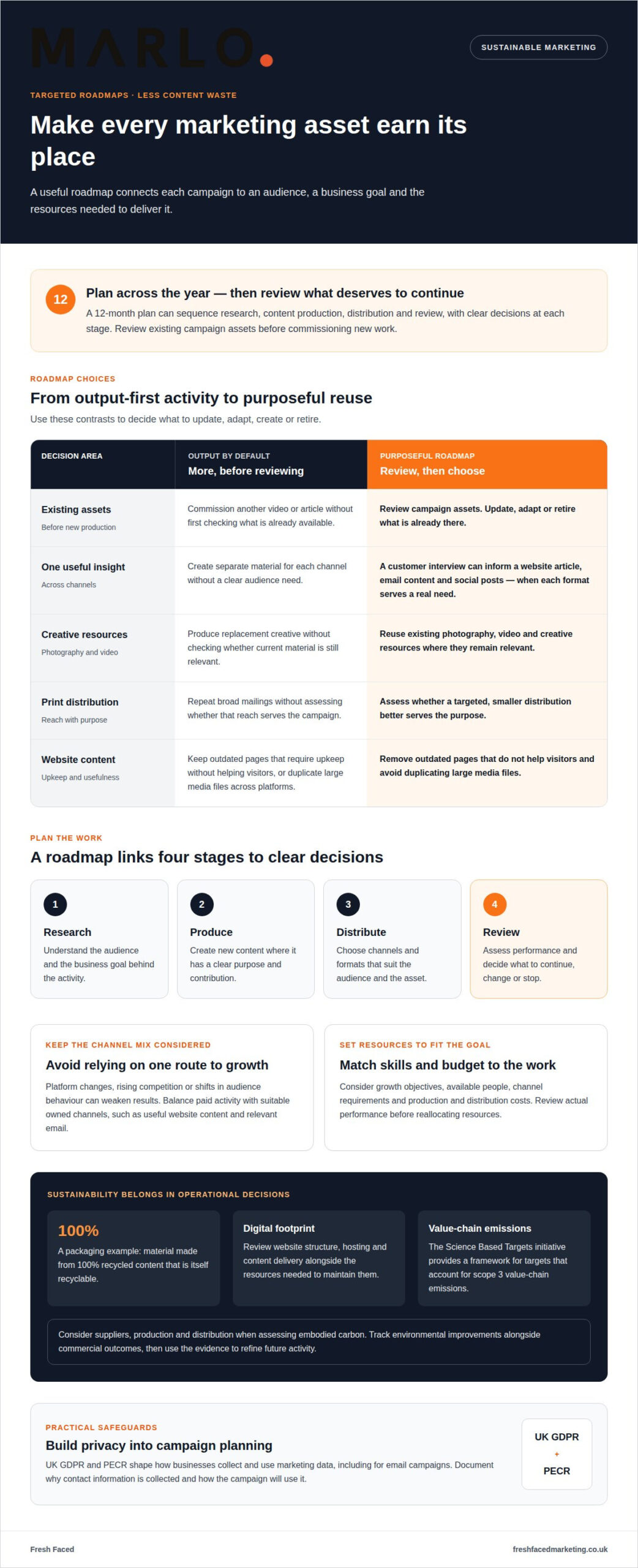
A useful marketing roadmap links each campaign to an audience, a business goal and a delivery resource. A 12-month plan can sequence research, content production, distribution and review, with clear decisions at each stage. For example, review existing campaign assets before commissioning a new video or article. That simple step can reveal content worth updating, adapting or retiring.
Reduce waste by planning how each asset will work across channels. One customer interview might inform a website article, email content and social posts, provided each format serves a real audience need. Reuse existing photography, video and creative resources where they remain relevant. For print, assess whether a targeted, smaller distribution serves the purpose better than broad, repeated mailings. A packaging example is material made from 100% recycled content that is itself recyclable.
Digital activity also has an environmental footprint. Review website structure, hosting and content delivery alongside the resources required to maintain them. Remove outdated pages that create upkeep without helping visitors, and avoid duplicating large media files across platforms. These choices can reduce unnecessary digital work and clarify where a carbon footprint may arise. Digital sobriety means using digital channels deliberately, not assuming they have no environmental impact.
Carbon reduction should connect to operational decisions, not sit apart as a marketing message. The Science Based Targets initiative provides a framework for targets that account for scope 3 value-chain emissions. Consider suppliers, production and distribution when assessing embodied carbon, rather than focusing only on campaign materials. Track environmental improvements alongside commercial outcomes, then use the evidence to refine future activity.
In-house teams have close access to internal knowledge and day-to-day decisions. Agencies can bring broader strategic capacity, while freelancers may provide specialist support for defined work. The right model depends on the skills required, available management time and consistency of demand. A roadmap can clarify which capabilities need ongoing ownership and which are project-based.
UK GDPR and PECR shape how businesses collect and use marketing data, including information for email campaigns. Build privacy considerations into data capture, audience segmentation and campaign planning. For example, document why you collect a contact’s information and how the campaign will use it.
There is no single marketing budget that suits every UK business. Set yours against growth objectives, available people, channel requirements and the cost of producing and distributing content. Prioritise activity according to its expected contribution, then review actual performance before reallocating resources.
Relying too heavily on paid advertising or a single channel concentrates risk. Platform changes, rising competition or shifts in audience behaviour can weaken results quickly. A roadmap should balance paid activity with suitable owned channels, such as useful website content and relevant email, so one channel doesn’t carry the entire growth plan.
Defining an audience and understanding its sustainability priorities
A sustainability message works best when it addresses a concern the intended audience recognises. Define the people or organisations most likely to value your offer. A UK clothing business, for example, might focus on customers seeking durable garments rather than everyone interested in environmental issues. A clear audience definition gives your team a practical basis for choosing topics, channels and evidence.
Separate assumptions from findings. Look for recurring questions in customer interviews, sales conversations, support enquiries and existing feedback. One group might care about product lifespan; another might focus on repair options or supply-chain information. Record these priorities alongside the customer’s buying context, including what prompts product research and what evidence helps someone decide. This grounds your framework in real decisions.
Stated interest alone doesn’t show which sustainability factors influence a particular purchase. A UK business can investigate this through customer interviews, feedback forms and sales conversations. Ask what information customers sought before buying, what influenced their choice and what remained unclear. Compare answers across customer groups, since a business buyer may prioritise supply-chain evidence whilst an individual customer focuses on product care.
Use a simple research sequence. First, group customers by shared needs or buying situations, not just broad demographics. Next, identify the sustainability questions that arise at each group’s decision points. Finally, compare those questions with what your business can substantiate. If customers ask how long a product lasts, for example, practical care advice may address the concern better than a general claim about being “eco-friendly”.
Turn each priority into a useful communication choice. If buyers value repairability, explain how repairs work and what parts can be replaced. If they ask about packaging, describe its materials accurately and explain how customers should dispose of it. Answering a concrete question is more useful than repeating a broad environmental promise. It also helps your team avoid producing several assets that make the same point without adding evidence.
Measure response against the purpose of each piece. Assess an educational guide by relevant enquiries or progression to product information; assess a campaign by qualified engagement. Treat comments and clicks as signals, not proof of changed purchasing behaviour. Compare results with the intended audience and action, then revise the message if the evidence shows a mismatch.
Audience priorities can change as products, expectations and operational practices evolve. Review customer feedback and campaign performance regularly, updating your framework when new questions emerge. If a business improves its product repair options, for instance, it can explain the change clearly while distinguishing completed actions from future plans. This keeps sustainability communication relevant, credible and grounded in what the organisation actually does.
ICP, positioning, funnel and marketing technology essentials
A workable marketing system connects priority customers with clear messaging, suitable channels and tools your team can maintain. These choices should support the business mission, not simply add more activity.
ICP and market positioning
An ideal customer profile (ICP) describes the organisations or people most likely to benefit from your offer, while positioning explains why it fits their needs. Together, they help teams focus on relevant prospects instead of broad, poorly defined audiences.
A software firm, for example, might prioritise UK manufacturers with a specific operational challenge rather than every business seeking digital tools. Similarly, trading and distribution businesses such as Port of Brands focus on specific consumer product categories to keep their commercial efforts focused. Clear messaging can explain the problem a business solves, the evidence behind its approach and the alternatives customers might consider. Revisit the ICP when sales conversations show that a different audience is responding.
Mission and consistent messaging
A mission gives marketing a shared direction; consistent messaging turns that direction into useful claims and examples. If a business aims to help customers reduce waste, its product pages, sales materials and campaign content should explain the same practical benefit.
Consistency doesn’t mean repeating identical copy. A LinkedIn post can introduce an issue while a detailed guide explains the response. Both should reflect the same positioning and use claims the business can support. This makes content easier to coordinate across internal teams and external partners.
Funnel and channel choices
A marketing funnel organises activity around customer progress, from discovering an offer to considering it and taking action. It matters because a channel that attracts attention may not answer the questions that influence a purchase.
For UK businesses, suitable channels depend on audience behaviour, buying complexity and available resources. LinkedIn and search ads can reach the 5% of people already in-market, while demand creation should reach the other 95%. Treat these as complementary roles: search can capture active intent, while helpful content can introduce a need before a buyer starts comparing suppliers.
Choose channels by matching each one to a funnel purpose. A specialist consultancy, for example, might use search content to explain a problem, webinars to demonstrate its approach and email to share follow-up material. Review whether each channel moves the right audience towards a meaningful next action.
Marketing technology, automation and AI
Marketing technology supports the capture, organisation and analysis of customer interactions. Automation handles repeatable tasks, while AI can assist with research or drafting. A lightweight, reliable stack matters because disconnected tools create duplicate records and extra work.
Automation can send a relevant follow-up after someone downloads a guide, while AI can help summarise recurring questions in customer feedback. Keep people responsible for checking context, accuracy and tone before messages go out. Clear data practices and useful communication help protect trust; excessive personalisation or irrelevant automated messages can undermine it.
Measurement and ongoing development
Define a clear purpose for each tool before adding it. A customer database might support lead management, while an analytics platform helps assess which content contributes to enquiries. Connect records consistently, assign ownership and remove tools that don’t support a clear decision.
Review the system as products, audiences and channels change. If a new service attracts a different segment, for example, update the ICP, adjust messaging and test whether the existing funnel still fits. This keeps technology and marketing aligned with the mission, rather than letting the stack grow without direction.
AARRR metrics, growth loops and North Star metrics
Measure progress across the customer journey, not just the leads generated by one campaign. AARRR and growth loops help connect marketing activity with customer value and business growth.
AARRR metrics and North Star measures
A customer-growth framework can help businesses understand how people move through different stages of their relationship with a service. It helps a business identify where people progress, pause or leave, rather than treating every new lead as a completed result.
For a subscription service, acquisition could mean a qualified website visit, activation a completed first task, and retention continued use. Revenue measures paid conversion; referral records customers recommending the service. Define each measure in operational terms and use the same definitions across marketing and sales. Otherwise, reports may count different behaviours as the same result.
A North Star metric is a central measure of the value customers receive and the growth the business aims to sustain. For a learning platform, it might track learners completing useful lessons rather than registrations alone. Supporting measures should explain what influences that result, such as lesson starts, completion and repeat visits.
Balance brand building with short-term lead generation by giving each activity a distinct role. Brand content can build recognition and trust over time, while campaigns capture current demand. Assess both against their intended outcomes, not one shared lead target. Growth marketing considers the full lifecycle; performance marketing focuses mainly on paid acquisition.
Growth loops
A growth loop is a repeatable process where one customer or marketing outcome helps generate the next. It matters because a well-designed loop can reinforce acquisition, engagement or referral instead of relying on a one-off campaign.
Consider a content loop: a useful guide attracts readers, their questions reveal further topics, and new articles bring more relevant visitors. A referral loop works differently: a satisfied customer recommends a service, a new customer experiences its value, and that experience can prompt another recommendation. Content, referral, product-led and paid acquisition loops are all possible models.
To implement a loop, map its input, customer action and next output. A software company might publish a practical template, invite users to share their completed version, then use common questions to improve it. Measure each transition. If readers download but don’t use the template, the loop stalls before creating value.
Scale while maintaining quality and profitability by expanding only activities that perform against agreed measures. Test one additional audience or distribution channel, for example, then assess customer outcomes, delivery effort and contribution to revenue. Competitors may use different channels, but copying their volume won’t show whether the same approach suits your customers or operating model.
Review the loop when customer behaviour or your offer changes. If a referral programme attracts poorly matched prospects, revise its audience or value exchange. If a content loop repeatedly generates visits without meaningful actions, strengthen the connection between each asset and the next customer need. This keeps growth tied to useful experiences, not output alone.
What is a sustainable marketing engine?
A sustainable marketing engine aligns how a business operates with how it communicates. It connects commercial growth with environmental and social considerations, rather than treating sustainability as a campaign theme. A business promoting durable products, for example, should make product development and customer support decisions that reinforce that claim.
That alignment changes what marketing teams plan and publish. Start with operational reality: what the business makes, how it delivers value and where its impacts occur. Marketing can then explain those actions accurately. If a company is improving packaging, it can describe the change underway and distinguish it from improvements already achieved.
Long-term planning tests whether commitments can last beyond a single campaign. Consider how the business will uphold its sustainability commitments three, five and ten years into the future. A clothing brand might connect product durability, repair options and customer guidance. Its marketing should reflect the actual development of those practices, not imply that every future goal has already been achieved.
Environmental, Social and Governance (ESG) frameworks can help businesses measure impact and support sustainability messaging with evidence. They’re useful when teams need to organise evidence across business activities and communicate progress clearly. A company could report which operational improvements are in progress, which have produced results and what evidence supports each statement.
Credible communication includes limitations as well as progress. If a business has improved one part of its supply chain, it should describe that specific change instead of presenting the entire operation as sustainable. Consumers, regulators and industry watchdogs increasingly scrutinise sustainability claims. Clear wording and supporting data help readers understand the scope of an initiative.
To assess whether marketing supports sustainable growth, connect its measures to business outcomes and operational effects. A campaign might generate enquiries, but its content should also represent the product and the organisation’s practices accurately. Reviewing both helps leaders identify where messaging and operations align, and where further work is needed.
Building a sustainable marketing engine means coordinating strategy, operations and communication over time. Set priorities that reflect real business changes, assign responsibility for the supporting evidence, and review progress as practices evolve. If a business changes its product development, for example, it should update relevant customer information and track whether the new message remains accurate. This makes marketing a practical part of sustainable business development, not a substitute for it.
Fresh Faced
Fresh Faced helps businesses turn marketing evidence into a focused strategy and practical next steps. If your activity feels fragmented, content lacks clear priorities or channel choices need to connect more closely with business goals, strategic support can bring those decisions together in one plan.
MARLO provides market research, competitor analysis and a prioritised plan. The Marketing Strategy Blueprint (MSB) adds human-led strategic interrogation and a detailed execution blueprint. Full Marketing Strategy Execution helps businesses put their strategy into practice.
The right route depends on whether you need clearer evidence, a detailed plan or support delivering the work. Contact Fresh Faced to discuss which approach best fits your marketing priorities.
Turn your strategy into a lasting practice
A marketing system becomes more useful when decisions stay clear after the initial plan is set. Before launching the next campaign, record what the team expects to learn, what evidence would change its approach and who will make that decision. This creates a practical learning record, not another reporting task. It also helps prevent familiar activity from continuing simply because it’s already on the calendar.
Building a sustainable marketing engine is an ongoing discipline. Keep testing whether your choices still fit the business, the audience and the evidence. When priorities shift, make changes deliberately: preserve what works, revise what no longer fits and stop activity that has lost its purpose. This gives your team room to respond without rebuilding its strategy from scratch.
If you’d like a strategic perspective on your next steps, contact Fresh Faced to discuss your strategy. A clear decision today can give your marketing a stronger direction for what comes next.
Frequently Asked Questions
What are the Steps to Build a Sustainable Marketing Strategy?
Start with a business objective, then identify the audience and customer decision you want to support. Assess existing activity before commissioning new work, so useful assets and gaps are clear. Select channels and tools that match audience behaviour and your team’s capacity. Assign ownership, agree measures and schedule reviews. A campaign review, for example, can decide whether to update a strong resource or stop an ineffective one.
What are the key components of a sustainable marketing strategy?
The essentials are a defined audience, clear positioning, prioritised activity, suitable channels, reliable tools and measures tied to business outcomes. Operational credibility matters too: marketing claims should reflect what the organisation actually does. Test this by tracing a campaign from its supporting evidence to its intended customer action, then to the business result. If any link is unclear, refine the plan before expanding the activity.
How do you build a marketing engine step by step?
Build it as a repeatable operating process. Set an objective, identify the customer decision that supports it and assign an owner to the activity. Prepare the evidence and content, then publish through the selected channel. Record responses consistently and review what happened against the original objective. An enquiry campaign, for example, should track enquiry quality and follow-up, not just form submissions.
What metrics and benchmarks should you use to measure marketing effectiveness?
Choose measures that match the activity’s purpose: qualified enquiries for lead generation, repeat purchases for retention or completed referrals for advocacy. Use your own historical results as a baseline, segmented by audience, channel or campaign, rather than treating a competitor’s performance as a target. Keep definitions consistent and include delivery effort alongside outcomes. A channel producing more leads may still need reassessment if those leads rarely progress.