More leads don’t automatically mean more customers. A sound lead generation strategy framework connects the steps that matter: identifying potential buyers, attracting them, assessing their fit and nurturing them towards a purchase. Without that structure, activity can rise while the reasons behind results remain unclear.
A strategy should do more than fill a pipeline. It should help distinguish qualified prospects from poor-fit enquiries, show how marketing contributes to progress and give sales teams useful context for conversations. The challenge is making those parts work together rather than treating lead capture as the whole process.
This guide explains how lead generation works and how to measure its performance. It also covers qualification, nurturing, ideal customer profiles, lead types and the process that links them. You’ll see how a professional strategy can turn market and competitor evidence into a practical roadmap, with priorities shaped around your audience, goals and available resources.
Key Takeaways
- Build lead generation around the full buyer journey, accounting for long sales cycles and the resources available.
- Measure whether campaigns attract qualified prospects and contribute to pipeline, not just how many leads they capture.
- Combine fit and engagement signals to prioritise prospects, then use relevant follow-up to nurture them.
- Define ideal customer profiles using organisation and behaviour data so enterprise leads are assessed against clear criteria.
- Map the lead types and process stages to expose gaps and identify where a structured strategy can improve consistency.
1. What is lead generation and why is it important?
Lead generation identifies potential customers, captures their interest and develops the relationship towards a purchase. It connects an audience’s needs with relevant information, then gives the sales team a way to prioritise follow-up. For example, someone downloading a product guide may need different communication from someone requesting a demonstration.
The process matters because interest rarely turns into a sale immediately. Enterprise sales cycles commonly last six to 18 months, so a single campaign may need to support prospects across an extended buying journey. Limited budgets add pressure: spending on broad reach can leave fewer resources for the content, follow-up and measurement that move suitable prospects forward.
Remarketing helps maintain relevance at different funnel stages. An early-stage visitor who reads an introductory guide could receive educational content, while a prospect comparing solutions may see a case study or product information. Tailor the sequence to demonstrated interests. Repeating the same advert or message at every stage can waste budget and make communication feel disconnected.
Scoring gives marketing and sales a shared way to assess readiness. A B2B lead score can use a numerical scale from 1 to 10, combining profile details with engagement. A suitable job role, for instance, may indicate fit; repeated visits to a pricing page may signal active consideration. The score only helps if both teams agree what actions trigger a handoff.
A clear handoff defines when marketing passes a prospect to sales, what context accompanies them and who follows up. A CRM can keep contact details, engagement history and sales notes in one shared record. Sales feedback then closes the loop: if a source repeatedly produces poor-fit enquiries, marketing can revise audience criteria or campaign messaging instead of simply increasing lead volume.
UK GDPR and PECR affect how businesses collect and use personal data and send electronic marketing. Campaigns need to account for lawful bases and channel-specific consent requirements, alongside clear opt-out handling. The Information Commissioner’s Office also cautions that a person’s public social media posts are not automatically free to use for direct marketing.
Common mistakes include treating every enquiry as sales-ready, targeting too broadly and judging success by capture volume alone. Another risk is defining the audience around sales potential while overlooking customer needs. The Financial Conduct Authority warns that this kind of target-market statement can miss those needs. A stronger process links audience fit, relevant follow-up and sales feedback.
2. How does a professional measure the success of your lead gen strategy?
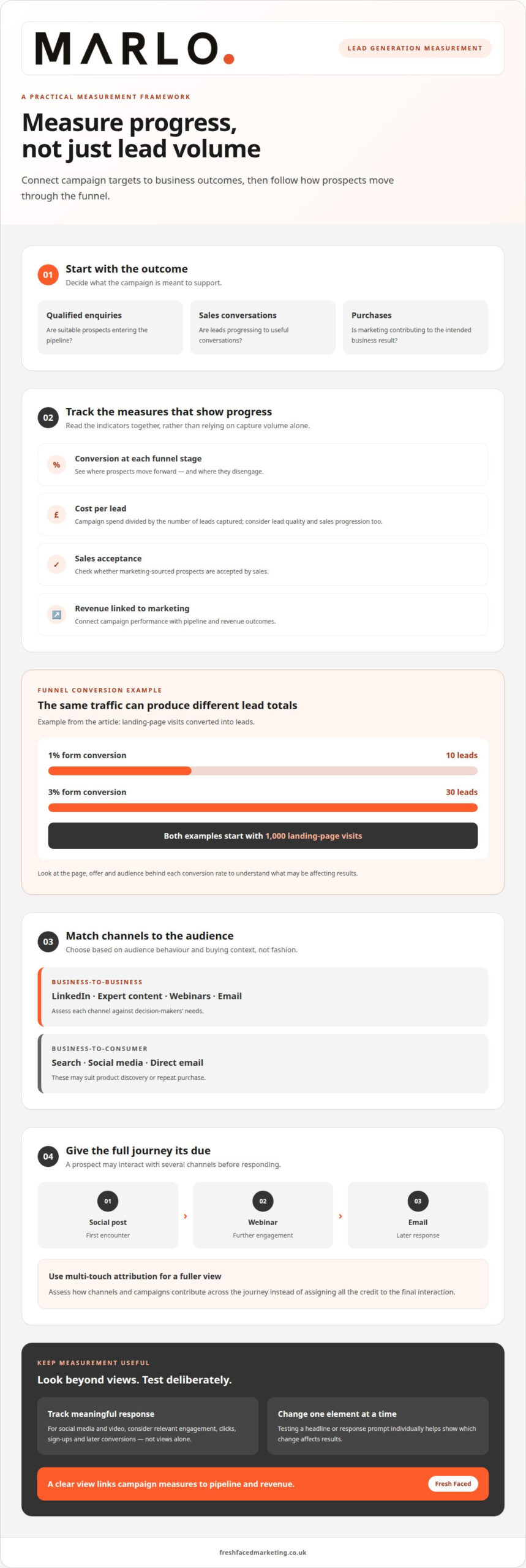
Start by defining the campaign target and the business outcome it should support. That might mean qualified enquiries, sales conversations or purchases. A lead generation strategy framework connects those outcomes to campaign measures, so reporting tracks progress rather than activity alone. Useful indicators include conversion at each funnel stage, cost per lead, sales acceptance and revenue linked to marketing.
Channel choice follows the audience, purchase journey and buying context. For B2B, a professional may assess LinkedIn, expert content, webinars and email against decision-makers’ needs. For B2C, search, social media and direct email may suit product discovery or repeat purchase. The channel mix should reflect evidence about audience behaviour, not assumptions about what is fashionable.
Content marketing gives potential customers a reason to engage before speaking with sales. A useful report, case study or webinar can attract a relevant audience and support lead capture through a form or voluntary sign-up. Email campaigns can then share related material and guide subscribers towards a suitable next step. Measure registrations, attendance, downloads, email engagement and subsequent conversions together.
Funnel analysis shows where prospects progress and where they disengage. For example, 1,000 landing-page visits with a 1% form conversion rate produce 10 leads; at 3%, they produce 30. A professional examines the page, offer and audience behind each rate. Cost per lead is calculated by dividing campaign spend by leads captured, then comparing it with lead quality and sales progression.
Attribution adds context to those figures. A prospect may first encounter a social post, later attend a webinar and eventually respond to an email. Multi-touch attribution assesses how channels and campaigns contribute across that journey, rather than assigning all credit to the final interaction. A lead generation strategy framework can connect those touchpoints with pipeline and revenue, giving decision-makers a fuller view of marketing’s contribution.
Social media and video need measures beyond views. A professional can assess relevant engagement, clicks, sign-ups and later conversions, then compare outcomes across platforms and content formats. Testing one element at a time, such as a headline or call to action, helps identify which change affects response. Results guide future tactics and keep efforts aligned with the target audience.
For a clear view of which channels and content merit investment, evidence-led marketing strategy can connect performance measures with practical priorities.
3. How do lead qualification and nurturing work?
Qualification separates prospects ready for a sales conversation from those needing more information. Assess need, authority, budget and timing using the BANT framework. For example, a contact with a clear business need but no current purchase timeline may suit continued nurturing rather than an immediate sales handoff.
Lead scoring and lead grading answer different questions. Scoring measures behaviour and interactions, such as webinar attendance or a product-demo download. Grading assesses how closely a prospect matches the target market. A high score cannot compensate for poor fit, and a strong-fit prospect may need more engagement before sales contact makes sense.
Once qualification criteria are defined, automated email sequences can respond to meaningful actions. A white-paper download might trigger a related case study, followed by a webinar invitation. If the recipient visits a product page, the next message can address relevant features. Tailor the sequence to the prospect’s stage instead of sending every contact identical messages.
Automation can also support re-engagement. If a prospect stops opening emails after an event, a later message could offer a different resource or ask whether their priorities have changed. A return to a landing page, fresh content download or reply can signal renewed interest. These actions help sales decide whether to resume a conversation or keep the contact in a lower-priority nurture path.
A CRM should hold the engagement history that informs those decisions. When marketing and sales systems exchange information in both directions, updates to qualification status can guide future communications. Sales can use a prospect’s email interactions, webpage visits and content downloads to shape a relevant conversation, rather than asking them to repeat information already recorded.
Nurturing can span email, websites, events, webinars and AI-powered chat. Specialists such as The Fraction illustrate how automated, AI-driven lead generation systems can streamline client acquisition across these touchpoints. Someone who attends a webinar, for example, could receive a follow-up email, encounter related guidance on the website and use chat to explore a specific question. Automation coordinates these channels, while human review remains useful for complex needs or signals that call for a tailored response.
Referrals provide another route to qualified prospects. Build a process for asking satisfied customers for reviews or introductions to potential customers in their networks. Make the request appropriate to the relationship and provide a clear way to respond. Referral leads should enter the same qualification process, rather than bypassing checks because someone made an introduction.
The strongest approach connects behaviour, fit and timely follow-up. A prospect scoring above 80 may be more likely to convert in one example, but that threshold only has value when it matches the business’s own qualification criteria and sales feedback.
4. Enterprise lead qualification and ideal customer profiles
Enterprise prospects are buyers in large organisations, typically with over 1,000 employees. That scale changes qualification: a single contact rarely represents every stakeholder or the full buying process. An ideal customer profile (ICP) should describe the organisation that benefits most, then identify relevant roles, needs and buying signals within it.
A robust profile combines firmographic, demographic and behavioural information. Firmographics describe the organisation, such as its sector, size and location. Demographic details cover the contact’s role and responsibilities. Behavioural signals show interest, including repeat visits to solution pages or engagement with sector-specific content. Together, these details help distinguish an aligned account from a large organisation that simply looks attractive.
For example, an enterprise ICP might prioritise organisations with complex operations and a defined need for the solution. Qualification can then examine whether the contact influences the decision, whether the problem fits the offering and whether there is an identifiable route to purchase. One sample profile describes organisations with fewer than 100 transactions per year, illustrating how transaction volume can distinguish enterprise opportunities.
Marketing automation can connect account profiles with relevant nurturing. A finance leader and an operational manager at the same organisation may need different evidence. The finance contact might respond to a business case, while the operations contact needs implementation detail. Coordinated messages can reflect each role’s concerns without treating everyone in the account as an identical lead.
Customer referrals and strategic partnerships can introduce prospects with existing context. A satisfied customer may introduce a peer organisation; a complementary business may connect its audience with a relevant solution. These routes still need qualification. An introduction signals interest, but the organisation’s needs, fit and decision process determine whether the prospect is suitable.
A customer referral programme gives existing customers a clear way to recommend the business. The process might invite reviews or introductions, then explain what information helps make a useful connection. A 5% incentive is one possible referral example, but the programme should suit the customer relationship and avoid making the referral feel like a transaction.
Access for non-customers matters too. Keep useful introductory resources available without requiring every visitor to submit details. A sector overview or practical guide can build trust before someone is ready to identify themselves. Reserve forms for resources that offer deeper value, then use the resulting profile and engagement to guide relevant nurturing.
5. Lead generation process and lead types
A useful process connects initial interest to qualified sales conversations and, ultimately, revenue. This framework has five steps: define the audience and outcome, attract relevant prospects, capture their details, qualify their fit and intent, then nurture or hand them to sales. Give each stage a clear purpose, owner and measure.
Lead types describe where a prospect sits in the process. An inbound lead has responded to an activity such as a search result, webinar or downloadable guide. An outbound lead comes from direct outreach to a selected prospect. These labels describe how contact began, not whether the prospect is qualified or ready to buy. In specialised sectors such as property surveying, targeted business development and outbound pipeline support from yrconsultants.co.uk illustrate how structured outreach can connect directly with commercial decision-makers.
Qualification makes that distinction. A marketing-qualified lead (MQL) has met marketing’s agreed fit and engagement criteria. A sales-qualified lead (SQL) has been assessed as suitable for a direct sales conversation. For example, a relevant role and repeated engagement with solution content may support an MQL decision; a confirmed need and buying authority may support sales qualification.
Lead scoring helps apply those criteria consistently. Assign values to profile fit and meaningful actions, such as attending a webinar or requesting a demonstration. A high score should prompt review against the agreed qualification rules, not an automatic assumption of purchase intent. Sales can record accepted, rejected or deferred leads, with a reason for each decision.
That feedback makes the process more useful. If sales repeatedly rejects leads from one campaign because their needs do not match, marketing can adjust the audience, offer or capture questions. If suitable prospects stall after handoff, examine response timing, message relevance and the information sales received. The CRM should preserve these decisions alongside source and engagement history.
Lead generation is a continuous improvement cycle, not a one-off campaign. Compare how each source contributes to qualified opportunities and revenue, then refine the weakest stage. A high volume of captured prospects means little if few match the profile or progress through sales. Relevant messages, clear ownership and consistent feedback connect the five steps into one operating process.
For a strategy that maps these stages to business priorities, discuss a data-led marketing strategy.
Fresh Faced
Fresh Faced connects lead generation priorities with market evidence, audience needs and available resources. When the challenge is deciding which prospects to target and how to reach them, MARLO provides market research and competitor analysis, plus budget guidance and a prioritised plan. For a more detailed strategic process, The Marketing Success Blueprint (MSB) provides forensic-level competitive analysis and an execution blueprint. Full Marketing Strategy Execution supports putting the agreed strategy into practice.
The right next step depends on whether you need clearer insight, a detailed plan or support with execution. Each approach brings structure to decisions about channels, qualification and nurturing, rather than treating lead volume as the only measure of progress.
If you’d like to discuss your lead generation priorities, contact Fresh Faced.
Make your next marketing decision count
A practical lead generation strategy framework should help you decide what to prioritise next, not simply document activity. Use it to connect evidence about your market with clear choices: where to focus, what to resource and how to judge progress. That gives your team a basis for adapting as prospect behaviour and business priorities change.
Fresh Faced supports this work through MARLO, which provides market research and competitor analysis; the Marketing Strategy Blueprint (MSB), a forensic-level strategic service; and Full Marketing Strategy Execution. The right fit depends on whether you need market insight, a detailed plan or support putting a strategy into practice.
You don’t need to resolve every marketing decision before starting a conversation. Bring your current priorities and the questions you need answered, then discuss a suitable next step with Fresh Faced. A clearer direction can start with one focused decision.
Frequently Asked Questions
What is lead generation and why is it important?
Lead generation creates a route from potential customer interest to a sales opportunity. It matters because marketing needs to reach people with a relevant need, not simply generate attention. For example, a software business might attract operations managers with a guide to a specific workflow problem, then use their response to inform a suitable follow-up. This connects marketing activity to commercial priorities.
How do lead qualification and nurturing work?
Qualification determines whether a prospect fits the business and has a plausible reason to buy; nurturing keeps communication relevant while they decide. A prospect might fit but need to defer sales contact while their project is still being scoped. Useful nurture content could answer implementation questions or explain how a solution addresses a particular challenge, helping the prospect make an informed next decision.
How do you measure the success of your lead gen strategy?
Measure whether the strategy produces suitable opportunities and contributes to business outcomes. Compare lead sources by the proportion that progress to sales conversations, proposals and completed purchases. A channel generating fewer enquiries may still be more valuable if those prospects consistently match the offer. Use the same definitions across marketing and sales, then review performance against the campaign’s original objective.
What are some methods for nurturing leads?
Useful methods include tailored email content, educational events, relevant website resources and well-timed sales follow-up. A prospect researching implementation could receive a practical checklist, while someone comparing approaches might benefit from a case study. Re-engagement can offer a fresh resource or invite the contact to update their preferences. Each message should reflect a genuine signal of interest and provide a clear, useful next step.
What are the key stages of a lead generation strategy?
A working strategy moves from audience definition to channel planning, lead capture, assessment and follow-up. Include review so results inform the next campaign. For example, map an initial awareness activity to its landing page, record the action that indicates stronger interest, and define what happens after that action. This makes ownership and measurement clearer at each transition.
How can a professional define an ideal customer profile and buyer personas for lead generation?
An ideal customer profile describes the organisation or customer most likely to benefit, while buyer personas represent the roles and needs of people involved in a decision. Develop both using customer interviews, sales records and campaign outcomes. For example, a business may identify a particular organisation type as its best fit, then create distinct personas for the budget holder and daily user.
How can a professional qualify and score leads using a lead generation framework?
Set qualification criteria based on customer fit and buying signals, then apply scoring consistently. A request for a consultation may carry more weight than a brief visit to an introductory page, while an unsuitable organisation may remain low priority despite frequent visits. The score should prompt a review, not replace judgement. Sales outcomes can help refine the criteria over time.
How can a professional align lead generation with sales and CRM processes?
Alignment starts with shared definitions for lead stages, acceptance criteria and handoff information. A CRM should record the source, relevant interactions, qualification status and sales outcome in a form both teams can use. For example, sales can record why an enquiry was deferred, allowing marketing to adjust its targeting or follow-up. Regular reviews help resolve gaps between campaign reporting and the conversations sales actually receives.