Competitor monitoring shows what has changed; competitive messaging analysis reveals what those changes may mean. It compares how businesses describe their value, whom they target and which claims recur, while monitoring tracks competitor activity over time. The distinction matters: a list of updates won’t show where brands sound alike or where a useful angle may remain open.
It’s easy to treat a competitor’s new campaign, headline or social post as the insight. The more useful question is whether it reinforces a shared market message, signals a shift or leaves a customer need unaddressed. This guide explains how to tell the difference and turn observations into decisions without copying another business’s language.
You’ll learn how to set a focused comparison, examine messaging across channels, identify repeated claims and assess potential gaps against customer evidence. You’ll also see how ongoing monitoring supports the analysis rather than replacing it. The result is a clearer basis for deciding what your business should say, what it can substantiate and where it can stand apart.
Key Takeaways
- Keep the comparison focused on a small competitor set so you can examine each brand’s claims in context.
- Assess positioning by looking at the value promised, the audience addressed and the evidence used to support each claim.
- Use changes in competitor activity as signals to investigate, not as a substitute for analysing what the messages mean.
- Look at repeated words and phrases alongside calls to action, landing pages and publishing patterns; counts alone can mislead.
- Test potential messaging gaps against customer and sales evidence before building them into your own positioning.
Identifying shared claims and unclaimed messaging angles
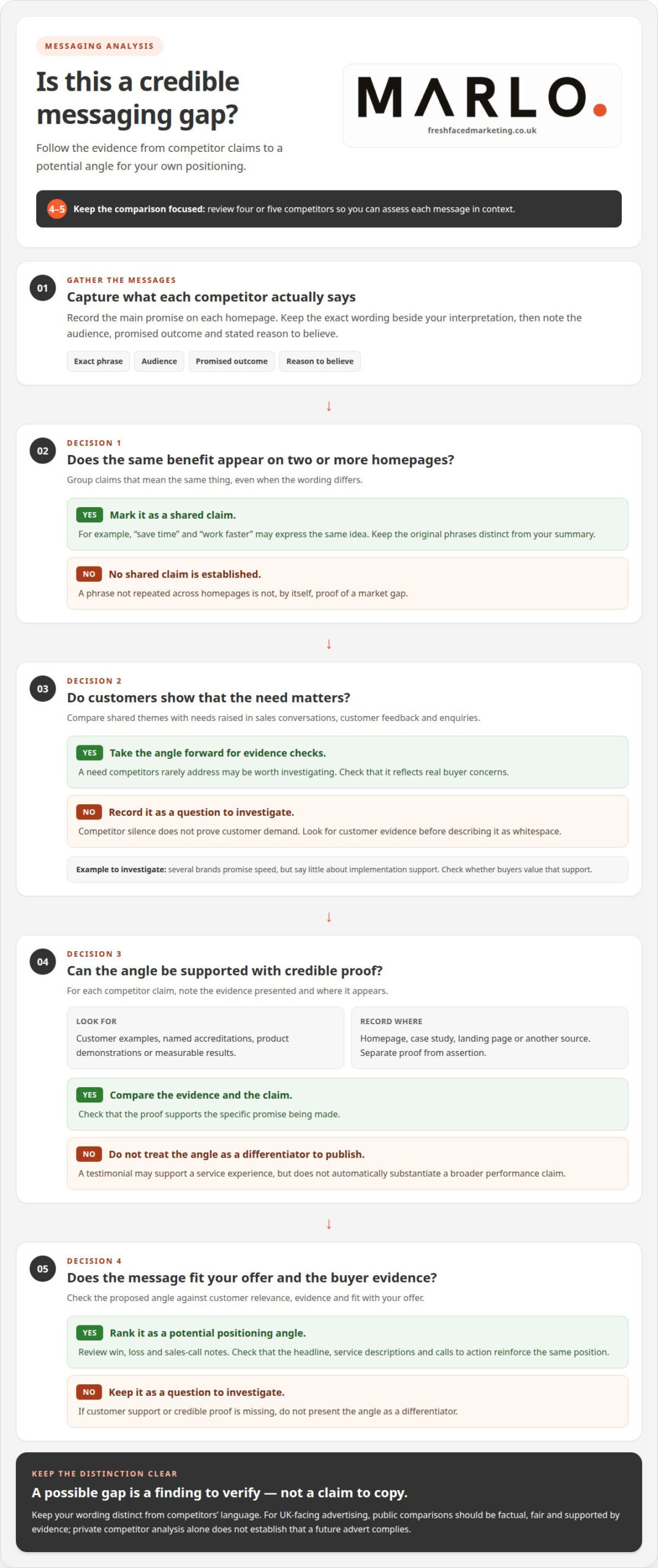
Use a focused comparison to separate repeated claims from credible opportunities. For UK-facing advertising, keep public comparisons factual, fair and supported by evidence. Private competitor analysis alone does not establish that a future advert complies.
-
Identify shared competitor claims
Record the main promise on each competitor’s homepage, then group claims that convey the same benefit. Treat a theme found on two or more homepages as a shared claim, even when the wording differs. For example, “save time” and “work faster” may express the same idea. Keep the exact phrases beside your interpretation to distinguish similar language from identical positioning.
-
Find messaging gaps and whitespace
Compare shared themes with the needs your audience raises in sales conversations, customer feedback and enquiries. A gap is a need competitors rarely address, not simply a phrase missing from their homepages. If several brands promise speed but say little about implementation support, investigate whether buyers value that support. Don’t treat silence as proof of demand; look for customer evidence before claiming whitespace.
-
Compare competitor positioning
Map each competitor’s audience, promised outcome and stated reason to believe. This can reveal positioning whitespace: a valuable combination that is weakly represented in the current landscape. Check whether each brand’s headline, service descriptions and calls to action reinforce one another. For example, a provider claiming to simplify complex work may muddy its position with jargon-heavy copy and competing promises.
-
Record competitor proof points
For every claim, note the evidence presented alongside it: customer examples, named accreditations, product demonstrations or measurable results. Separate proof from assertion, and record where it appears, such as a homepage, case study or landing page. A prominent testimonial may support a service experience, but it doesn’t automatically substantiate a broader performance claim. Compare the evidence, not just the confidence of the wording.
-
Check whether an angle is genuinely open
Keep the review to four or five competitors, then rank possible angles by customer relevance, evidence and fit with your offer. Ask sales teams whether a proposed message reflects real buyer concerns, and review win, loss and sales-call notes before using it in a headline. If an angle lacks customer support or credible proof, record it as a question to investigate, not a differentiator to publish.
Brands can also monitor emerging competitor themes, claims and campaign narratives to anticipate broader market shifts. In a Forbes survey, 46.67% of brands said standing out in a crowded marketplace remained a primary challenge.
What is competitor messaging analysis?
A useful framework records each competitor’s audience, positioning statement, brand promise, proof, source and intended action. Select competitors, capture their messages, compare the evidence and apply the findings. Watch for common risks: copying claims, treating assumptions as facts and mistaking a homepage slogan for a full strategy.
-
Assess positioning statements and promises
Start by recording what each competitor promises, who the promise addresses and which outcome it emphasises. Use the homepage’s main message as an entry point, then compare it with service pages, case studies and calls to action. A headline about reducing complexity, for example, should connect to the detail below it. Note the source and channel so a social post isn’t mistaken for the company’s core position.
Separate the stated promise from the evidence supporting it. A claim of specialist expertise may be backed by named experience, a detailed method or relevant customer examples. If the page offers no supporting proof, record that distinction rather than inferring the claim is false. This creates competitive intelligence based on what buyers can actually see.
-
Map competitors across value disciplines
Place each competitor against three value disciplines: operational excellence, product leadership and customer intimacy. Assess which discipline its messages most strongly convey, using service descriptions, product details and customer support language as evidence. A brand promoting streamlined delivery may lean towards operational excellence; frequent product innovation points towards product leadership. Tailored guidance may indicate customer intimacy.
Keep the map evidence-led. Companies should choose one market position and devote most resources to strengthening leadership in that discipline. Record a competitor’s secondary themes, but don’t treat every claim as an equal strategic priority. Compare each position with the audience it serves and the proof it presents. The aim is to understand the choices behind its messaging, not assign labels for their own sake.
-
Note common mistakes and risks
Check whether a competitor’s homepage, service pages and calls to action tell a consistent story. A headline promising simplicity alongside dense technical copy may create muddled positioning. Don’t count a phrase as a strategic promise without checking its context, and don’t assume an absent message means there’s no market demand for it. Those shortcuts turn observations into unsupported conclusions.
Keep your own claims distinct from competitors’ wording, and base any public comparison on substantiated evidence. Record assumptions separately from observed messages, then use audience feedback to test whether an apparent gap matters. For a structured view of evidence-led market research, connect the messaging findings with wider market signals before changing your position.
Comparing messaging analysis with competitor monitoring
Analysis explains what competitor messages may mean; monitoring records how they change. Use both to distinguish a strategic shift from a one-off update in the competitive landscape.
-
Distinguish analysis from monitoring
Start with messaging analysis: compare competitors’ current audiences, promises, proof and positioning. This creates a baseline for your strategy. Monitoring tracks subsequent changes against that baseline, such as a revised homepage headline or new campaign. One changed headline is an observation; a pattern across several channels may signal repositioning.
Keep the two tasks separate in your records. Note the exact date and page for a new claim, for example, then assess what it could mean in a separate field. This prevents an isolated update from becoming an unsupported conclusion about a competitor’s priorities or the wider market.
- Choose the signals that matter before tracking them. Record changes to competitors’ homepages, service descriptions, campaign themes, calls to action and proof points. A shift from “easy to use” to “built for specialist teams” may indicate a change in intended audience. Compare the new wording with the earlier baseline rather than interpreting it in isolation.
Log the channel, date, wording and apparent change for each observation. These details help distinguish lasting repositioning from a temporary campaign message. Keep direct observations separate from interpretation, and note whether the same theme appears elsewhere in the competitor’s communications.
-
Monitor messaging changes over time
Set a regular review rhythm and apply it consistently across the competitor set. Businesses should secret-shop competitors every 3-6 months to learn how they treat prospective buyers. Track visible changes between reviews, too. A new landing page, for instance, may reveal a different offer or audience before the home page changes.
Use the same categories at each review, such as audience, promise, evidence and call to action. Consistent records make comparisons more useful: teams can see whether a claim appeared once or became a repeated theme. Avoid changing categories mid-review, as this makes earlier and newer observations harder to compare.
- Bring observations into one shared record or marketing dashboard. For each change, capture what appeared, where and when it appeared, and what needs further interpretation. This gives the team a view of how competitor positioning evolves over time, rather than a collection of disconnected screenshots.
Review the log alongside your own campaign and customer evidence before adjusting strategy. If a competitor introduces a new promise, ask whether it reflects a broader market shift or a specific promotion. Monitoring helps identify the signal; analysis determines its relevance to your business and the next decision.
Counting words and phrases in competitor content
Use competitor websites, landing pages, social posts, adverts and sales materials as source material. A spreadsheet or messaging dashboard can record recurring words, calls to action, formats and publishing cadence. Counts help identify patterns, but context determines what they mean.
- Define what to count. Select a consistent sample, such as each competitor’s homepage, service pages and recent thought leadership. Record repeated phrases, audience labels, benefit statements and calls to action separately. A phrase such as “expert support” means little without its surrounding promise. Count meaningful themes, not every occurrence of common words such as “the” or “and”.
- Compare frequency with context. Note how often a claim appears, where it appears and which audience it addresses. If “simple implementation” appears in a headline, case study and advert, it may be a deliberate theme. If it appears once in a blog, it may not define the competitor’s positioning. Keep examples beside counts so the analysis remains traceable.
- Review calls to action and gated content. Capture the action each page invites, such as booking a demonstration, downloading a guide or requesting a consultation. Record whether a resource requires contact details, and compare its subject with the surrounding message. A competitor’s detailed implementation guide may help build authority, while a direct demonstration request signals a different next step.
- Assess content and thought leadership. Compare formats, subject matter and publishing cadence across articles, reports, webinars and social posts. Note whether a competitor repeats product features or develops a distinct point of view. For example, a series of practical guides may convey expertise more clearly than occasional product announcements. Analyse observable content choices to identify potential advantages, not to copy them.
- Turn counts into evidence-based findings. Summarise the top three claims and up to three proof points from each homepage, then compare them with other channels. Check whether repeated language matches the competitor’s case studies, customer stories and calls to action. Treat a high word count as a prompt for interpretation, not proof of market leadership or customer preference.
- Use a consistent recording method. A spreadsheet can capture exact wording, page, format, date and frequency; a dashboard can bring those observations together across competitors. Include owned, earned and paid media, alongside sales messaging where available. Keep observations distinct from interpretation, so a recurring phrase isn’t mistaken for a proven buyer priority.
Competitive messaging versus standard competitive analysis
Standard competitor analysis examines businesses, offers and market activity. Messaging analysis focuses on what competitors communicate, how they support it and what it signals about their positioning.
- Separate business facts from message interpretation. Start with observable information, such as products, channels and campaign activity. Then examine the claims used to explain those choices. A competitor may launch a new service; messaging analysis asks how its landing page frames the service’s value and intended audience. This distinction stops a list of business changes being mistaken for insight into positioning.
- Use messaging to understand market direction. Compare claims across owned, earned and paid media, alongside sales messaging where available. The language can show how competitors define value, which trends are gaining momentum, where they focus attention and how their positioning evolves. If several campaigns foreground convenience, assess whether the theme appears in landing pages and sales conversations too. Repetition across channels gives stronger context than one advert alone.
- Connect claims to commercial evidence. A messaging review should examine which themes appear to drive engagement, conversion and commercial performance. Compare the promise with the action each page invites, then consider whether available performance data supports your interpretation. For instance, a claim might attract attention but lead to a landing page that emphasises a different benefit. Treat that mismatch as a finding to investigate, not proof of campaign failure.
- Turn findings into a positioning decision. Standard analysis can inform choices about products, markets and channels; messaging analysis helps translate those choices into language for your audience. Organise findings in a messaging hierarchy, from core position to supporting claims and proof. Then use them to shape ideal customer profile messaging, a content roadmap and tone. Review homepage titles and alt tags too: they can reveal wording written for algorithms rather than customers.
- Apply the distinction before a launch. Use broader competitor analysis to understand the commercial context, then use message-level evidence to refine differentiation. Check whether your campaign promise matches the audience, landing page and proof. If the evidence points to a strategic change, connect the messaging findings with customer and internal performance data before prioritising action. Turn competitor findings into a marketing strategy that connects positioning with execution.
Competitive messaging and positioning analysis can examine owned media, earned media, paid media and sales messaging. This scope covers communication across those channels and sales interactions.
A competitor messaging analysis can use a messaging hierarchy to organise findings about competitors. Competitor marketing analysis can inform a company’s ideal customer profile messaging, content roadmap and tone.
Fresh Faced
Fresh Faced turns competitor messaging findings into evidence-led marketing decisions. If you need a clear view of competitors’ channels, claims and market opportunities, MARLO brings research together in an interactive dashboard. For deeper strategic interpretation, the Marketing Success Blueprint (MSB) adds human-led analysis and a detailed execution blueprint.
Choose your next step based on what you need: structured insight or strategic direction. Contact Fresh Faced to discuss how competitor messaging findings can inform your marketing strategy.
Turn your next message into a strategic choice
The next step isn’t to say more. It’s to decide what your business wants to be known for, then make that choice clear wherever customers encounter you. Use competitive messaging analysis to inform the decision and connect it to priorities your team can deliver. A distinctive position matters only when your marketing and customer experience can support it.
Bring the decision into planning before your next campaign, website update or sales initiative. Agree what the message needs to achieve, whom it must reach and what evidence will help you assess its impact. This gives your team a practical standard for making consistent choices instead of revisiting the same positioning debate whenever new work begins.
If you’re ready to shape your next strategic move, discuss your messaging with Fresh Faced. A considered position gives your team a clearer direction to build on.
Frequently Asked Questions
How is this different from competitor monitoring?
Competitor monitoring tracks observable changes; messaging analysis interprets their strategic meaning. For example, monitoring records a new product page, while analysis considers how its language reframes the offer or audience. Use monitoring to spot changes and analysis to decide whether they matter to your positioning. A change carries more weight when it appears consistently across a competitor’s website, campaigns and sales materials.
What is competitive messaging analysis?
It’s a structured review of how competitors describe their value, audience and reasons to choose them. Rather than judging a slogan alone, examine how claims appear across a website, campaign and sales material. For example, compare a promise of specialist expertise with the services, customer examples and language supporting it. The aim is to make better-informed positioning decisions, not reproduce another business’s wording.
How do you identify and compare competitors’ positioning, value propositions and tone of voice?
Use the same criteria for each competitor: intended audience, promised outcome, supporting evidence and writing style. Note whether the language is technical or plain, formal or conversational, and how directly it addresses the reader. Then compare the stated promise with the detail on service pages and in customer examples. A confident tone alone doesn’t establish a distinctive position; the message and its evidence need to align.
How do you build a messaging comparison matrix?
Create a table with one competitor per column and consistent categories down the side. Include audience, core promise, proof, tone, calls to action, content formats and channels reviewed. Add exact examples and their page or campaign source, then keep interpretation separate from observation. For instance, record a headline verbatim before labelling its theme. This makes disagreements easier to resolve and comparisons easier to update.
How can you identify gaps and opportunities in competitors’ messaging?
Compare recurring competitor themes with customer questions, sales conversations and reasons for choosing or rejecting an offer. A rarely mentioned topic is only a potential opportunity until buyer evidence supports its relevance. Ask sales colleagues whether the gap comes up in real discussions, then check whether your business can substantiate a message addressing it. This separates useful differentiation from a novel claim customers may not value.
How often should competitive messaging analysis be updated?
Review the messaging framework once a year, and monitor important changes between reviews. A secret-shop review every 3-6 months can reveal how competitors handle prospective buyers. Revisit the analysis sooner if a competitor changes its offer, launches a new campaign or shifts its intended audience. Keep the review schedule consistent, but focus extra attention on changes that could affect customer expectations or your positioning.