Growth is not proof of opportunity. A market opportunity analysis in the UK assesses whether genuine customer demand exists, what could support future growth and which strategic moves make sense. It turns market and competitor evidence into a clearer basis for deciding where to focus.
It’s reasonable to want more than a headline market-size estimate. A useful analysis connects potential audience size with customer needs, existing alternatives, competitive gaps and the practical barriers to reaching buyers.
This article explains how market opportunity analysis evaluates demand, assesses growth potential and informs strategic recommendations for UK businesses. You’ll learn what the process examines, how to interpret its findings and when to revisit the analysis as markets change. The aim is a sounder decision, not a forecast presented as certainty.
Key Takeaways
- Define the customer and market boundaries before estimating the opportunity; broad figures can hide differences in demand and competition.
- Assess market size alongside demand maturity and competitor activity to understand whether growth is realistically accessible.
- Use search behaviour and purchasing patterns as complementary signals, then interpret them in the context of customer needs.
- Turn the evidence into prioritised recommendations that account for your strengths, resources and barriers to entry.
- Revisit the analysis every 6-12 months to respond to market shifts and reassess where growth potential lies.
What is market opportunity analysis?
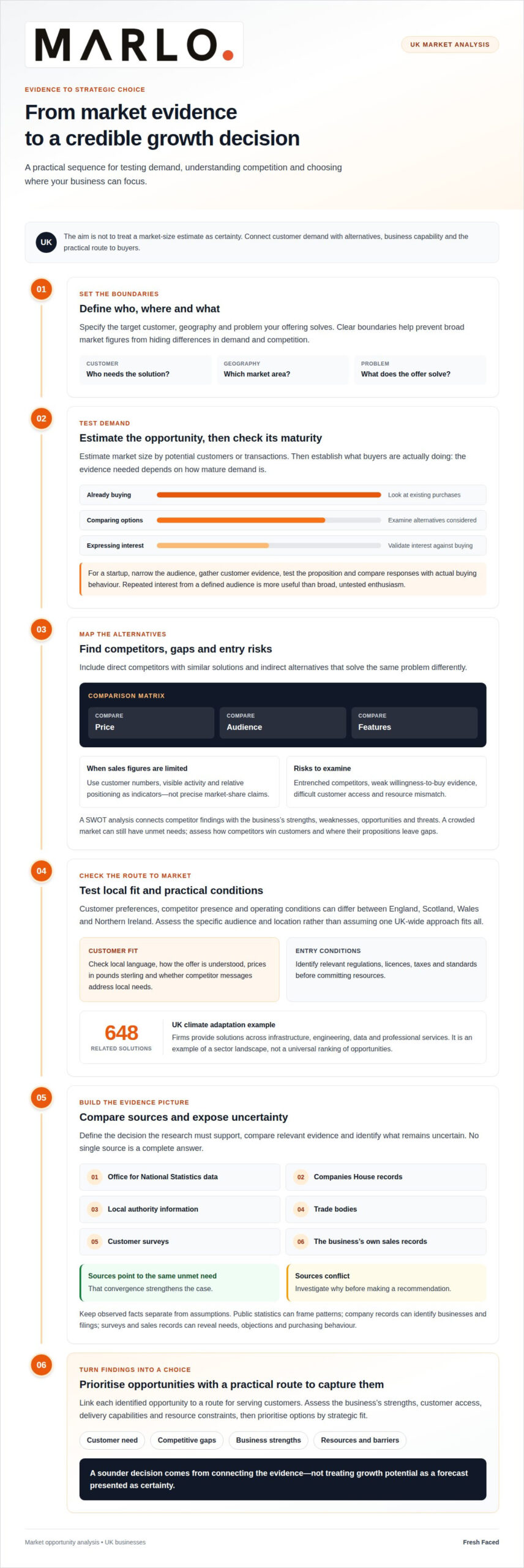
Market opportunity analysis tests whether demand, competitive conditions and business capabilities support a credible growth decision. In the UK, it compares potential customers or transactions with the practical route to serving them.
Market size and demand maturity
Start by defining the target customer, geography and problem your offering solves. Estimate market size by potential customers or transactions, then assess demand maturity: are buyers already purchasing solutions, comparing alternatives or only expressing interest? Each stage calls for different evidence. Competitor customer numbers and sales can help estimate opportunity when direct market data is limited.
For a startup, validation means narrowing the audience, gathering customer evidence, testing the proposition and comparing responses with actual buying behaviour. No single signal proves demand; repeated interest from a defined audience is more useful than broad, untested enthusiasm.
Competitive intensity and market share
Identify direct competitors offering similar solutions and indirect alternatives that solve the same problem differently. A comparison matrix can assess price, audience, features and estimated market share. When reliable sales figures are unavailable, use customer numbers, visible activity and relative positioning as indicators, not precise market-share claims.
Competition affects growth potential, but a crowded market can still have unmet needs. Assess how competitors acquire customers, what they emphasise and where their propositions leave gaps. A SWOT analysis connects those findings with the business’s strengths, weaknesses, opportunities and threats, helping prioritise viable responses.
Key entry risks include entrenched competitors, weak evidence of willingness to buy, difficult customer access and a mismatch between the offer and available resources. Their relative importance depends on the market and the business’s route to customers.
Language, currency and competitor messaging
Localisation means assessing how customers interpret the offer, not simply changing labels. Review whether prices are presented in pounds sterling, whether language suits the intended audience and whether competitor messages address local needs. In Wales, for example, Welsh-language communication may be relevant to particular audiences. The right approach depends on customer preferences.
Compare competitor claims, proof points and calls to action. This can reveal whether buyers prefer convenience, specialist expertise or a simpler option. For businesses entering another UK nation, test these assumptions with evidence from that audience rather than treating UK-wide messaging as automatically interchangeable.
Industry and regional opportunities
No single UK industry or region is strongest for every business. The best opportunity depends on customer need, competition, delivery capability and barriers to entry. Climate adaptation is one example: UK firms provide 648 related solutions across areas including infrastructure, engineering, data and professional services.
England, Scotland, Wales and Northern Ireland differ in audience composition, local demand, competitor presence and relevant operating conditions. Compare these factors for the specific sector before choosing a launch area. Regulations, licences, taxes and standards can also shape entry; identify the requirements relevant to the activity and location before committing resources.
For a market opportunity analysis in the UK, treat regional demand and competition as evidence to test, not assumptions to generalise. A focused niche can reveal market gaps and reduce direct competition, but only if its customer need and commercial potential hold up under scrutiny.
Strategic interpretation and growth recommendations
Strategic interpretation turns market evidence into choices about where to compete, how to enter and what to prioritise. UK research can draw on Office for National Statistics data, Companies House records, local authority information, trade bodies, customer surveys and a business’s own sales records.
Strategic market research
Useful market research combines evidence sources rather than treating any one dataset as a complete answer. Public statistics can help frame customer or sector patterns; Companies House records can identify businesses and company filings. Trade bodies add sector context, while customer surveys and sales records reveal needs, objections and purchasing behaviour.
Interpret each source in light of the decision it needs to support. For example, a company considering an international launch should assess local regulations, cultural differences, market growth, key players and barriers to entry. It should also test whether the offering fits local expectations. A broad market trend is not enough if intended buyers show little interest.
A practical research sequence is to define the decision, compare evidence and identify what remains uncertain. Then separate observed facts from assumptions. If several sources point to the same unmet need, that convergence strengthens the case. If they conflict, investigate why before recommending investment.
Auction strategy calls for the same discipline. Analyse how auction rules shape bidding incentives, participation and likely outcomes before advising on design. For example, a market review could compare eligibility criteria, bid evaluation and payment structure, then assess how each affects competition. The right design depends on the market’s objectives and participant behaviour, not on copying another auction.
Growth recommendations
Recommendations should link an identified opportunity to a practical route for capturing it. Assess the business’s strengths, customer access, delivery capabilities and resource constraints. Then prioritise options by strategic fit and the evidence supporting demand. An attractive market that is difficult to access may rank below a smaller, more reachable segment.
Strategic partnerships can address specific capability gaps. A business might seek a partner to manufacture, distribute, supply or co-develop an offering. Each arrangement affects control, delivery requirements and risk. The recommendation should explain what the partnership enables and how it supports the growth objective.
For international expansion, compare target countries before selecting an entry route. Examine local rules, cultural differences, established brands and barriers to entry. A proposition that works in one market may need adaptation elsewhere. This assessment helps distinguish transferable strengths from assumptions tied to the home market.
Finally, turn the preferred direction into sequenced actions, measures and decision points. Fresh Faced’s MSB provides human-led strategic interrogation of the evidence and a detailed execution blueprint. It suits leaders moving from analysis to an agreed plan, with priorities shaped around goals, budget and available resources.
Economics consulting and market analysis
Economics consulting connects customer evidence, sector trends and commercial decisions. For UK research, costs depend on scope, audience, methods and analytical depth, with a price provided after a quote request.
Consumer needs and market trends
Define the customer before collecting data. That choice sets the boundaries for useful research: a UK business selling specialist equipment, for example, needs insight from likely buyers, not broad public opinion. Surveys, team insights and market data can then reveal what customers value, where they encounter difficulties and how their needs shape purchasing decisions.
Market trends add context, but they don’t automatically prove demand for a particular offering. Separate observed changes from assumptions, then ask whether a change affects customer priorities, buying behaviour or access to solutions. If businesses report interest in reducing waste, for instance, research should establish which operational problem they want solved and what would prompt them to act.
Customer engagement can reveal differences between stated preferences and practical behaviour. Compare survey responses with customer conversations, sales records or recurring enquiries. If potential buyers praise a feature but repeatedly choose another benefit, that contrast matters. It gives the analysis a clearer view of the commercial landscape and helps distinguish a passing trend from a persistent need.
Market analysis can also test how external conditions influence the opportunity. A change in supply, customer expectations or sector practice may alter demand and competitive pressure. The useful question is not simply whether a trend exists, but which audience it affects, how it changes their choices and whether the business can respond effectively.
Consumer segmentation
Segmentation groups potential customers by characteristics that affect their needs or decisions. A buyer persona can combine personal and professional information, values, goals, challenges, habits and the places customers spend time. Customer surveys, team insights and market data help build these profiles, provided each detail informs a business decision.
For a business serving organisations, useful segments might differ by sector, purchasing role or operational challenge. For a consumer offering, groups may respond differently to price, convenience or product features. These are starting points, not fixed categories. Research should test whether each segment has a distinct need and a credible reason to choose the offering.
Next, compare segments by need, accessibility and commercial fit. One group may be large but difficult to reach; another may have a clearer problem and stronger alignment with the business’s capabilities. The analysis should show what evidence supports each choice, where uncertainty remains and which audience deserves priority.
Segmentation also sharpens research questions. Instead of asking whether customers generally like an idea, test how a defined group responds to its specific value proposition. Compare answers across relevant segments, then use the differences to refine messaging, product decisions or market focus. This turns broad customer insight into practical direction.
Estimating demand using search behaviour and customer purchasing patterns
Search behaviour shows what people actively seek, while purchasing patterns show what they choose. Combining both gives a more grounded view of demand and potential growth opportunities.
White-space and underserved customers
White space is a customer need that existing offerings address poorly or overlook. Search queries can expose it: people repeatedly seeking a specialist solution may struggle to find relevant options. That signal needs context. A query might reflect curiosity rather than purchase intent, so compare its wording with customer conversations and competitor propositions.
Look for gaps between what customers ask for and what available providers emphasise. For example, a small business may find plenty of general software but few tools suited to its specific workflow. The opportunity depends on whether that unmet need is important enough to influence buying behaviour and whether the business can serve it credibly.
Assess the target audience’s problem, current alternatives and reasons for switching. If existing customers describe the same unresolved issue, that pattern can strengthen the case for a focused offer. If the gap appears only in search data, further customer research is needed before treating it as a commercial opportunity.
Customer research and feedback
Customer research helps explain the intent behind search and purchase signals. Interviews can explore why buyers began looking, what they considered and what stopped them choosing an option. A survey can then test whether those themes appear across a wider target group. Each method answers a different question.
Compare search terms with the customer journey. Someone searching for “how to choose” may still be exploring, while a query naming a product type or specific requirement can suggest a more developed need. These are indicators, not proof of purchase. Check them against enquiries, sales conversations and recorded transactions.
Purchasing patterns reveal how demand behaves after interest becomes action. Examine which products customers select, what prompts repeat purchases and where prospective buyers abandon the process. For a subscription business, cancellations can point to a mismatch between expectations and delivered value. For a one-off purchase, reasons for choosing another supplier may be more informative.
Bring the evidence together rather than relying on a single metric. Search activity can indicate what people seek; customer feedback can explain why; transaction records can show what they actually buy. If these signals diverge, investigate the difference before committing resources. High interest paired with few completed purchases may point to pricing, access, trust or product-fit barriers.
Finally, translate findings into a testable decision. Identify the customer group, the unmet need and the evidence supporting demand. Then define what response would justify further investment, such as stronger enquiry quality or repeat buying. This turns market signals into practical choices without mistaking online attention for proven growth.
Benefits and timing of market opportunity analysis
Market opportunity analysis is most useful before a decision commits significant time, budget or operational capacity. For an initial launch, it tests whether the target audience has a clear need and whether the business can reach it. For expansion, it compares potential markets and entry barriers. In both cases, findings help leaders choose whether to invest, adapt the offer or delay action.
The benefit is sharper prioritisation. A business weighing several growth routes can assess each against customer demand, competitive conditions, internal strengths and delivery requirements. For example, a specialist supplier might compare expanding its existing range with entering a new customer segment. The stronger route is the one supported by evidence and aligned with the organisation’s ability to serve buyers.
Analysis also improves resource decisions. It helps teams identify which audiences, channels and propositions deserve attention, then connect those priorities to a practical plan. This matters when an organisation has several possible growth opportunities but limited capacity. Rather than spreading effort across every option, leaders can sequence initiatives and establish what evidence should guide the next decision.
Timing matters because markets change. Customer expectations shift, new competitors emerge and established brands adjust their propositions. Repeat the analysis every 6-12 months to keep strategic assumptions current. Review it sooner when a meaningful trigger appears, such as a new market-entry plan, a change in customer purchasing patterns or a competitor move that alters the basis of competition.
Use the findings as a decision tool, not a static report. At each review, compare the current position with the original assumptions: is the target audience responding as expected, are competitors changing their approach, and do planned actions still match available resources? If the evidence has shifted, update priorities and the sequence of work. If it remains consistent, retain the direction and focus on execution.
A clear review cycle also creates better decision points. Before expansion, assess the destination market and the capabilities needed to serve it. During entry, monitor customer response and competitor activity. After launch, compare actual engagement and purchasing patterns with the initial case. These stages help identify when to refine the offer, strengthen market access or reconsider the chosen route.
For a structured assessment tied to your next growth decision, discuss your strategic priorities.
Fresh Faced
Fresh Faced helps UK businesses turn market and competitor evidence into clearer growth decisions. MARLO brings market research, competitor analysis and a prioritised plan together in an interactive dashboard, with budget guidance. For decisions that need deeper strategic analysis, the Marketing Strategy Blueprint (MSB) develops the evidence into an execution blueprint shaped around your goals and resources.
When the direction is agreed and your business needs support putting it into practice, Fresh Faced’s Full Marketing Strategy Execution turns recommendations into action through ongoing strategic oversight. The right next step depends on whether you need evidence, strategic interpretation or implementation. Each meets a different need in the decision process.
Contact Fresh Faced to discuss the market opportunity you’re assessing and choose the support that fits your next decision.
Make your next growth decision evidence-led
A market opportunity analysis in the UK is most valuable when it changes a real decision. Before committing to a launch, expansion or new audience, define what you need to decide and what evidence would change your direction. This keeps the analysis focused on the choices ahead, rather than producing insight without a practical use.
Set a clear next step: identify the decision-maker, agree the priority and bring the relevant market questions into one conversation. Fresh Faced can connect market evidence with strategic direction, whether you need competitor insight, a considered plan or support putting the strategy into practice.
Explore your next strategic move with Fresh Faced. A clearer decision starts with a focused conversation, and can give your team a stronger basis for moving forward.
Frequently Asked Questions
What is environment analysis?
Environmental analysis examines external conditions that can affect a business, including economic, social, technological, political and competitive factors. For a UK childcare provider, for example, it could assess household needs, local alternatives, technology use and relevant policy changes. The purpose is to identify external opportunities and risks before they influence a commercial decision. It complements customer and competitor research but focuses on the wider conditions shaping the market.
What is market opportunity analysis and how is it conducted in the UK?
Market opportunity analysis assesses whether a business can meet a defined customer need in a commercially viable way. In the UK, a practical assessment defines the audience and geography, gathers market and customer evidence, examines competitors and entry conditions, then compares possible routes to growth. For example, a firm considering a new service could test demand with target customers before committing operational resources. The findings should lead to a clear decision and prioritised next steps.
What are the latest UK market size, growth and consumer spending statistics by sector?
There is no single current figure covering UK market size, growth and consumer spending across every sector. Each measure depends on the sector, category boundaries, reporting period and whether figures describe sales, output or household expenditure. For a reliable comparison, use the latest relevant Office for National Statistics series alongside sector-specific data, and check that periods and definitions match. A retail spending figure, for instance, cannot stand in for the size of the whole retail market.
How do UK businesses estimate market size, TAM, SAM and SOM?
Businesses estimate TAM as the total potential demand for an offering, SAM as the portion they can serve, and SOM as the share they can realistically capture. Define the customer, product and geography first. Then estimate potential buyers or transactions, narrow the figure to reachable segments, and account for competition and delivery capacity. For a specialist training provider, the relevant market might be organisations with a specific skills need, not every UK employer.
How do competitors, customer demand and pricing affect a UK market opportunity?
Competitors shape the alternatives customers can choose, while demand indicates whether the problem matters enough to prompt action. Pricing affects both customers’ willingness to buy and the business’s ability to serve them sustainably. For example, strong interest may not translate into sales if the offer costs more than buyers consider worthwhile. Assess why customers choose or reject alternatives, then judge whether the business can differentiate its offer at a viable price.