A sharper logo won’t resolve unclear positioning. A brand positioning framework for the UK helps you decide what a priority audience should associate with your business, relative to the alternatives, and what credible value supports that choice. It sets the strategic direction; it isn’t a visual identity or a slogan.
You may already know your business needs to stand out, but standing out for a clear reason matters more than simply sounding different. A value-based position connects what your audience genuinely needs with the value your business can deliver and prove, without relying on being the cheapest.
This guide explains what brand positioning means, how to build a framework around audience needs, competitor positions and credible strengths, and how brand strategy differs from brand identity. You’ll see how positioning informs the words, visuals and experiences that follow, so every part of your brand expresses the same underlying choice.
Key Takeaways
- Define the audience you serve, the alternatives they consider and the value your business can credibly offer.
- Build a position around a customer need that influences choice, not simply a claim that sounds different.
- Use competitor analysis to identify open market spaces, then test whether your business can genuinely serve them.
- Turn your strategic position into a clear guide for messaging, customer experience and marketing decisions.
- Keep strategy and identity distinct: strategy sets the direction, while visual and verbal elements make it recognisable.
What Is a Brand Positioning Strategy in Marketing?
A brand positioning strategy defines what a priority audience should associate with an organisation compared with its alternatives. For UK-facing claims, build on accuracy, evidence and clarity: substantiate factual statements, make comparisons fairly and keep qualifications visible.
-
Research audience psychographics and cultural alignment
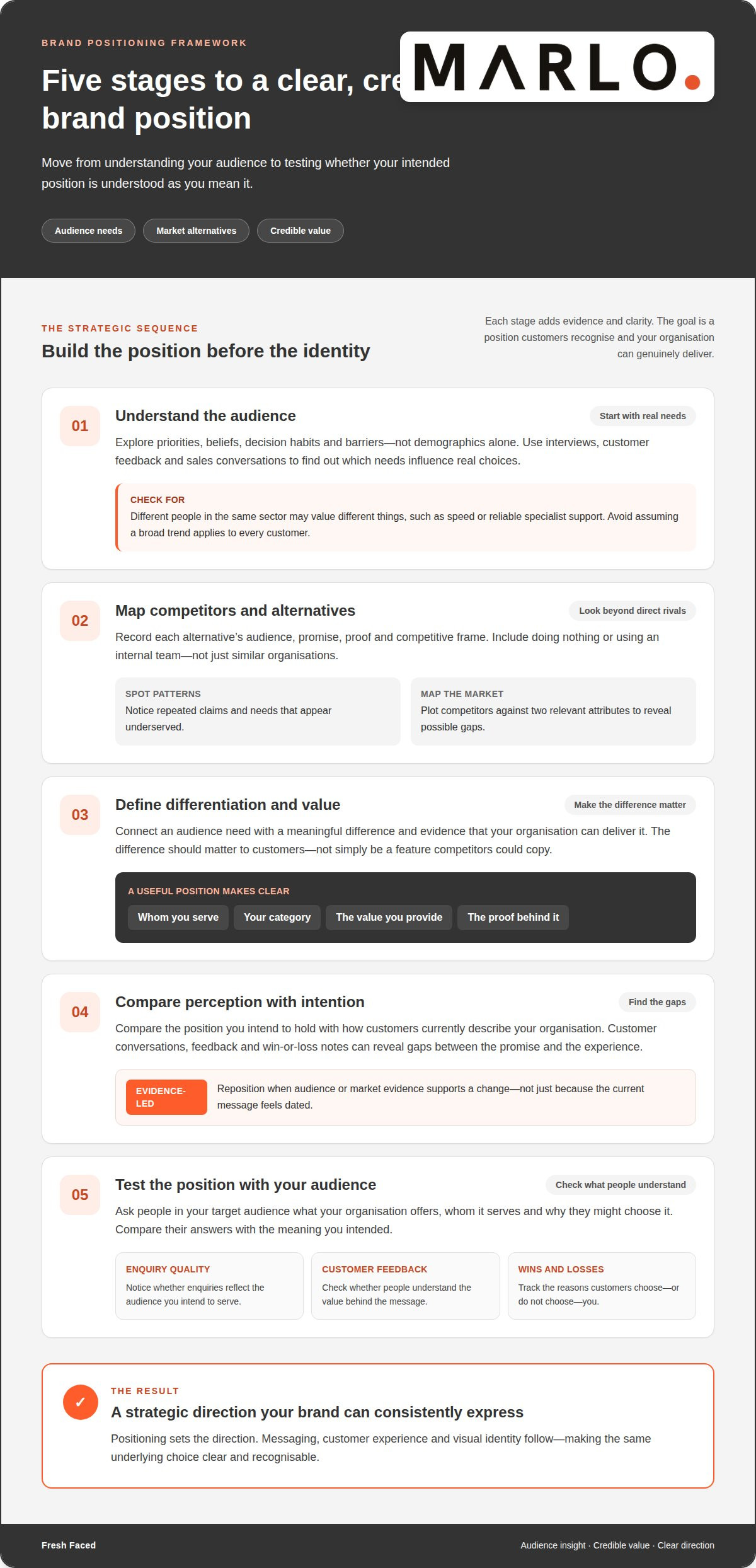
Define your target audience by examining its priorities, beliefs, decision habits and barriers, not demographics alone. Two UK business owners in the same sector, for example, may value different things: one may prioritise speed, while another wants reliable specialist support. Use interviews, customer feedback and sales conversations to check which needs influence real choices. Don’t assume a broad cultural trend applies to every customer.
-
Map competitors and their audience
List direct competitors and the alternatives your audience might choose, including doing nothing or using an internal team. Record each organisation’s audience, promise, proof and competitive frame. A leadership course, for example, may compete with coaching, an MBA or internal development, not just similar courses. Look for repeated claims and underserved needs. A perceptual map can plot competitors against two relevant attributes to reveal possible gaps.
-
Define differentiation and brand value
Connect three elements: an audience need, a meaningful difference and evidence that your organisation can deliver it. A useful position states whom you serve, the category you compete in, the value you provide and the proof behind it. Check that the difference matters to your audience and isn’t simply a feature competitors can copy. Don’t claim innovation or superior quality unless customers receive a genuine, demonstrable benefit.
-
Assess audience perception and repositioning needs
Compare your intended position with how customers currently describe your organisation. Use customer conversations, feedback and win-or-loss notes to identify gaps between the promise and the experience. A supplier shifting from serving large organisations to smaller businesses, for example, may need to clarify which needs it now prioritises, rather than simply changing its brand identity. Reposition when audience or market evidence supports a change, not just because the current message feels dated.
- Test the position with people in your target audience before applying it across campaigns. Ask what they think your organisation offers, whom it serves and why they might choose it. Compare their answers with your intended meaning, then track indicators such as enquiry quality, customer feedback and reasons for wins or losses. If people remember the wording but misunderstand the value, refine the position before changing the visual identity.
Value-based positioning
Value-based positioning makes an offer’s worth clear without relying on the lowest price. Build it around value your target audience cares about, recognises and can receive.
-
Distinguish positioning from a value proposition
Set your market position first, then define the proposition that expresses its value. Positioning establishes the distinctive place your organisation aims to hold relative to alternatives. The value proposition explains what it does and what tangible value customers can expect. For example, a bookkeeping firm might position itself around clearer financial decisions for growing businesses, then explain how its service helps clients achieve that clarity.
Keep the two connected, but don’t treat them as interchangeable. A position guides choices across messaging, service and customer experience; a proposition makes the benefit easier to understand when customers are considering their options.
- Choose a customer need that influences decisions, rather than one that merely sounds important. Examine what your audience prioritises when comparing options: reduced complexity, dependable expertise, speed or a better fit with its working practices. Then assess whether your offer delivers that value consistently. Relevance earns consideration; a distinctive angle helps customers remember why your organisation is different.
Value-based positioning isn’t about finding a clever phrase. It depends on evidence from customer conversations, sales discussions and service delivery. If customers ask for responsive support, for instance, that need matters only if your organisation can provide it reliably. Avoid promising a benefit your operations can’t support. The promise and the lived experience must match.
-
Define a unique value proposition
Write your value proposition as one plain sentence explaining what you do, whom you serve and why customers should choose you. A specialist accountancy firm could say it helps independent retailers understand cash flow through clear, sector-specific reporting. Each part should be specific enough to guide a customer’s choice, without relying on vague claims such as “excellent service”.
Test every phrase against customer evidence and your ability to deliver. Remove benefits customers don’t value, and replace unsupported superlatives with concrete proof. Your proposition needn’t claim that no other organisation offers a similar service. It must make your particular value clear and believable.
- Review your proposition when your offer, audience or market changes. Repositioning may be appropriate if customer priorities shift or your organisation develops a genuinely stronger way to meet a need. Keep the central value intact while it remains relevant, and adapt the language or supporting proof where needed. This avoids changing direction just for novelty.
For an impartial view of how market evidence can inform strategic decisions, explore Fresh Faced’s approach to marketing strategy. Use that evidence to sharpen the value you communicate, not to borrow another organisation’s claims or tone.
What does “brand positioning framework” mean in practice?
In practice, a framework connects your audience, competitive context, difference and proof. Use these steps to turn market evidence into a position that guides campaigns and your proposition.
-
Analyse competitors and the market
Map direct competitors and alternatives your audience could choose, including internal solutions or doing nothing. Record each organisation’s audience, promise and evidence, then identify claims repeated across the market. A leadership course, for example, may compete with coaching, an MBA and internal development. This broader view avoids a narrow comparison with similar providers alone. Check audience needs alongside competitor messaging, since a market gap matters only when it addresses a real customer priority.
-
Identify competitive points of difference
Compare your offer with the alternatives and identify differences customers can recognise and value. A useful point of difference might be specialist expertise, a more accessible service model or a distinct customer experience. Test whether it’s genuine, relevant and supported by evidence. Don’t present a standard feature as unique simply because competitors describe it differently. Your strongest competitive position links a specific audience need to a benefit your organisation can credibly deliver.
-
Compare commonly used positioning models
Choose a model that fits the strategic problem. Value-based positioning clarifies the worth customers receive; niche positioning focuses on serving a defined audience particularly well; problem-solution positioning presents the organisation as an answer to a specific issue. Quality-based positioning relies on recognisable, genuine quality. A perceptual map compares competitors across two attributes and can reveal potential market gaps. UK examples show repositioning in practice: Greggs broadened beyond a traditional bakery, while Boots expanded beyond pharmacy into health, beauty and self-care.
-
Create the positioning framework
Bring the evidence together in a short statement: for a defined audience, your organisation is a choice within a competitive frame, offering meaningful value backed by proof. Check that the audience, category, benefit and evidence agree. Then test whether people understand the proposition as intended, rather than just recalling its wording. Use the statement to guide campaigns, sales stories and customer experience. If your team explains the offer differently, refine the framework before using it across communications.
Benefits of clear positioning
Clear positioning gives your team a shared basis for decisions, from campaign priorities to customer experience. Use these five steps to connect promised benefits with what customers actually receive.
- Translate your position into customer benefits. Start with a feature, identify the practical outcome it creates, then clarify why that outcome matters. For a payroll provider, automated calculations are a feature; fewer manual checks are a functional benefit; greater confidence in payday accuracy is a customer outcome. This approach keeps messaging focused on value, not a list of internal capabilities.
- Build a benefit ladder from evidence. Move from a feature to its functional benefit, then to the customer’s emotional or organisational payoff. A delivery service might offer scheduled collections, helping a retailer manage dispatch more predictably and plan staff time with greater confidence. Check each link against customer feedback and actual service delivery. If the final benefit is only an aspiration, don’t present it as a dependable result.
- Use positioning to make your marketing decisions more selective. A clear position helps your team assess whether a campaign, partnership or new message reinforces the chosen value. For example, a consultancy positioned around practical guidance for growing firms could prioritise case studies showing useful decisions and outcomes. A campaign built around unrelated claims may attract attention, but it can blur the organisation’s intended perception. Consistency is a strategic choice, not repetition for its own sake.
- Align your visual and verbal identity with the benefit. If your brand promises straightforward service, use direct language, easy-to-follow navigation and legible colours across key touchpoints. These elements can help make the intended position easier to recognise. Check that the same promise appears in sales conversations, campaign materials and customer experience, not just in a polished brand presentation.
- Track whether customers understand and experience the intended value. Review enquiry quality, common reasons for choosing you, customer feedback and where expectations fall short. A specialist recruitment firm, for example, could assess whether enquiries reflect its chosen sector focus and whether clients describe the expertise it wants to be known for. Use those findings to refine messaging or delivery. A change in perception needs evidence, not just a new colour palette.
Brand strategy versus brand identity
Brand strategy sets the direction; brand identity makes that direction recognisable. Keep the sequence clear: decide what your organisation should mean before choosing how it looks and sounds.
- Define the strategic choices first. Record your audience, competitive position, value proposition and reasons to believe. These decisions explain whom your organisation serves, what value it offers and why customers should consider it. For a specialist recruitment firm, that might mean prioritising one sector and explaining the expertise candidates and employers gain.
Check that each choice is supported by your offer and customer evidence. A positioning statement can capture the direction in one or two sentences. It’s a decision-making tool, not a finished slogan or visual brief.
- Separate the strategy from its visible expression. Brand identity includes controllable elements such as the logo, colour palette, typography, tone of voice and visual systems. These elements help audiences recognise your organisation. They don’t establish its competitive position or explain why its offer matters.
For example, a confident typeface can’t make a general consultancy distinctive if its proposition and customer experience remain generic. Treat identity as the expression of strategic decisions, not a substitute for them.
- Translate strategy into messaging and behaviour. Use your position to shape the value proposition, key messages, sales stories and customer experience. A financial advice firm positioning itself around clear explanations should use plain language on its website, in proposals and in client conversations. Its service behaviour must also match that promise.
Check each touchpoint against the same strategic choice. If a campaign promises personal guidance but customers encounter an impersonal process, the gap weakens credibility. Your team needs a shared understanding of the promise and how to deliver it.
- Brief creative work with strategic criteria. Give designers and writers the audience, position, intended perception and proof points. Assess concepts against those criteria, rather than personal taste alone. For a family-focused service, the identity should support the intended sense of accessibility and trust while remaining distinctive in its competitive context.
Creative work matters, but it should solve a defined communication problem. Without that brief, discussions can become subjective debates about colour or style, disconnected from the value customers need to understand.
- Review the strategy before commissioning a rebrand. If your identity feels dated, first establish whether the underlying position still fits your audience and offer. A rebrand may be unnecessary if sharper positioning, messaging or brand architecture addresses the issue. Change the visual system when it obstructs recognition or no longer expresses the strategy.
Use this distinction to brief a strategy project or assess existing work. Get support aligning brand strategy and identity when the strategic direction needs clearer definition before creative decisions.
Fresh Faced: MSB (Marketing Strategy Blueprint)
Fresh Faced’s Marketing Strategy Blueprint (MSB) turns positioning questions into a practical marketing direction. It suits organisations that need more than competitor data: the work combines forensic competitive analysis across every channel with human-led strategic interrogation.
Fresh Faced develops a detailed execution blueprint that you can hand to any team or agency. The process includes direct access to the strategists behind the methodology, two one-to-one strategy calls and a two-to-three-hour strategy workshop. This can help your team interpret market evidence, make clear strategic choices and translate them into prioritised action.
Ready to discuss how the MSB could support your positioning work? Contact Fresh Faced.
Put your positioning to work
A brand position earns its place through the decisions it helps your organisation make. Use it to assess a new campaign, proposition or audience opportunity. If a choice doesn’t reinforce the value you want customers to recognise, pause and examine why.
A brand positioning framework for UK organisations should remain useful beyond the planning document. Bring it into team discussions, customer conversations and reviews of how your promise is delivered. These real-world signals can show where the strategy is clear and where the experience or messaging needs adjustment. Refine your position as the market and business develop, keeping changes grounded in evidence rather than taste alone.
Fresh Faced can help you decide what strategic support fits your next step, from clearer market insight to a plan for action. Discuss your brand’s next strategic step with Fresh Faced, and move forward with a position your team can apply with confidence.
Frequently Asked Questions
Brand Positioning vs Messaging: What’s the Difference?
Messaging is the language used to communicate a strategic choice; positioning is the choice that messaging must express. To check the distinction, give two colleagues the same positioning statement and ask them to draft a customer email. Their wording can differ, but the central meaning should stay intact. If each email gives a different reason to choose the organisation, clarify the strategic direction before polishing individual messages.
Is brand positioning only for large companies?
No. A small organisation can use positioning to decide which opportunities deserve attention and which don’t. A local trades business, for example, might assess whether to focus its next campaign on planned renovation work or urgent repairs. The decision can guide scheduling, sales conversations and the services it promotes. Positioning is useful whenever a business must choose whom it wants to reach and how to allocate its effort.
What Are the Signs Your Brand Positioning Is Unclear?
Look for recurring friction in decisions, not just inconsistent wording. Sales teams may struggle to explain why one lead is a better fit than another, or product discussions may swing between unrelated customer groups. Review recent proposals and lost-sale notes for competing explanations of the organisation’s value. If your team can’t use a shared rationale to prioritise work, the positioning may need clarification.
What are its benefits?
One practical benefit is faster decision-making. A clear strategic direction gives your team a consistent test for new proposals, partnerships and product ideas. Before accepting a sponsorship opportunity, for example, a business can assess whether its audience and association support the intended market role. This helps distinguish activity that advances business priorities from work that merely adds another task to the marketing calendar.
What is it?
Brand positioning is the place a business seeks to hold in its market relative to the alternatives customers consider. It isn’t simply the organisation’s preferred self-description. For example, a customer may compare a consultancy with an internal hire, a software tool or postponing the project. Understanding those alternatives gives the business a more useful basis for deciding what role it should occupy.
What is a brand positioning framework?
A brand positioning framework is a practical reference for applying strategic choices to business decisions. It helps a team assess a proposed service name, sales presentation or partnership before committing resources. For instance, a new service should make sense alongside the organisation’s existing offer and intended customer focus. The framework is most useful when teams consult it during planning, rather than creating it once and filing it away.
What are the key elements of a brand positioning framework?
Alongside strategic choices, include decision rules that help colleagues apply them consistently. Specify which customer opportunities take priority, what evidence supports claims and who reviews proposed changes. A training company, for instance, could require new course proposals to show a clear learner need and a credible route to delivery. These practical rules turn an abstract direction into a tool teams can use in planning and review.
How to research UK customer needs and competitor positioning?
Gather evidence from different points in the customer journey. Review sales enquiries, customer service themes, proposal questions and post-purchase feedback. For UK market context, separate findings by relevant audience or sector rather than assuming the same priorities apply nationwide. Compare those patterns with competitors’ public offers and language, then record where customer concerns appear poorly addressed. This helps distinguish a genuine opportunity from a difference that matters only internally.