What if the issue isn’t how much you’re spending, but where prospects stop moving forward? A marketing budget not converting doesn’t automatically need more money. It needs a closer look at the path from audience and message to website, enquiry and follow-up.
It’s frustrating when reports show clicks, impressions or activity but don’t explain why enquiries or sales aren’t keeping pace. The answer may lie in the channel, the offer, the website experience or the way results are measured. Changing one without evidence can leave the real problem untouched.
This article will help you identify where marketing loses momentum, what evidence to examine and how to prioritise your next steps. You’ll learn to follow the customer journey, distinguish a traffic problem from a conversion or measurement issue, and use the findings to shape a clearer plan for budget and channels. The aim isn’t to chase every metric or make a quick cut. It’s to understand what’s happening, decide what needs attention first and make your next investment with greater confidence.
Key Takeaways
- A marketing budget not converting can mask different issues, from limited reach to weak engagement, unqualified enquiries or sales lost later in the process.
- Check each stage of the conversion path, from audience and message to destination, action and measurement, to pinpoint where progress stalls.
- Compare reach, response, qualified enquiries and conversions using measures that reflect each channel’s role and your agreed business outcomes.
- Rank possible fixes by likely impact, evidence strength, effort and available resources, separating measurement repairs from wider marketing changes.
- MARLO provides competitor analysis and a strategic roadmap; the separate Marketing Success Blueprint adds human-led analysis and an execution blueprint.
Marketing budget not converting? Separate the symptom from the cause
A marketing budget not converting is a symptom, not a diagnosis. It means spend isn’t producing the measurable business response you intended. But that response must be defined first. Is the goal an enquiry, a qualified lead, a purchase or another agreed outcome? Without that definition, a report can show activity without revealing whether marketing is progressing towards a meaningful result.
Marketing activity is the work and attention generated by a campaign; a business conversion is the agreed action that moves someone towards a commercial outcome. Clicks, views and social engagement can indicate that people noticed your message. They don’t, on their own, show that the right people took the next step. Conversion marketing focuses on improving the likelihood that visitors complete a desired action, including by addressing their experience along the way.
What does a non-converting marketing budget actually mean?
Start with the gap between the activity you can see and the outcome the business needs. Then identify where the evidence changes. Low reach points towards visibility or distribution. Weak engagement may indicate that the message isn’t relevant enough to prompt a response. Enquiries that don’t meet your criteria suggest a mismatch in audience, offer or expectations. If qualified prospects don’t buy, the issue may sit later in the journey, such as the sales process or the decision itself.
These are different symptoms. Treating them as one problem can lead to the wrong fix. A conversion rate also needs context: compare like with like, over a relevant period, against your own agreed objective. An unsupported industry average won’t explain what is happening in your business.
Why more spend may not solve the problem
Additional investment can bring more people into the same journey. If the offer doesn’t meet their needs, the landing page makes the next step difficult, or the follow-up is delayed, extra traffic may expose those weaknesses rather than repair them. More clicks are not useful evidence of progress if the intended outcome remains out of reach.
Performance can also change as a campaign expands. The initial audience may be the most responsive; reaching further can bring in people with less interest or weaker fit. That can reduce the value of each additional pound, even if overall activity rises. It’s a reason to inspect the evidence before scaling, not proof that every campaign has reached a ceiling.
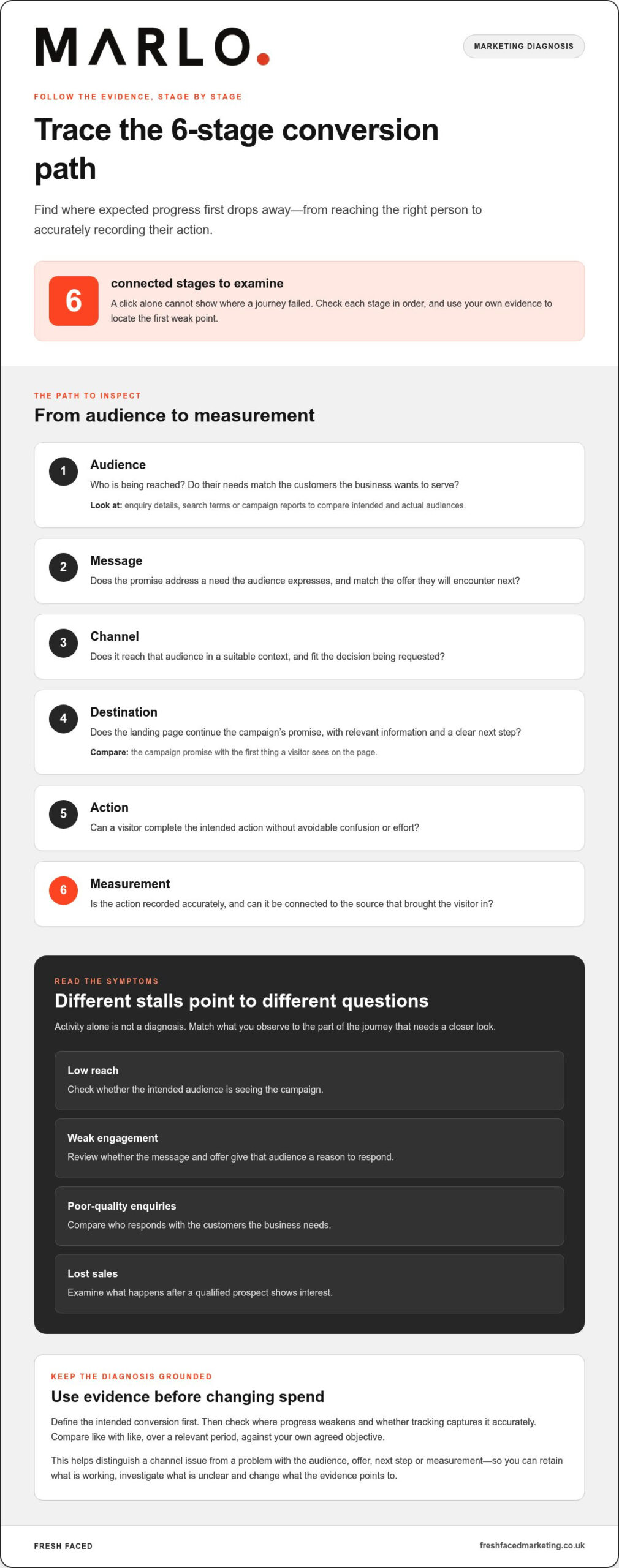
- Low reach: Check whether the intended audience is seeing the campaign.
- Weak engagement: Review whether the message and offer give that audience a reason to respond.
- Poor-quality enquiries: Compare who responds with the customers the business needs.
- Lost sales: Examine what happens after a qualified prospect shows interest.
Don’t pause a channel or increase its budget on activity alone. First confirm the intended conversion, then check where progress weakens and whether the tracking captures it accurately. The evidence will help distinguish a channel issue from a problem with the audience, offer, next step or measurement. That makes the next decision more proportionate: retain what’s working, investigate what’s unclear and change what the evidence points to.
Trace the conversion path to find where marketing loses momentum
Conversion diagnosis follows the whole customer journey because a result depends on connected stages, from reaching the right person to recording the action they take. A click alone can’t tell you where the journey failed. Trace each step in order, and use evidence to locate the first point where expected progress drops away.
Check audience, message and channel alignment
Begin with who the campaign intends to reach and what it promises them. Compare the audience definition with available evidence about who is actually responding, such as enquiry details, search terms or campaign reports. Then check whether the message addresses a need that those people express. A mismatch here may produce attention without relevant interest.
Competitor search visibility and content can help you understand the wider market: which topics attract attention, what questions are being answered and where alternative offers appear. Digital marketing specialists such as kdinteractive.com highlight how refining local search targeting can help small businesses capture relevant demand from the outset. Treat this as context, not evidence of your own campaign’s performance. Your own response and enquiry data must show whether your audience is engaging.
- Audience: Who is being reached, and do their needs match the customers the business wants to serve?
- Message: Does the promise reflect the audience’s concerns and the offer they’ll encounter next?
- Channel: Does the channel reach that audience in a suitable context, and is it appropriate for the decision being requested?
- Destination: Does the landing page continue the campaign’s promise, with relevant information and a clear next step?
- Action: Can a visitor complete the intended action without avoidable confusion or effort?
- Measurement: Is that action recorded accurately, and can it be connected to the source that brought the visitor in?
Inspect the destination and the next action
Compare the campaign promise with the first thing a visitor sees on the destination page. If an advert promotes a specific service but leads to a broad homepage, the person may have to search for what they expected. Check whether the page answers the questions raised by the campaign, whether key information is easy to find and whether the call to action says clearly what happens next. Web design specialists such as Marcy Design emphasise that intuitive, mobile-optimised layouts are essential for ensuring visitors navigate smoothly towards that next step.
Distinguish a visit from a completed action. A healthy volume of clicks alongside few completed enquiries may point towards the page, the offer or the action required. If visitors complete the action but enquiries are unsuitable, revisit the audience and message. If the page appears to work but records show gaps, investigate measurement before changing the campaign.
Look for the earliest stage where evidence weakens, then compare it with the stages before and after. That helps distinguish a channel issue from a landing-page problem: if the audience is relevant and engages with the message but leaves at the destination, review the page and offer before ruling out the channel. A structured marketing strategy approach can help connect these decisions to the wider plan.
Compare performance evidence before reallocating the marketing budget
Once you’ve mapped the journey, compare evidence across channels and stages before deciding where the budget should go. A high impression count and a qualified enquiry are not equivalent results. Each measure answers a different question, so the comparison needs to show both what happened and how confidently you can interpret it.
Channel comparisons are meaningful only when they use consistent definitions of the intended business outcome. Agree what counts as a response, a qualified enquiry and a conversion, then apply those definitions consistently. Otherwise, a channel can appear stronger simply because its results are counted differently.
Which indicators help explain weak conversion?
Read the measures in sequence. Impressions and reach indicate exposure; clicks and engagement indicate a response. Enquiry records can show whether that response is relevant, while sales progression may reveal what happens after an enquiry. These metrics describe different stages. A rise in engagement doesn’t prove that enquiry quality or sales have improved.
Where records are incomplete, mark the gap rather than filling it with an assumption. For example, if enquiries can’t be connected to their original source, the business may know that leads arrived but not which channel contributed to them.
How to compare channels without false certainty
Judge each channel against its intended role, audience and conversion path. A channel designed to build awareness shouldn’t be assessed only by immediate sales; a channel intended to generate enquiries needs evidence tied to that goal. Keep the comparison period and outcome definitions consistent, and note where a customer may have encountered several channels before acting.
If tracking is missing or inconsistent, treat that as a measurement finding, not proof that the channel failed. For a business with a marketing budget not converting, that distinction matters: reliable evidence can support a reallocation, while uncertain attribution may call first for clearer measurement.
Turn the diagnosis into a focused marketing budget recovery plan
A useful diagnosis should lead to a small number of decisions, not a longer list of possible fixes. Rank each action by likely business impact, strength of evidence, effort required and the people or budget available to deliver it. This makes the plan practical as well as evidence-led. A potential high-impact change supported by clear evidence may take priority over a quick adjustment based mainly on assumption.
Separate measurement repairs from changes to marketing itself. If enquiry sources aren’t recorded consistently, improve that visibility before using channel comparisons to move investment. If tracking is sound and evidence points to a mismatch between the audience and offer, plan a focused test or change. Root causes can sit in the measurement, channel, audience, offer or website, so match each action to the evidence rather than applying a blanket budget cut.
Choose the first actions, not every possible action
Group findings into three practical categories: fix now for clear issues that prevent reliable measurement or block a next step; test next for plausible changes that need a controlled comparison; and investigate further where the evidence is incomplete. Keep the first action list short enough for the team to deliver, then record the evidence behind each recommendation.
- Fix now: Repair a broken enquiry form or correct inconsistent source recording if checks confirm either problem.
- Test next: Compare a revised message or landing-page offer with the current version if response data suggests a relevance gap.
- Investigate further: Gather more information before changing a channel if tracking cannot show whether it contributes to qualified enquiries.
For each chosen action, specify an owner, the intended outcome and a review point. For example, the owner might be responsible for improving a form, with completed enquiries as the outcome measure. Set the review point to allow the change to be implemented and enough relevant evidence to be collected. The right interval will depend on the activity and the volume of meaningful responses, so avoid imposing an arbitrary deadline.
Set a review rhythm that supports decisions
At review, compare results with the intended outcome, not just the visible activity. If the measure improves but the business outcome does not, revisit the assumption behind the action. If the evidence remains too limited, continue the test or investigate the gap. A broader marketing strategy roadmap can help connect these choices to wider goals, priorities and available resources.
Use the review to decide whether to maintain, test, reallocate or pause investment. Maintain it where the evidence supports its role; test a specific change when the cause is plausible but not established; reallocate when comparable evidence shows a better use elsewhere; and pause when a confirmed issue makes continued activity unproductive. A marketing budget not converting calls for a considered response, not automatic cuts. For help turning diagnosis into practical priorities, build a clearer marketing plan.
Use MARLO or the Marketing Success Blueprint to build the next step
Once you’ve identified where progress stalls, the next question is what evidence can guide your strategic choices. MARLO and the Marketing Success Blueprint (MSB) support that work in different ways. MARLO is competitor-research software with a strategic roadmap. The MSB builds on that analysis through human-led investigation and planning. Neither replaces checking your own campaign tracking and conversion records.
What MARLO contributes to a marketing budget decision
MARLO analyses competitors across search, content, social and paid media. Its interactive dashboard can show where competitors rank in search, which content attracts traffic and engagement, how they use social platforms, and what paid campaigns are active. This gives you market context for considering opportunities and gaps before committing budget or resource.
MARLO’s strategic roadmap prioritises options against your goals, budget and available resource. It helps organise potential choices into a clearer direction. It doesn’t measure your own campaign conversions or establish where your customers leave your website, so use your internal performance evidence for that part of the diagnosis.
If competitor evidence would help inform your next strategic decision, explore MARLO competitor analysis and its roadmap capabilities.
When the human-led Marketing Success Blueprint is relevant
Some teams need more than a structured view of competitor activity. The premium, human-led MSB adds forensic competitive analysis across channels and strategic interrogation of the data. The aim is to examine what the findings mean for your business, then shape recommendations into a detailed execution blueprint that can be handed to a team or agency.
The MSB also includes direct access to the Fresh Faced strategists behind the methodology, two one-to-one strategy calls and a two-to-three-hour workshop. It’s a distinct service from MARLO: the software provides competitor analysis and a strategic roadmap, whilst the MSB adds human-led interpretation and execution planning.
For a business with a marketing budget not converting, the choice depends on the next step needed. If you want competitor evidence and prioritised options to inform planning, MARLO may be the relevant starting point. If you need strategists to interrogate the analysis with you and develop a more detailed execution blueprint, consider the MSB. In either case, combine that strategic perspective with your own campaign and sales evidence before changing investment.
Explore the Marketing Success Blueprint to see how human-led analysis and an execution blueprint can support your next marketing decision.
Make your next marketing decision with greater confidence
If your marketing budget not converting, treat the uncertainty as a reason to investigate, not an instruction to spend more or stop altogether. Your next step is to turn what you’ve learned into a decision the team can act on, then review it against the business outcome that matters. Keep the plan grounded in evidence, with clear priorities and ownership.
Where competitor context would help shape that plan, MARLO brings research into an interactive dashboard and organises potential directions around your goals, budget and resources. If you need deeper human-led interpretation, the separate Marketing Success Blueprint offers a more involved strategic process. Choose the level of support that fits the decision ahead.
Explore how MARLO turns competitor research into a clearer marketing roadmap. A more informed next step can help you move from uncertainty towards a marketing plan your team can put into practice.
Frequently Asked Questions
Is a marketing budget not converting always a sign that I should spend less?
No. Poor conversion alone can’t show whether a budget is too high or too low. A marketing budget not converting may reflect measurement problems, audience fit, the offer, channel choice or the destination. For example, relevant visits may be reaching a form that records submissions incorrectly. Check the journey and data first. Then decide whether to maintain, test, reallocate or reduce investment based on what the evidence supports.
Can more marketing spend improve conversions?
It can increase exposure, but it won’t automatically fix weak targeting, unclear messaging or a difficult next step. If a channel and its conversion journey are already working, a controlled increase may be worth testing. Set a clear limit and outcome measure first. If the cause of weak results is still unknown, extra investment can make it harder to tell whether the problem lies in the campaign, the offer or the experience after the click.
How long should I wait before deciding a marketing campaign is not converting?
There isn’t a universal number of days or clicks that suits every campaign. Choose a review point based on the sales cycle, objective, conversion volume and reliability of tracking. For a short buying journey, completed enquiries may provide a useful signal; for a longer one, monitor meaningful progress such as a sales-qualified conversation. Decide these measures before launch, so you can distinguish a recurring issue from normal fluctuation.
What happens if my marketing reports show clicks but no enquiries?
Clicks show that someone responded to an advert or piece of content, not that they completed the intended action. Check that the destination delivers what the campaign promised, the next step is easy to find and any form or booking process works. Confirm that enquiry tracking records submissions correctly. Then assess whether the audience and offer fit. A channel shouldn’t be written off until you’ve checked the full journey.
Can attribution make a marketing channel look like it is not working?
Yes. If someone sees a social post, later searches for your business and then enquires, a last-click report may credit search alone. That doesn’t prove the earlier interaction had no influence. Compare attribution reports with enquiry or sales records and, where possible, ask new customers how they found you. State what the reporting method can and can’t show, then treat channel credit as one part of the evidence.
What should I do when there is not enough data to identify the problem?
Start by checking whether key actions are being recorded reliably. Then define one outcome and run a focused test, changing a single element such as the audience or message so the result is easier to interpret. Record the reason for the test and when you’ll review it. If evidence is still limited, label your conclusion as provisional. That keeps an early indication from becoming an unsupported claim about performance.
Should I pause a campaign that has not generated sales yet?
Not necessarily. Sales may take time, so check the campaign’s objective and whether it is producing useful progress, such as relevant conversations or qualified enquiries. Review lead quality and confirm that sales are being attributed accurately. If evidence points to a clear mismatch or a practical issue, adjust the campaign. If the picture is inconclusive, use a defined test. Don’t continue simply because you’ve already committed budget.