The channel with the weakest short-term results isn’t automatically the one to cut. It may support a longer buying journey or build demand that shows up elsewhere. To understand how to stop wasting marketing budget, trace spend back to evidence and business outcomes, rather than relying on a single report or platform metric.
If your budget is spread across channels, reports show activity without making performance clear, and there’s pressure to reduce costs, cutting investment across the board is unlikely to solve the problem. First separate avoidable waste from activity that may still support future growth. That means setting clear goals, choosing relevant measures and being honest about what the data can and can’t tell you.
This guide sets out a practical way to review your marketing spend. You’ll learn how to spot common sources of waste, assess longer-term investment fairly and prioritise what to change first. The process is straightforward: connect activity to outcomes, investigate the gaps, then reallocate where the evidence supports it.
Key Takeaways
- Learn how to stop wasting marketing budget by linking each spend line to an audience, intended action and business outcome.
- Separate avoidable spend from activity whose contribution may be indirect, delayed or difficult to attribute.
- Use a four-step diagnostic to assess objectives, map spend, inspect evidence and decide whether to retain or change activity.
- Compare blanket cuts with targeted reallocation by weighing strategic fit, evidence quality, opportunity cost and available resources.
- Build a staged budget reset, with priorities and follow-up decisions informed by evidence. MARLO can support this with competitor analysis, a strategic roadmap and budget and resource guidance.
How marketing budget waste happens – and why it is not always obvious
Marketing spend becomes difficult to judge when the purpose of each activity is unclear. A campaign may generate clicks, a content programme may attract visitors and an event may produce conversations. These signals show activity, but they don’t establish whether it supports a business objective.
A useful starting point for understanding how to stop wasting marketing budget is to distinguish a weak rationale from an uncertain result. If nobody can explain what a budget line is meant to achieve, it deserves scrutiny. If its purpose is clear but the result hasn’t appeared in the available data, investigate before deciding to cut it.
What does wasted marketing budget actually mean?
Wasted marketing spend is avoidable expenditure with no credible connection to a stated business objective. This definition focuses on the reason for spending, not simply whether a campaign has already produced a sale. An activity can be inefficient, but it can also be a valid investment whose short-term return is not yet proven.
Consider a paid campaign that reports a high number of clicks. If the objective is qualified enquiries, clicks are only an early signal. Check whether the right audience arrived, whether visitors took a relevant action and whether the resulting enquiries fit the business’s needs. A high lead count may still represent poor performance if the leads are outside the target market or unlikely to progress. Ensuring that campaigns focus on tangible commercial outcomes rather than surface-level figures is central to the approach taken by Big Voice – Digital Marketing Agency when managing paid media.
Waste is harder to spot when objectives are broad, measurement varies between channels or recurring activity continues without review. A campaign might be labelled “awareness” without defining what evidence would show progress. Reports can then reward visible activity, such as impressions or engagement, while leaving the business outcome unexamined. These measures can be useful, but only when their role in the decision is clear.
Why can marketing spend look wasteful when it is not?
Some marketing contributes indirectly or over a longer period. A prospective customer might encounter a brand through an article, return through search, attend an event and later respond to a sales conversation. A last-click report may credit only the final interaction. That makes attribution incomplete, but it doesn’t prove earlier activity had no influence.
Different activities also perform different jobs. Brand activity can build recognition—whether through tangible merchandise from suppliers like BRAND NEW Promotions | Top Promo Supplier in North Texas or wider awareness campaigns; demand creation can help prospective customers understand a need; conversion activity can prompt people already considering a purchase to act. Judging all three by immediate enquiries can distort the picture. Assess each against its intended outcome and a review period suited to how that outcome is expected to develop.
Before cutting spend, record the objective, the measure that best reflects progress, the evidence available and when it will be reviewed. If the connection between activity and outcome is unclear, identify what information is missing. That gives you a fairer basis to retain, adjust or stop activity, rather than relying on one short-term metric.
How to diagnose marketing budget waste with evidence
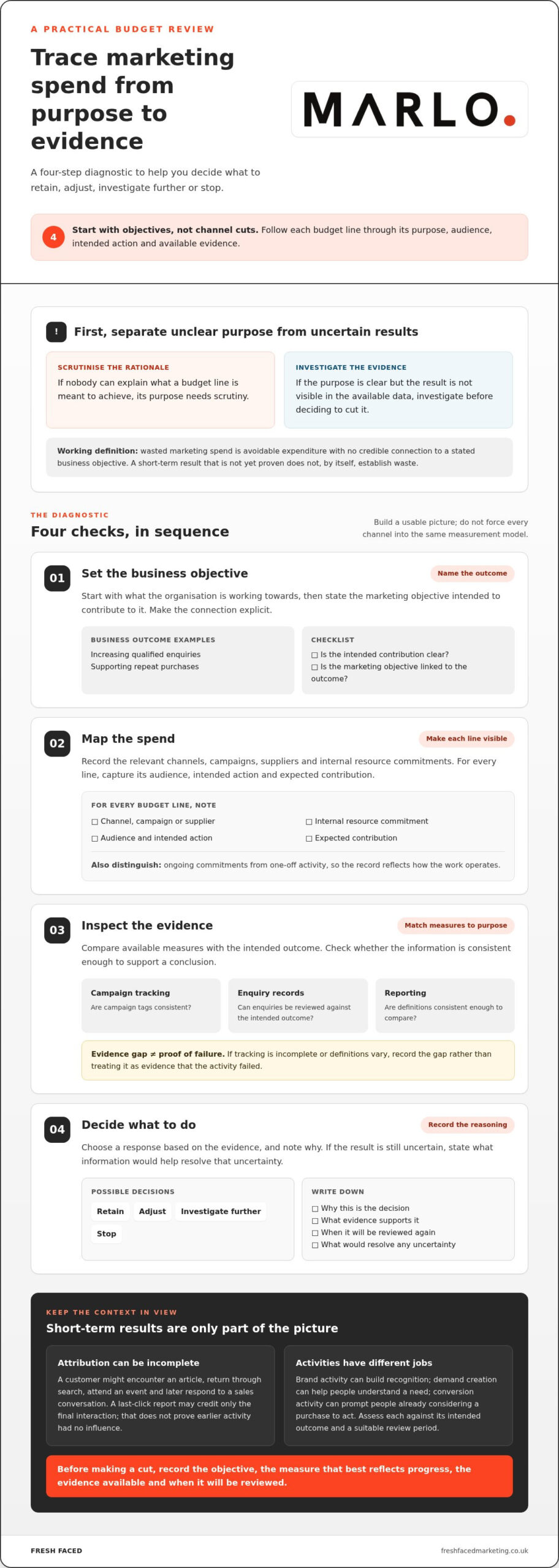
Begin a budget review with objectives, not channel cuts. This keeps the investigation focused on what the business needs to achieve, rather than which activity looks easiest to remove. To understand how to stop wasting marketing budget, trace each line of spend from its purpose to the available evidence, then make a decision that accounts for both.
How do you trace spend from objective to outcome?
Work through the review in sequence. The aim is to build a usable picture, not force every channel into the same measurement model.
- Set the business objective. Start with the outcome the organisation is working towards, such as increasing qualified enquiries or supporting repeat purchases. Then state the marketing objective intended to contribute to it. Make the connection explicit.
- Map the spend. Record each relevant channel, campaign, supplier and internal resource commitment. For every line, note the audience, intended action and expected contribution. Separate ongoing commitments from one-off activity to reflect how the work operates.
- Inspect the evidence. Compare available measures with the intended outcome. Check whether campaign tagging, enquiry records and reporting are consistent enough to support a conclusion. If tracking is incomplete or definitions vary, record an evidence gap, not proof that the activity failed.
- Decide what to do. Retain, adjust, investigate further or stop the activity. Record why, what evidence supports the decision and when you’ll review it again. If the result remains uncertain, define what information would help resolve that uncertainty.
For example, a paid campaign might target a defined audience and aim to generate relevant enquiries, while a content programme is intended to help potential customers research a service. Assess the campaign against enquiry quality and the content against measures suited to its role. For both, note whether the activity can be connected to later business outcomes.
Which evidence helps you decide what to review first?
Use sources that match the activity. Search data can reveal which queries bring visitors and where opportunities may be missed. Content reporting can show which pages attract relevant attention. Social data can help assess audience response and repeated effort. Paid campaign records can indicate whether targeting, spend and outcomes align with the original objective.
Look for three things: opportunities your current activity isn’t capturing, activity that falls short of its intended measure and duplicated work across channels or teams. Treat each as a lead for investigation, not an automatic instruction to cut. First check that the data covers the right audience, period and outcome. Incomplete tracking can make sound activity appear ineffective, while an impressive platform metric may not answer the business question.
For a wider view of how evidence can inform marketing choices, explore Fresh Faced’s evidence-led marketing strategy. A disciplined review distinguishes what the data shows from what it cannot yet establish, giving you a more reliable basis for the next decision.
Marketing budget cuts versus reallocation: how to tell the difference
A cut removes spend. Reallocation moves it towards a different activity or priority. The distinction matters: reducing a channel may lower expenditure, but it can also remove useful support from the wider marketing plan. A sound decision weighs strategic fit, evidence quality, opportunity cost and the resources needed to act.
Change investment when the evidence and strategic fit support the decision. Weak measurement is a reason to investigate, not proof that the activity should stop. Separate what you know from what remains uncertain before deciding.
When should a business reduce, pause or retain spend?
Use the options below to frame the decision. They are prompts for assessment, not automatic rules. The right choice depends on the activity’s role and the quality of the available evidence.
Reduce or pause: The activity has a weak connection to current priorities, credible evidence shows it isn’t contributing as intended, or the resources required outweigh its likely value. Before stopping it altogether, consider whether a smaller test or adjustment would answer an important question.
Retain: The activity has a clear strategic role, and removing it could undermine another priority, even if short-term attribution is limited. Set a suitable review point and define what evidence would indicate progress.
Investigate: Tracking is incomplete, reporting is inconsistent or the intended outcome can’t be assessed with the available information. Treat the measurement gap as a separate action, not poor performance by default.
This approach helps avoid a common mistake: treating missing evidence as negative evidence. If a campaign’s results can’t be connected to the intended outcome, first determine whether the issue lies in the activity, the measurement or both.
How can reallocation protect useful marketing investment?
Compare each possible use of the budget against the organisation’s goals, available funds and delivery capacity. A promising opportunity may still be unsuitable if the team lacks the time or skills to execute it well. Include internal effort and external commitments in the assessment, not just the channel budget.
Opportunity cost matters too. Moving spend from an established activity to a new channel means giving up whatever the current activity might contribute. Equally, maintaining every channel can spread investment too thinly to support any priority effectively. Focus on options with a clear role and a workable plan, rather than dividing funds evenly just to maintain a presence.
- Strategic fit: Does the option support a current business priority?
- Evidence quality: Is the case based on relevant, consistent information, or does it need further testing?
- Opportunity cost: What contribution might be lost by moving the investment?
- Available resource: Can the work be delivered with the people, budget and time available?
Broader prioritisation can turn these comparisons into a coherent plan. Fresh Faced’s marketing strategy approach connects choices with goals and available resources. Apply the same discipline to your review: decide what to protect, what to test and what to redirect before making cuts. That’s a practical foundation for how to stop wasting marketing budget without removing investment that still serves a purpose.
What to do first: a practical marketing budget reset
A useful reset doesn’t start with a target percentage to cut. Start by establishing what marketing needs to support, then decide which evidence and actions will help the business make sound choices. This sequence keeps the review manageable and separates a quick operational tidy-up from decisions that need deeper analysis.
Which marketing budget actions should happen first?
First, agree the business priorities and the outcomes marketing is expected to contribute to. Then gather current information, including spend, activity, reporting and the people or suppliers needed to deliver it. Research into customer needs and the market can add context by helping you test whether planned activity is aimed at a relevant audience and opportunity.
Sort findings into distinct categories. Avoidable duplication, inactive activity and missing measurement are different issues, so they need different responses. Rank potential actions by strategic relevance, confidence in the evidence and resources required. A high-priority action should matter to a business goal, have a credible basis for change and be practical to carry out.
How should you review changes without overreacting?
Record the decision, evidence needed, owner and review point for each action. Set that review point according to the intended outcome and buying cycle, rather than choosing an arbitrary deadline. Record your assumptions too. If you expect a change to affect a particular audience or customer action, write that down so the later review can test the reasoning as well as the result.
Use a simple action log to keep the reset specific:
- Decision: Clarify whether the activity will be retained, adjusted, paused or investigated.
- Evidence needed: Note the information required to assess the choice, including any tracking or reporting gaps.
- Owner: Assign responsibility for gathering evidence or carrying out the change.
- Review point: Set a date or milestone that fits the activity’s purpose and buying cycle.
At review, compare the available evidence with the original objective and assumptions. Look for a sustained pattern where possible. A short-term rise or dip may reflect normal fluctuation, incomplete data or changing conditions. Don’t treat it as conclusive proof of success or failure on its own. If the evidence remains uncertain, refine the measure or continue investigating before making another major allocation change.
This creates a repeatable cycle: prioritise, act, review and learn. If you want support turning marketing evidence into a prioritised plan, explore Fresh Faced’s marketing strategy support. The aim isn’t to change everything at once, but to make each decision clearer and more accountable.
How Fresh Faced helps turn marketing evidence into budget decisions
A budget review can reveal incomplete information or competing priorities. The next step depends on what you need: a clearer view of the competitive landscape, or deeper human-led strategic analysis that helps shape an execution plan. Fresh Faced offers two distinct services for these needs: MARLO, its software, and the premium Marketing Success Blueprint (MSB).
What does MARLO show about the competitive landscape?
MARLO brings competitor and marketing analysis together in an interactive web dashboard. It examines competitor search traffic, including the keywords competitors rank for and their positions, alongside content performance and social activity. Its social analysis covers 90 days of competitor data. For paid media, MARLO identifies active Google, Meta and LinkedIn campaigns, along with PPC keywords and cost-per-click information.
This evidence can help frame questions for a budget review. Are competitors visible for relevant search terms? Which of their pages attract attention? What patterns appear in their social activity? Where are paid campaigns active, and where might there be less competition? These findings provide market context, but decisions still need to reflect your own goals, evidence and resources.
MARLO also provides a strategic roadmap that prioritises options against your goals, budget and available resources. Its budget and resource guidance maps channels against those constraints, helping you understand what is achievable and in what order. Explore the MARLO competitor analysis dashboard to see how the software organises these insights in one report.
When is the human-led Marketing Success Blueprint relevant?
MARLO provides software-based analysis and structured recommendations. The MSB is a separate, more substantial premium service with human input. It’s designed for organisations that need strategists to interrogate the evidence and develop an execution-ready plan.
The MSB includes forensic competitive analysis across channels, human-led strategic interrogation and a detailed execution blueprint that can be handed to a team or agency. It also includes direct access to the Fresh Faced strategists who built the methodology, two one-to-one strategy calls and a two-to-three-hour strategy workshop. This is more than dashboard access: it gives you space to discuss the evidence and build a practical blueprint for implementation.
Choose based on the decision in front of you. If you need competitor insight and a structured roadmap to inform your own next steps, MARLO provides that software-led analysis. If you need strategists to examine the findings with you and shape them into an execution plan, the MSB adds that human-led input. Both help organise evidence around clear business priorities.
If you’re considering how to stop wasting marketing budget and want to explore which kind of support fits your need for evidence or strategic direction, explore a more evidence-led approach to marketing decisions.
Make your next budget decision more deliberate
The next step isn’t to overhaul every channel at once. Choose one decision that matters, write down the business outcome it should support and identify what evidence would give you confidence to act. That gives you a manageable starting point, even if some information is incomplete.
Knowing how to stop wasting marketing budget is less about finding a perfect measurement model and more about building a consistent habit of questioning assumptions. Keep a record of what you change and why, then use what you learn to refine the next decision. Over time, this discipline can help your budget reflect the business’s priorities and capacity, rather than simply repeating last year’s allocation.
If you’d like support turning marketing evidence into clearer priorities, explore MARLO and the Marketing Success Blueprint. Fresh Faced can help you organise competitor insight, budget guidance and strategic planning into a clearer next step.
Frequently Asked Questions
How can I tell if my marketing budget is being wasted?
Check whether recurring payments still match what your team uses and needs. For example, compare software licences, agency retainers and campaign commitments with current plans, active users and agreed deliverables. Look for charges tied to paused projects or duplicate tools. These checks can reveal practical oversights before you judge a channel’s effectiveness. Record what you find so any change has a clear operational reason.
Should I stop a marketing campaign if it is not generating leads?
Not until you’ve checked whether the campaign is designed to generate leads or support another stage of the customer journey. If it is intended to capture enquiries, inspect the route from advert to landing page to completed form, including whether the form works on mobile. If it serves a different purpose, assess a measure that reflects that role. This helps separate a campaign problem from a broken conversion path or a mismatch in expectations.
How often should a business review its marketing budget?
Use two kinds of review: a regular check that actual commitments match the approved plan, and a broader review when priorities or operating conditions change. A new product, a revised sales focus or a paused project can all affect where investment makes sense. Keep the review rhythm consistent enough to spot drift, but avoid changing allocations simply because one reporting period looks different from the last.
Can marketing activity be valuable if it cannot be directly attributed to a sale?
It can be, though the case should rest on more than assumption. Ask new customers what prompted them to consider your organisation, and compare their answers with sales-team observations and enquiry patterns. These sources may surface influences that tracking misses, such as a recommendation or an earlier piece of content. Treat them as qualitative evidence, record how consistently they appear and avoid assigning precise revenue to them without support.
What should I do before cutting marketing spend?
Model the practical consequences of the change before approving it. Identify who relies on the activity, what work would need to stop and whether the decision affects a launch, seasonal campaign or existing customer commitment. Also distinguish costs that would genuinely disappear from work that would simply shift to another team. This gives decision-makers a more realistic view of the trade-off than looking at the budget line alone.
How can competitor research help me decide where to invest my marketing budget?
Use competitor observations to form testable questions, not as a template to copy. If several rivals address a particular customer concern, check whether your own customers raise it in enquiries or sales conversations. If competitors appear absent from a topic, investigate whether that reflects an opening or low demand. This keeps research grounded in your market position and helps you choose a small, relevant test before committing broader resources.
What is the difference between MARLO and the Marketing Success Blueprint?
The practical distinction is how much interpretation and planning support your team needs. MARLO provides software-based competitor analysis in an interactive dashboard, with a strategic roadmap and budget and resource guidance. If your team can review those findings and decide how to apply them, MARLO provides the tools to do so. The Marketing Success Blueprint adds human-led analysis, direct access to Fresh Faced strategists, two one-to-one strategy calls and a strategy workshop. It’s suited to teams that want support turning the evidence into an execution blueprint.