A bigger marketing team isn’t automatically a better-structured one. If ownership is unclear, adding another role can create more overlap rather than solve the problem. Learning how to structure a marketing department starts with the work your business needs marketing to deliver, then assigns clear accountability for it.
You may already know where the friction sits: important work is neglected, responsibilities are duplicated, or the team lacks the capabilities to support current priorities. The right response might be to clarify ownership, reorganise existing roles, hire for a genuine gap or bring in external support. It depends on your goals, resources and the complexity of your organisation.
This guide will help you define ownership across core marketing activities and choose a structure that fits your business, without treating a fashionable org chart or fixed headcount as the answer. We’ll look at common department models, the roles and capabilities they cover, and practical steps for assessing your current setup. You’ll also see how competitor and marketing evidence can inform priorities, so your next decision is grounded in what the business needs, not assumption.
Key Takeaways
- Learn how to structure a marketing department around measurable business outcomes, clear ownership and the capabilities your priorities require.
- Map accountability across strategy, customer insight, campaign planning, channel delivery, content and measurement before deciding which roles to add or change.
- Compare functional, centralised, embedded and hybrid structures by how they affect consistency, collaboration and coordination.
- Use a practical sequence to assess objectives and responsibilities, identify gaps, make targeted changes and review what’s working.
- See how competitor analysis and human-led strategic support can inform priorities while your internal team retains context and decision-making responsibility.
Why how to structure a marketing department starts with business needs
When nobody owns a piece of marketing work, it can fall between teams. When several people believe they own it, effort can be duplicated. Conflicting priorities follow when teams work to different interpretations of what the business needs. The remedy isn’t automatically another hire or a new reporting line. Start by defining the outcomes marketing must support and who is accountable for each part.
A marketing department is the people and capabilities that coordinate work towards agreed business outcomes. Its structure connects objectives to responsibilities and the resources available to deliver them. That definition is more useful than a standard list of job titles because it focuses on what the team must achieve, not what it should look like.
An organisation chart shows reporting lines: who manages whom. An operating model explains how work gets done: who sets priorities, makes decisions, delivers activity and assesses results. The chart might show a content lead reporting to a marketing director. The operating model clarifies how that lead works with sales, product teams and campaign owners, and who decides which audience or message takes priority.
What should a marketing department be responsible for?
Most departments need to build customer understanding, define positioning, create demand and learn from performance. The balance depends on business goals, customers and operating context. A business entering a new market may need deeper customer and competitor insight. One focused on retaining existing customers may prioritise relevant communications and customer experience.
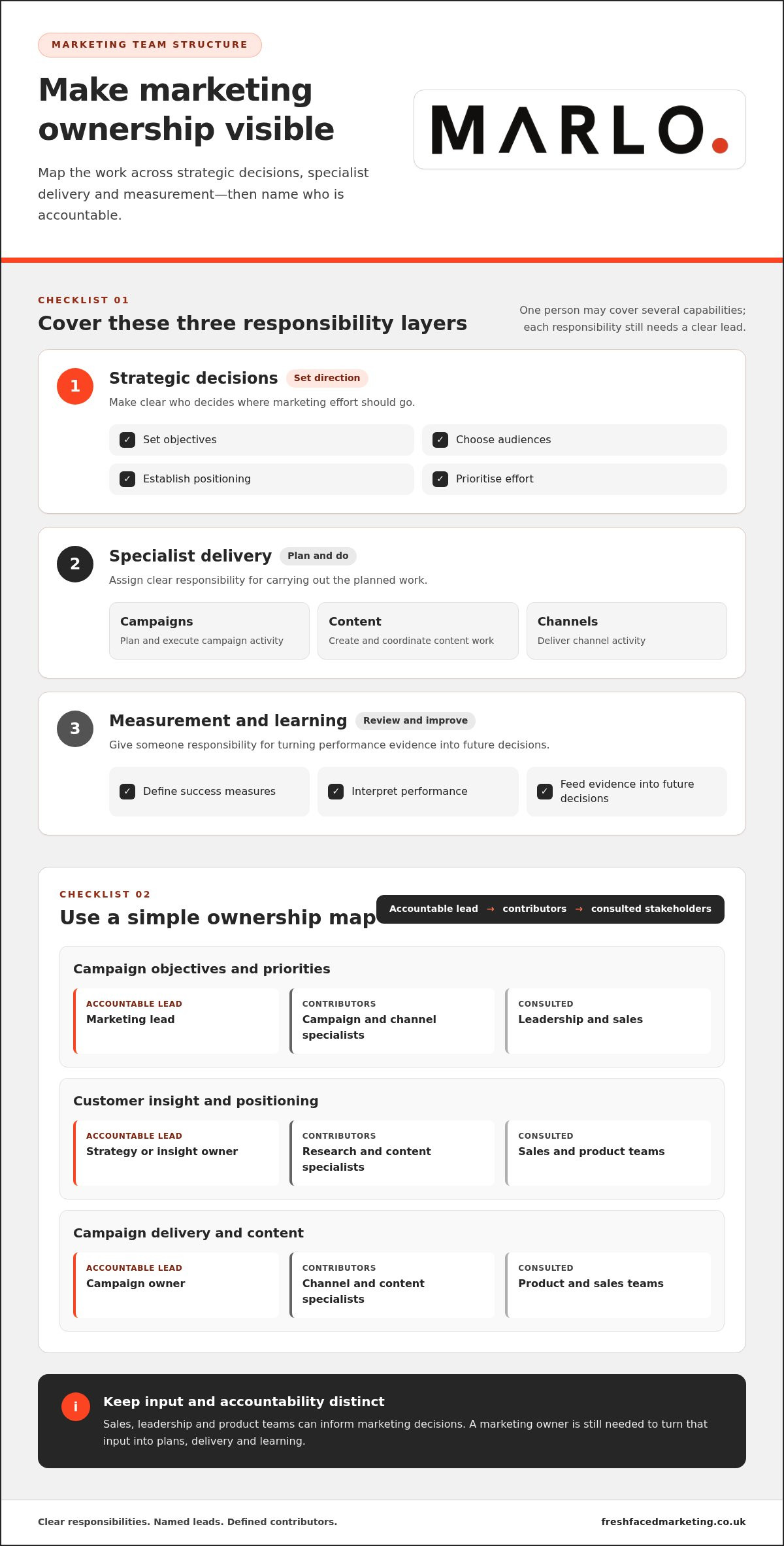
Make three kinds of responsibility explicit:
- Strategic decisions: set objectives, choose audiences, establish positioning and decide where effort should go.
- Specialist delivery: plan and carry out the work, from campaign execution to content and channel activity.
- Measurement and learning: define success measures, interpret performance and feed evidence into future decisions.
These responsibilities may sit with different specialists, or one person may cover several in a smaller team. The key is to distinguish them. Delivery without strategic direction can produce activity that lacks focus. Measurement without a named owner can leave results unexamined. Marketing management principles also place research, planning and strategic decisions within marketing’s remit, reinforcing why the department needs more than channel execution alone.
Why one standard marketing org chart does not fit every business
Scale affects how much work a team can own internally. Complexity matters too: multiple products, customer groups or markets can increase the need for specialist expertise and coordination. Existing capability also counts. A business with strong internal analysis skills has different gaps from one relying on external support for measurement or campaign delivery.
Copying another company’s headcount or reporting lines can create roles that don’t match your workload, while leaving essential responsibilities unowned. Structure should evolve when objectives, workload or capability requirements materially change. Review the work first, then decide whether to clarify ownership, develop expertise, reorganise or add capacity. That keeps the design connected to business needs rather than appearances.
Which marketing roles and capabilities should your department cover?
Define the work before assigning job titles. A capability is a type of work the department needs to perform. An owner is the person accountable for making sure that work is prioritised and completed. In a smaller team, one person may own strategy, campaign planning and measurement. The important point is that each responsibility has a clear lead, even when several capabilities sit with the same person.
Core marketing responsibilities and clear ownership
Start with the decisions and work that connect marketing to customers and business objectives. Someone needs to set marketing objectives and priorities, develop customer insight, shape positioning, coordinate campaigns and review performance. These duties can be shared, but accountability shouldn’t be vague. The accountable lead keeps the work moving and resolves gaps; contributors carry out defined tasks.
Sales, leadership and product teams provide important input. Sales can share customer questions and feedback. Product teams can clarify features and launch plans. Leadership sets business direction and agrees priorities. Those contributions inform marketing decisions, but they don’t replace a marketing owner who turns the input into plans, delivery and learning.
A simple ownership matrix makes those boundaries visible. For example:
- Campaign objectives and priorities: accountable lead, marketing lead; contributors, campaign and channel specialists; consulted stakeholders, leadership and sales.
- Customer insight and positioning: accountable lead, strategy or insight owner; contributors, research and content specialists; consulted stakeholders, sales and product teams.
- Campaign delivery and content: accountable lead, campaign owner; contributors, channel and content specialists; consulted stakeholders, product and sales teams.
- Performance reporting: accountable lead, measurement owner; contributors, campaign and analytics specialists; consulted stakeholders, leadership and sales.
The names will vary by organisation. What matters is that each activity has one accountable lead, with contributors and consulted colleagues identified separately. This makes collaboration easier without creating competing decision-makers.
Specialist skills: build, share or access externally
Research, content, design, channel management and analytics are capabilities to source, not automatic reasons to create separate posts. Assess the frequency and importance of each activity. If a skill is needed every week and closely tied to your customer knowledge, building it internally may make sense. If a specialist task arises occasionally, accessing that expertise externally may be more practical.
Consider the handovers too. External expertise can add capacity or specialist knowledge, while internal owners retain organisational context, make decisions and coordinate the work. For example, an external analyst may help interpret market evidence, but an internal lead should connect the findings to customer priorities and campaign plans.
This capability-first approach makes how to structure a marketing department a question of accountable work, not a checklist of hires. If competitor and marketing evidence would help clarify which capabilities deserve attention, explore Fresh Faced’s strategic approach as one source of support.
Which marketing department structure fits your organisation?
Choosing a structure is a decision about where expertise sits, who sets direction and how teams coordinate their work. A functional arrangement groups people by skill. A centralised model keeps marketing authority or services in one shared team. An embedded model places marketers close to business units, products or markets. Hybrid structures combine elements of these approaches.
The right structure depends on where decisions and delivery need to sit to meet business goals, use available expertise and coordinate work effectively. Compare the trade-offs before changing reporting lines.
| Model | Accountability | Collaboration | Consistency | Coordination demands |
|---|---|---|---|---|
| Functional | Leads own specialist disciplines | Teams collaborate across functions | Strong depth within each discipline | Cross-functional handovers need active management |
| Centralised | A shared marketing team sets priorities and serves business areas | Business areas brief or consult the central team | Shared standards and direction are easier to maintain | Priorities and service across areas need clear processes |
| Embedded | Marketers work close to a product, market or business unit | Frequent local collaboration | Practices can vary between teams | Shared expertise and organisation-wide alignment need attention |
| Hybrid | Shared and embedded owners divide responsibility | Combines central expertise with local input | Can balance common standards and local needs | Decision rights and handovers must be explicit |
Functional, centralised and embedded marketing teams
A functional team can build specialist depth in areas such as content, campaigns or analytics. It may suit work that benefits from consistent expertise across the organisation, though projects can slow if each function waits on another. A centralised team can coordinate priorities and maintain shared standards for several business areas. The trade-off is that a single team must manage competing requests and stay close to local needs.
Embedded marketers work alongside the teams closest to particular customers, products or markets. That proximity can support responsive planning and stronger day-to-day relationships. However, separate teams may duplicate work or apply different standards unless there’s a clear way to share learning and expertise.
When a hybrid marketing department makes sense
A hybrid model can combine shared strategic direction with specialist or business-unit delivery. For instance, a central team might set messaging standards and measurement approaches, while embedded marketers plan activity around local priorities. This can balance consistency with responsiveness, but it also creates more interfaces to manage.
Document decision rights before adopting a hybrid design. Specify who sets priorities, approves shared standards, owns delivery and resolves conflicts. Without that clarity, central and embedded teams may produce overlapping campaigns or leave work unclaimed. Review coordination demands first. If teams need another reporting layer just to determine ownership, simplify the responsibilities before adding management structure.
To decide how to structure a marketing department, map where expertise, decisions and customer context need to sit. Then compare that design with your organisation’s actual collaboration needs and capacity. No model is automatically best; the useful one makes accountability visible without adding more coordination than the work requires.
How to design a marketing department in practical steps
A sound design starts with the work the business needs, not a preferred org chart. Use the sequence below to assess current responsibilities, expose capability gaps and decide whether to clarify, develop, reorganise or add capacity. Work from evidence already available, such as business objectives, campaign plans, team responsibilities and performance reports.
- Set measurable business outcomes. Identify the objectives marketing must support, then define what progress would look like. For example, if the business needs to increase demand in a particular market, agree how marketing will contribute and which measures can show progress. This gives the department a clear basis for setting priorities.
- Translate outcomes into required work. List the activities needed to support each objective, such as customer research, positioning, campaign planning, content, channel delivery and reporting. Sequence them according to their importance and dependencies. An actionable marketing roadmap can then make clear what happens first, who needs to contribute and what resources each priority requires.
- Audit responsibilities and capabilities. Use existing plans, role descriptions and team discussions to record the current picture. A simple audit can capture:
- Activity: what work is required and how often it occurs.
- Owner: who is accountable, who contributes and who approves.
- Capability: which skills and tools are available to deliver it.
- Capacity: whether the work fits alongside current commitments.
- Dependency: which teams or decisions must be involved first.
Look for activities without an owner, duplicate effort, recurring bottlenecks and expertise the team can’t currently access.
- Identify the real constraint. A gap doesn’t always mean a vacancy. It may reflect unclear ownership, excessive workload, a missing skill or a slow approval route. Check the cause before proposing a change. If a specialist capability is needed occasionally, accessing it externally may be more proportionate than creating a permanent role.
- Assign decision rights and measures. For each priority activity, name one accountable owner, the people who contribute and the route for approvals. Choose measures that connect the work to the agreed business outcome. For example, a campaign owner might report against an agreed demand measure, while an analyst supports interpretation of the results.
- Review and adjust. Set regular review points to assess progress, workload and dependencies. If objectives shift or evidence shows that an activity isn’t supporting the intended outcome, adjust its priority or ownership. Treat the structure as a working design, not a permanent chart.
This process helps answer how to structure a marketing department using the responsibilities and resources you actually have. If you want strategic support to turn evidence and priorities into a practical plan, explore Fresh Faced’s marketing strategy support.
How strategic support can strengthen your marketing department
Sometimes a team understands its responsibilities but lacks the evidence or specialist perspective to decide what deserves attention next. Competitor and market analysis can reveal where others are visible, which content attracts attention and where activity appears limited. That evidence can help test assumptions and inform priorities. It doesn’t determine your structure for you: internal owners still need to interpret findings against customer knowledge, business goals and available resources.
Use competitor evidence to sharpen departmental priorities
MARLO is software for competitor and marketing analysis, delivered through an interactive web dashboard. It brings several evidence types together, giving teams a view they can use to assess possible priorities:
- Search traffic analysis shows competitor keyword rankings and positions, including non-branded opportunities.
- Content performance analysis highlights competitor pages, posts and formats that generate traffic and engagement.
- Social media analysis examines competitor activity, frequency and engagement across social platforms.
- Paid media analysis identifies active campaigns, PPC keywords and cost-per-click information, as well as areas with little visible activity.
This evidence can help a marketing lead frame useful questions. Are competitors investing in content that your team hasn’t prioritised? Is there an apparent channel opportunity, and does it fit your audience and capacity? The analysis provides a basis for investigation, not an instruction to copy another organisation’s activity. For a closer look at competitor research for marketing strategy, use the findings to inform discussion about objectives, ownership and resources.
When a human-led Marketing Success Blueprint may help
Software can organise competitor evidence. A separate kind of support may be useful when your team needs experienced strategic interpretation and a plan for acting on that evidence. The Marketing Success Blueprint is a premium, human-led service that builds on the analysis with forensic competitive analysis across channels, strategic interrogation of the data and a detailed execution blueprint that can be handed to a team or agency.
The process also includes two one-to-one strategy calls and a two-to-three-hour strategy workshop. This may suit a business facing competing priorities, uncertain capability gaps or a need to turn analysis into a coordinated plan. The blueprint supports decision-making; it doesn’t replace the organisation’s knowledge of its customers, internal constraints or commercial objectives. Keep those decisions with internal owners, who can adapt recommendations as circumstances change.
The choice is practical: use competitor analysis when you need evidence to examine, and consider human-led support when you also need help interpreting that evidence and mapping out execution. If you’re ready to discuss a strategic starting point for your department, speak with Fresh Faced.
Make your next marketing decision with confidence
Your department’s structure doesn’t need to be perfect before it can improve. Treat it as a working design. Choose one area where ownership or capability is holding progress back, agree what better looks like, then review whether a change has helped. That creates a practical starting point without committing to a major reorganisation before you understand the need.
The next step in deciding how to structure a marketing department is to connect the people, priorities and evidence you already have. Where outside analysis or strategic input could help clarify your options, bring it into the discussion while keeping decisions grounded in your organisation’s context.
Explore strategic support with Fresh Faced and identify a useful starting point for your team. A clearer direction can begin with one considered decision, then develop as your business and priorities change.
Frequently Asked Questions
How many people should be in a marketing department?
No fixed headcount suits every organisation. The right number depends on objectives, workload, capabilities already available and the scope of marketing’s responsibilities. Before recruiting, list recurring activities and estimate the time they require, then compare that demand with current capacity. A department may need to cover several capabilities without appointing a separate person to each. Identify whether the issue is insufficient capacity, missing expertise or unclear ownership before adding people.
What roles should a marketing department have?
A marketing department needs ownership across strategy, customer and market insight, planning, delivery and measurement. These are capabilities, not a compulsory list of separate job titles. In a smaller organisation, one marketer might plan campaigns and report results, while specialist production is sourced when needed. In a larger team, distinct leads may make sense. Set roles by the decisions and outputs each priority requires, then name who is accountable for each.
Should marketing report to sales or the managing director?
Neither reporting line is automatically right. The choice depends on how your organisation makes decisions and connects marketing with commercial priorities. Consider whether the marketing lead can access senior decision-makers and work closely with sales without losing sight of longer-term objectives. For example, regular planning meetings can link campaign activity to sales feedback. Clear authority and useful communication matter more than treating a particular position on the organisation chart as proof of effectiveness.
Can a small business have an effective marketing department with one person?
Yes, one person can coordinate marketing in a small organisation if the priorities and workload are realistic. They might manage planning and supplier coordination without personally producing every specialist asset or analysing every dataset. List what they can own, what requires external input and what can wait. Keep priorities focused, agree who approves decisions and schedule reviews to spot overload early. A larger headcount isn’t the only route to organised marketing.
When should a business restructure its marketing department?
Consider restructuring if work repeatedly falls between owners, teams duplicate activity, or changed objectives require capabilities your current arrangement can’t support. First examine workload, responsibilities and approval routes. For example, a delayed launch may stem from unclear sign-off rather than the reporting line itself. Define the problem, make a targeted change and assess whether it improves accountability or coordination. Restructuring is useful when it addresses a diagnosed issue, not simply because the organisation has grown.
Should a business hire marketers or use external strategic support?
Choose according to the gap: ongoing internal capacity, specialist expertise or strategic analysis. Hiring can build sustained knowledge and ownership within the business. External support can bring focused expertise to a defined question or planning need. The options can work together. Before deciding, specify the capability missing, how regularly it’s needed and which decisions the support should inform. That assessment helps distinguish a continuing workload from a short-term need for evidence or interpretation.