What good is a detailed competitor report if it leaves your next marketing decision just as uncertain? That’s the problem competitor analysis services should solve. Research can become a long inventory of rivals without showing what to prioritise. Useful evidence is more than a record of what competitors are doing. It connects what you learn to your goals, budget and available resources.
This guide explains what a useful analysis should examine across search, content, social and paid media, and how to judge whether its findings are relevant enough to act on. You’ll learn how to compare research outputs by the decisions they support, then turn observations into a practical sequence of marketing priorities. More data doesn’t automatically mean a better strategy.
At Fresh Faced, MARLO provides competitor discovery and channel analysis through an interactive dashboard. The separate premium Marketing Success Blueprint adds human-led strategic interrogation and a detailed execution blueprint. The distinction matters: software organises evidence, while strategic interpretation helps determine what to do with it. The aim is clear, prioritised decisions, not a thicker report.
Key Takeaways
- Useful competitor analysis services investigate rivals’ market positions and marketing activity, rather than simply listing competing brands.
- Assess evidence across search, content, social and paid media to identify competitor strengths and possible gaps.
- Compare research by the decisions it supports, and whether its recommendations fit your goals, budget and internal resources.
- Define the decision you need to make before setting the research scope, then prioritise actions against your constraints.
- Consider whether MARLO or the separate premium Marketing Success Blueprint better matches the analysis and strategic support you need.
What competitor analysis services should reveal before you commit
Competitor analysis services provide structured research into rivals, their market positions and the marketing activity relevant to a business decision. The useful output isn’t a longer list of brands. It’s a clearer view of where your organisation stands, what alternatives the market presents and which choices deserve closer examination.
Useful competitor analysis connects evidence about rivals to decisions your business needs to make. That gives you a practical test: can the research help you assess an opportunity, weigh a risk or choose where to focus? A report’s length alone can’t answer that. The broader concept is outlined in Competitive analysis in marketing and strategic management, which covers assessing competitors’ strengths and weaknesses.
This work differs from general market research, which may examine a market’s size or structure, and customer research, which investigates buyers’ needs and behaviour. Competitor analysis focuses on relevant rivals and their observable activity. A list of brands can help establish who to investigate, but it doesn’t explain their positioning, marketing choices or relevance to your goals.
What does a competitor analysis service examine?
The right competitor set depends on the question. Direct competitors offer similar products or services to a similar audience. Indirect competitors may meet the same need through a different solution. If you’re reviewing your positioning, both could matter. If you’re assessing a specific channel, a narrower set may be more useful.
Good analysis separates what can be observed from what it may mean. A competitor publishes regular articles: that’s observable. The articles are intended to attract a particular audience: that’s an interpretation, unless supported by further evidence. Sound research makes this distinction clear and labels assumptions, rather than presenting them as established facts. Set the scope according to the decision, not simply because more information is available.
When does competitor analysis help a business?
Evidence can inform how you position an offer, which channels merit attention, what content to prioritise and how to allocate time or budget. It doesn’t dictate a single answer. It gives your team a better basis for comparing options and identifying questions that need further testing. For more on the research process, see Forensic Competitor Research for UK Marketing Growth.
For example, a business considering a new content theme could examine whether relevant competitors publish on it, how their material appears to serve the audience and whether the topic aligns with its own goals. The evidence might support a small test, a different angle or a decision to focus elsewhere. The point is to investigate before committing substantial resources, not to assume that a competitor’s activity proves an opportunity will work.
Which evidence should competitor analysis services examine?
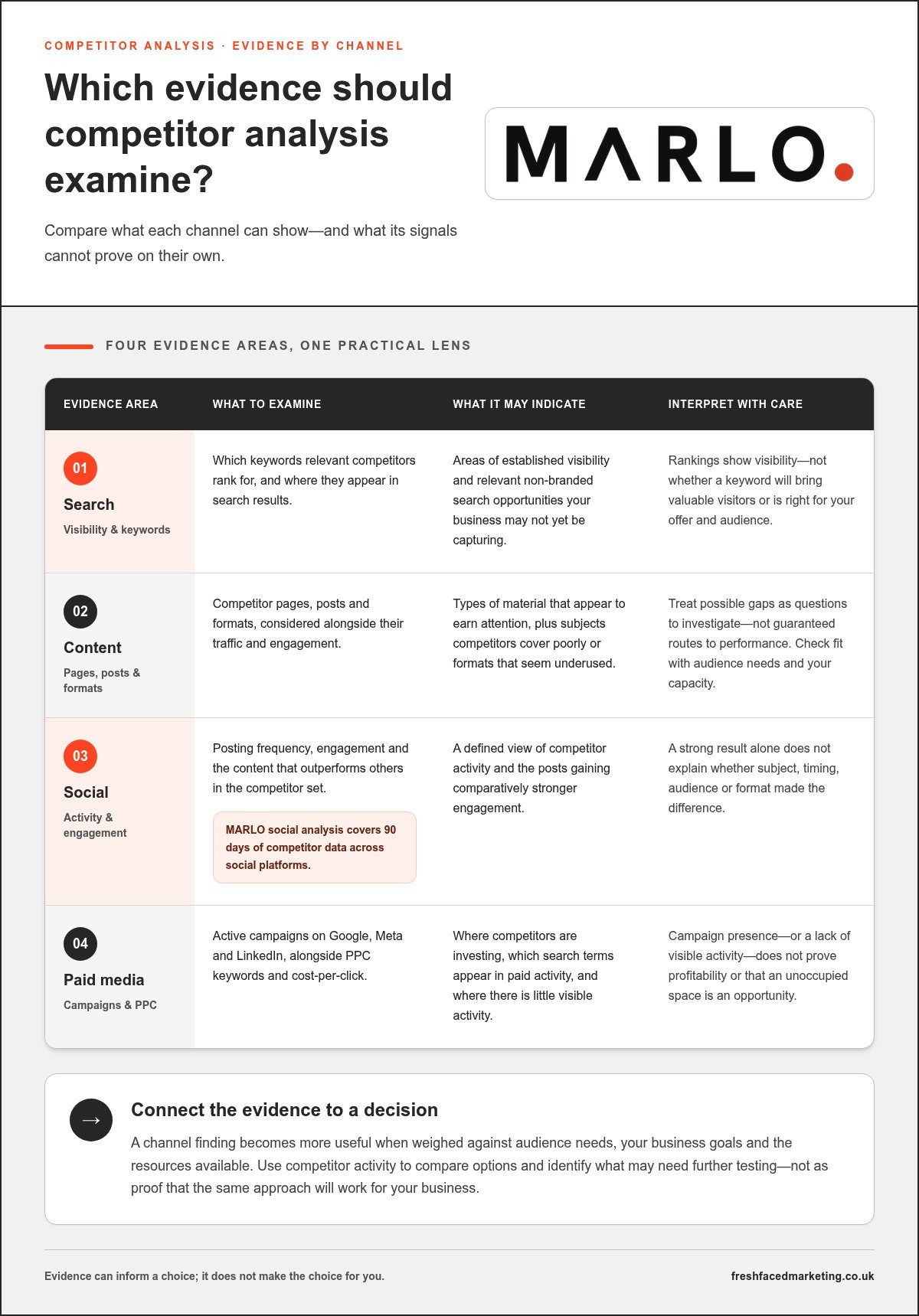
A useful channel review connects evidence to a specific question. Which rivals appear in search results for relevant topics? What content attracts attention? Where are competitors active, and where might there be room to test a different approach? Competitor analysis services should examine enough reliable evidence to answer those questions, not collect data simply to make a report look comprehensive.
Search and content evidence: visibility, keywords and performance
Search analysis can show which keywords competitors rank for and where they appear in search results. This helps reveal areas of established visibility as well as relevant non-branded search opportunities your business may not yet be capturing. Rankings indicate visibility, not proof that a keyword will bring valuable visitors or that your business should target it. Relevance to your offer and audience still matters.
Content analysis adds context. Reviewing competitor pages, posts and formats alongside their traffic and engagement can indicate which types of material appear to earn attention. It can also expose gaps: a subject competitors cover poorly, or a format that seems underused across the relevant group. Treat these as opportunities to investigate, not guaranteed routes to performance. The University of Kansas discusses how competitive evidence can inform broader planning in Competitive Analysis Frameworks for Strategic Planning.
Connect channel findings to the wider questions shaping your market. A keyword gap, for instance, becomes more useful when considered alongside audience needs and your business’s capacity to produce relevant content.
Social and paid media evidence: activity and gaps
Social analysis can compare posting frequency, engagement and the content that outperforms others in the competitor set. MARLO’s social analysis covers 90 days of competitor data across social platforms. This provides a defined view of activity, but still needs careful interpretation. A highly engaged post may reflect its subject, timing, audience or format, and the visible result alone doesn’t explain which factor mattered.
Paid media analysis can examine active campaigns on Google, Meta and LinkedIn, alongside PPC keywords and cost-per-click. These signals can help identify where competitors are investing and which search terms feature in their paid activity. They can also point to areas with little visible activity. Neither presence nor absence proves that a campaign is profitable or that an unoccupied space is automatically worth pursuing.
Prioritise relevant evidence over volume
Across all four channels, assess whether the sources cover the competitors and questions that matter. Look for evidence that distinguishes observed activity from interpretation. A smaller, well-scoped review can be more useful than a much larger collection that leaves the decision unclear. Make both strengths and gaps visible, and be explicit about uncertainty.
If you want these channel findings brought together in one interactive view, explore MARLO’s competitor analysis dashboard.
How to compare competitor analysis services by decision value
A useful comparison starts with the decision you need to make, not the method that sounds most sophisticated. Competitor analysis services can vary in scope and output. Assess whether each option turns relevant evidence into a practical basis for action, and whether that action is realistic for your organisation.
What makes competitor analysis actionable rather than descriptive?
A competitor profile describes what a rival does. Decision-ready analysis explains why that evidence matters to your business and which options it raises. For example, a profile might record that a competitor publishes regularly. A useful finding would connect that observation to a relevant audience need, an opportunity worth testing or a reason to focus elsewhere.
Look for a clear line between evidence collection, interpretation and execution. The first gathers and organises information. The second assesses its relevance to your goals. The third turns selected findings into work that someone can carry out. These stages inform one another, but they are not interchangeable. Research alone doesn’t deliver an execution plan, and recommendations shouldn’t disguise assumptions as facts.
Use this comparison to judge whether an output can support a real decision:
| What to assess | Useful test |
|---|---|
| Research scope | Does it examine the competitors and questions relevant to your decision? |
| Evidence sources | Are the sources clear, relevant and separated from interpretation? |
| Outputs | Do you receive findings that explain what the evidence may mean, not just profiles? |
| Prioritisation | Are options ranked against your stated goals and constraints? |
| Practical usability | Can your team identify a feasible next step and who or what it requires? |
How should the analysis reflect budget and internal capacity?
A recommendation has limited value if it assumes money, skills or time your team doesn’t have. Consider what each proposed channel or activity would require, then compare that with your actual budget and available resources. A potential gap in competitor activity is only one factor. It doesn’t automatically make that gap the right place to invest.
Trade-offs matter. A business with limited content capacity may need to choose between producing more material and improving the pages it already has. A team weighing paid activity against organic work should understand the resource implications of each route before assigning priority. The purpose isn’t to pursue every apparent opportunity. It’s to select the options that best fit your objectives and capacity, and make the reason for that choice clear.
Before choosing an analysis, ask what decision it will inform, what evidence supports the recommendations and what your team could realistically do next. That keeps the comparison focused on decision value, rather than report size or impressive-sounding methods.
How to prepare for a competitor analysis and use its findings
Competitor research is more useful when it starts with your business priorities, not a broad request to collect information. Before examining rival activity, define what you need to decide and record the constraints that will shape any response. Competitor selection matters too: the wrong comparison set can make even accurate findings irrelevant.
Use this sequence to prepare the work and move from evidence to action:
- Define the decision. Set out one specific question, such as whether to strengthen visibility for a service, test a new content theme or reconsider your positioning. A focused question gives the research a clear purpose.
- Identify relevant competitors. Select direct rivals and, where they matter to the question, alternative providers or solutions customers might consider. The chosen set shapes every later comparison, so explain why each organisation is relevant.
- Set the scope. Decide which channels and evidence are needed to answer the question. Record your business goals, existing strategic priorities, available budget and team capacity before reviewing competitor activity.
- Review the evidence. Separate observable activity from interpretation. Note where a finding is clear, where it raises a possibility and where more evidence is needed before drawing a conclusion.
- Prioritise action. Compare each opportunity with your objectives and constraints. Decide what is feasible now, what needs further investigation and what should wait.
Define the decision and competitor set
Be precise about the choice at stake. “Understand the market” is too broad to guide a useful analysis. “Assess whether our current positioning reflects what customers can choose instead” gives the work a boundary. Include the audience or customer alternatives relevant to that question. A business examining a service category may need different competitors from one assessing a particular marketing channel.
Write down resource limits at the outset, too. If the team has little capacity to produce content, that constraint should inform which opportunities receive attention. It shouldn’t be introduced only after recommendations have been made.
Turn findings into a prioritised next step
Once findings are assembled, assess each option against its relevance to your goals, its resource requirements and the strength of the supporting evidence. Some actions may be practical to explore immediately. Others may require a test, internal discussion or additional strategic consideration. A roadmap can lay out those choices in a considered order, rather than treating every possible activity as equally urgent.
This is the purpose of an actionable marketing roadmap: it connects evidence to sequence, responsibility and available capacity. MARLO includes a strategic roadmap with budget and resource guidance, helping organise options around business priorities. To see competitor evidence in an interactive view, explore MARLO’s competitor analysis dashboard.
MARLO or the Marketing Success Blueprint: choose the right level of support
The practical choice is how much interpretation your team wants alongside competitor research. MARLO is software; the Marketing Success Blueprint is a separate premium service with human strategist involvement. Consider who will use the findings, how confident they are in evaluating them, and whether they need support turning analysis into an execution plan.
What MARLO provides as competitor analysis software
MARLO brings competitor research into an interactive dashboard. It suits teams that want to examine the evidence directly and make their own decisions about what deserves attention. The format gives stakeholders a structured reference for internal planning, rather than requiring them to work from disconnected research notes.
If your team is ready to interpret findings and decide its own next steps, MARLO’s competitor analysis dashboard supports that approach. The key consideration is internal ownership: someone needs to assess which observations matter and how they relate to the business’s priorities.
What the Marketing Success Blueprint adds
The Marketing Success Blueprint is designed for businesses that want strategists to interrogate the evidence with them. Its human-led approach brings judgement to the analysis, helping examine competing interpretations and clarify the reasoning behind strategic choices. This can be valuable when the decision has wider implications or the team wants structured challenge before committing to a direction.
The service also provides a detailed execution blueprint, direct access to the Fresh Faced strategists who developed the methodology, two one-to-one strategy calls and a two-to-three-hour workshop. These elements support discussion and planning around how the strategy should be carried forward. They are distinct from MARLO’s software-led analysis.
Choose according to the work your team needs to do next. If it can interpret the research and shape its own response, software may be the appropriate level of support. If it needs expert interrogation and a guided route from analysis to execution, the Blueprint provides that additional human input.
Make your next marketing decision with greater clarity
Competitor analysis is most valuable when it becomes part of how you make decisions, not a document that gets filed away. As your priorities shift, return to the questions behind the research: what has changed, which assumptions still hold, and where would new evidence help you choose your next move?
The right competitor analysis services should give your team a useful basis for deciding what to test, refine or set aside. Start with a decision that matters now. Then choose the level of analysis and strategic support that fits the people, time and resources available to act on it.
Ready to examine your competitor landscape in a structured way? Explore MARLO’s competitor analysis dashboard and bring your next marketing decision into sharper focus.
Frequently Asked Questions
How many competitors should a competitor analysis include?
Include the competitors needed to answer your business question, rather than aiming for a fixed number. A focused review might compare a few close alternatives for a specific product decision, whilst a broader positioning question may call for a wider set. Include a rival only if its offer, audience or marketing activity provides a meaningful comparison. This keeps the analysis relevant and manageable.
How often should a business update its competitor analysis?
Update it when a business decision or a material market change makes the existing evidence less useful. A new offer, a shift in your positioning or a change in the alternatives customers consider may justify a review. You can also set a review point that fits your planning cycle. The key is to revisit the assumptions and evidence behind decisions, rather than repeat research on a fixed schedule without a clear purpose.
Can competitor analysis identify opportunities competitors have missed?
It can highlight areas that appear under-served, such as a customer need that receives little attention or a topic competitors cover superficially. Treat these as hypotheses, not proof of demand. Check whether the opportunity fits your offer, audience and capabilities before committing resources. For example, an apparent lack of competitor content on a subject may reflect low audience interest, so additional customer evidence may be needed before acting.
What is the difference between competitor analysis and market research?
Competitor analysis concentrates on relevant rivals: their offers, positioning and observable activity. Market research examines the wider conditions that shape decisions, which may include customer needs, market structure and demand. The two can complement each other. If competitor reviews reveal an underserved audience, broader research can help establish whether that audience matters to your business. Keeping the questions distinct makes it easier to see what each type of evidence can and can’t tell you.
Can competitor analysis show which marketing channels are working?
It can show where competitors are visible and what activity attracts observable attention, but it can’t establish their internal return on investment. A rival’s active campaign or popular post is a signal to investigate, not evidence of profit. Compare activity with your own objectives and results before deciding whether to test a channel. Set a clear measure for your test, such as qualified enquiries, so your decision uses evidence from your own marketing too.
Is competitor analysis software enough to build a marketing strategy?
Software can contribute evidence, but a strategy also needs a clear business objective, insight into your customers and a realistic view of internal constraints. Before choosing priorities, connect competitor findings with your own performance data and decide how you’ll judge progress. For example, if you’re considering a new channel, establish what outcome would justify continued investment and what result would prompt a change. That gives the strategy a basis for review.
What should a competitor analysis report include?
A useful report should make its purpose and boundaries clear: the business question, competitors selected and evidence reviewed. It should distinguish observed activity from interpretation, note limitations and explain why each finding matters. Recommendations are more usable when they identify a decision or next step, its rationale and any resource implications. That structure helps readers assess not only what the research found, but how confidently they can act on it.