An ambitious marketing target can be less useful than a modest one if neither is grounded in evidence. Learning how to set realistic marketing goals starts with what your business needs, what current performance shows and what your team can deliver, not an arbitrary growth figure.
If your goals feel vague, disconnected from business priorities or difficult to measure, you’re right to question them. A target without a reliable baseline or enough time and resource behind it is a forecast dressed up as a plan. Ambition still matters, but it needs a credible route to results.
This guide shows you how to translate business priorities into measurable marketing outcomes, set targets against evidence and capacity, and define a timeframe that makes progress visible. You’ll also learn how to review results and adjust your goals without losing strategic focus. The process considers internal performance data alongside market and competitor context, so your targets reflect both what’s happening in your business and the opportunities available to it.
Key Takeaways
- Learn how to set realistic marketing goals by connecting measurable outcomes to business priorities, evidence and delivery capacity.
- Build targets from a verified baseline, using relevant historical data and accounting for seasonality or major changes.
- Choose KPIs that show whether you’re making progress, not simply how much activity your team completes.
- Give each goal a clear owner, practical actions, sufficient resources and defined review points.
- Use competitor insight to assess opportunities alongside your internal data. MARLO can help reveal competitor activity across search, content, social and paid media.
How to set realistic marketing goals that support business priorities
To understand how to set realistic marketing goals, begin with a business priority, then define the marketing contribution, evidence and capacity required to support it. A realistic goal is measurable and time-bound, and its target is supported by a credible baseline and the resources available to deliver it.
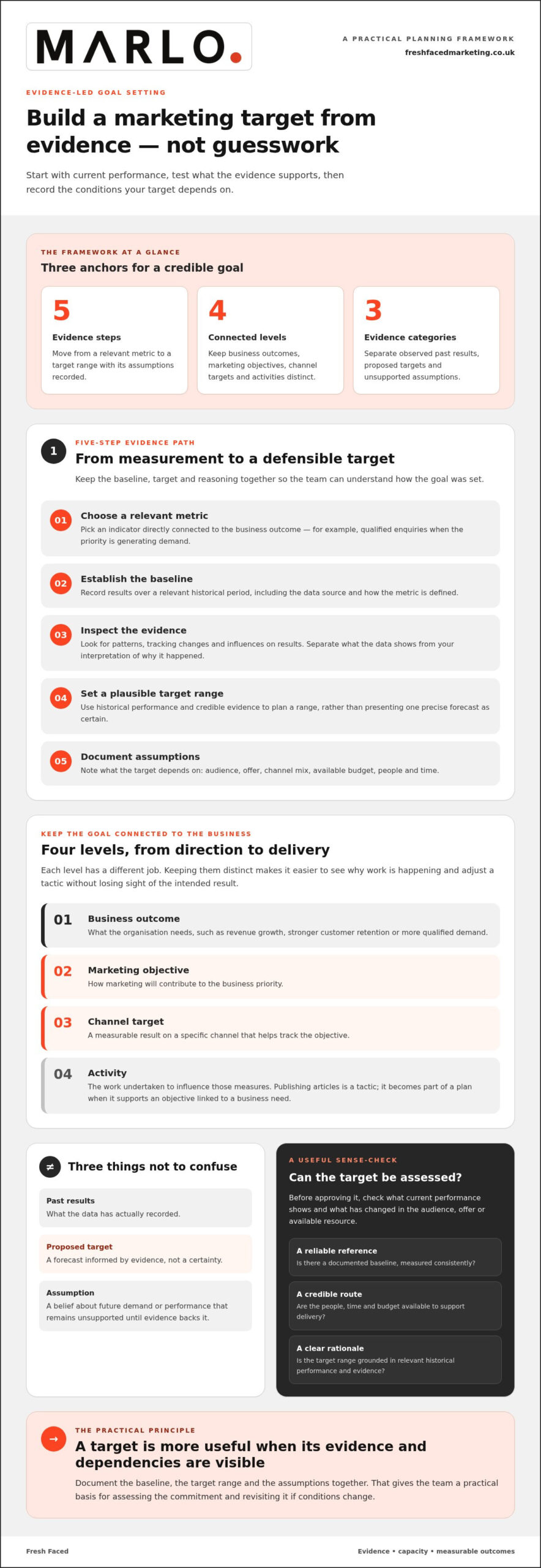
This sequence matters. A business outcome describes what the organisation needs, such as revenue growth, stronger customer retention or more qualified demand. A marketing objective states how marketing will contribute. Channel targets translate that objective into measurable performance on a specific channel; day-to-day activities are the work undertaken to influence those measures.
A marketing goal defines a measurable result marketing will pursue within a set timeframe; a marketing tactic is an action chosen to help achieve that result. Publishing a series of articles is a tactic. It becomes part of a plan only when it supports an objective linked to a business need.
Start with the business outcome, not the channel
First, clarify the organisation’s current priority. If the priority is retention, marketing may focus on useful customer communications. If the business needs qualified demand, the objective might centre on reaching suitable prospective customers and encouraging them to enquire. Revenue growth may require a different contribution, depending on the audience, offer and customer journey.
The right outcome depends on the organisation’s circumstances. Choosing a channel first, such as social media or email, reverses the logic: it selects an activity before establishing what the business needs it to achieve. A sound marketing strategy links direction, audience and action, rather than treating channels as goals in themselves. For a foundational overview, see Marketing Strategy.
Turn broad ambitions into measurable marketing objectives
“Grow awareness” expresses an ambition, but leaves the audience and evidence unclear. Make it observable by defining whose awareness matters, what change would indicate progress and when you’ll assess it. The objective should describe the intended outcome; the metric is the indicator used to track movement towards it.
For example, an organisation seeking to reach more relevant prospective customers could set an objective to increase qualified enquiries from a defined audience during a specified period. The chosen enquiry measure would track progress. It would not, on its own, establish whether marketing caused the change or whether the enquiries fit the business priority.
Before approving a target, check its rationale. What does current performance show? What has changed in the audience, offer or available resource? If there’s no baseline, evidence or explanation for the target, it’s an assumption, not a plan. Record what the goal depends on, including the people, time and budget available. This makes the commitment assessable and gives the team a practical basis for deciding whether the target is achievable.
Keep the levels distinct when documenting goals: the business outcome sets direction, the marketing objective defines the contribution, the channel target measures a route, and activities describe the work. That separation helps teams see why they’re doing the work, and makes it easier to adjust a tactic without losing sight of the intended result.
Build realistic marketing goals from a baseline and credible evidence
A target is only as useful as the evidence behind it. To learn how to set realistic marketing goals, distinguish what your data has actually recorded from what you expect may happen. Past results are observations. A proposed target is a forecast, while beliefs about future demand or performance are assumptions until evidence supports them.
A target without a documented baseline has no reliable reference point, so its ambition cannot be properly assessed. Keep the baseline, target and reasoning together. That record lets your team understand how the goal was set and revisit it if conditions change.
Choose a baseline that reflects current performance
Start with the metric most closely connected to the business outcome, then check that it has been measured consistently. If tracking definitions, reporting tools or attribution methods changed, note the impact before comparing periods. A gap in the data doesn’t make a target impossible, but it does make the evidence less certain.
Use this sequence to move from measurement to a defensible target:
- Choose a metric. Select an indicator that relates directly to the outcome, such as qualified enquiries if the priority is generating demand.
- Establish its baseline. Record the result over a relevant historical period, along with the data source and how the metric is defined.
- Inspect the evidence. Look for patterns, changes in tracking and factors that may have influenced results. Separate what the data shows from your interpretation of why it happened.
- Set a target range. Use historical performance and credible evidence to define a plausible planning range, rather than presenting one precise forecast as certain.
- Document assumptions. Record what the target depends on, including audience, offer, channel mix, available budget, people and time.
Set a target range without pretending to know the future
The historical period should reflect the decision you’re making. A short period may capture current conditions but overstate a temporary spike or dip. A longer period can reveal patterns, yet may include outdated performance if the offer, audience or tracking has changed. For a seasonal business, compare like with like where possible, such as the same seasonal period, rather than treating the immediately preceding months as a fair comparison.
Then assess whether the proposed range follows from the evidence. Consider what has changed, what will stay consistent and what the team can realistically deliver. If a new offer or channel has little comparable history, make that uncertainty explicit. Avoid borrowing a target from a different organisation or treating competitor performance as a substitute for your own baseline.
A range supports planning, not a promise. The lower and upper bounds should reflect different plausible conditions, with assumptions stated clearly. For instance, the range might depend on maintaining the current audience while introducing a revised offer. If either condition changes, the forecast may need review. Label observed results, forecasts and assumptions separately in your planning document; this small discipline makes later decisions more transparent.
Where the evidence is complex, evidence-led marketing strategy can help bring internal performance and planning assumptions into a clearer decision framework.
Choose marketing KPIs that measure progress, not just activity
Once a goal is defined, select measures that show whether marketing is moving towards it. More output does not automatically mean more business impact. A team can publish more posts or increase email sends without generating better-qualified enquiries, improving conversion or retaining more customers.
A marketing goal describes the result to achieve; a KPI is a measure used to assess progress towards that result. The goal sets direction. The KPI helps you judge whether your actions are contributing.
It helps to distinguish three types of measure:
| Measure type | What it tracks | Example and purpose |
|---|---|---|
| Activity metric | Work completed by the team | Campaigns launched or content published. Useful for checking delivery, but not proof of impact. |
| Leading indicator | An earlier signal that may point towards future results | Relevant landing-page visits or enquiry form starts. Helps show whether the audience is taking an initial step. |
| Lagging outcome measure | A result connected to the business objective | Qualified enquiries, conversion rate or customer retention. Shows whether the intended outcome is being realised. |
These measures work together, but they don’t carry equal weight. Activity confirms that work took place. A leading indicator can help diagnose what is happening along the way. An outcome measure shows whether the goal itself is progressing.
Match each KPI to the outcome it helps explain
Choose one primary outcome measure for each objective, then add a small number of supporting indicators that help explain movement. For an objective to generate qualified demand, qualified enquiries could be the primary KPI; relevant visits and completed enquiry forms may offer context. Define what counts as “qualified” so the team applies the same standard.
Record where each measure comes from, such as your CRM for lead status or analytics data for website behaviour. Set the date range, filters and calculation method too. A KPI is only useful for decisions if people can reproduce it and understand what it includes.
Avoid vanity metrics and misleading comparisons
Reach and clicks can show exposure or interest, but they don’t establish commercial progress on their own. Compare like with like: use consistent audience definitions, time periods and KPI calculations. If the audience or tracking method has changed, say so before interpreting the trend.
Attribution also has limits. A customer may interact with several channels before enquiring, and incomplete data can make one channel appear more responsible than it was. Treat the KPI as evidence, not automatic proof of cause. This distinction is central to how to set realistic marketing goals: measure the intended outcome, then use supporting indicators to investigate what may be influencing it.
Make marketing goals achievable with clear ownership and review points
A goal becomes deliverable when someone owns it, the work is defined and the necessary resources are available. Without those conditions, even a well-reasoned target can remain an aspiration. A practical plan makes responsibilities and constraints visible before the team commits.
Use this sequence to turn the objective into an operating plan:
- Assign one accountable owner. Name the person responsible for coordinating progress and raising obstacles. Others may contribute, but accountability should be clear.
- Define the actions. Identify the work needed, who will complete it and which dependencies must be in place.
- Confirm the resources. Check people, budget, time, tools and access to the data required to deliver and measure the work.
- Connect actions to measures. Record the outcome measure and any leading indicators the team will monitor, so activity stays connected to the objective.
- Set review dates. Agree when the team will check delivery, early signals and results, and what evidence will inform decisions.
Test the goal against real delivery capacity
Before confirming the target, assess the workload alongside existing commitments. Does the owner have time to coordinate it? Are the required skills and budget available? Can the team access reliable data, and are there dependencies on other teams or systems? If a critical resource is missing, ambition alone won’t close the gap. Reduce the scope, secure the necessary capacity or extend the timeframe.
For example, a campaign that depends on new content may also need subject-matter input, approval time and measurement set-up. Include those steps in the plan. Otherwise, the delivery date may reflect only the visible activity, not the work needed to make it possible.
Review progress without moving the goalposts
Set review points in advance, using a cadence that fits the sales cycle and how quickly reliable data becomes available. At each review, examine whether planned work is happening, whether early indicators are moving and whether the outcome measure is responding. A missed milestone may call for a delivery change; it doesn’t automatically mean the underlying objective should change.
If progress is slow but the assumptions still hold, investigate execution first. Reallocate effort, address a bottleneck or test a different tactic while keeping the goal stable. Revisit the goal when material evidence changes the basis for it, such as a shift in available resources, audience, offer or market conditions. Record what changed, why the original plan no longer applies and how the revised target follows from that evidence. This creates a clear decision trail rather than quietly resetting expectations.
Clear ownership and review discipline help turn planning into coordinated action. If you’d like support aligning priorities, capacity and execution, explore Fresh Faced’s evidence-led marketing strategy.
Use evidence-led strategy to turn realistic marketing goals into action
Internal performance data gives you a view of what your organisation has achieved. Competitor evidence adds a different perspective: it can show how others are approaching the market and help identify areas worth investigating. Use both carefully. External activity can inform your choices, but another organisation’s results cannot set a suitable target for your business. Its audience, offer, resources and starting point may be very different.
This distinction matters when deciding how to set realistic marketing goals. Competitor analysis can help you assess whether an opportunity appears relevant, where activity is concentrated and what alternatives might deserve consideration. Your own baseline and delivery capacity still determine whether a particular goal is appropriate.
Use competitor evidence as context, not as your target
Look for useful signals, not numbers to copy. A competitor’s visible presence across search, social or paid media may suggest a route to explore, but it doesn’t prove that route will work for your audience. Compare the evidence with your own priorities, performance and available resources. A deeper competitor analysis through MARLO can help build this external market context.
Know when software insight or human-led strategy can help
MARLO is software that presents competitor research in an interactive web dashboard. It analyses competitor search, content, social and paid-media activity, helping you examine the market before deciding which opportunities merit attention. It supplies external context; it doesn’t replace your internal performance data or make strategic decisions on your behalf.
The Marketing Success Blueprint is a separate, premium human-led service. It adds strategic interrogation of the data, direct access to the strategists behind the methodology, and a detailed execution blueprint for a team or agency. It also includes two one-to-one strategy calls and a two-to-three-hour workshop. The distinction is practical: MARLO provides the competitor-analysis software, while the Blueprint brings human-led analysis and planning into the process.
Choose the level of support that fits the decision in front of you. If you need a clearer view of competitor activity, software may help organise that evidence. If you need people to interpret the wider picture and shape it into a plan, human-led strategy offers a different kind of input. In either case, keep decisions anchored to your own business priorities, internal baselines and delivery capacity.
With evidence in hand, revisit the goal’s rationale, measures and assumptions before committing resources. That final check turns analysis into a considered plan, while leaving room to adapt the work if new information emerges. If you’d like support developing an evidence-led marketing strategy, explore strategic support from Fresh Faced.
Turn your next marketing decision into a clear direction
Goal-setting isn’t a one-off planning exercise. The next step is to make the choices behind each target visible: what evidence supports it, what your team can deliver and what new information might prompt a change. That discipline keeps ambition connected to reality without turning the plan into a fixed script.
If you’re still working out how to set realistic marketing goals for your organisation, begin with one priority that matters now. Identify the decision you need to make, the information you trust and the capacity you can commit. Then agree what a useful next step looks like across the people involved. A focused starting point is more useful than a long list of targets with no clear route to delivery.
For teams seeking support in turning evidence into a considered direction, Fresh Faced offers strategic planning grounded in market context and business priorities. Explore evidence-led marketing strategy and take the next step towards goals your team can act on with clarity.
Progress starts with a well-founded decision, then builds through deliberate action. Your next goal can be both meaningful and achievable.
Frequently Asked Questions
How do you set a realistic marketing goal when you have no historical data?
Start with a learning goal, not a precise performance forecast. Define the audience, action and tracking method, then run a focused pilot to establish what happens in practice. For example, test one message with a clearly defined audience and record the response consistently. Once you have initial observations, use them to shape a provisional target and state the uncertainty. This is a practical first step in how to set realistic marketing goals without inventing a baseline.
What is the difference between a marketing goal, objective and KPI?
A marketing goal is the broader result marketing is expected to contribute to, such as stronger customer retention. An objective makes that contribution more specific, for example encouraging existing customers to return. A KPI is the measure used to assess progress, such as repeat-purchase behaviour recorded in your customer system. Keep the terms connected but distinct: the goal gives direction, the objective defines the intended change, and the KPI provides evidence to assess it.
How often should a business review its marketing goals?
Set review frequency according to how quickly reliable information becomes available and how long the customer decision process takes. A short campaign may need frequent operational checks, whilst a longer-term initiative may be better assessed at planned milestones. Avoid changing direction in response to every daily fluctuation. Agree the review dates in advance, and use them to identify trends, delivery issues or new evidence that could affect the plan.
Can marketing goals be realistic if results depend on external factors?
Yes, provided the goal recognises uncertainty rather than treating outside conditions as controllable. Demand, competitor activity and customer decisions can affect results, even when execution is consistent. Identify which factors the team can influence and which it can only monitor. Where uncertainty is material, plan for different plausible scenarios and agree what evidence would trigger a response. This makes the goal useful for decisions without presenting the outcome as guaranteed.
Should marketing goals be based on competitor performance?
Competitor performance can provide context, but it shouldn’t determine your target. Another organisation may have a different audience, offer, reputation or level of investment, so its results may not be comparable. Use competitor activity to identify questions worth investigating, such as an underserved audience or a channel your business hasn’t tested. Then assess that opportunity against your own customers, business priorities and ability to act.
How many marketing goals should a business set at once?
There’s no fixed number that suits every business. Set only the goals your team can actively resource, measure and review alongside its existing commitments. If priorities compete for the same people or budget, identify which outcome matters most now and treat the others as secondary. A useful test is whether each goal has a clear owner and a distinct reason to exist. If not, combine it with a related priority or defer it.
What should you do when marketing performance is below target?
First, check that the data is complete and the measure is being interpreted consistently. Then locate where progress is slowing: delivery, audience response or the step between interest and conversion. Speak with the people responsible for the work and examine relevant customer feedback. If the objective still makes sense, test a change to execution and monitor its effect. Reconsider the goal itself only if new evidence changes the assumptions behind it.