What if the problem isn’t a shortage of leads, but a gap between the leads you attract and the conversations your sales team needs? A rising lead count can look like progress, yet disconnected marketing and sales activity can leave teams unsure which channels work or what makes a lead worth pursuing. A reliable lead generation strategy for B2B connects those decisions instead of treating them as separate tasks.
It can be difficult to prioritise channels when lead volume doesn’t consistently turn into sales opportunities. Lead nurturing matters too: Callbox Inc. reports that 79% of leads never convert to sales without a proper nurturing strategy. More activity alone won’t resolve weak qualification or unclear follow-up.
This guide sets out a practical sequence for building a measurable system, from defining your audience to agreeing what a qualified lead looks like and how sales will follow up. You’ll learn how to compare channels against your audience, resources and goals, then track lead quality and pipeline outcomes to improve your decisions. The aim is a joined-up process: clear insight, focused activity and useful feedback from sales.
Key Takeaways
- Build a lead generation strategy for B2B around a defined business goal, a researched audience and a clear route through the buyer journey.
- Use competitor and buyer evidence to prioritise channels before investing in campaign production.
- Compare content, search, paid media, social and outbound by audience fit, intent and the resources each requires.
- Set baselines, assign ownership and track early engagement alongside pipeline and commercial outcomes.
- Use MARLO for competitor insight and a strategic roadmap; choose the Marketing Success Blueprint when you also need human-led analysis and an execution blueprint.
Why a B2B lead generation strategy needs more than campaign activity
Lead volume, qualified opportunities and revenue contribution measure different things. A campaign can attract many contacts without reaching the organisations or buyer roles most likely to purchase. A smaller group of well-matched prospects may lead to more useful sales conversations. Counting form submissions alone can hide that difference.
A lead generation strategy for B2B is a connected plan for attracting potential buyers, converting their interest and assessing whether they’re ready for a sales conversation. It links audience insight and demand to conversion points, qualification criteria and follow-up. The broad concept of Lead generation involves identifying and developing prospects, not simply collecting contact details.
Without that connection, activity can build without creating a clear route to pipeline. A team might run a webinar, publish search-led content and collect enquiry forms, but have no shared agreement on which actions signal buying intent or who follows up. Marketing sees engagement; sales sees contacts with too little context. A strategy gives each activity a role and defines what should happen next.
What does a B2B lead generation strategy include?
Start with the commercial goal, then identify the organisations and buyer roles that could contribute to it. Map the demand they’re likely to have, how they might discover your offer and which conversion points capture meaningful interest. Set qualification criteria and agree how marketing and sales will follow up. Make sure these decisions reflect the team’s available time, skills and budget.
- Target: Which organisations and roles matter?
- Attract: What demand or buyer need will your activity address?
- Convert: Which next steps show a prospect’s interest?
- Qualify: What makes an opportunity relevant and ready?
- Follow up: Who acts, and what information do they need?
Lead generation doesn’t stop at a form submission. Marketing and sales need a shared process for interpreting each response, passing on useful context and recording what happens next. That feedback helps teams assess whether their targeting and qualification criteria are working.
Why more leads do not automatically mean better pipeline
Lead quantity tells you how many records entered a process. Fit, intent and readiness help explain whether those records could become worthwhile opportunities. A contact may match your target organisation but show little interest; another may be actively exploring a solution but lack the role or influence to progress a purchase. Each needs a different response.
Unclear definitions create avoidable friction. If marketing counts every download as a qualified lead, whilst sales expects evidence of a relevant need and an agreed next step, the handover will feel unreliable. Set definitions together, then review measures across the journey:
- How many leads meet the agreed fit and qualification criteria?
- How many are accepted by sales, and how many progress to a conversation?
- Where do leads stall or get rejected, and what reasons are recorded?
- Which sources contribute to opportunities and revenue, not just initial responses?
Use those findings to refine the process rather than relying on a universal conversion benchmark. Your sales cycle, offer and qualification rules determine what good performance looks like for your pipeline.
How to build a B2B lead generation strategy around the full buyer journey
A useful plan connects a commercial objective to evidence about buyers, a deliberate choice of channels and a clear handover to sales. The New Rules of B2B Lead Generation also highlights the value of aligning lead generation with buyer preferences rather than relying on activity alone.
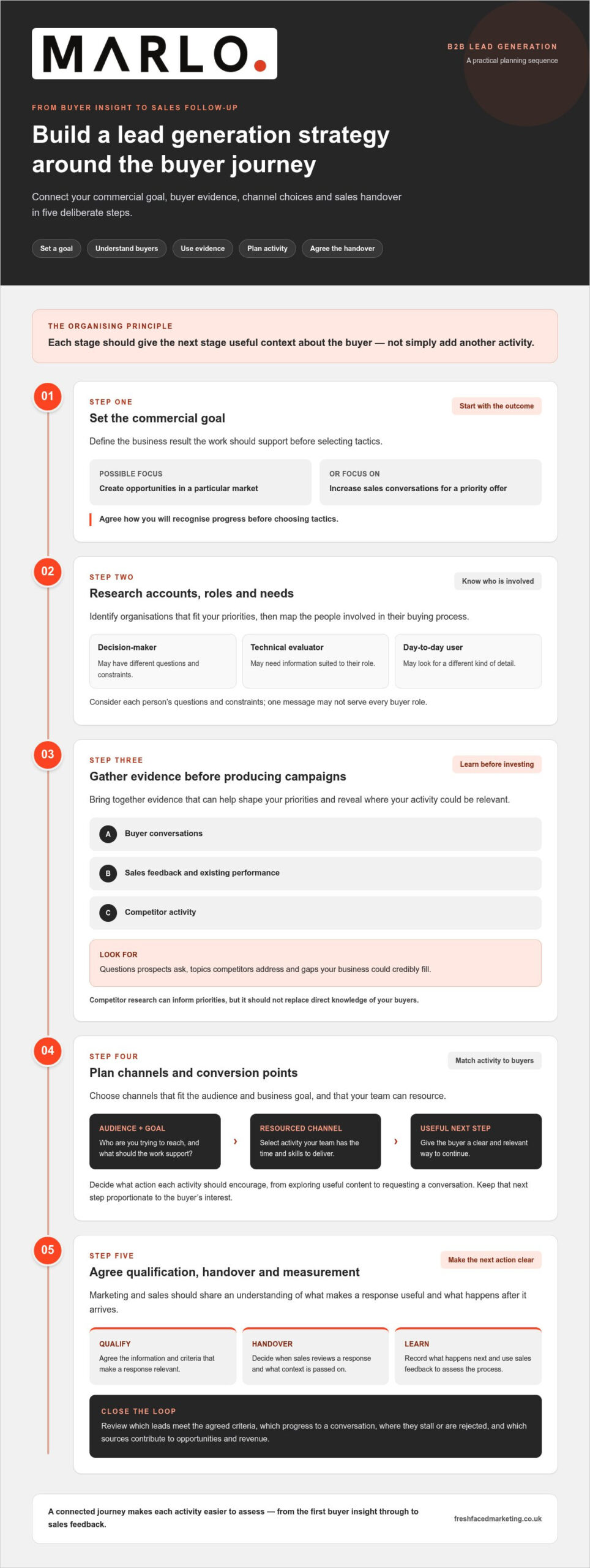
Design every lead-generation stage as one connected journey, with each step giving the next useful context about the buyer. Use this sequence to build a lead generation strategy for B2B:
- Set the commercial goal. Define the business outcome the work should support, such as creating opportunities in a particular market or increasing sales conversations for a priority offer. Agree how you’ll recognise progress before choosing tactics.
- Research accounts, roles and needs. Identify organisations that fit your commercial priorities, then map the people involved in their buying process. Consider their different questions and constraints. A decision-maker, technical evaluator and day-to-day user may need different information.
- Gather evidence before producing campaigns. Review buyer conversations, sales feedback, existing performance and competitor activity. Look for questions prospects ask, topics competitors address and gaps your business could credibly fill. Competitor research can inform priorities, but shouldn’t replace direct knowledge of your buyers.
- Plan channels and conversion points. Match the audience and business goal to channels your team can resource. Decide what action each activity should encourage, from exploring useful content to requesting a conversation. Make the next step clear, relevant and proportionate to the buyer’s interest.
- Agree qualification, handover and measurement. Define what information makes a response useful, when sales should review it and what context must accompany the handover. Track performance against the original goal and use sales feedback to adjust the plan.
Start with the right accounts, buying roles and needs
Account selection should reflect more than broad industry labels. Depending on your offer, consider organisation type, strategic fit and whether the business has a need your team can address. Then distinguish the account from its buying group. Several people may shape one decision, and each may enter the process with different knowledge. Map likely needs and information gaps, but don’t assume every prospect follows the same sequence.
Connect awareness, conversion, qualification and follow-up
Early-stage educational material can help someone understand a problem. Later, a detailed comparison or direct conversation may be more useful. Whatever the route, agree what counts as a lead and what makes it ready for sales review. Pass on the source, expressed interest and relevant interactions so follow-up responds to the person’s context rather than repeating generic messages. Teams shaping the wider plan can also explore broader marketing strategy planning to align lead generation with commercial priorities.
How to compare B2B lead generation channels and tools
Channel selection is a strategic decision, not a popularity contest. The right mix depends on who you need to reach, how they prefer to research, the outcome you’re pursuing and the capacity your team can sustain. A channel may attract attention but still be a poor fit if it reaches the wrong roles or requires resources you don’t have. In sector-specific fields such as construction, specialist digital marketing firms like harryandally.com focus on matching promotional channels directly to how industry contractors and decision-makers evaluate partners.
Choose channels by buyer behaviour and strategic purpose
Compare channels against the same questions: do they reach the intended audience, support the buyer’s current needs and fit your team’s capacity? Some channels help create demand; others capture existing interest. A combination can work when each activity has a clear role in the buyer journey.
| Channel | Potential role | Fit and operating demands to assess |
|---|---|---|
| Content | Explain a problem, answer questions and support evaluation. | Consider the audience’s information needs and your ability to produce and maintain useful material. |
| Search | Help buyers find relevant information when they’re actively researching. | Assess whether search topics match buyer intent and whether you can build visibility over time. |
| Paid media | Put a message in front of selected audiences or capture demand around relevant searches. | Check targeting options, available budget and the team’s capacity to monitor and refine campaigns. |
| Social | Build awareness, share expertise and support ongoing engagement. | Choose platforms based on where relevant buyers participate, not general popularity; account for regular publishing and interaction. |
| Outbound | Initiate relevant conversations with selected organisations or roles. | Consider account selection, message relevance and the time needed for thoughtful follow-up. |
Competitor activity can reveal which topics, channels and messages attract attention. Treat it as evidence to investigate, not a template to copy. Look for unanswered buyer questions or areas where competing messages are similar, then assess whether those opportunities fit your offer, audience and resources.
Assess tools by the decision they help a team make
Channels create or capture demand; tools support the work around them. A CRM organises prospect records and handovers, analytics helps teams understand activity and outcomes, and sales intelligence can support account and contact research. Google search and LinkedIn, for example, can help teams reach or research audiences. Neither replaces decisions about whom to target, what to say and how to qualify responses.
Competitor research tools answer a different question: what are other organisations doing across the market? MARLO competitor research and strategic insight is delivered through an interactive web dashboard. Select the competitors you want to analyse, then use the dashboard to review their search, content, social and paid media activity. MARLO also provides a strategic roadmap, with options prioritised against your goals, budget and resources. This evidence can inform channel priorities before campaign production.
For a practical comparison, list each channel and tool beside the decision it supports, its owner, the resources required and the outcome you’ll review. Keep the mix focused. Add activity when it fills a defined gap, not simply because a competitor uses it.
How to launch, measure and improve a B2B lead generation strategy
Measurement is useful when it informs a decision. Before launch, agree what the strategy is intended to achieve, how you’ll recognise progress and who will act on the findings. Review a lead generation strategy for B2B against its stated objective, not a disconnected set of activity totals.
Set useful measures before activity begins
Choose measures that follow the journey from audience fit to commercial outcome. Leading indicators show whether activity reaches and engages the intended audience. Pipeline and commercial measures show whether that activity contributes to sales opportunities and revenue. Neither tells the full story alone.
- Audience fit: Are responses coming from the organisations and roles the strategy intends to reach?
- Early engagement: Are people responding, exploring relevant content or completing the intended next step?
- Progression: Are leads moving to sales review, being accepted and progressing to a discussion?
- Commercial contribution: Which activity is associated with opportunities and revenue?
Record current performance before changing activity. Use consistent definitions, time periods and data sources so later comparisons are meaningful. If a measure has no reliable baseline, document the gap and establish one before drawing conclusions. Your own historical results are a more relevant reference point than a general industry benchmark because audience, offer and sales process all affect performance.
Agree how information will be recorded too. Capture campaign source, qualification status and sales feedback consistently. Without a shared record, a team may see rising responses but be unable to tell which ones fit the target audience or progressed beyond initial interest.
Turn results into a prioritised next action
Set a review point that gives the activity time to produce useful evidence. Marketing and sales can then assess the same journey: which audience was reached, what prompted engagement, whether leads met the agreed criteria and what happened after handover. Rejection reasons and stalled conversations can reveal problems with targeting, message relevance, timing or qualification.
End each review with a decision, an owner and a date to revisit it. Keep the record practical:
- Continue: Activity is reaching a relevant audience and progressing towards the stated objective.
- Change: The audience is appropriate, but the message, conversion step or follow-up needs adjustment.
- Stop or pause: Evidence suggests the activity isn’t serving the objective, or the team can’t support it effectively.
Turn those decisions into an actionable marketing roadmap: specify the next task, its owner, required resources and the result you’ll assess. This keeps learning connected to delivery instead of ending with a report. The principle is straightforward: report outcomes in relation to the objective the strategy was designed to achieve.
Fresh Faced’s marketing strategy and execution connects evidence-led planning with implementation, helping teams turn priorities into action.
When to use MARLO or the Marketing Success Blueprint for B2B growth
The right option depends on what’s missing from your planning process. If your team needs a clearer view of competitor activity to inform its next decisions, MARLO provides structured research through software. If you also need strategists to interrogate that evidence and shape it into an execution blueprint, the Marketing Success Blueprint (MSB) adds a human-led layer. These are separate offerings for related but distinct needs.
What MARLO contributes to strategy development
MARLO is software delivered through an interactive web dashboard. Choose the competitors you want to analyse, then use the dashboard to examine their search, content, social and paid media activity before committing to campaign production. MARLO organises competitor evidence into a strategic roadmap, with options prioritised against your goals, budget and resources.
Search analysis shows competitor rankings, keyword positions and non-branded opportunities in your market. Content analysis helps you see which competitor pages, posts and formats attract traffic and engagement. Social analysis covers 90 days of competitor activity, including posting frequency and engagement. Paid media analysis identifies active campaigns across Google, Meta and LinkedIn, alongside PPC keywords and cost-per-click information.
This view helps teams investigate where they’re visible, where competitors are attracting attention and which options merit closer consideration. The roadmap also provides budget and resource guidance, mapping channels against your available budget so recommendations are achievable. Your commercial objectives and knowledge of your buyers remain important when deciding what to prioritise. MARLO gives you competitor research and a strategic roadmap in an interactive dashboard, with access to your report indefinitely.
When the Marketing Success Blueprint is the better fit
Choose the MSB when your team needs more than access to competitor research. This premium, human-in-the-loop service includes forensic-level competitive analysis across channels, human-led interrogation of the data and a detailed execution blueprint you can hand to a team or agency. It turns findings into a considered sequence of decisions and activity.
The MSB includes direct access to the Fresh Faced strategists who built the methodology, two one-to-one strategy calls and a two-to-three-hour strategy workshop. These sessions create space to examine the evidence, test assumptions against your business context and align on priorities. MARLO is the software and research tool; the MSB is a separate service that adds human-led analysis and strategic direction.
There’s a practical distinction between deciding what to do and delivering the plan. Use competitor insight to clarify priorities, choose the MSB when you need human interpretation and a handover-ready blueprint, and use full marketing strategy execution to put the agreed direction into practice. The right route depends on whether your main need is research, strategic interpretation or delivery.
Explore a more evidence-led approach to B2B growth and consider which level of support best fits your team’s next decision.
Make your next pipeline decision evidence-led
A more dependable pipeline starts with a focused decision: which audience, opportunity or handover needs attention first? Use what you’ve learned from your own results to choose a priority, agree who will act and decide how you’ll judge progress. That gives your lead generation strategy for B2B a clear next step without adding activity for its own sake.
If your team needs to decide where to focus, Fresh Faced can turn market evidence into practical priorities. Choose the level of support that fits your needs, from competitor insight to human-led strategic planning and execution. The aim isn’t a busier marketing calendar. It’s a clearer path from informed choices to meaningful sales opportunities.
Explore Fresh Faced’s evidence-led approach and identify a practical next move for your pipeline. With clear priorities and shared measures in place, your team can build momentum with greater confidence.
Frequently Asked Questions
What is a B2B lead generation strategy?
A B2B lead generation strategy is the operating plan that helps a business turn interest from potential buyers into relevant sales opportunities. It connects the commercial outcome to decisions about who to reach, what evidence of interest matters and how teams respond. For example, a business targeting larger organisations might distinguish a general content download from engagement by a role involved in evaluating its solution.
How do you create a lead generation strategy for B2B?
Build the plan around a specific commercial objective, then use customer conversations, sales records and existing campaign results to identify what needs to change. For a lead generation strategy for B2B, document which account types matter, what buyer signals are meaningful and what sales should do when those signals appear. Start with a manageable set of priorities, then refine them using evidence from actual prospect interactions.
Which channels work best for B2B lead generation?
The most suitable channels depend on where your intended buyers look for information and what they need to do next. Search content may help reach people actively researching a problem; LinkedIn activity could support visibility among professional audiences; direct outreach may suit a tightly defined account list. A channel combination can cover different moments, but only if your team can maintain it and connect responses to useful follow-up.
How can a B2B business measure lead generation success?
Assess performance against the business result the activity is meant to support. Compare groups of leads by source, target-account fit and subsequent sales progress, using consistent CRM records. This can reveal whether a source attracts relevant organisations but fails to prompt a conversation, or whether a smaller group advances further. Allow for the organisation’s sales cycle before judging whether an opportunity has progressed.
What is the difference between a lead and a qualified lead?
A lead is a person or organisation that has shown some interest or entered your records; a qualified lead has also met criteria your marketing and sales teams agree indicate relevance or readiness for review. For example, a newsletter subscriber may be a lead, whilst a contact at a target organisation who has raised a relevant business need may warrant sales attention. Qualification should reflect your offer and buying process.
Can competitor research improve B2B lead generation?
Yes. Competitor research can show which topics, search terms and campaign approaches already receive attention, helping you spot areas to investigate before investing in new activity. If several competitors discuss the same problem, compare their coverage with questions your sales team hears from prospects. That may suggest a useful content angle, but validate it with buyer evidence rather than assuming competitor activity proves demand.
What is the difference between MARLO and the Marketing Success Blueprint?
MARLO is software for competitor research and strategic insight; the Marketing Success Blueprint (MSB) is a separate, premium human-led service. MARLO gives teams an interactive dashboard and research to inform decisions. The MSB adds strategist-led analysis and a detailed execution blueprint. Choose based on whether your team mainly needs structured competitor insight or also needs expert interpretation to shape the plan.