A channel list isn’t a SaaS marketing plan. A marketing plan for a SaaS company UK teams can rely on starts with the customer lifecycle: how prospects discover the product, evaluate it, become customers and decide to stay. Marketing can look busy while remaining disconnected from pipeline, revenue and retention, so the plan needs to show how activity supports business outcomes.
It’s understandable to find channel choices difficult. SaaS buying journeys can be long, recurring revenue takes time to interpret, and limited resources make every priority count. Rather than trying to do more everywhere, identify the customers you need to reach, what they need at each stage and how marketing can support your business goals.
This guide explains how to research your market, define objectives and map the funnel before selecting channels. You’ll learn to prioritise activity against available budget and resource, then measure performance from first interaction through acquisition and customer outcomes. The result should be a practical roadmap your team can review and adapt as evidence accumulates, rather than a static plan or a collection of disconnected tactics.
Key Takeaways
- Clarify the decisions, priorities, owners and measures your marketing plan must set before choosing channels.
- Use customer conversations, competitor research and current performance data to uncover where your strongest opportunities may lie.
- Assess channels by audience fit, buying intent, evidence, effort and measurement readiness, not by popularity alone.
- Build a marketing plan for a SaaS company UK teams can act on by sequencing initiatives into phases with clear owners and review points.
- Use competitor search, content, social and paid media analysis to inform priorities, then translate the evidence into a practical roadmap.
What a SaaS marketing plan needs before choosing channels
A marketing plan is more than a list of campaigns. It sets out the decisions the team will make, the priorities it will pursue, who owns the work and how progress will be measured against business goals. A strategy document explains the broader direction; a channel calendar schedules activity. The plan connects the two, turning direction into owned, measurable work. For a marketing plan for a SaaS company UK teams can use, that connection needs to reflect how customers discover, adopt and renew a subscription product.
SaaS growth is shaped by recurring revenue, product adoption and renewals, as well as sales cycles that can vary by segment or buyer. A campaign that generates enquiries may not show its full value immediately. Set the commercial context first, so channel choices respond to how the product is bought and used.
Definition: A SaaS marketing plan records the business goals, priority audiences, marketing objectives, chosen initiatives, owners, resources and measures for a defined period. It links activity to acquisition, activation or retention, and sets out how the team will review progress.
This is consistent with the broader role of marketing planning: Understanding the Marketing Plan means seeing it as a practical route from business direction to coordinated action, not simply a schedule of promotional activity.
Which SaaS business inputs should shape the plan?
Begin with the people and problems the product serves. Record priority customer segments, the buyer and user roles involved, the use cases that matter, and the problems that prompt a search for a solution. A finance lead and a day-to-day product user may assess the same software differently. Capture both perspectives, using evidence from customer conversations, sales discussions and support interactions.
Then document the offer and how it reaches the market. Note the current product, pricing model, sales route and any role the product experience plays in evaluation or onboarding. This helps distinguish a need for more qualified demand from a friction point after sign-up. For example, if prospects understand the offer but new users fail to reach a key feature, more acquisition activity may not address the main barrier.
Finally, make the constraints explicit: growth goals, available team capacity, marketing budget and planning horizon. A plan that assumes skills or resources the team doesn’t have is not actionable. Set priorities within what can realistically be delivered, and identify dependencies such as sales input, product changes or customer evidence. A useful test is whether each proposed initiative has an owner, the time and skills to deliver it, and a clear link to a business objective.
How should SaaS goals connect to marketing outcomes?
Translate each business priority into a marketing objective, then choose a measure that reflects the intended outcome. If the priority is acquisition, define which segment and type of qualified opportunity matter. If activation is the issue, focus on the steps that help new customers reach product value. If retention is the priority, connect marketing activity to customer engagement or renewal outcomes.
Separate leading indicators from business results. A leading indicator, such as qualified enquiries or completion of an onboarding step, can show whether activity is moving in the intended direction. Revenue, new customers and renewals are outcomes. Track both, but don’t treat an early signal as proof of commercial impact.
Set targets using the company’s own historical performance, customer economics and sales cycle. Generic benchmarks can provide context, but they can’t account for your product, audience or buying process. Start with a clear baseline, assign an owner to each measure, and agree when the team will review it. Record how each measure is defined, too, so marketing and sales use the same terms when assessing progress.
How to research the UK SaaS market, audience and competitors
Research should test assumptions, not simply collect information. Keep a record of what you find, where it came from and what decision it could change. For a marketing plan for a SaaS company UK teams can act on, combine first-hand customer evidence with competitor observations and your own performance data. Avoid treating a market-size estimate or a competitor’s visibility as proof that demand exists for your offer.
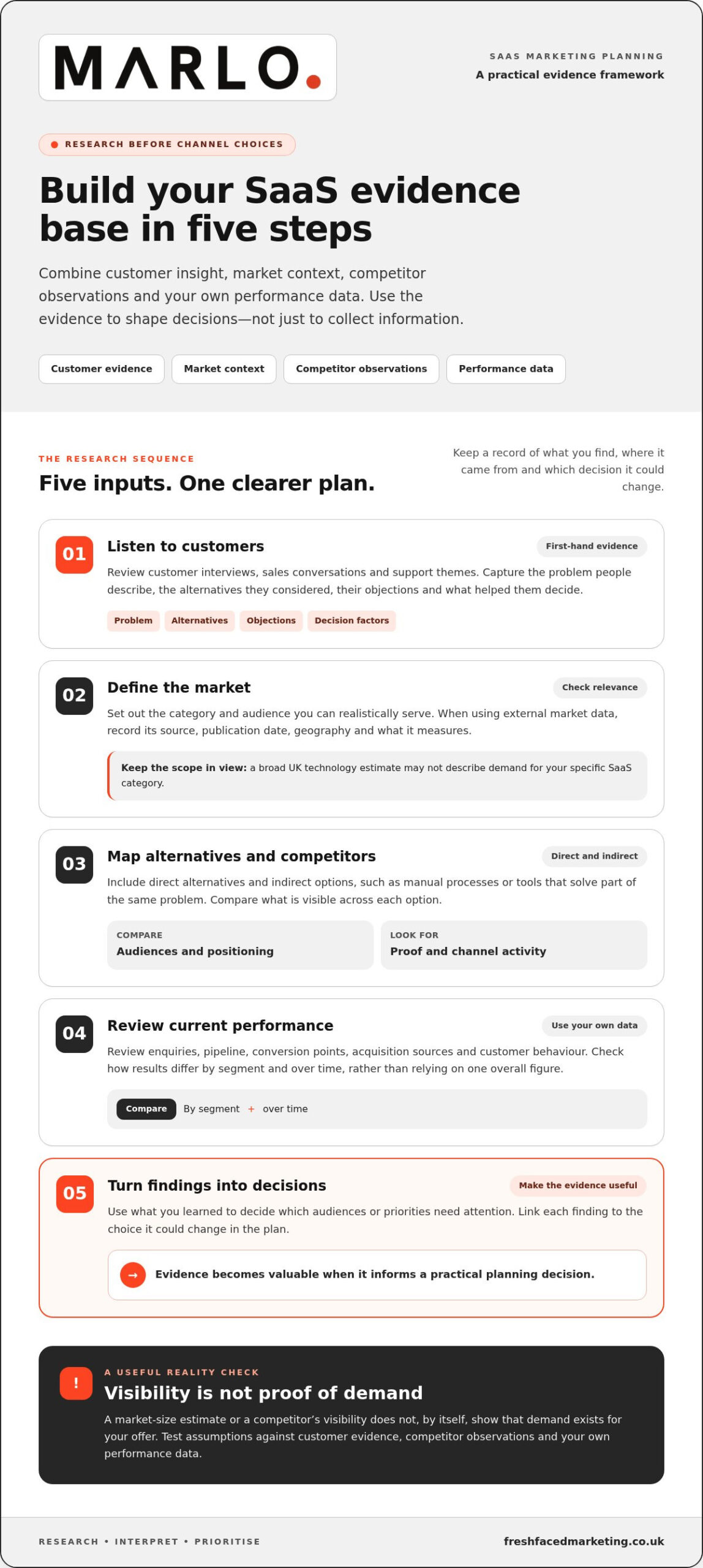
Use this five-step process to build a working evidence base:
- Customers: Review customer interviews, sales conversations and support themes. Record the problem people describe, the alternatives they considered, their objections and what helped them decide.
- Market: Define the category and audience you can realistically serve. If you use external market data, note the source, publication date, geography and what it measures. A broad UK technology estimate may not describe demand for your specific SaaS category.
- Competitors: Map direct alternatives and indirect options, including manual processes or tools that solve part of the same problem. Compare their audiences, positioning, proof and visible channel activity.
- Current performance: Review your own enquiries, pipeline, conversion points, acquisition sources and customer behaviour. Check how results differ by segment and over time, rather than relying on a single overall figure.
- Implications: Turn findings into decisions. State which audience or need appears most relevant, what evidence supports that view, what remains uncertain and what the team should investigate or test next.
How do you identify SaaS audiences and buying triggers?
Segment only where the business model supports a meaningful distinction. Firmographic traits such as organisation size or industry may matter for a business-to-business product; role, use case and problem may be more revealing for another offer. For each priority segment, map questions across awareness, evaluation, purchase and onboarding. Ask sales and support teams which concerns recur, including switching effort, integration needs, risk and decision criteria. Customer language can reveal the words and proof prospects need before taking the next step.
Make the segment actionable by describing who is involved, what prompts them to look for a solution and what might prevent them from choosing it. A segment defined only by broad company characteristics may not tell the team what to say or where to reach potential buyers. Add the use case and buying trigger so the plan can guide messaging and channel decisions.
What competitor evidence should inform SaaS positioning?
Compare what competitors say with what they make visible: website messages and proof, search visibility, content topics, social activity and paid campaigns. Look for audiences or needs receiving less attention, but treat gaps as hypotheses, not guaranteed demand. A quiet search result or absent campaign could reflect low opportunity as easily as an overlooked one. Validate potential openings against customer conversations and your own market evidence. A structured competitor research approach can help organise these observations into decisions.
For a closer comparison, assess each competitor against the same questions: who they target, what problem they claim to solve, what evidence supports the claim and which channels appear active. Keep observations separate from interpretation. “No visible campaign found” is an observation; “this audience is underserved” is a hypothesis to test.
Close the research stage with a short evidence summary: strongest customer signals, relevant market context, competitor patterns, current performance and unresolved questions. Turn each key finding into a planning implication. For example, if a competitor’s content earns attention around a recurring customer problem, check whether that problem matters to your own priority audience before committing production resource. Explore Fresh Faced’s evidence-led approach to see how competitor insights can inform marketing priorities.
How to choose SaaS marketing channels and measures
Choose channels against a defined audience and business objective, not because competitors use them or they’re familiar to the team. Compare audience fit, buying intent, evidence of potential, effort, cost and measurement readiness. A channel with strong reach but no clear route to qualified demand may be a lower priority than one that reaches fewer, better-matched prospects.
Use the table to frame the discussion. The right choice depends on your SaaS buying journey, internal capacity and the evidence you gathered during research. Before committing, specify the audience, the activity you’ll test, the outcome you’ll measure and what result would justify continuing.
| Channel | Potential role | Useful measures | Check before prioritising |
|---|---|---|---|
| Content | Explain problems, use cases and product value | Engaged visits, content-assisted enquiries, qualified opportunities | Can you produce credible, useful material consistently? |
| Organic search | Reach people researching needs or solutions | Relevant organic visits, conversions, qualified demand | Are there valuable topics your audience actively seeks? |
| Paid media | Test messages or reach defined audiences quickly | Qualified leads, opportunity progression, acquisition outcomes | Can you track results beyond clicks and afford a valid test? |
| Nurture prospects or support customer adoption | Meaningful engagement, next-step conversions, activation | Do you have a relevant audience and a clear reason to communicate? | |
| Partnerships | Reach audiences through trusted organisations or advisers | Introductions, qualified opportunities, customer outcomes | Is there a genuine audience fit and a workable shared proposition? |
Product-led and sales-led motions change the emphasis, not the underlying test. A product-led team may prioritise channels that bring suitable users into a trial or self-serve experience, then measure meaningful product use. A sales-led team may focus on reaching buying groups and creating qualified conversations, with pipeline progression as a key measure. Some businesses combine both. Let the buying process and available evidence determine the balance.
Which metrics reveal progress across the SaaS customer lifecycle?
Map measures to the outcome you’re trying to influence. For acquisition, track qualified demand and, where relevant, opportunities entering and progressing through the pipeline. Define activation through product-specific actions that demonstrate early value, rather than sign-ups alone. If retention or expansion supports the business objective, monitor related customer engagement, renewal or account-growth outcomes. Assign each measure an owner and a review point.
Keep the measure close to the decision it supports. If the objective is to improve trial-to-customer conversion, for example, review the steps between registration and purchase, not just total trial sign-ups. If the objective is to improve retention, separate the customer groups or use cases being assessed so an overall figure doesn’t conceal different patterns.
How can a SaaS team avoid vanity metrics?
Pair reach, traffic or engagement with what happens next: conversion, qualification, product use or customer outcomes. Establish a baseline before judging a change, and record other factors that could affect results. Attribution has limits, particularly when buying journeys involve several channels and interactions. Treat channel data as evidence to assess, not automatic proof that one campaign caused a revenue result.
A marketing plan for a SaaS company UK teams can improve over time gives each channel a job, a measure and a decision rule: continue, adjust or investigate further. This keeps reporting focused on useful choices rather than numbers that look positive but don’t inform action. Explore Fresh Faced’s marketing strategy approach for support turning evidence into practical priorities.
How to turn SaaS marketing research into a practical 12-month plan
A 12-month roadmap gives the team direction without pretending every decision can be made in advance. Convert research into initiatives, then rank them by strategic fit, strength of evidence, available resources and dependencies. An initiative may fit the goal but depend on product work or sales input. Make that dependency visible before assigning a delivery date.
How should a SaaS team prioritise marketing initiatives?
Score each opportunity against the business goal it supports, the audience evidence behind it and the team’s capacity to deliver it. Separate foundational work, such as measurement or message development, from experiments designed to test an assumption and ongoing channel activity. For each item, record the assumption and what evidence would change its priority. This makes trade-offs clear when capacity is limited.
Build the year in phases rather than filling every month with fixed campaigns. For example, an early phase could establish tracking and prepare a message test; a later phase could use what the team learns to refine content or channel investment. The sequence should reflect your own dependencies and buying cycle, not a standard template. Make space for review, too, so the roadmap can respond to results instead of treating the original schedule as fixed.
| Roadmap phase | What to define |
|---|---|
| Prepare | Owner, foundation work, required inputs and baseline measures |
| Test | Experiment, audience, deliverable, success signal and decision date |
| Develop | What to scale or refine, resource needs and downstream outcome |
| Review | Results, learning, next action and any revised assumptions |
Every initiative needs one accountable owner, a deliverable, a measure and a review point. Include dependencies and capacity, not just deadlines. A content project, for instance, may require subject-matter input before production; without that, its planned launch date is not realistic. A marketing roadmap alignment guide can help clarify how planned activity should support business priorities.
How often should a SaaS marketing plan be reviewed?
Set review points that match how quickly reliable evidence becomes available and when the team can make decisions. At each review, check delivery against plan, channel contribution, resource constraints and new customer or market evidence. Avoid changing direction because of one short-term fluctuation; look for a meaningful signal in context, including the time needed for a sales cycle or customer outcome to emerge.
Use a simple decision for each initiative: retain it if evidence supports continued investment, refine it if the approach needs adjustment, or stop it if the rationale no longer holds. Record why. This protects strategic intent while allowing the roadmap to adapt as the evidence changes.
A marketing plan for a SaaS company UK teams can use should make priorities, ownership and learning visible across the year. Discuss your strategy with Fresh Faced to shape competitor evidence and business goals into a practical marketing roadmap.
How Fresh Faced can help turn SaaS evidence into a plan
Competitor research is most useful when it informs a decision: which audience to prioritise, what message to test or where to focus limited resource. Fresh Faced offers two distinct ways to support that work. MARLO is software for interactive competitor analysis and strategic direction. The Marketing Success Blueprint (MSB) is a separate, premium service that adds human-led analysis and a detailed execution blueprint. Neither replaces your knowledge of customers or your own business data. Each helps make evidence easier to assess and apply.
What does MARLO contribute to SaaS marketing planning?
MARLO presents competitor intelligence in an interactive web dashboard. You choose the competitors, then use one report to explore what they’re doing across search, content, social and paid media. Search analysis shows competitor rankings and keywords, including potential non-branded opportunities. Content analysis compares the pages, posts and formats that attract traffic and engagement. Social analysis examines competitor activity and engagement, while paid media analysis reviews visible campaigns, PPC keywords and cost-per-click information.
These are separate evidence sources, not a verdict on which channel your SaaS company should choose. Compare the findings with customer needs, your own performance and the resources available. A competitor’s active campaign may be worth investigating, but it doesn’t prove that the same investment will work for your product. Likewise, an apparent gap is a hypothesis to assess, not a guarantee of demand.
MARLO also provides a strategic roadmap and budget and resource guidance. These inputs help organise potential activity against business goals and practical constraints, so the team can consider what to do, in what order and with the capacity available. Explore MARLO to see how competitor evidence can inform your planning.
When does the Marketing Success Blueprint add human input?
The MSB is designed for teams that want strategists to interrogate the evidence and shape it into a more substantial plan. It goes beyond MARLO’s software-based analysis with forensic competitor analysis across channels, direct input from Fresh Faced strategists and a detailed execution blueprint that can be handed to a team or agency.
The process includes a two-to-three-hour strategy workshop and two one-to-one strategy calls. This human input can help clarify which findings matter most, challenge assumptions and connect priorities to an actionable sequence. The MSB is distinct from MARLO: it builds on the evidence with strategic interpretation and planning, rather than being another dashboard or a promise of standalone channel management.
If your team is building a marketing plan for a SaaS company UK, consider which gap you need to address first: competitor evidence, strategic interpretation or a clearer handover for execution. Discuss your marketing planning needs with Fresh Faced to explore whether MARLO or the MSB best fits your next step.
Put your next marketing decision into motion
A plan becomes useful when it changes what the team does next. Choose one priority to act on, name an owner and agree what evidence will show whether the work is helping. Keep the first step proportionate to your capacity. The aim isn’t to predict every result, but to create a disciplined way to make and improve decisions.
A marketing plan for a SaaS company UK teams can rely on should stay connected to business goals as the market, customer needs and internal priorities shift. Treat it as a working tool: revisit assumptions, learn from performance and adjust activity without losing sight of the outcome you’re pursuing.
Ready to turn your priorities into a clearer direction for the year ahead? Plan your next step with Fresh Faced. MARLO brings competitor intelligence together in an interactive dashboard, while the Marketing Success Blueprint adds human-led strategic analysis and a detailed execution blueprint. Choose the support that fits the decision your team needs to make next.
Frequently Asked Questions
What should a marketing plan for a SaaS company include?
It should show how marketing will support the company’s commercial priorities, from reaching suitable prospects to helping customers gain value from the product. Include audience and product context, chosen initiatives, owners, budget, timing and measures. Also record key assumptions and dependencies, such as product changes or sales-team input. This makes the plan useful when priorities shift, because the team can see what each activity depends on and what it is intended to influence.
How do you create a marketing plan for a SaaS company?
Start with one business priority and define the customer group it concerns. Then check existing evidence, including sales feedback, customer behaviour and past campaign results. Select a focused set of initiatives the team can deliver, assign owners and agree how progress will be assessed. For example, if trial users aren’t reaching a key feature, investigate onboarding barriers before increasing acquisition activity. The plan should turn that finding into a testable action, not an assumption.
Which marketing channels work best for SaaS companies?
No single channel works best for every SaaS business. The right mix depends on where its buyers look for information, how they evaluate software and whether they purchase independently or with a sales team. A product with a self-serve trial might test educational content alongside onboarding emails; a complex business product may need channels that support several decision-makers. Start with one audience and one clear objective, then compare channel contribution using consistent measures.
How should a SaaS company measure marketing performance?
Measure performance at more than one point in the customer journey. For example, connect a campaign’s qualified enquiries to opportunities and, where data allows, eventual customer acquisition. For product-led journeys, examine whether acquired users reach meaningful product actions, not only whether they register. Use consistent definitions across marketing and sales, and account for the delay between first interaction and purchase. This gives the team a more credible view than attributing revenue to the last click alone.
How often should a SaaS marketing plan be updated?
Review it on a regular schedule that fits your sales cycle and how quickly useful evidence becomes available. A monthly check may help teams spot delivery or capacity issues, whilst a deeper quarterly review can assess whether priorities still fit business goals. Revisit the plan sooner if a major product change, customer insight or shift in company direction affects its assumptions. Update actions where needed, and document why the change was made.
What is the difference between a SaaS marketing strategy and a marketing plan?
A strategy sets the broad direction: which customers the business intends to serve and how it aims to compete for their attention and trust. The plan translates that direction into decisions the team can carry out, including the work to prioritise, who will lead it and how progress will be assessed. For example, a strategy may favour a particular market segment; the plan specifies how the team will test and reach that segment.
Can a small SaaS team create a marketing plan without an agency?
Yes. A small team can build a useful first plan using customer feedback, sales records, product data and a realistic view of its capacity. Keep the scope focused, document what the team doesn’t yet know and avoid committing to more channels than it can manage. External strategic support can help when the team needs structured competitor analysis, interpretation or an execution blueprint. Fresh Faced’s MARLO and Marketing Success Blueprint provide distinct options for that support.