
A crowded market doesn’t mean growth is out of reach. It means guesswork gets expensive. When competitors sound alike, it becomes harder to choose which audience to pursue and where your budget can make a difference. Navigating market saturation with strategy starts with evidence, not louder promotion.
If your marketing feels indistinguishable from the competition, or investment is spread across tactics without a clear reason, you may have a strategic problem. This article shows you how to diagnose market pressure, identify customer opportunities and choose a defensible position that supports lead acquisition and revenue generation.
You’ll learn how to assess competitor activity and customer needs, prioritise opportunities against your goals and resources, and turn your findings into a focused marketing plan. The aim is practical clarity: know which audience to serve, what sets your offer apart and where to invest.
Key Takeaways
- Distinguish intense competition from a mature category or weak differentiation before deciding how to respond.
- Use customer needs, competitor activity and your own performance to uncover market gaps, separating evidence from assumptions.
- Compare differentiation, a new audience and channel reallocation against the evidence, resources and risks involved.
- Turn navigating market saturation with strategy into a focused plan with clear priorities, owners, measures and decision points.
- Understand when internal analysis is enough and when MARLO’s research dashboard or the separate, human-led Marketing Success Blueprint could support your next decision.
Navigating market saturation with strategy: diagnose what is actually crowded
When several competitors offer similar products, growth can feel harder. But visible competition alone doesn’t mean demand has run out. A crowded market is one where providers compete intensely for existing demand; an exhausted opportunity is one where relevant customer needs are already met and viable demand is limited. The distinction matters: even a crowded market may contain customers whose needs are underserved.
The economic concept of market saturation offers useful context, but a business diagnosis needs more than a general definition. Separate three conditions that are often mistaken for one another:
- Category maturity: The category is established, and growth may depend more on winning customers from alternatives than introducing the category to new buyers.
- Competitor density: Many providers target similar customers. This can intensify competition without proving that customer demand is fully served.
- Weak differentiation: Buyers struggle to see why one offer is different. The issue may be positioning, not a lack of market opportunity.
Each condition points to a different response. Category maturity calls for a realistic view of demand. High competitor density calls for closer analysis of customer segments and needs. Weak differentiation calls for examining how your offer is presented and understood.
How can you tell whether your market is saturated?
Look for patterns in qualified enquiries, conversion quality and customer retention over time. Review these measures by audience and offer. If enquiries have fallen for one segment but remain steady for another, the whole market may not be the problem. If enquiries are stable but fewer convert, investigate the proposition, sales process and fit between audience and offer.
Treat falling response or rising acquisition friction as signals to investigate, not proof of saturation. Check whether seasonality, measurement changes or shifts in channel activity could explain the pattern. A change in one campaign or channel isn’t enough to establish a market-wide condition.
What saturation does, and does not, mean for growth
Competitors serving the same broad need don’t prove that every customer need is met. Buyers may be poorly served by existing offers, overlooked by current messaging or looking for a different combination of features, service or value. These are hypotheses to test against evidence, not assumptions to build a strategy around.
Also distinguish limited category demand from weak visibility. If the right audience doesn’t encounter your offer, a lack of response may reflect reach rather than saturation. If people see it but don’t understand its relevance, the proposition may need clarification. Navigating market saturation with strategy starts by identifying which condition the evidence supports, then testing the next decision against that diagnosis.
Use market evidence to find unmet demand and competitive gaps
A credible opportunity needs more than an appealing hunch. Build a focused evidence set from three sources: customer needs, competitor activity and your own business performance. Each reveals a different part of the picture. Customer conversations can uncover recurring questions or unmet needs. Competitor analysis shows how other providers position their offers and which audiences they appear to target. Your enquiry, conversion and retention data shows where interest becomes business, and where it drops away.
Which customer and competitor signals should you investigate?
Look for patterns in what customers ask, what they say is missing and why prospects choose another provider. Compare those observations with competitor positioning, content performance and visible audience focus. A competitor publishing extensively on a topic may signal an area of investment, but it doesn’t prove that the content meets customer needs or generates business.
Search traffic can add another useful layer. Review the terms competitors attract visitors for, including uncaptured non-branded opportunities related to customer needs rather than a company name. Treat these as leads for investigation, not guaranteed revenue. Search interest alone can’t establish whether people are a good fit, ready to buy or reachable with your current offer.
For a structured view of competitive pressure, Harvard Business School outlines a framework for analysing industry competition. Use it to consider rivalry, potential entrants and alternatives alongside customer evidence. For practical guidance on the research process, see this article on forensic competitor research.
How do you turn findings into a credible opportunity?
Write each potential opportunity as a testable statement. Name the audience, the need and the evidence supporting it. For example: “Prospective customers in this segment repeatedly ask for a particular outcome; current competitor messaging does not clearly address it.” Then mark which parts are observed and which are assumptions. If you haven’t confirmed that customers will choose or pay for a relevant offer, record that as a gap to validate.
Finally, check whether your business can serve the audience credibly with its existing capabilities. Consider delivery requirements, fit with your goals and the resources available. An opportunity isn’t actionable simply because competitors appear to overlook it. Navigating market saturation with strategy means testing the evidence, recording uncertainty and selecting only opportunities your business can pursue.
If you need a consolidated view of competitor and market signals, MARLO’s market research dashboard provides one comprehensive report. You choose the competitors to assess and retain indefinite access to the data.
Compare strategic responses to market saturation before spending
Once you’ve identified a credible gap, choose a response that fits the evidence and your ability to deliver. Consider three options separately: sharpen differentiation, pursue a new audience or reallocate investment between channels. They solve different problems. A channel change won’t fix an unclear offer, and entering a new segment won’t help if the business can’t meet its needs.
Sharpen differentiation or expand the audience?
Sharpen differentiation when evidence points to unmet needs among your current audience, but your offer or messaging doesn’t make its relevance clear. Look for recurring customer requests, objections or reasons prospects choose alternatives. The work may centre on refining the proposition and how it’s communicated. The risk is making a change based on a handful of opinions rather than a consistent pattern.
Consider a new audience when a distinct group has a relevant need and there’s evidence you can reach it. Assess whether your existing offer fits, or whether changes to delivery, capability or positioning would be required. This may open a different route to growth, but it also brings execution demands. Don’t commit on the basis of an assumed audience need or competitor absence alone.
How should you compare channels and investment options?
Reallocate channel investment when evidence shows a better fit between a channel and your target audience, and you can measure meaningful outcomes there. Compare audience reach, the quality of available performance data and the expertise needed to execute. Paid-media cost-per-click data can help assess competition and potential access to an audience. It doesn’t establish lead quality, conversion likelihood or return on its own.
Use the same decision criteria for each option:
- Evidence: What observed customer or performance data supports the choice?
- Resources: What budget, time, capability and delivery changes will it require?
- Risk: What assumption could prove wrong, and how will you test it before committing further?
- Fit: Does it support your business goals and current capacity?
This comparison helps avoid a familiar mistake: moving spend into another channel before confirming that the audience and offer are clear. Prioritise the option you can support with evidence and execute with available resources. Set a measure and review point before committing more. There’s no guaranteed return, but a disciplined comparison makes the reasoning behind each pound clearer.
Navigating market saturation with strategy means choosing a proportionate response, not adding activity by default. For a broader view of how Fresh Faced approaches marketing strategy, see Fresh Faced’s strategy support.
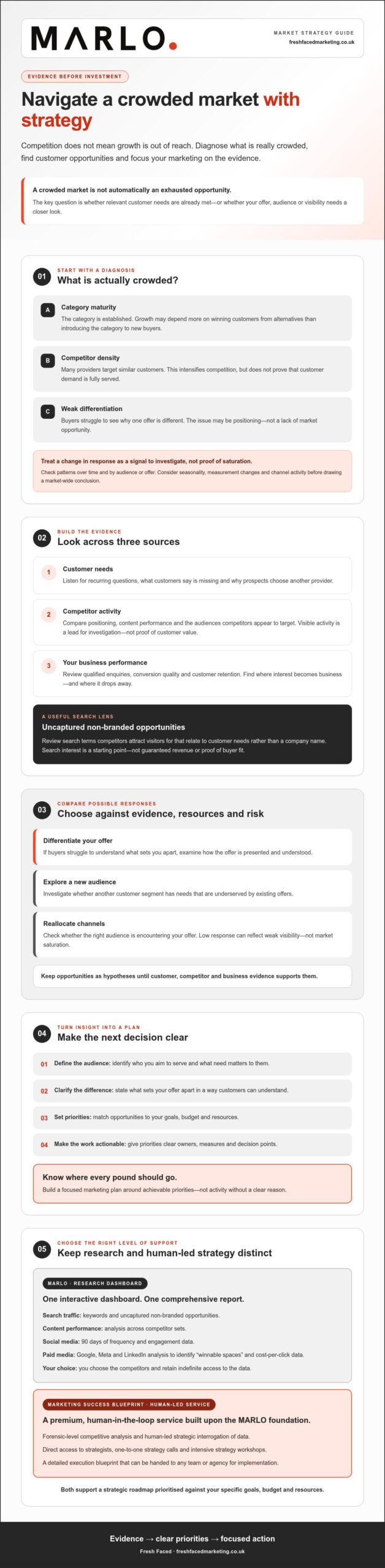
Build a market-saturation strategy around evidence and achievable priorities
Market analysis creates value when it informs action. Use a clear sequence: define the business goal, assess the evidence, select an opportunity, assign resources and review the results. This keeps decisions connected to what the business needs, rather than producing an unranked list of tactics.
How do you prioritise opportunities against business goals?
Assess each opportunity against three criteria: evidence strength, strategic relevance and delivery feasibility. Record what supports the opportunity, how directly it contributes to the goal, and whether your team has the budget, people and operational capacity to act. An idea with strong evidence may still need to wait if delivery would displace a higher-priority commitment.
Keep the shortlist tight. A prioritised set of actions makes trade-offs visible and helps the team focus. A long catalogue of possible tactics obscures what matters most and spreads attention across work that may not be achievable.
How can you measure whether the strategy is working?
For each recommendation, specify four things before work begins:
- Owner: Who is accountable for moving it forward?
- Action: What will they do, and for which audience or offer?
- Measure: What verified indicator connects the activity to lead acquisition, revenue generation or the stated goal?
- Decision point: When will the team review the evidence and decide whether to continue, adjust or stop?
Use the business’s own baseline and consistent measurement definitions. Don’t import a generic benchmark or change how results are counted midway through an activity. If a recommendation rests on an untested assumption, stage it as a test: define its scope, track the agreed measure and treat the result as evidence to assess, not a proven outcome.
Then review what the evidence shows. Continue where results support the original rationale; refine the approach where they reveal a correctable weakness; stop or reassess when the underlying assumption isn’t supported. This creates a practical learning cycle without treating early signals as certainty.
For broader planning context, read the marketing strategy blueprint guide. Navigating market saturation with strategy means translating evidence into achievable priorities, clear accountability and measured decisions. To explore strategic support aligned with your goals and resources, discuss marketing strategy with Fresh Faced.
Choose the right support for navigating market saturation with strategy
Internal analysis may be enough when you have reliable customer and performance data, a clear business goal, and the expertise to interpret findings and set priorities. Consider deeper competitive analysis when evidence is fragmented, assumptions are driving decisions or your team needs an actionable plan linked to available resources. The right level of support depends on the decision you need to make, not on how much activity you can add.
What does MARLO help a business examine?
MARLO is an interactive web dashboard that provides one comprehensive report. It brings together search traffic analysis, including keywords and uncaptured non-branded opportunities; competitor content performance; and 90 days of social media data covering frequency and engagement. Paid media analysis across Google, Meta and LinkedIn can identify winnable spaces and cost-per-click data.
You choose the competitors for analysis and retain indefinite access to the data. MARLO provides a research and diagnostic foundation: it helps you examine the market and identify where further investigation may be useful. Search visibility or paid-media costs are evidence to consider, not proof of demand, conversion or revenue. Explore MARLO’s market and competitor research when you need a consolidated view to inform your next decision.
When is the Marketing Success Blueprint the better fit?
The Marketing Success Blueprint is a separate, premium, human-in-the-loop service built on the MARLO foundation. It’s suited to businesses that need more than research findings: forensic-level competitive analysis, human-led strategic interrogation of the data and a considered route from evidence to action.
The process includes direct access to strategists, one-to-one strategy calls and intensive workshops. Its output is a detailed execution blueprint that prioritises recommendations against your goals, budget and resources. You can hand it to any team or agency for implementation. The distinction is practical: MARLO provides the research dashboard and comprehensive report; the Blueprint adds human strategic analysis and a plan for putting priorities into practice.
Choose the route that matches your current need. If you have the capacity to interpret research internally, a diagnostic foundation may be the right starting point. If you need expert analysis and a prioritised execution plan, the human-led service offers a more substantial level of strategic support. Discuss a strategy built around your evidence.
Turn market evidence into your next growth move
A crowded market isn’t a reason to spend more without direction. Diagnose what’s limiting progress, look for unmet customer needs and compare strategic options against your goals and capacity. Then turn the strongest opportunity into a focused plan with clear ownership, measures and review points.
Navigating market saturation with strategy means making decisions from evidence, not assumptions. MARLO provides an interactive dashboard and one comprehensive report, with indefinite access to data on competitors you choose. For deeper analysis, the separate Marketing Success Blueprint combines forensic-level competitive analysis with direct strategist access and a handover-ready execution blueprint. Each supports a different stage: research and diagnosis, or human-led strategy and implementation planning.
Your next step depends on the clarity you need. Discuss a strategy built around your evidence and identify where focused investment can support lead acquisition and revenue generation.
Frequently Asked Questions
Is a saturated market still worth entering?
Yes, if evidence shows a reachable audience with a need your business can meet distinctively and sustainably. Competitors indicate that others are serving demand, but they don’t prove every customer need is met. Before entering, assess the audience, existing alternatives, your offer and the resources required to deliver it. Treat unverified demand as a hypothesis to test, not a reason to commit significant budget immediately.
How do you know if a market is genuinely saturated?
You can’t confirm saturation from one falling metric or a high number of competitors. Review qualified enquiries, conversion quality and customer retention over time, comparing results by audience and offer. Check whether seasonality, measurement changes or shifts in channel activity could explain the pattern. Then investigate whether demand is limited, your proposition is unclear or the right customers aren’t seeing it. These conditions need different responses.
Can a business grow in a saturated market without lowering prices?
Yes. Lowering prices is only one possible response, and it may not address why customers choose another provider. Investigate what your audience values, where current offers fall short and whether your proposition clearly communicates a relevant difference. Growth may come from serving an unmet need, improving how the offer fits a specific audience or reaching suitable customers more effectively, subject to evidence and delivery capacity.
What is the best strategy for standing out in a crowded market?
The best strategy is the one supported by customer evidence and achievable with your resources. Start by identifying a specific audience, its needs and the alternatives it considers. Then sharpen your proposition around a meaningful difference customers can recognise and your business can deliver. Avoid claims of uniqueness without proof. Test whether the message improves relevant enquiries or conversion quality, and refine it using consistent measures.
How can competitor analysis reveal growth opportunities?
Competitor analysis can show which audiences others target, how they position their offers and what topics their content addresses. Compare those findings with customer questions and your own performance to identify potential gaps. Search terms, including uncaptured non-branded opportunities, can highlight needs to investigate, but don’t guarantee demand or revenue. Record which findings are observed and which remain assumptions, then validate promising opportunities before committing resources.
Should a business change its marketing channels when competition increases?
Not automatically. First establish whether the current channel reaches the intended audience and produces measurable outcomes. Compare channel fit, audience evidence, data quality and the expertise needed to act. Paid-media cost-per-click data can inform a decision, but it doesn’t show lead quality or likely revenue on its own. If the offer or audience is unclear, changing channels may simply move the same problem elsewhere.
What is the difference between MARLO and the Marketing Success Blueprint?
MARLO is an interactive web dashboard that provides one comprehensive report on selected competitors, with indefinite access to the data. The separate Marketing Success Blueprint is a premium, human-in-the-loop service that builds on the MARLO foundation. It adds forensic-level competitive analysis, human-led strategic interrogation, direct strategist access, one-to-one calls and intensive workshops. Its detailed execution blueprint prioritises recommendations and can be handed to any team or agency for implementation.